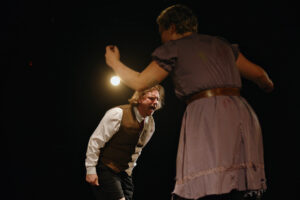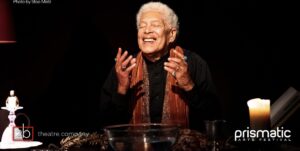

Burgandy Code
Burgandy Code has made her Shakespeare by the Sea debut this summer playing Jacob Grimm in Beauty and the Beast, and she is about to take the stage as Julius Caesar, in the Shakespeare play of the same name, which opens tomorrow July 17th at the Cambridge Battery in Point Pleasant Park, directed by Drew Douris-O’Hara. I was able to chat with Burgandy Code while she was rehearsing at the Park Place Theatre about performing these two roles, and why she is so moved to perform outside in the summer.
Burgandy Code doesn’t consider the characters that she has played to be villains, even if that’s how they may appear from the outside, and she feels the same way about Jacob Grimm in Beauty and the Beast. In Dan Bray and Garry Williams’ musical adaptation of the story, Jacob Grimm is the director of a Bachelor-style Reality Television program who manipulates certain elements of the show, which profoundly impact the trajectory of Belle and the Beast’s lives. “He’s someone who is running a Reality TV show, and he wants it to sell well, and somewhere along the way, after years and years and years of doing this, he’s made that the only goal, and so that leads to all kinds of conflicts with other people, but not for Jacob. Jacob is single-minded, determined, incredibly intelligent- and the smarter he gets the further away he travels from his own heart.” Jacob works, as you might guess, with his brother Wilhelm, played by Matt Lacas. “[Wilhelm] doesn’t have the same killer instinct that [Jacob] does, but there’s definitely affection there, which keeps Jacob anchored.”
Since Jacob is the director of the Reality Show there are many points during the show where he is sitting in his director’s chair watching the other characters perform. “I quite like it,” says Code, “There are songs that I enjoy so immensely as Jacob because the show is going well, but also as Burgandy inside of Jacob I’m like, ‘Oh, that’s so funny,’ and I let myself laugh and watch. It’s kind of effortless. It’s a dream gig. I have a director’s chair, I get a [megaphone] that I get to yell at people with… Dan has written a really tight, funny, current script.” She says that sometimes when the writing is this fresh you can run the risk of having the references “age out,” even just in the time it takes to rehearse the piece. “We have Siya [Ajay] in the cast who is just nineteen, and so Siya would keep us on track if there was a phrase that was already out of favour, and we would replace it with a more modern one.” Code says the younger cast members have prioritized this aspect of the script saying, “You lose all credibility [with the young people], and they disengage for a little bit [when the references are passé]. The word on the street is that the young people have not disengaged.”
Code says that Jacob Grimm and Julius Caesar are not unalike. “I was excited to play Caesar because I was like, ‘I shall be powerful!’ [He was] one of the most powerful rulers of all time, given the size of the world in his time, and that is not the case. I feel incredibly lonely. Jacob and Caesar are isolated because they have no one with whom to truly share their ambition, and their outsider-ness.” For both Jacob and Caesar it is lonely at the top. “I’ve only ever been in the middle of anything,” says Code. “I’ve been a director, but the designers and, even in my heart of hearts, the actors, all the creators are peers. I believe it’s more of a horizontal creation process.” She admits that when she has directed part of the appeal was thinking that she would be able to make executive decisions, “but if a person has a shred of humanity, there’s always a willingness to converse. So, the idea of being a person who does not believe in that, who is a dictator means that [as Caesar, as Jacob] I don’t think I need to talk to anyone. And that means utter loneliness. Burg is a very social creature, and so this is killing me. Even in the Jacob stuff; I tell everyone what to do, I’m dragging my brother along, in the end I’m just by myself until the resolution. And Caesar gets zero resolution. I go to work one day and all my “friends” kill me. I’m like, ‘these are my besties. We all came up together. They all come to my house to take me to work, and I’m like, “come on in, let’s have a drink, let’s go to work…”’” She says that she sees Caesar as a victim, but that there is a very grey line there.
She sees Caesar as “wishy-washy,” “I think what that actually means is that he’s keeping his mind open to be changed, which is not a dictator’s behaviour. And Caesar is very much for the people, but I don’t know if he’s for the people for their sake or his own sake. So, the conflict is that there’s the government, and the government are all the wealthy people, and ostensibly this was a democracy where everyone got a vote, not women, every free person who was a male got a vote, it’s just that all the general public’s votes had much less weight than a wealthy person, or a senator’s vote, so not all votes were equal. And so the senators did not like that some of their power was being redistributed to the “lesser people.” Were the senators just being greedy? Was Caesar being greedy? Did the people deserve their vote? It’s very complicated.” She says that geographically the size of the empire was massive, and in order to vote folks had to literally come to Rome to vote there. “What regular person is going to [travel] from what is now France to vote in Rome?” she asks.
She notes that Caesar used brutal, but wildly effective, tactics on the battlefield, where thousands were killed in part sometimes because he would cut off water supplies to a certain area, which would even deprive his own army’s members of water. “He would sacrifice whoever needed to be sacrificed to [achieve his military goals].” She says that there was not a lot of peace during Caesar’s rule, in contrast to Octavius Caesar, who came later, and who ruled over 40 years of peace. “It was nonstop conquering [for Julius Caesar], fighting, and fighting, and infighting, and conquering. As a truly empathetic human I was looking forward to sort of replacing myself with Caesar and having this clarity and power, and part of my body is [resistant to it]. It has become a real obstacle. I am such a community member, and a lot of the things that Caesar does and believes are very single-minded, and that has been a really exciting challenge for me. I’m still only 80% there [she said a week ago], but I’m looking forward to it. Just to taste it for once, to say, do, be whatever I want, and not worry what anyone thinks. Isn’t that the greatest gift of being an actor? It’s getting to do what you’ve never been able to do as Burgandy… to die over and over,” she laughs.
While this is Code’s first summer at Shakespeare By the Sea she is no stranger to performing outside. Nova Scotia audiences are likely familiar with her from her many seasons on the North Mountain performing with Two Planks and a Passion Theatre at Ross Creek Centre for the Arts in Canning. She says that there’s two things that she tells herself she should do more often- go to the theatre and go outside- and so it just makes sense to combine the two together. “I think it’s good for us,” she says, “to be in the sun and the fresh air… When I really stop and look at a tree, I’m like, ‘that thing is huge, and it did it all by itself.’ If we just sit among these great elders, and the sky, and the sun, the scale of it… the ocean, the trees, the mountains, and I feel that epic-ness reflects on the work that we do. It helps to sort of stretch us to its size, so I feel elevated. I could be in a theatre and projecting my voice to the back row, and it’s going to bounce off the wall behind them and come back at me, but outside, the voice just goes and never comes back. That’s an interesting feeling of kind of infinity. … I love being able to see the people [in the audience]. Sometimes when I’m looking at people in the eye as the character they’re looking back at me in a way that we seldom just stare at strangers in public. And sometimes, because it’s broad daylight, I just look right in their faces, and they’re just listening. It’s probably pretty close to social media, where it’s parasocial- I’m doing all the talking, I might make them laugh, and I’ll hear them laugh, which I love, but definitely the conversation is mostly one direction, and I’m surprised at the thrill that I get from all these little micro-connections. I will have made eye contact with every single person in that audience, no matter how big or small it is, by the end of the night. And I’m like, ‘oh, I just met 400 people.’ Or I didn’t- the character did.”
Sometimes Code says that the opposite can be true, mentioning that when she played Claudius in Hamlet on the Neptune Theatre stage she knows that she was sitting at a table of eight actors, but in her memory she sees only one. “I was completely focused on what I was doing.” She says she imagines that for an audience member seeing an actor that focused must be “like putting your hand as close as possible to a fire, but without actually getting burnt… There’s just this kind of other. And I feel like when we’re doing outdoor theatre we can’t hide that other. The audience is in it, and I find that really exciting.” She says that with the way that the audience is set up in the park, similarly to way they are set up at Ross Creek, the audience can see the actors sometimes making their entrances before they are really “onstage.” “They get to see us be actors, and then that sort of intangible moment where we become characters, and I find that porousness really thrilling.” She says she loves seeing her fellow actors in one moment as themselves complaining about something, like their feet being sore, and then in the next moment, those feet forgotten as they go onstage. “They’re totally someone else. I find that thrilling.” She says that in having Julius Caesar living inside her this summer, they do not have the same objectives, and yet they are sharing the same body. “If I were a record player you could pick up the needle from Burg and drop it right into the groove for Caesar.” She says she has even had the experience where she is wearing a very hot costume, like a fur coat, in sweltering heat outside, and yet she has felt cold in the moment onstage because it is supposed to be winter for her character. Yet, as soon as she gets offstage her own body kicks in, and she has to take the coat off and cool herself down.
She notes that Shakespeare By the Sea offers a unique audience experience compared to what she has been used to at Ross Creek in that Shakespeare By the Sea operates in a busy park where folks are already gathering, which makes it possible for people to stumble on the theatre by accident. If you are able to bring your own chair or sit on the ground, you can come in for free and just spend your money on popcorn and candy. In contrast, Ross Creek is a much more remote locale where people need to come there intentionally, and this often includes making plans well in advance. “There is an openness to just stumbling across Shakespeare by the Sea and feeling like ‘I belong here’ because I was already here. There’s a different kind of belonging, equally valuable, with Two Planks… there’s a community that happens with outdoor theatre because we are all a part of nature.” She says that both Two Planks and Shakespeare by the Sea have fostered a community of folks who come back to see their shows every summer. She says that whether you are seeing theatre outside or inside “there are all different ways of finding an experience that is elevated, and it’s all different doorways into it, and this nature, to me, seems the most [inclusive].”
Julius Caesar opens July 17th and runs in repertory with Beauty and the Beast until August 29th, 2026 at the Cambridge Battery Site at Point Pleasant Park (5718 Point Pleasant Drive, Halifax). To reserve your Sweet Seats please visit this website, or you can bring your own chair, or a blanket and PWYC at the door. Performances begin at 7:00pm. There will be a free matinee performance of Julius Caesar at 1pm at the Halifax Central Library (5440 Spring Garden Road, Halifax) on August 1st (and August 8th for Beauty and the Beast). There are no performances on Mondays.
For more information about Accessibility and the logistics of theatre in the park please visit Shakespeare By the Sea’s Frequently Asked Questions Page.
Canadian Theatre Criticism is an essential part of a healthy and thriving theatre community. It helps theatre companies find new audiences for their shows, deepens audiences’ engagement with local artists and the work being created in their communities, and it is one of the best ways to preserve a snapshot of an ephemeral art form for future generations of theatre lovers. TWISI relies on support from its Subscribers, folks like you who care about the survival of local and independent arts coverage. Please consider becoming a Subscriber today, or click here for more information. Thank you so much for supporting TWISI.
Incoming search terms:
- https://www twisitheatreblog com/?p=6760