

Geordie Brown as Mark Cohen Photo by Stoo Metz
There were a bunch of us kids in Halifax at the end of the Millennium who were OG Rentheads. There was a gang of us who were taking classes at Neptune Theatre School. I was only in Acting Youth I at the time, but some of the older kids were already in YPCo. There was a gang of us at Sacred Heart School too, with some overlap, and I would blast the orange CDs on the stereo of my eighth grade classroom early in the morning or after school when the more popular kids in my class weren’t there. It’s a testament to the teachers at this Catholic school that no one ever told me to turn it off. We Rentheads always seemed to find each other, and sometimes we became best friends, and sometimes we competed with each other over who loved the show more, who would be more likely to be cast in what role, and, of course, who had discovered the show first. Unsurprisingly, I expressed my reverence for the Original Broadway Cast (OBC) by writing fan fiction. When Jeremy Webb announced that Neptune Theatre would be producing Rent for the first time it was like a Bat Signal went up and it re-activated the city’s Rentheads.
As theatre kids most of us have our individually nostalgic shows, albums, and specific productions that we have seen that have changed our lives, but Jonathan Larson’s Rent is one of just a handful of communal cultural zeitgeist fandoms that Broadway has cultivated- especially amongst this very specific sect of Young Gen Xers and Elder Millennials back when the Internet was brand new, that connects us all to this day. I saw Rent in Toronto when I was thirteen at the peak of my obsession, and it was like a religious experience for me. I saw it on Broadway in 2004, and just happened to catch Gwen Stewart (the original “Seasons of Love” soloist) during one of her returns to the role and I was floored. I was then absolutely flabbergasted to have the opportunity not just to see but to review Adam Pascal as Roger and Anthony Rapp as Mark when their tour of the show came through Toronto back in 2010. Having the show at the theatre where I literally grew up is its own unique experience, and seeing it through the eyes of an adult so much older than many of the characters provides me with a fresh perspective. Like many who will see this production at Neptune between now and August 30th I come into the theatre with nearly 30 years worth of opinions, and expectations, knowledge, experiences, and season after season after season of love.
I had a truly magical experience watching Neptune’s cast bring this story to life last night.
Rent was written by Jonathan Larson beginning in 1989. He was a longtime aspiring musical theatre composer and lyricist who had been hustling for his big break for a long time. He wrote, in part, about his own experience living precariously on the Lower East Side of Manhattan, and his best friend Matt O’Grady’s HIV diagnosis. Larson died suddenly of an aortic aneurysm on January 25, 1996, the morning of the first preview of Rent at New York Theatre Workshop Off-Broadway. This means that Rent, despite winning the 1996 Pulitzer Prize and all the success that it has accrued in the decades that have followed, is also perpetually dramaturgically unfinished. The poignancy of that in a show that is fundamentally about living in the immediacy of this present moment because the future is never promised is part of what audiences have been connecting to so ardently over the last thirty years.
We are introduced to Mark, an aspiring filmmaker and his best friend and roommate Roger, a musician who is struggling with his sobriety having just come back from “half a year of withdrawal.” Roger is trying to piece some semblance of his life together after his girlfriend died by suicide, and he received an HIV positive diagnosis. Roger has lost interest in everything and everyone, but also feels determined to write one great song before he dies. Mark and Roger’s friend Collins is a disillusioned University professor who is also HIV positive, and on Christmas Eve he and Angel, a fashionista drag queen, fall in love on the street at first sight. Mark and Roger are stressed because they had a verbal agreement with their friend Benny that they could live in this dilapidated loft apartment in the dangerous poverty-stricken neighbourhood of Alphabet City in Manhattan for free while Roger is struggling and Mark is trying to focus on his art. Benny is Nouveau-Riche, having married into a wealthy family, and he now owns this building. He sees his wealthy father in law as his chance to get into the bourgeoning tech industry and the Dot Com Boom, and Roger and Mark become a liability for him that he seeks to eliminate. Even more annoying for him is Mark’s ex girlfriend, Maureen, who has planned a performance art protest, and rallied the unhoused who are living in a tent city in an adjacent lot that Benny also owns. Benny is going to build a new Cyber Arts Studio at this location, forcing these unhoused folks to find somewhere else to live. At the same time Mimi, an upstairs neighbour of Mark and Roger who is really struggling with a drug addiction and is also HIV positive, arrives at random at Roger’s door flirtatiously trying her best to coax him out of hibernation- hoping to inspire him to seize whatever time he has left. Maureen’s new girlfriend, Joanne, a powerful lawyer also from a wealthy family, gets dragged into this politically charged and socially and culturally complex neighbourhood where she is woefully out of her depth. The musical follows this group of found-family members over snapshots of a year, and it explores themes of gentrification, the real human impact of a lack of social safety net during an epidemic health crisis, the crushing reality of capitalism’s heartlessness, and the power of love, acceptance, and community in the face of it all.
Allister MacDonald plays Roger and gives a beautiful nuanced performance of someone disassociated and brokenhearted, and who, as a musician in a rock band probably wasn’t emotionally effusive to begin with. Director Jeremy Webb has him facing upstage and toward the side backstage wings a lot so he is kept at a distance even from the audience, and it is only Chariz Faulmino’s Mimi who he makes a tentative connection with. Faulmino oscillates between being a torrent of energy, sensuality, wild abandon, and desperation to experience all the world can offer her, and then is more like a trembling leaf in a hurricane just trying to anchor herself to anything. There is immediate chemistry between the two, but MacDonald’s Roger has a sweetness to him that seems motivated as much by a desire to protect Mimi as by lust, perhaps driven from the fact that he wasn’t able to protect April. All the characters in Rent are adapted from Giacomo Puccini’s La Bohème (1896), and Mimì in the opera is the tragic consumptive heroine, historically an extremely heightened role, but in Rent it works so well to have both MacDonald and Faulmino so grounded in the grim reality of their world.
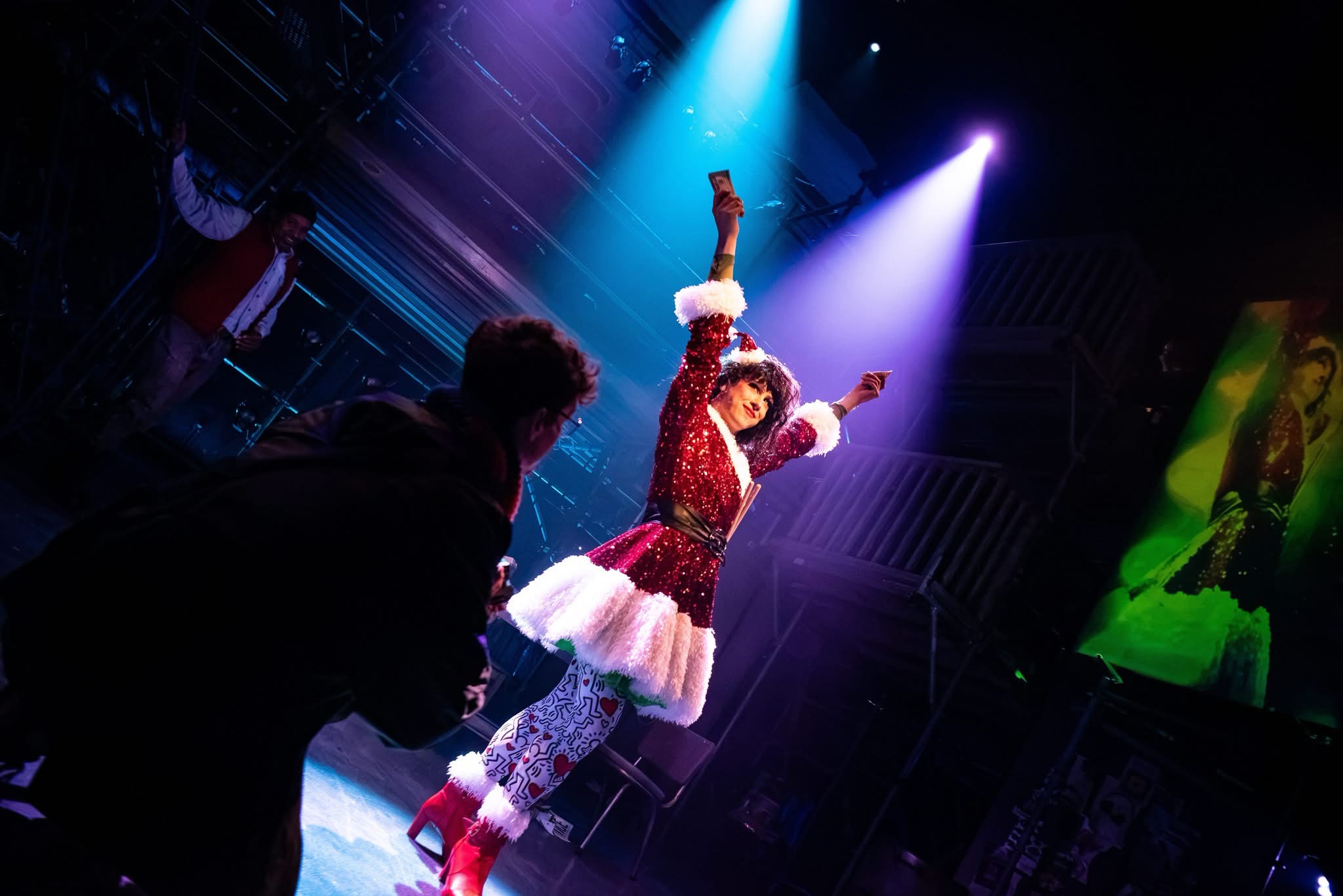
Audiences fall immediately in love with Felix Turgeon’s Angel when he arrives to provide gentle and sheepishly flirtatious support to Collins who has just been mugged. Objectively, Angel is one of Larson’s stranger choices because it’s imperative that the audience love and connect with Angel deeply, while also glossing over the reality that Angel has just purposefully killed a dog. This plot point, of course, comes from a similar (but, I’d argue less grisly) moment in La Bohème. This makes it a larger feat for an actor like Turgeon that we are willing to do whatever empathy gymnastics required to keep that dog at an intellectual distance, because it is so antithetical to the joyful, sweet, kindhearted, gentle soul that we see in Angel. The audience, like the rest of the characters, adore Angel despite any problematic choices she has made in her past.
I am sure Todd Hunter gives one of the most heartbreaking and formidable performances with “I’ll Cover You (Reprise)” that has ever happened on the Fountain Hall stage. As with MacDonald, Jeremy Webb keeps Hunter within the confines of his own world in this moment, without opening up to the audience until the end of the song, making us feel like we are eavesdropping in on a harrowing private moment of grief.
The levity in the show is provided by Maureen, played by Kelly Holiff, who performs “Over the Moon,” an absurd but also intellectually astute performance art piece. Holiff’s mammoth vocal prowess, like that of the role’s originator Idina Menzel, establish Maureen as a truly gifted singer- someone who, like Menzel, maybe made her living singing at weddings and Bar Mitzvahs, and who could have chosen to show up to the Broadway cattle call (no pun intended), but instead is trying to use her gifts as a means for activism and civil disobedience at a time when this concept was far less mainstream. Conversely, Maureen’s on again off again relationship with Joanne, played by the sweetly consternated Madeleine Eddy, shows that for folks living with more privilege the everyday dramas of who was flirting with which woman in rubber still feel so momentous to the young people experiencing them, even against the backdrop of those who are literally surviving from one day to the next and barely.
Geordie Brown plays Mark who, beyond his videocamera, has sort of put his own life on hold, seeking instead to help herd his friends around like lost kittens while privately mourning his reality that likely some day he will be left alone with little to show for all the years he spent caring for others. He puts on a brave face in the first act, but becomes much more of a poignant figure in the second. Kailin Glasgow plays Benny less as a malevolent figure, but more self-absorbed. He floats through the space with the comfort that money has provided him, and rarely allows anyone to root him back down into reality.
Rent is very much an ensemble piece and Colin Asuncion, Kih Becke, Nicholas Singh Fassbender, Dorian Fournier, Stephane Gaudet, and Thaydra Gray are essential in creating the world of the Lower East Side that surrounds our protagonists. The show oscillates between being very literal and more figurative; there were a few instances where I thought there could be more opportunity for the violence and the police presence to have more menacing stakes. But, especially in a number like “Christmas Bells” the ensemble is working so well together to create the frenetic energy of New York. Musical Director Sarah Richardson is a literal rockstar for helping to build all these scenes where actors are singing all on top of one another, and the audience is tasked with choosing their own adventure of which narrative or narratives to follow. Alexandra Herzog brings in a lot of allusions to the iconic original Broadway choreography, especially Angel spinning in her Santa Claus outfit (a real treat from Diego Cavedon Dias) in “2 Day 4 U,” and the entire “La Va Bohème” sequence. Cavedon Dias too does a great job of bringing in allusions to the beloved original costumes while also creating something new. At one point Geordie Brown wears a coat that really makes him physically become Anthony Rapp for a moment in a little trick of magic. It’s apt that for Halifax MacDonald’s Roger doesn’t just wear plaid pants, but plaid on plaid. Kelly Holiff’s Maureen has gone full cowgirl for “Over the Moon,” showcasing both her full commitment to the bit, but also the resources that she has at her disposal. My favourite addition was Angel’s homemade Mickey Mouse jeans, which seem like a fun subversive allusion to Times Square that seems apt for the 90s.
This show also has the best use of projections, from Aaron Collier, that help to bring Mark’s film alive in a way that I felt the film was able to do so well in 2005, but that I hadn’t experienced this viscerally in the theatre before. The way Jean-Pierre Cloutier has transformed the Fountain Hall stage needs to be seen to be believed. It tricks you into thinking the space is twice as big.

As a young Renthead there were a lot of references and nuances in the show that I didn’t have the frame of reference to understand. I didn’t know that the Sex Pistols were a punk band, for example. I was confused by the Christmas Bells ringing at “Saks” because I’d never heard of Saks Fifth Avenue. “La Vie Bohème” was filled with allusions to people and concepts I had yet to encounter from “Ginsberg, Dylan, Cunningham, and Cage” to, Václav Havel, and adorably, for quite a long time I thought the line in that song was “and, suddenly, it’s between God and me.” I also didn’t realize that at the end when Maureen says, “Collins will call for a doctor, honey,” to Mimi that someone in that room would have to be able to pay for the doctor. When I fell in love with Rent I had no concept of what a “tent city” was because I had grown up in Halifax and had never seen one. Now, on my way to the theatre in 2026 I pass a small but still significant community of tents along Barrington Street on the banks of the harbour- very close to where the first home where my grandparents lived used to be when they first moved here from Prince Edward Island. When Benny tells Mark and Roger about how they’ll have condos on the top of his studio building, and the rent they collect from them will pay for their artistic pursuits, it hits differently now in a Halifax that is newly crawling with condos, and yet people are also sleeping outside at rates unimaginable here in 1997. In hindsight Larson’s depiction of this New York seems very much like the canary in the coal mine, and all these themes he is exploring seem so much more sadly immediately relevant to this place in this time. I think if Neptune had done Rent earlier it would have seemed relevant but distant from us, or even a little bit like a more historical piece. Now, it is much more a punch in the gut.
As a teenager I doodled the Rent logo on notebook after notebook, binder after binder, often accompanied by some kind of iconic quote from the show: “No Day But Today,” “Measure your life in love,” “Forget Regret or Life is Yours To Miss”, or “Over the Moooooooooon.” Last night the line that jumped out and smacked me was from Collins, “the powers that be must be undermined where they dwell.” It’s not pithy or sexy or easy, but my god, is it just as true today as it was thirty years ago- if not even more so. We don’t know the fate of these characters, or of the lot, although we do know the history of what is coming to New York. Maureen and Mark and Collins are not succeeding on a spectacular level at saving their neighbourhood, even Angel and Roger just through their kindness and care of one other person aren’t making grandiose gestures, but they are all waking up every day and in their own small microcosms they are undermining the powers that be where they dwell. They are making a difference. At a time where it feels impossible to impact a world seemingly owned by eight supervillains it’s still all about finding “connection in an isolating age,” and doing whatever we can to make this minute count for the people we love and the people who need help the most in our community.
Jonathan Larson’s Rent directed by Jeremy Webb plays at Neptune Theatre’s Fountain Hall (1593 Argyle Street, Halifax) until August 30th, 2026. Performances run Tuesday to Saturday at 7:30pm with 2:00pm matinees on Saturday and Sunday. Tickets range in price from $40.00 to $99.00 depending on seating. They are available online here, by calling the Box Office at 902.429.7070, or going in person to the Box Office at 1593 Barrington Street.
Special Performances As Follows:
Industry Night
Tuesday, July 14 – 7:30pm
Masked Performance
Sunday, July 19 – 2:00pm
Talkback
Thursday, July 23 – 7:30pm
Sing-a-long
Tuesday, July 21 – 7:30pm
Run Time: Act I: 1 hour and 20 minutes, Intermission: 20 minutes, Act 2: 1 hour.
Content Advisory: This production contains mature themes including HIV/AIDS, bereavement, drugs and addiction, suicide, and sexual content, alongside coarse language, flashing lights, and theatrical fog/haze.
Neptune Theatre has a range of Accessibility Options for folks (Both Fountain Hall and the Scotiabank Stage are accessible for wheelchairs. Patrons can now purchase wheelchair seats for individual shows online with the promo code WHEELCHAIR. For more information, please contact the Box Office.). Click here for more thorough information.
Canadian Theatre Criticism is an essential part of a healthy and thriving theatre community. It helps theatre companies find new audiences for their shows, deepens audiences’ engagement with local artists and the work being created in their communities, and it is one of the best ways to preserve a snapshot of an ephemeral art form for future generations of theatre lovers. TWISI relies on support from its Subscribers, folks like you who care about the survival of local and independent arts coverage. Please consider becoming a Subscriber today, or click here for more information. Thank you so much for supporting TWISI.
Incoming search terms:
- https://www twisitheatreblog com/?p=6714






2 thoughts on ““It Was Us, Baby, Who Were the Lucky Ones:” Jonathan Larson’s Rent More Immediate Than Ever at Neptune Theatre”
Comments are closed.