
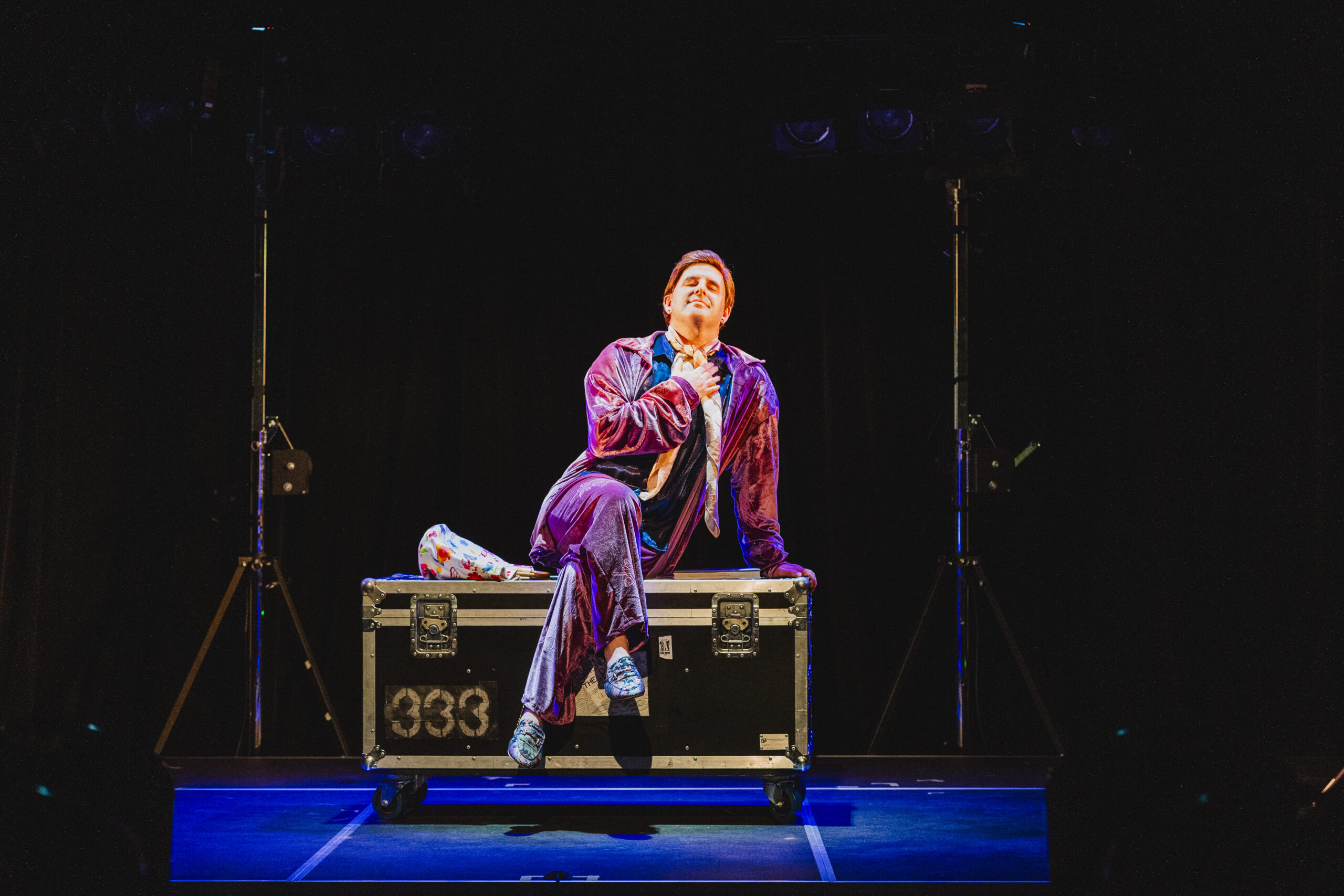
Jay Whitehead as Honey Bee. Photo by Andrew Lewis
At the end of Act I of Jay Whitehead’s new play 333, which plays at the Bus Stop Theatre in Halifax just until July 4th, I felt like I had been sucker punched and needed to take a moment. “Holy shit,” I said to myself.
It is rare to have such a visceral response at the theatre. We are exposed to so much every day: on social media, on television, in movies- we see both over-stimulating content that we ourselves seek out, and unsolicited content so dark and heartbreaking that our brains can’t quite process it. We have learned to compartmentalize it, and we have grown more numb as a survival strategy. The theatre is a place where, historically, people have opened themselves up to feel intense emotions, and 333 doesn’t let you sit at a comfortable, intellectual distance- parts of this story are harrowing, and the audience feels it hit them in their guts.
It is the Winter of 1981 and we meet Honey Bee, played by Jay Whitehead, who grew up as Stanley, and loves to frequent the Toronto bathhouses not just because they offer a safe place to have queer sex, but because she can dress in women’s clothing, express herself in a feminine way, and feel comfortable- even though within queer spaces she is often dismissed as a “freak.” Honey feels protective over Eddy, played by Diego Guerrero, a Hispanic recent immigrant to Canada who works at the bathhouse. Within the bathhouse Eddy is flirtatious and playful, and seems to have absolute confidence in his sexuality. Darren, played by John Tasker, arrives into Room 333 for the very first time- potentially even looking for his first queer sexual encounter. He is a fifth grade teacher from Alberta who is married to a woman he wishes he could feel sexually attracted to. He is scared to death to even wander into the bathhouse, despite the fact that there is immediate and obvious attraction between him and Eddy. Just when it seems like Eddy may have managed to settle Darren’s nerves enough to move toward at least first base the bathhouse is filled with police officers screaming homophobic obscenities at them and hauling them naked into the street.
As horrifying as this moment of the play is, depicting the real Bathhouse Raids that occurred at this time in Toronto, it is the aftermath beyond the police station that is the most intensely powerful. When the bathhouses were raided people’s names were publicized, and folks had the police calling their parents or their wives telling them what had happened, when many of those arrested weren’t out to their families, and certainly weren’t out at work. Ian McFarlane’s set design uses stage lights on stage, both as a means of lighting the show, and in creative ways as props and set pieces. The light plays an integral dual role in this play- and in this moment it is the garish light spotlighting these vulnerable people against their will. The stakes here are high; people can lose their jobs, their homes, their familial relationships, and their standing in the community. Out of this level of anxiety and panic we see the characters begin to spiral in ways that are both heartbreaking and understandable.
The acting here is exquisite. Jay Whitehead plays Honey as someone who is channeling femininity from a bygone era, even in 1981. She is often slow and deliberate with the way she chooses her words- peppering in a few antiques like “shan’t,” and holding herself with all the decorum and quiet power of Cinderella’s stepmother, or a Classical Hollywood actress with a Transatlantic accent. Her unwavering sense of herself and her worth is all the more powerful in the face of the way she is treated by others- as barely human. As formidable as she is in some ways, she is certainly not immune to getting her feelings hurt either, which Whitehead plays with a beautiful mix of vulnerability and defiance.
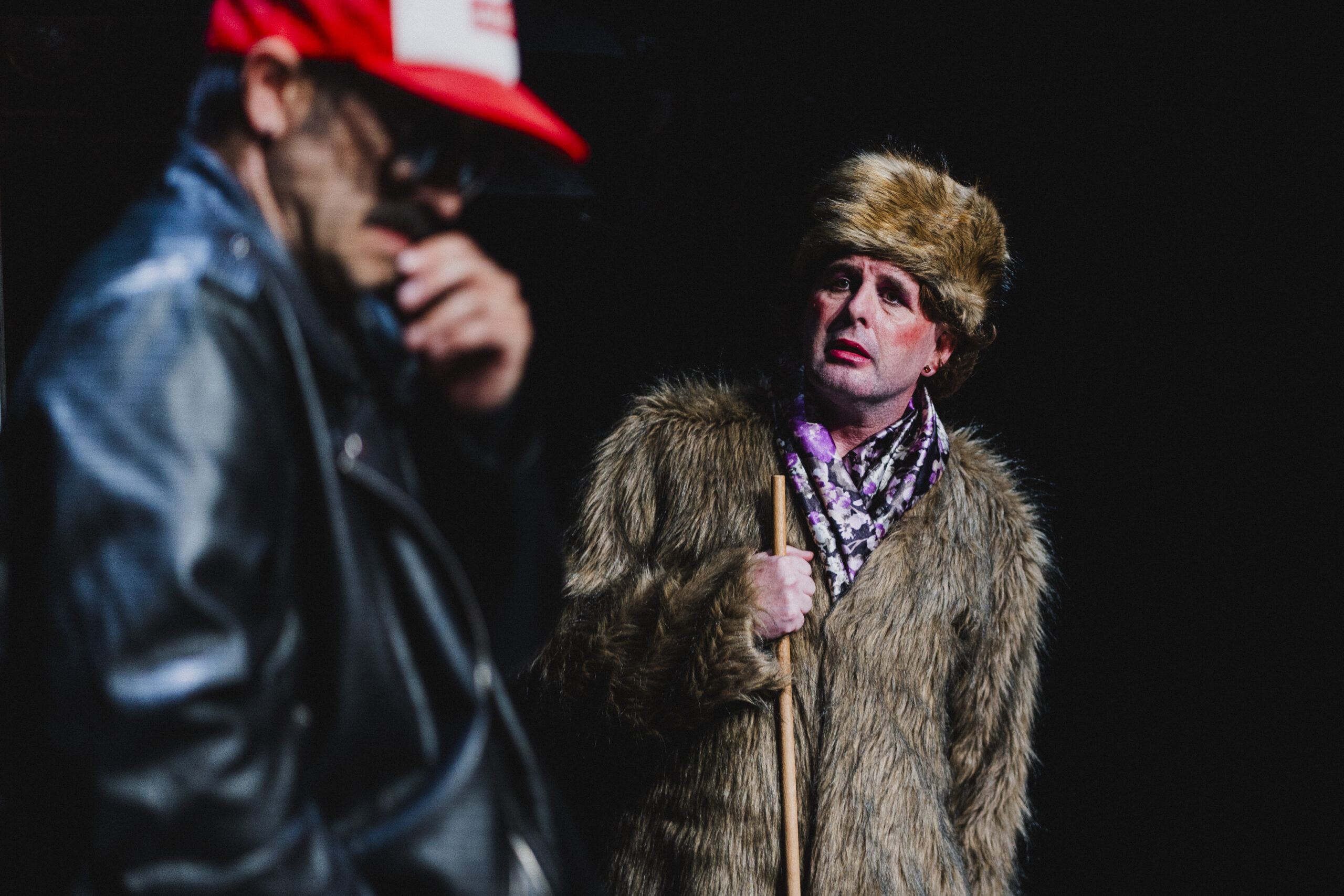
Diego Guerrero plays Eddy whose public life and bathhouse life are the most disparate. At work he confidently flirts with Darren, but also shows him patience and grace. At home he keeps secrets and tries to make himself small to stay out of his father’s way, which is the same energy he brings out into the world- with hunched shoulders and a bowed head he tries to fly under the city’s radar as a very practical means of survival. This puts him at odds with Honey who is becoming more and more emboldened to take up space. Guerrero and John Tasker, who plays Darren, have passionate chemistry with one another in the bathhouse as Eddy tries to entice Darren to let his guard down, and Darren continually finds another wall he can build. The level to which they are so likeable together at the beginning of the play makes the fallout from the raid so much more heartbreaking and disturbing- and Guerrero shows us the depths of Eddy’s pain and tenderness in a way that makes you want to run onstage and comfort him.
John Tasker brings so much humanity to Darren, a nerdy naïve young man who is perpetually on the brink of an anxiety attack, but also reckoning with mammoth levels of self-loathing. Despite his outward veneer this mixture makes him incredibly dangerous. It would be easy, I think, to make Darren the villain of the piece, or at least to have him be completely unlikeable, but Tasker’s nuanced performance encourages the audience to offer him at least some level of understanding and compassion.
Ian McFarlane’s set evokes the backstages of small black box theatres, as there are meta-theatrical moments when the fourth wall is broken in ways that feel like an ode to trailblazing Canadian Queer playwrights like Daniel MacIvor. Even in the play we are looking back at 1981 with a little bit of hindsight- and this allows Whitehead to allude to the ways in which the struggle for gay rights continued to unfold in this country beyond 1981- prioritizing those who looked the most like their heterosexual counterparts. Eric McCormack, for example, playing Will Trueman on Will & Grace (1998) becomes mainstream first- then folks accept Sean Hayes as the more flamboyant Jack. We don’t meet Sophia, played by Laverne Cox, on Orange is the New Black until 2013. 333’s set being more minimalist and less literal allows time to be more fluid so that we don’t gloss over all that has happened in between the Toronto raids and today, and all the ways progress has been slow, stilted, unfair, and perpetually two steps forward one step back.
Diego Cavedon-Dias’ costume design also helps to fill in the nuances of who these characters are- both in private and in public- and then as their worlds begin to meld. I loved that Honey dressed sometimes like she was the fifth Golden Girl, and even when the characters are undressing you can tell that Cavedon-Dias has been so intentional even choosing what kind of underpants each of them would wear. I found Aaron Collier’s sound design especially effective in the bathhouse when it helped create the tension in the pacing between Eddy and Darren’s first meeting.
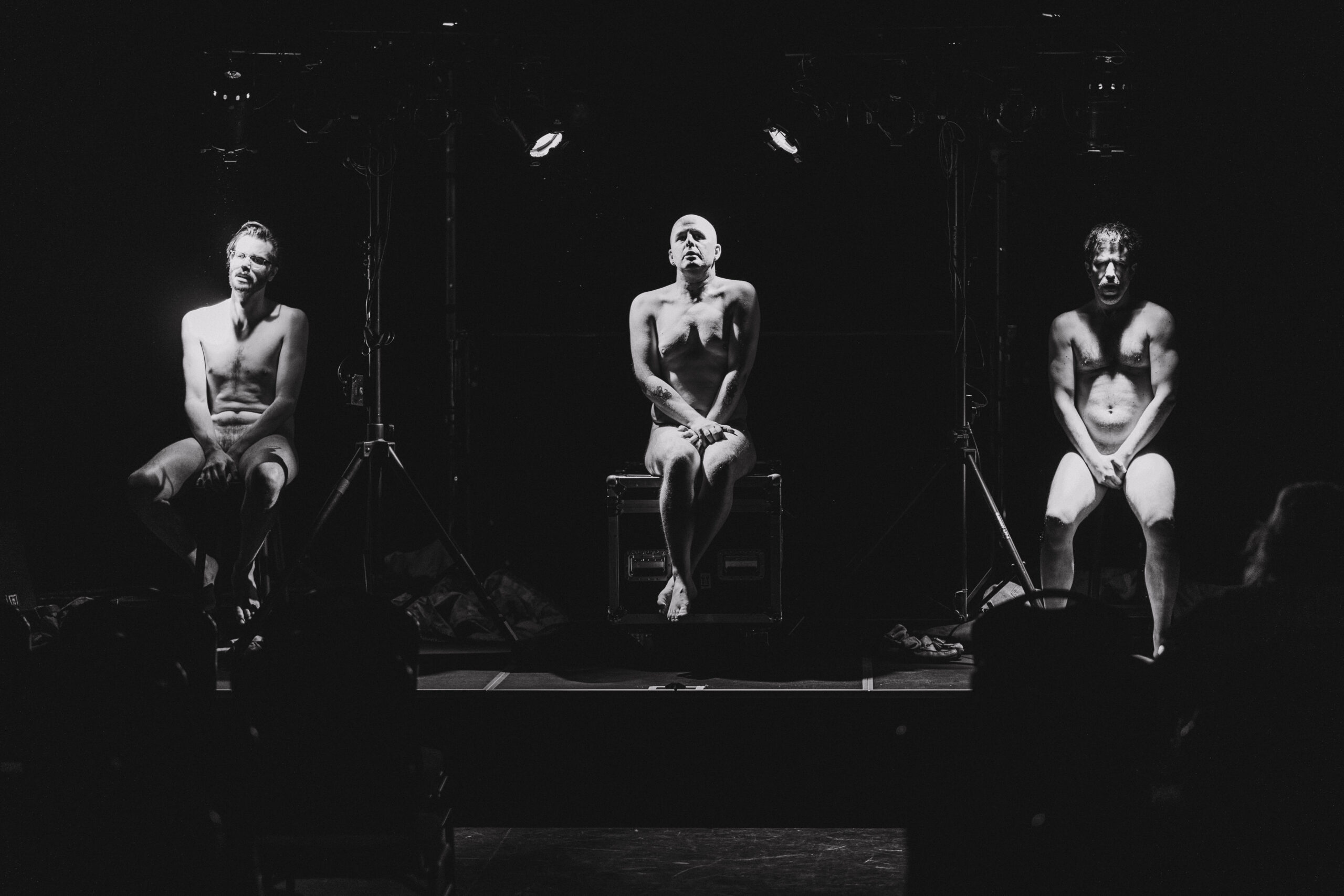
The figurative concept of the space mixed with the stark realism of the play’s nudity provides an interesting challenge for director GaRRy Williams because, while the actors are nude for parts of the piece, the sex and the violence in the play are, of course, not real. The violence, coordinated by Dylan Brentwood, is rooted in realism because the play hinges on those stakes being extremely high. The sex is more playfully represented in a way that corresponds nicely to the deft way that Whitehead mixes absolute seriousness with cheeky humour throughout the play. Williams does a masterful job of making the play feel both immediate and immersive, and also framing it within a more meta-theatrical context where even the nudity becomes symbolic.
Jay Whitehead is exploring an interesting paradox in 333 that I had never really considered before. In 1981 in Canada there were places hidden in plain sight like these bathhouses that were meant to be secret Queer-only spaces. They existed in the shadows, and the people who frequented them lived, at least partly, in those shadows. As time has gone on things have changed in our society, and more people have moved into the light- moved into shared spaces, and have been able to “come out” of the shadows. In obvious ways this is progress, but what 333 is also asking is- do queer folks also lose something in having less spaces that are exclusively for them? Sometimes that light is garish and unforgiving, and there is comfort somewhere darker where you feel less exposed and more comfortable to be yourself. The play is also about the importance of intergenerational relationships, in this case the maternal role that Honey takes in Eddy’s life, and how these are essential so that queer history like this can be passed down in ways that are anecdotal, meaningful and personal, instead of just theoretical.
333 is an important addition to the canon of Canadian plays. It’s the most alive I’ve felt in a theatre in a long time.
Queerly Canadian Productions’ 333 runs in Halifax at the Bus Stop Theatre (2203 Gottingen Street) at 8:00pm July 1st-4th, 2026. Tickets are available here. Tonight (Friday, July 3rd is sold out, but there are still tickets available for tomorrow July 4th.)
Content Note: This play features non-gratuitous nudity, harsh language and simulated sex, portrayals of physical violence, police violence, sexual violence, and domestic violence, hate speech and racialized slurs, loud noises and flashing lights, portrayals of transphobia, xenophobia, and internalized homophobia, suicidism, and the discussion of suicide.
Canadian Theatre Criticism is an essential part of a healthy and thriving theatre community. It helps theatre companies find new audiences for their shows, deepens audiences’ engagement with local artists and the work being created in their communities, and it is one of the best ways to preserve a snapshot of an ephemeral art form for future generations of theatre lovers. TWISI relies on support from its Subscribers, folks like you who care about the survival of local and independent arts coverage. Please consider becoming a Subscriber today, or click here for more information. Thank you so much for supporting TWISI.