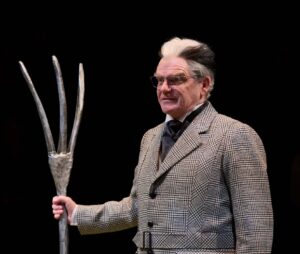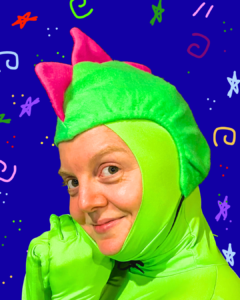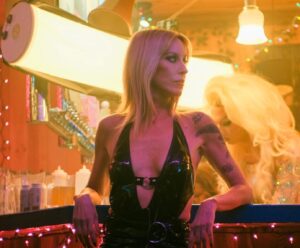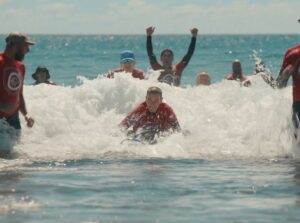
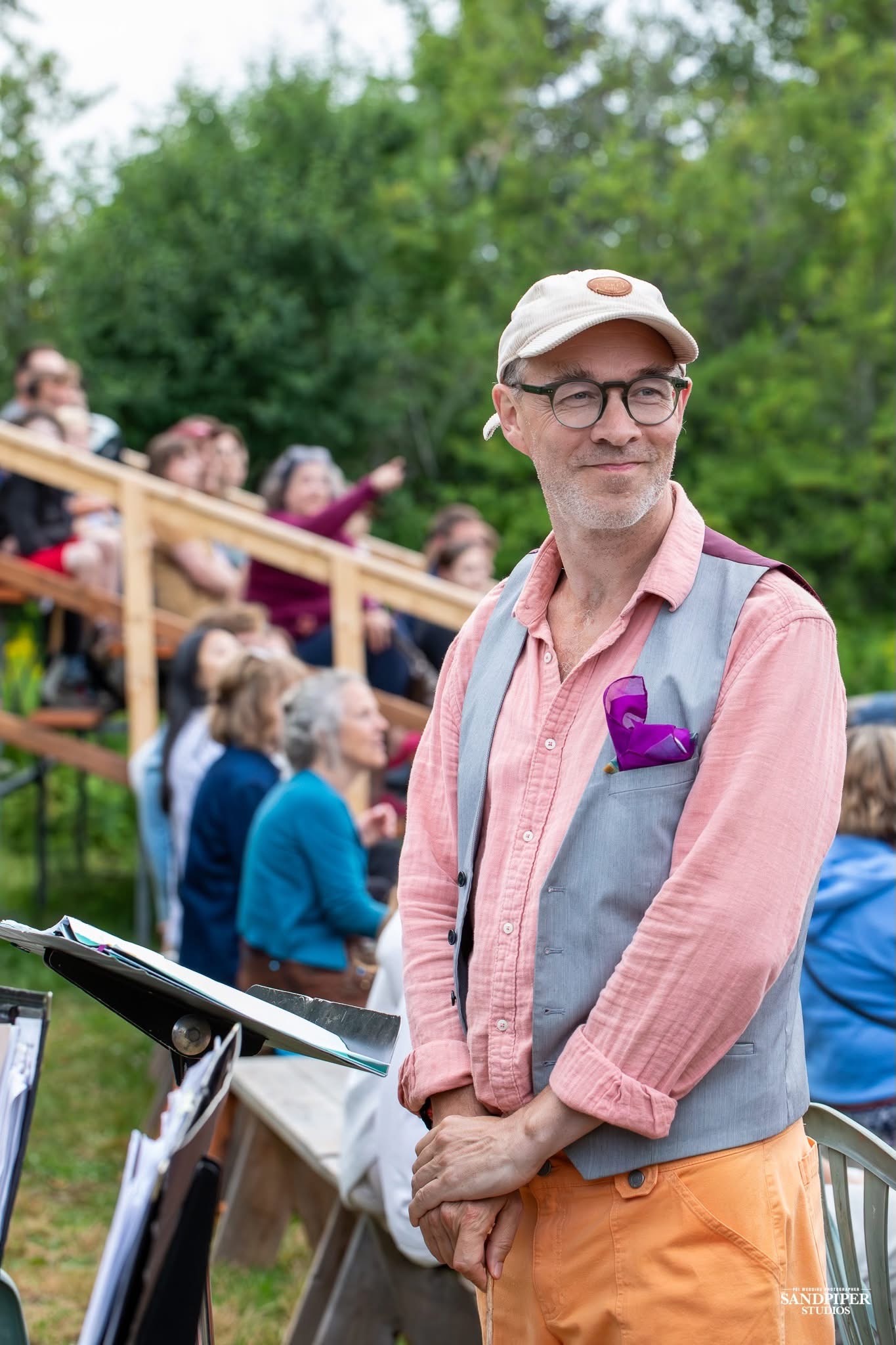
Garry Williams at the 2025 River Clyde Pageant. Photo by Sandpiper Studios
Garry Williams has been having a busy June working on three different theatre projects that will have performances in three different Atlantic Canadian provinces. He directed Jay Whitehead’s play 333, which opened last night at the Arts Guild in Charlottetown and will play there, at Mount Allison in Sackville, New Brunswick, in Parrsboro at Ship’s Company, and in Halifax at the Bus Stop Theatre; he wrote the music and lyrics for the new adaptation of Beauty and the Beast that opens at Shakespeare By the Sea on July 4th at Point Pleasant Park in Halifax, and he is the Musical Director for the River Clyde Pageant in New Glasgow, Prince Edward Island, which runs the last weekend of July and first weekend of August. I had the great pleasure of speaking with Williams via Zoom about each of these exciting projects.
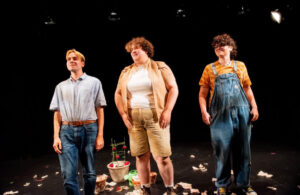
First on the docket is Jay Whitehead’s play 333, which is based on the true events surrounding the 1981 Toronto Bathhouse Police Raids, which helped to spearhead Canada’s own gay rights movement. The story centres on three fictionalized people whose lives were affected by these raids: Honey, Darren, and Eddie, and also explores how the fallout from this event affected different folks in the same queer community in different ways.
“There’s a character originally conceived as a narrator, Honey Bee, and in the script Honey Bee is often called by their given name, Stanley, and they exist in a difficult world, 1981, navigating, as we would say today, AMAB body identity, but inside she knows that that is not correct, and in the bathhouse she feels safe and can be a version of herself, even though that is a male coded space, there are men who perform femininity in that space, historically, who are still welcome. They may not be everyone’s sexual fantasy- not everyone will feel social magnetism, but she’s able to be there. The raid forces her, among other things, to lean into that identity.” He says that while Honey doesn’t use the word “trans” in the play, she is someone who presents as femme, and she “ [moves] more into a role of mother, a role of activist, of knowledge holder matriarch. She is not seen as a legitimate expression of herself; she is seen as a freak. She is seen as a troublemaker. She is seen as a problem.” He says that the prevailing attitude among many queer folks at the time is the desire to remain “invisible,” so they could exist under the radar of the police, and of anyone else who put their safety at risk. “She has an amazing journey, and she’s also the historian. She’s the one who starts telling the story. She’s writing it all down- inspired by her own mother who loved her and taught her how to be in the world.” Williams likens Honey to Hera from Greek myth, saying, “she is so constant. She fiercely defends the bathhouse, the right to privacy, and she wants stability. She wants her queer family to be true to each other and loyal, and so she is challenged. She has a friend, really a chosen family member, Eduardo or Eddie, and that character is a newcomer, and is navigating a cultural difference, probably leaning into the kind of cultural stereotyping that can become a fetish, but also resisting it- craving also to be seen as who he is- a person who wants safety and connection. The two of them have this kind of familial relationship. Honey in some ways sees herself, eventually, as a mother to Eduardo, and Eddie, whose mother has not been with him for most of his life, is craving that kind of family, that kind of love. He lives with a homophobic, abusive father, and so there is domestic violence, there’s judgement, and so they need each other so profoundly, and Eddie works at the bathhouse.”
Darren is a closeted teacher who is married to a woman. “He has followed society’s expectations and chosen an opposite sex partner, and they have done the thing that God ordains, according to our society, mythology, and they’ve married.” Williams also points out that- especially in the 80s, but we see this still to this day, there were homophobic misinformed correlations being made, with no evidence, that linked gay men with pedophilia. “He shows up for his very first time in this bathhouse and meets Honey, who offers him some kind of allegiance, friendship, guidance… potentially also love, maybe love without sex, maybe sex without love- we don’t know. And he also meets Eddie, who is an employee who also is responsible for Darren’s wellbeing- safety. I think in the script they have a love at first sight chemistry- or lust at first sight… and so these characters they all love each other and need each other and complete each other, and yet they’re on these very different journeys.”
“At one point I was saying in some ways they each have their own hero’s journey in that they have to face their dragon, but then they all play different roles in each other’s hero’s journey too. They are each other’s magical helpers… they’re also each other’s, I guess, part of each other’s nemeses. They each make a mistake. Eddie cannot see Honey as a woman initially, and Darren cannot be aware that he is seeing Eddie as a newcomer, as, you know, someone of difference. Because he can’t see that he is seeing him that way he can’t accept it and see it as a positive thing. It’s just something he can’t speak to, and, of course, Darren is also struggling with his own closeted nature, his secret, and can’t quite see himself as a queer person. So, it’s fascinating. The way Jay has constructed this play is… [he] lets each of these characters fight for what they need with each of the other characters, and sometimes the violence, this flighting, the struggle becomes quite erotic or sexualized or generative- so that’s the energy of the play. You know that there’s always a sexual undercurrent because they’re all fighting for a freedom to express themselves that way that they do not have in society- and they’re also fighting and struggling in this more existential civil rights thing- they just want the right to live and not fear hate crimes, and to not have to hide. So, it’s quite beautiful.”
333 is very much a play for adult audiences, but Williams has also been working on two shows- one in Halifax and one in Prince Edward Island that are aimed at audiences of all ages.
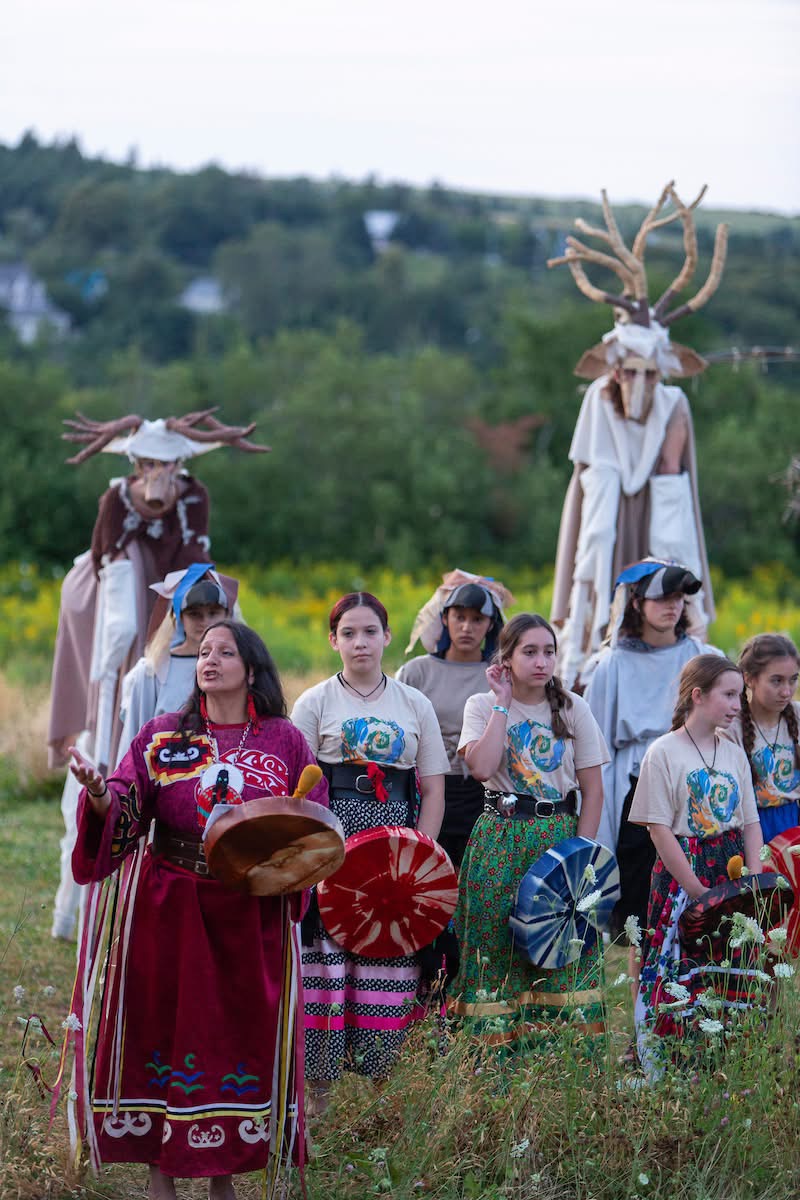
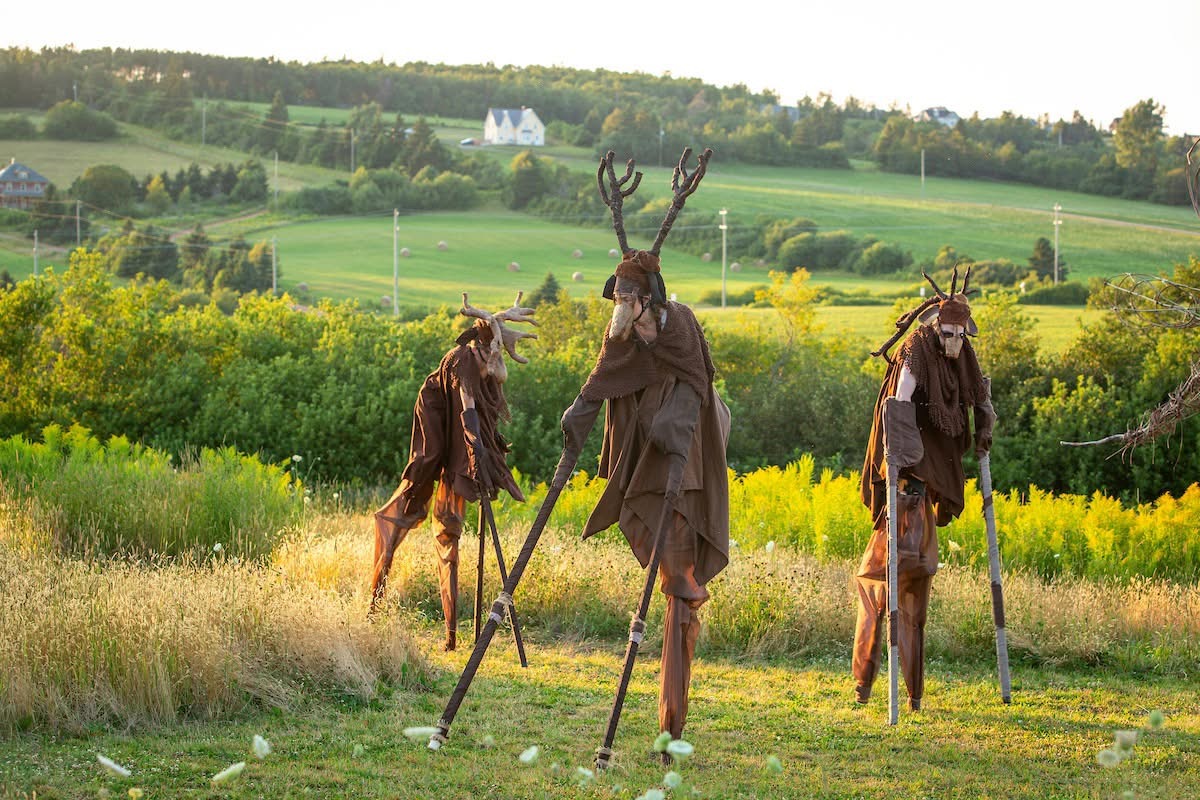
This is also Williams’ fourth year working at the River Clyde Pageant, which was established in 2016 in New Glasgow, Prince Edward Island, and he describes it as “this amazing community event that’s led by arts professionals and [is] exploring our relationship to nature and the land, and the animals, humans included, living on the land.” “How do we coexist?” he asks, “How do we congregate? What is flocking? What is herding? How do we set boundaries? How do we sound alarms? And, of course, the natural landscape in New Glasgow, it’s on the River Clyde, and in an agricultural area of the island, so I think the impetus for the pageant was to have a conversation about agricultural runoff and how it affects the river. It’s a really beautiful, socially engaged project.”
Williams was introduced to the pageant by Ian McFarlane, who is also the set and lighting designer for 333. When the pageant’s musical director was taking a year off Williams says, “they needed somebody who could fill this very particular role of working with musicians and instrumentalists and singers, both at a professionally trained and an amateur level, and create and guide a collaborative creation process, but arrive at a performance, and so Ian thought I could do the job, and so I was welcomed in.”
“It’s a real gift to someone who likes to compose and likes to arrange to be asked by a producing entity, River Clyde Arts, to create music for a standing ensemble- to say ‘this will be performed, and we have resources for you’- it’s such an incredible situation. It’s the dream.”
The pageant also includes puppetry, and Williams says that there are puppets that are used to invoke the animals within the performance, but then there are also the real animals that inhabit the performance space. “There are puppet birds. I haven’t seen this year’s collection of puppets. It’s always a slightly new or thoroughly new affair, but then there are also [real] birds in the trees, and so it’s this very interesting and strange marriage. There are puppet insects and puppet fireflies and puppet bees, but then, of course, there are actual fireflies, dragonflies, bees..”
He says that last year they were looking at flocks and herds of animals, and that there were ungulates performed by stilt walkers “representing the deer and the moose, and these beautiful ancient creatures.” Last year the dance ensemble performed a flock of geese, and there was a coyote that played a large role in the show representing a newcomer who may be a threat, but, also, Williams stresses, may not be a threat at all. He says the piece is using the lens of these creatures to “[navigate] that space of travelling and settling and integrating and maintaining difference, and finding your place in the ecosystem… My job is so interesting because the women who run the pageant will tell me things like, ‘Okay, we need some music for a flock of geese. We think they’re coming down a hill.’ So then I say, ‘okay there’s a dance ensemble, the choreographer, and there’s some duration that is, as yet, undisclosed- there will be movement patterns…. Do I compose music early and impose that? Do I wait to see the choreography that has been generated to music I may not even have heard and describe what I see? If I know there’s an appearance of a moth, or an appearance of a firefly- how do I use the skills and talents I have in my music ensembles, and how do I choose music to help that moment in the pageant come to life?’… It’s a beautiful dance- a chicken and egg situation.”
The artists who come in from different places stay in a rented house for the two months of the contract and there are kayaks for them to use. “Last year I discovered that if I had some hours off I could paddle myself upstream and there are eagles nesting. It’s amazing. It feels a bit like I’m disappearing into prehistory because parts of that tiny river take you into this forested banked area where you do not see houses or people or hear cars. It’s you and the insects and the birds. It’s beautiful.”
“A lot of people involved with the pageant, both as audience members and performer/creators, use the word “magical” to describe it,” he says, “and I think one of the things they’re responding to is that the expression on a young person’s face who somehow has fallen under the spell of three puppeteers manipulating an object made of mostly found material or recycled material that comes to life. It is kind of magic because an inanimate object has become an animate object in our eyes, in our hands, in our imagination.” Williams says that for many of their youngest audience members this show is their introduction to the theatre. He also likes the idea that it can be a ritual for families to come and see the pageant every summer. He alludes to the fact that the arts are so often characterized within governments and elsewhere as being “marginal” or “frivolous” but “[here] you really feel how it builds community, how it changes people, and how it helps people feel they are in the right place to be sharing these stories.” He adds, “#ArtsEducation, #BudgetCuts,” referring to the budget debacle happening with the provincial government in Nova Scotia right now.

The idea to adapt Beauty and the Beast as a new family musical for Halifax’s Shakespeare By the Sea was being floated years ago when Williams was working there as an actor and composer, but because the 1991 Disney film, and its musical score by Alan Menken and Howard Ashman are so iconic at first he wasn’t sure how they could create something completely different from the source material. “We walked through the hoops of The Wizard of Oz and it was a similar question. How do you get away from the MGM version? With The Wizard of Oz we focused on country/bluegrass and said, ‘let’s put Dorothy where she grew up… let her hear the music she would know.’”
Williams’ collaborator Dan Bray first had the idea of setting the story at a beauty pageant. “I found [that] a little bit repulsive as a concept. I was really excited about the idea of Belle being a werewolf.” Out of this brainstorming eventually came the idea that the Beast would be a contestant on a dating show. “He is the Bachelor. And, although, sure, he is a beast, it’s not about that- he’s just an arrogant person because he’s been put in a situation to let these women fight over him…. Belle, as this kind of creative, literate character, comes in as a production assistant who actually wants to help the production, believes in true love, really wants to write screenplays and be an auteur, … she is so turned off and reviled by a man who thinks [he’s] all that. Which is entirely the spirit of the original story.”
The music was then inspired by the Eurovision Song Contest. “The songs are competing for kind of hit status because the characters are competing to win the show… I leaned into this kind of orchestral pop world, and some disco, and some Motown, and some kind of French chanson, and some German Oompa band sounds. Dan leaned into this contemporary world in the way that Shakespeare was very contemporary, even though the plays were often set in ancient Rome or medieval England, it was all very in the here and now. So, that’s where we landed with this show.”
“One of the things I really love about the kind of intergenerational appeal that those [family] shows strive for is that we see young audiences watching the adults they’re there with laughing at things that, for a child, maybe are not yet accessible, but they see the joy in their guardian, and they experience joy with their guardian, and there’s happiness that suddenly fills that unit whoever they are, and then, of course, there are things that fill the young audiences with glee, and then we watch the adults enjoying that discovery that the child they’re there with has just guffawed or started dancing, and that allows, I think, the adults to remember their inner child. There’s something very wholesome and beautiful about the way Shakespeare By the Sea provides … an accessible exposure to theatre and music theatre.”
333 plays at The Arts Guild (111 Queen Street, Charlottetown), June 18-20th, 2026 at 8:00pm. Tickets are $25.00 and are available here.
There is a performance at the Motyer Fancy Theatre (62 York Street, Sackville) at Mount Allison University on June 25th, 2026 at 8:00pm. Tickets are $25.00 and are available here.
There is a performance at Ship’s Company Theatre (18 Main Avenue, Parrsboro) at 7:30pm on June 27th, 2026. Tickets are $25.00 and are available here.
And the show runs in Halifax at the Bus Stop Theatre (2203 Gottingen Street) at 8:00pm July 1st-4th, 2026. Tickets are available here.
Beauty and the Beast: The Fairytale-Gameshow Musical! By: Dan Bray. Music & Lyrics by: Garry Williams runs July 4th to August 29th, 2026. For more information and to buy your tickets please visit this website.
For more information about the River Clyde Pageant please visit this website.
Canadian Theatre Criticism is an essential part of a healthy and thriving theatre community. It helps theatre companies find new audiences for their shows, deepens audiences’ engagement with local artists and the work being created in their communities, and it is one of the best ways to preserve a snapshot of an ephemeral art form for future generations of theatre lovers. TWISI relies on support from its Subscribers, folks like you who care about the survival of local and independent arts coverage. Please consider becoming a Subscriber today, or click here for more information. Thank you so much for supporting TWISI.