
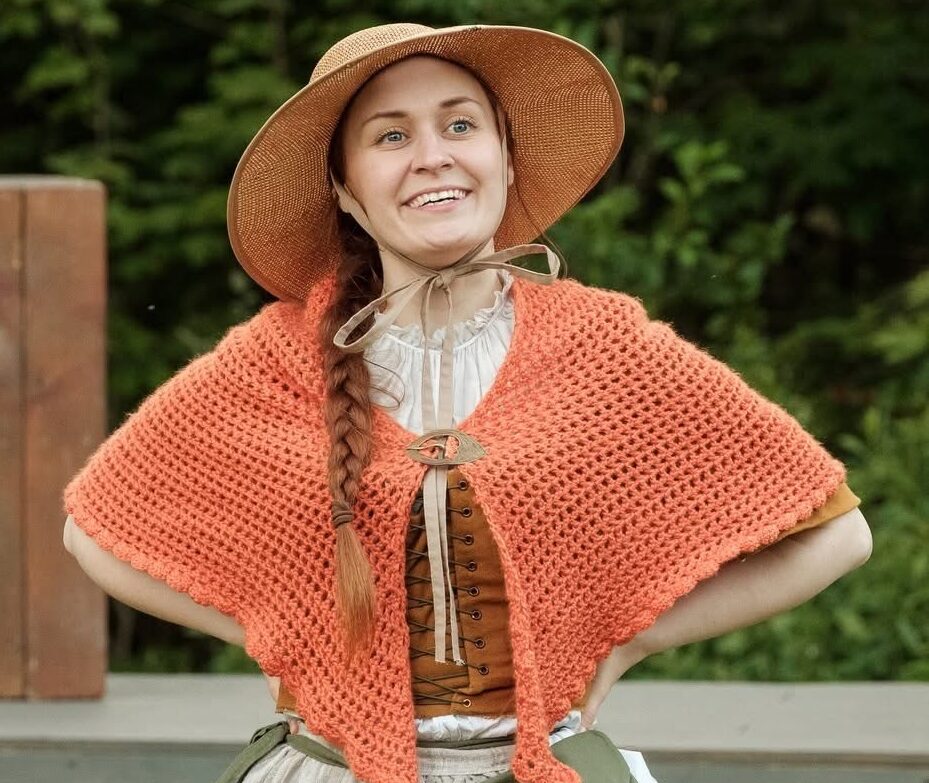
Becca Guilderson as Jane Johnson Photo by Memo Calderon Photography
The following conversation contains some spoilers for The Wind Coming Over the Sea so please only proceed if that doesn’t bother you or you’ve already seen the show.
Becca Guilderson and Hugh Ritchie play a young married couple Jane and Henry Johnson in Emma Donoghue’s play The Wind Coming Over the Sea, now playing at Ross Creek Centre for the Arts until August 15th. Jane and Henry are separated when Henry decides that he can make a better life for the family by emigrating from Ireland to Ontario during the widespread famine and sending for them once he has a homestead set up. Guilderson and Ritchie are a couple in real life, and they have been fortunate to work together quite a bit recently, including both being in the company of Neptune Theatre’s smash hit Come From Away, which had five weeks of overlap with the rehearsals for the two plays they are doing in repertory with Two Planks and a Passion Theatre this summer. I caught up with the very busy couple via Zoom to chat with them about their experience inhabiting Gander and Antrim at the same time, working together on such an emotional piece, and how their own family stories have informed the way that they’ve brought these characters to life.
By the time Guilderson and Ritchie accepted their roles for a summer at Ross Creek they had nearly given up hope that they would be cast in Neptune Theatre’s production of Come From Away. “It was to the point where I think both of us thought there’s no way we’re going to book this show, and so we were like, ‘Ken, we are definitely good.’ And it was within one day of saying, ‘we’re definitely good’ that I got an offer [for Come from Away],” says Guilderson. Then it became a matter of seeing whether she could manage both shows. She was already in conversation with Two Planks’ Artistic Director Ken Schwartz about the logistics of this when Ritchie got an offer to be a Standby in Come From Away as well. Guilderson says that Schwartz figured if they were working out a way for her to be in both shows they could find a solution that worked for both of them. “Initially there was only going to be one week of overlap,” says Ritchie. But then Come From Away was extended by four weeks.
Ken Schwartz was extremely accommodating. He changed the day off for the cast from the traditional Monday to Sunday so that Guilderson and Ritchie could be at Neptune for the matinee and the evening show, and then could come to Ross Creek during their day off from Come From Away to rehearse. Schwartz also made sure that since they both had such prominent roles in The Wind Coming Over the Sea they had smaller roles in The Monkey’s Paw so they would get a bit of a break during rehearsals for that show. Ritchie points out that this is, to a certain extent, how things typically work in a repertory ensemble- there is usually a sharing of principal roles between the two shows so all the actors have equal amounts of responsibility.
On a typical day Ritchie says they would drive up to Canning in the morning, rehearse, and then drive back to Halifax for Come From Away. “I can never sing Ken’s praises enough,” says Guilderson of the way he checked in with them to make sure they weren’t extending themselves too much in a way that was unsustainable, and how he planned for the five weeks of overlap from the start because he knew how popular Come From Away would be.
“We front loaded a lot of our Come From Away stuff so that… [it was] all in the bank, and we could start trying to learn our things early for the summer. That was helpful, but it still felt crazy being inside of it,” says Guilderson. Ritchie says that it was, of course, easier for him as a standby because when it was clear that he wasn’t going to be onstage for that performance he could go to his dressing room and work on his lines for the Two Planks shows. “But Becca, she had to do the show every single night, so there were lots of [instances] where during the car rides to and from that she would be drilling her lines, and I’d be coaching her,” he says. Guilderson wasn’t just playing Bonnie in Come From Away either, she was also understudying Julie Martell’s role of Beverley Bass. “On Sundays between shows I would go up and I would run Julie’s entire track on the deck. So, on Sunday I [couldn’t] look at the Irish show because my brain [was] going to get so confused with the dialects.” Beverley Bass has a very specific American accent, as she is based on a real pilot who landed in Gander on September 11th, 2001.
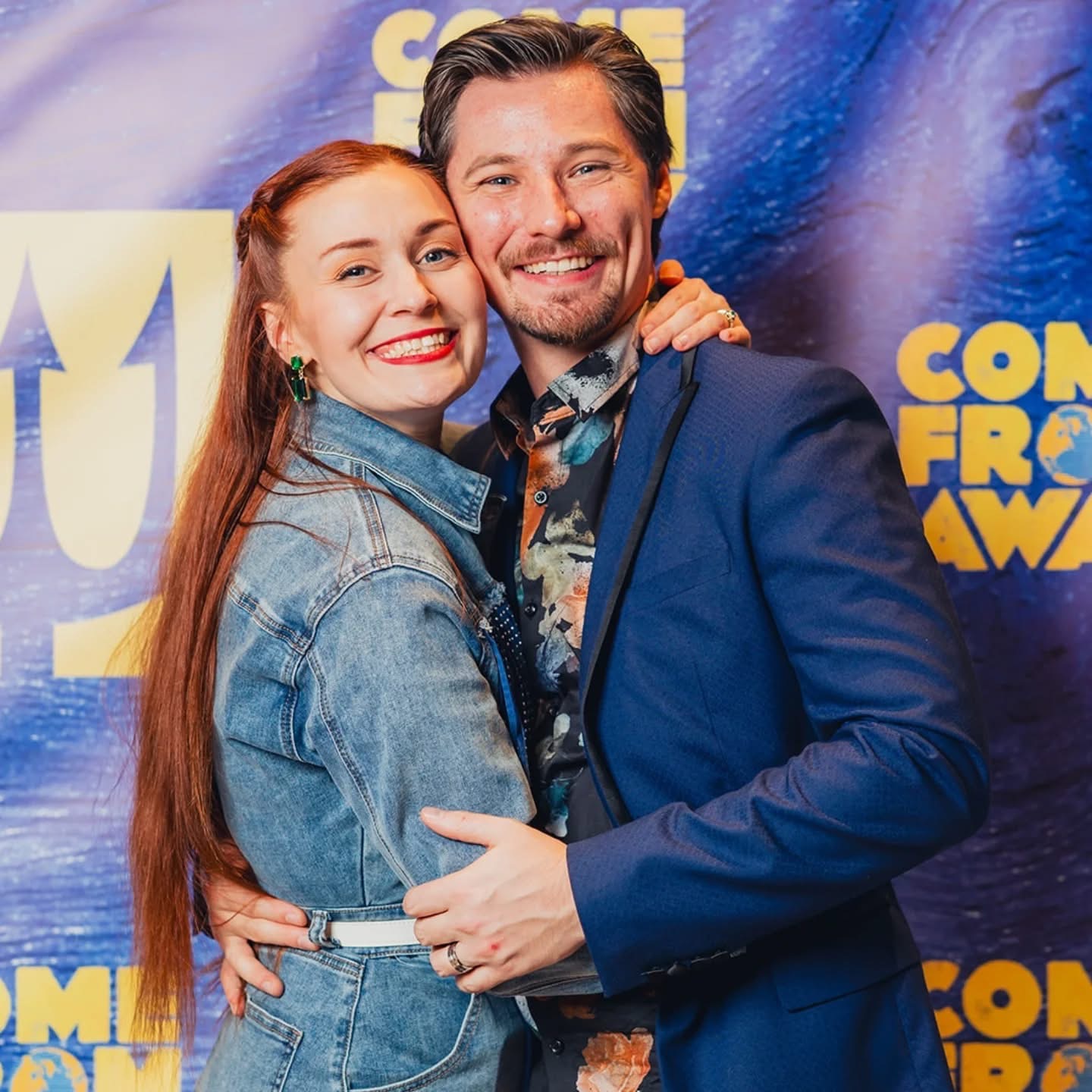
Becca Guilderson and Hugh Ritchie Open Come From Away Photo James Arthur MacLean
“I don’t think we could have done it without each other,” says Ritchie.“Having a partner to do all the drives with, and working on the same projects, and being able to run lines together-” “-and just being able to manage day to day house and activities, it was so much easier because there are two of us doing all the same things,” adds Guilderson. They divided up the chores they would do, and the way they prepped their meals in many ways felt like being back in school.
Guilderson and Ritchie weren’t the only two cast members in Come From Away who had overlapping projects. Martha Irving and Julie Martell had one week of overlap between the musical and rehearsals for Frenchy’s: The Thrift Musical, which is onstage now at Ship’s Company Theatre. Allen Cole musical directed both the Ross Creek shows in rehearsal, but had to leave to musical direct Frenchy’s, so Guilderson took over as MD for The Monkey’s Paw, and Ian Sherwood, who was also in Come From Away, took over for The Wind Coming Over the Sea. “Eight of the fifteen of us, I think, had overlaps in Come From Away,” says Guilderson.
Both Ritchie and Guilderson point out what a luxury it was in the Come From Away cast for there to be both understudies and three standbys because both have been in situations before where they have had to perform when they were extremely sick, putting others in their cast at risk, because there was no other option short of cancelling the performance. “It’s not so much for yourself, it’s to protect the people around you,” says Ritchie, “… you don’t know if there’s immunocompromised people that are around you, and how things spread, or who [others] are going home to. It’s always the better choice to call out if you’re ill, especially if there are systems in place to cover for you.”
Guilderson says that it could be disconcerting to understudy Julie Martell’s role while she was rehearsing her own role of Bonnie in Come From Away because they were usually near one another so the shift to Martell’s physical space was often quite slight. “I’m almost where I should be standing, but it’s slightly different. I’m landing in a different place on the revolve. Now I have to put on a different vest, but from the same corner. You’re trying to overwrite old information, but you’re like, ‘this is a whole different experience. I’m a different body. I’m a different person.’” “It’s always unique with musicals,” adds Ritchie, “because there’s so many moving parts. You’re cueing lighting, you’re cueing the band, you’re cueing your fellow actor on stage, and everything is timed to music as well, usually, so you really feel like a cog in a machine that you’re like, ‘I have to do exactly this, otherwise I’m going to throw off people all over in every department.’” He says that means that he’s not coming in and doing his own interpretation of the role, in fact, he is trying to inhabit the actors he’s covering as closely as possible. “We called him the skin suit, because he would try to become [the other actors] and wear them like a skin,” says Guilderson of the way she and others in the cast would tease him about not just his standby process, but his absolute proficiency at it. “We all laughed whenever he would do Ryan Rogerson’s bits because [they] look nothing alike and, somehow, [Hugh] is the same. We’re all confused.”
The standbys in Come From Away have a series of videos of the Neptune production that they watch for reference. Guilderson says that standby Jade Douris-O’Hara, who covered Bonnie, would watch each new video she received looking specifically for tiny little changes that actors had made to their tracks. “Martha found a way to help somebody get their coat, so she moves to a slightly different place so that this person can get through, all things that are so helpful, but [Jade] wouldn’t know [without the video] because [she] isn’t there all the time. It’s amazing that you can go back and find those little details.” The standbys also watch the show from the house quite a bit. “You get an idea of the space, and what the relationship is between the performers and the audience. [For example], ‘oh, this section usually gets a laugh, so I should hold for a little bit before steamrolling to the next part.’ Things like that aren’t on the page, and even from video sometimes they don’t translate,” says Ritchie.
In the rehearsal process the standbys would sit and write notes as the principal cast, the director, and musical director are building the show. “We weren’t contributing ideas, we were just writing down what people decided, and then the next day when they would review it, and they would change it, we’d have to scratch out our notes, and write down the new thing,” says Ritchie. Guilderson said that part was great for the principal cast. “Everyone kind of had their own personal stage manager to a degree” where she could check in with Douris-O’Hara to check and make sure that the blocking that she had written down was correct. “It honestly built such a nice environment of being able to communicate with our understudies. I was like, ‘this is amazing. I have an extra set of eyes on me when I’m going rogue.’” Ritchie says that there’s a certain demeanour that helps standby actors thrive in this environment. He only went on for one of the three tracks that he learned, and he says, “You don’t get the same sort of release that you get from doing all the work and then finally doing the show for an audience… The learning and the honing of skills- that’s the payoff.” “If you don’t go in, that’s actually great because your job wasn’t needed in that case, but you were prepared just in case,” says Guilderson.“You’re either ready to be helpful or you are helpful, and both things are a success.”
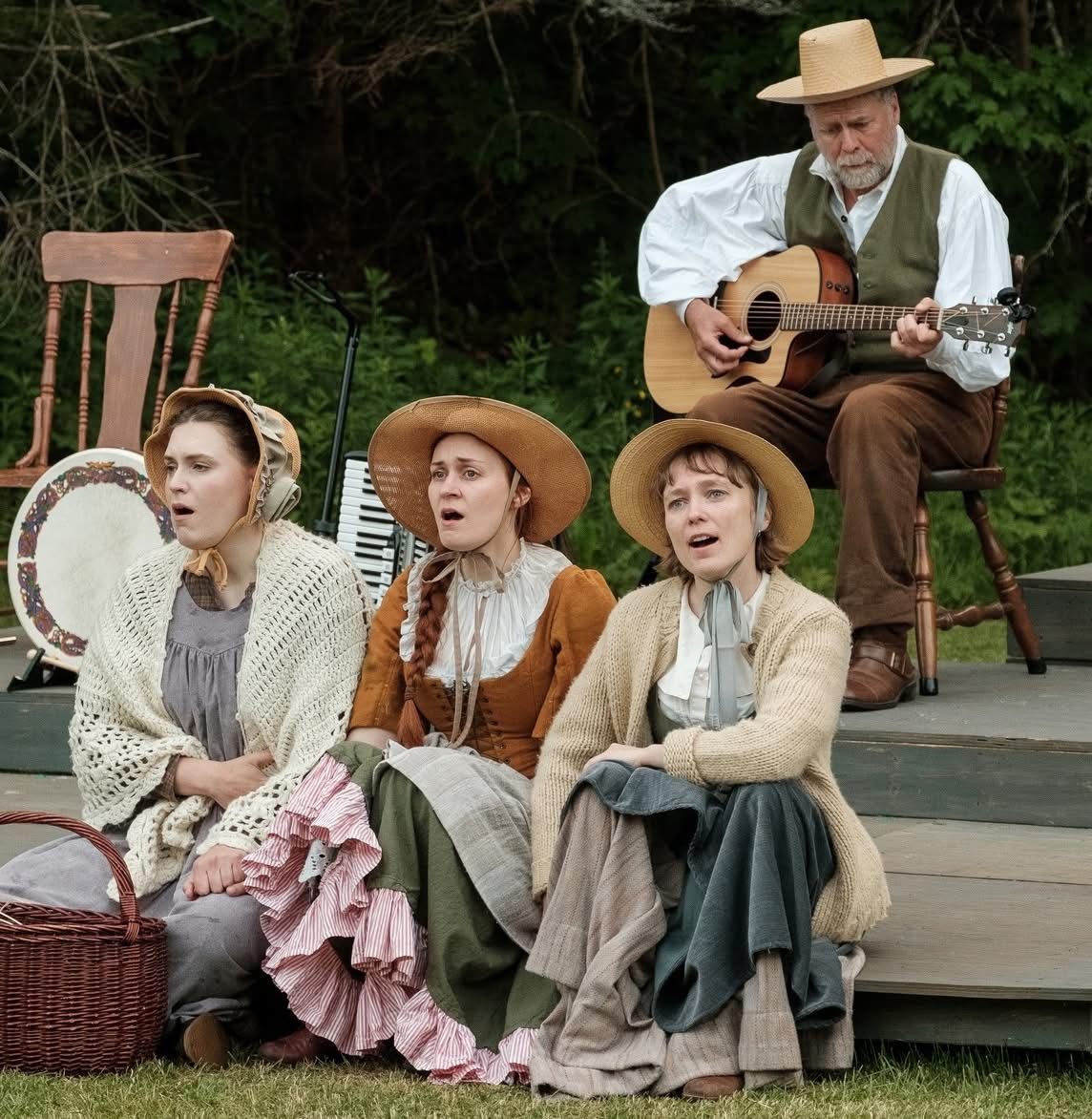
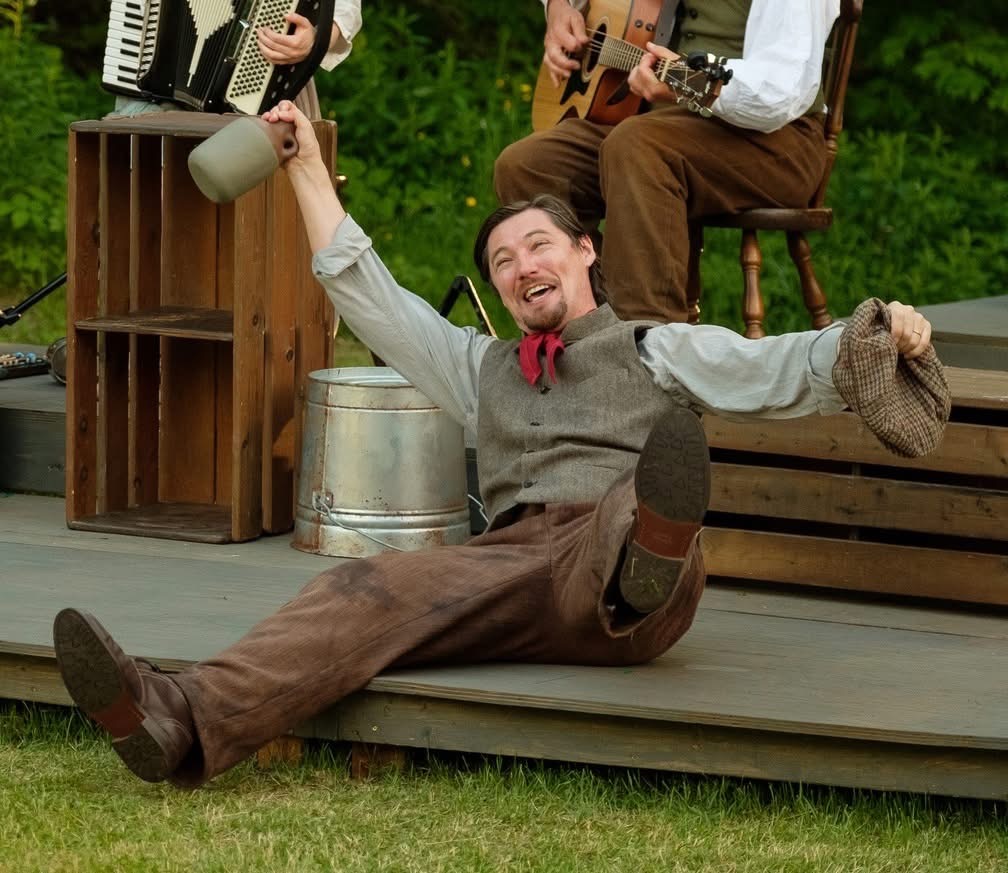
Sophie Schade Becca Guilderson & Lily Falk. Tim Machin behind Hugh Ritchie Photo by Memo Calderon Photography
Onstage now at Ross Creek both Becca Guilderson and Hugh Ritchie have very prominent roles in Emma Donoghue’s play The Wind Coming Over The Sea. Guilderson says that it is a “very relatable and understandable story of immigration- a story that transcends a lot of decades because anyone that has to immigrate to a new place is going to live a lot of the same experiences to varying degrees. You’re typically coming from a place where you’re sort of seeking refuge or relocating and changing your whole life. I think that feeling is really relatable and understandable. It’s a beautiful way to look at the difficulties of being an adult and having a family, and how those decisions are limited by not really knowing the place you’re going, so it’s fascinating to be able to talk about all those themes in a way that makes it feel accessible to people. I think doing it through the platform of letters is a really neat way to talk about it.”
“I was reminded and gained a whole other level of appreciation for our ancestors in general,” says Ritchie. “This was their story, and to recognize firsthand the hardships that they went through, and the sheer amount of luck that was involved for events to transpire for us to be here, it’s very moving, [and] to recognize all the sacrifices that were made, and to recognize how many people had the goals to come across and safely build a family, and weren’t able to do so because they got sick on the boat, or they arrived and didn’t have enough money and they had to go back… I think that our show does ultimately have a happy ending you could say, but you realize the scope of what they went through.” “It paints the perfect picture of any sort of Irish storytelling,” adds Guilderson, “which is that there needs to be some sort of sadness to appreciate the happiness…. It’s this beautiful thing that the Irish do so well where it’s never truly happy or truly sad. It’s a beautiful marriage of both things.”
Ritchie says that the use of music in this show is akin to the way it is done in jukebox musicals, in that the songs are all traditional Irish folk songs that weren’t written to tell this particular story but that Donoghue did a great job at marrying them to this story. Guilderson points out that at this time in history the Irish were the most persecuted people in the UK, and she hopes that seeing a story of white immigrants being persecuted when they arrived in Canada in the years around Confederation will encourage white folks to be aware of their biases against immigrants now “because it’s the exact same situation…. I think it’s a really important time to talk about things like that, especially in the Martimes, because we are seeing mass immigration in Canada, and it’s really important that it’s happening, and, if anything, it will make our ultimate landscape more beautiful, and more unique, and more interesting. I think it’s nice to plant that seed for people that, listen, anyone can be treated poorly, and we should actually just be treating people like humans.”
Ritchie says that while he isn’t a religious person himself playing a character who is in this context he can see why folks in Henry and Jane’s situation held onto their faith so strongly. “How do you choose to make that harrowing trip overseas where you [might] die unless you have faith that it will work out? That you will be taken care of?” says Guilderson. “A lot of their prayers are all about keeping each other safe, which I think is such a beautiful mentality to have. That, at the end of the day, [their] religion is really about keeping everybody safe, and taking care of the people you love.” She notes that audiences might find some humour, as she does, in the references to the friction between Methodists and Presbyterians, because, especially by today’s standards, those two Christian denominations have much more in common than they have differences.
Both Guilderson and Ritchie’s own family histories mirror the experience of Henry and Jane. Guilderson’s ancestor came from Donegal in the 1880s, and like Henry, the patriarch came over first and established a place to live, and then the entire family came over after. Ritchie’s grandfather came to Canada from Ukraine after World War II, and he too arrived in Montréal first, and then Ritchie’s grandmother followed with his uncle. “It was the same scenario [as in the play] of like, ‘alright, I’m going to be on this boat that docks on this day here,’ and you’re just waiting and hoping that they’re there when you get there.” For Ritchie he was able to find some records of his ancestors’ immigration at the Museum at Pier 21. “I honestly think about that story often when we’re doing the scene where we’re on the dock looking for Henry,” says Guilderson, “and I think about the fact that often people never found each other again.” “I also think it’s really smart what Emma did with this show how, since 95% of our interactions are through letters across the ocean it’s kind of like they end up having an idea of their husband and wife, and so later on when Henry dies [Jane] still carries on this notion of him being present in her life, even though he’s gone, because she’d already been doing that for a year. In your mind, that energy and their spirit is still around somewhere,” says Ritchie.
“I find the latter half of Act Two to be a really interesting picture of grief,” says Guilderson, “how you start to process that when your brain doesn’t know what to do, and a lot of it is still feeling like that person is with you all the time, and going through every scenario like they’re guiding you. I think Emma’s done a great job of constructing those three letters that end the show- that transition of how you start to let go of what I would call your training wheels, now I’ve got to ride the two wheeler by myself, and that’s scary.” The reality for Jane as a mother of two very young children alone in the wilderness of a brand new country is that she is surrounded by danger. “Henry is like, ‘you need to carry your marriage license with you the whole time because if you can prove, essentially, that you’re another’s man’s property no one will touch you.’ At this time, [men] respect that more than [they] respect women, which also paints a beautiful picture of probably why Jane chooses to marry Nettleton,” says Guilderson.
The play is based on real historic letters sent between a husband and wife that have been preserved by their descendants in Ontario. After her husband’s death Jane marries an older neighbour who comes calling on her. Guilderson says that she’s been having some interesting conversations with young folks who have seen the show about this aspect of the story. She said that she told them that they asked great questions and offered, “at the time, Jane wouldn’t have been able to do anything by herself- women didn’t own their own lives. The best way to protect yourself and your kids was to have a a husband, and as far as husbands go [Nettleton] seems pretty great. We talked about how he continues to be kind to her and take care of her.” She says that she got to speak with Donoghue a bit more about what happened to these characters during their lives together, and she told her that they ran a pub for awhile in London, Ontario, “which I found fascinating because they were both sober,” says Guilderson. “I think it’s beautiful how we talk so much about Jane and Henry, because there is nothing like your first love, and they had known each other since they were children, and so to lose that companion that you’ve had forever is really difficult. I’m just grateful that Emma frames it in a way that Henry kind of helps her move forward to continuing to be an adult and figure out the rest of her life.”
The play is an expansion of a story in a book Donoghue wrote called Astray (2012), and Ritchie says that she puts the sentences that she has lifted directly from the letters between Henry and Jane in italics in the story. “What I found striking was the affection that is carried in the letters. It’s always ‘your faithful and affectionate husband til death,’ and ‘my dearest, my angel’ it’s always very deliberate poetic language. I find, especially in our age of communication now where we’re constantly texting someone or calling someone, in some ways we express less affection on a day to day basis. So, when you have less of an opportunity to speak with someone, it only makes sense that you would say what you’re really feeling. Unfortunately, in the world, the timeline, that we live in it’s just so easy to take people you care about for granted [because] you don’t feel as much pressure to make the moments you have matter as much. I think the amount that it feels like [Henry and Jane] made those things really matter is really beautiful and impactful, and what people seem to be connecting to the most.”
Guilderson points out that Henry’s children, Alex and Mary, are extremely young when she marries Nettleton. They grow up with him being their father figure, and yet, they know the love story between their parents because their mother felt it was necessary to pass it down to them somehow. “I also think it’s really telling that Nettleton gets to a point in his life where he is okay with Jane giving a child Henry’s name. One of their children… Seeing a man be comfortable with his wife having a previous husband, and that that life existed, is also very uncommon for the time.” The play ends with the birth of a stream of children, who, of course, were needed, practically, to help their parents with the homestead and the business, and to look after them when they were elderly, but we can also see them as a defiant triumph of the Irish lineage. “In our research we were exploring how the potato famine was actively orchestrated by England in an attempt to minimize or even fully eradicate the Irish people, which, with the state of the world currently I think is a relevant comparison that we can clearly draw markers from,” says Guilderson.
“It’s very sobering how topical a lot of this seems to be in present day,” says Ritchie, “and always, unfortunately, disappointing how we continue to know the lesson that history repeats itself, and to not take away the message from that in a way that we should. There’s a scene when Henry first gets to [North America], and you see the American businessman that he tries to get a job from who says, ‘No, no, you go back across the border there… if it was up to me- I’d build a wall.” Clearly, Emma deliberately put that in because of [Donald] Trump, but it always gets a big reaction with every audience because the sentiments haven’t changed… That’s the most deliberate way for her to say, ‘pay attention because things like this are happening now.’”

Becca Guilderson and Hugh Ritchie as Anne Shirley & Gilbert Blythe in Anne & Gilbert
Guilderson says that Donoghue specifies that she wants Jane to be redheaded in the script because she wants it to be very visual to the characters in the play that she’s Irish. “She can’t pass as English,” she says. Guilderson played one of the world’s most famous redheads, Anne Shirley, in Anne and Gilbert in Charlottetown back in 2022, and Ritchie played her love Gilbert Blythe in that production too. We mention how having red hair is so associated, culturally, with being Irish, and yet it is also one of the things Anne hates the most in herself in Lucy Maud Montgomery’s novel. Her red hair is largely the reason that she incurs ridicule both from children her own age like Gilbert, and from fully grown adults like Rachel Lynde. “When we were growing up anybody that had red hair got teased,” says Guilderson, “people always make jokes about gingers. I don’t think people realize that sort of thing inherently comes from prejudice,” says Guilderson.
They also mention that for folks like Henry and Jane they may initially think that coming to Canada will be a temporary measure- just to wait out the hard times in Ireland- but that likely by the time they survive the treacherous journey they have to make peace with the fact that they will never see their beloved homeland and the family members left behind again. And then, as their children Alex and Mary grow up in an entirely different reality, they grow to become more Canadian than Irish, which is just exacerbated by each subsequent generation as Ireland becomes more and more intangible and remote. There is a different kind of grief that Jane must experience as she watches this unfold, while she also likely feels grateful that her children are able to acclimate and assimilate into this new world with more ease and fluidity than she can. This is another experience that is very much unfolding in real time in our communities, and for those of us whose families have lived here for generations we would all do well to show compassion and empathy for those who are raising first generation Nova Scotians and first generation Canadians. Conversely, for Guilderson working with dialect coach Sarah English on the Northern Irish accent she was sometimes told that she was doing too much, and she realized that a lot of what English was instructing her to do, she already did naturally because remnants of that accent of her ancestors, and all the ancestors of the community where she was raised, were still there in her body all these generations later.
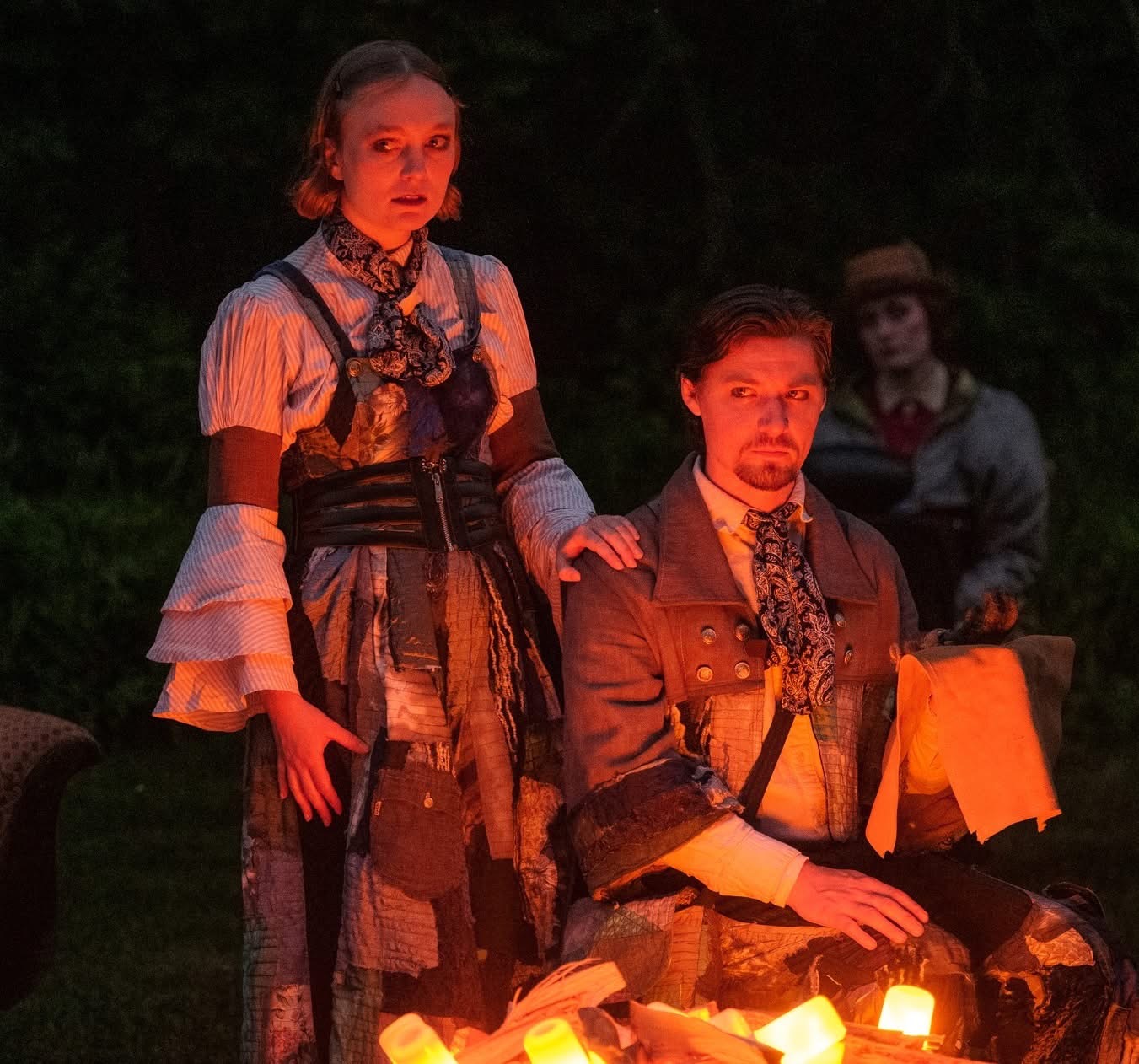
Lily Falk & Hugh Ritchie Photo by Memo Calderon Photography
Like The Wind Coming Over the Sea The Monkey’s Paw, Two Planks’ fireside show, is also adapted from a short story, but the difference is that The Monkey’s Paw is only eight pages long. Ritchie says that the script for the play ended up being about 34 pages, still very short for an hour-long piece. “I feel like the pace in the Irish show is very quick… I found instead we were deliberately exploring silence a lot with Monkey’s Paw, and the added weight of the information, because there is less dialogue so we can allow things to sink in and build more tension from that.” Guilderson said that she saw the role of the music in the show in a very filmic way. “It’s there to make the moments of silence feel more tense, so that you can kind of sit in the quiet longer in a way that makes the audience feel comfortable and uncomfortable.” She says that she has a unique perspective because she spends so much of the show watching the play waiting for her one short scene, but she is adding the underscoring to support the other actors in the work that they’re doing. She also says that a lot of the tension comes from the fact that the story all takes place in one location, and so it allows for everything that exists beyond those four walls to seem sort of ominous. “I love in shows where, as an audience, your relationship changes with the set as the story progresses. Initially, the front door, people come and go through it all the time, and then as the show progresses it becomes this foreboding presence. It’s like a portal where there’s danger on the other side,” says Ritchie, “But nothing has changed with it. Just the context has changed.” He notes that all the theatre magic associated with the door are practical effects created by John and Bonnie Thomson, “the tech wizards.” “Ken is always trying to see how the fire is another character, and in this setting where it’s a static setting, [the fire] is the source of heat and light, and then we are toying with the idea of throwing the monkey paw in the fire, or it’s the firelight playing tricks, [making characters] hallucinate and see things that aren’t there; everything challenging comes back to the fire somehow…. This is our third summer with Two Planks, and I had never done outdoor theatre before this, and I found it so fulfilling to work on outdoor theatre, and especially the fire shows because there’s something very primal and ancient about this form of storytelling, and you recognize that for thousands of years people have told stories around the roaring fire, and unless you’re actually doing it, it’s hard to replicate the feeling.”
“There’s something particularly special about doing the Irish show outside,” says Guilderson, “because you feel so connected to the earth… and the ground, and you’re like, ‘this is where people who are just like us have walked for centuries. How many feet have passed this field before they knew that we would be here gathering to tell stories? What else has this world seen?” “Emma Donoghue, when she came [to see the show], she said that she’d seen a lot of outdoor theatre before, but never the way we do it, and how the setting and the outdoors are so integrated into the storytelling.” Donoghue pointed specifically to the way the fireside shows work as being unique, and also the way that in The Wind Coming Over the Sea Henry’s ghost “wanders off, just slowly into the woods and disappears,” Ritchie says that she found that moment very cinematic.
“I’m feeling really cathartic to work on the Irish show and do more research, and trying to find out about my family,” says Guilderson, “because it does feel like, not a secret, but it’s just over the years people stopped passing information on, and so you stop knowing where you came from and, while these [ancestors] don’t necessarily define you, there are parts of that genealogy that stayed with your body, and so it’s good for you to be aware of the things that other people in your circle lived, right? What did get you to be where you are right now? What were the events that happened?” “How to recognize that so many decisions came down to chance and luck,” adds Ritchie, “It’s so crazy to think about.”
The couple tell me too how grateful they are to have gotten to work together so much this year- in Come From Away, here at Two Planks for the summer, and they will both be back at Neptune in Dracula: A Comedy of Terrors in the Fall. Telling this particular story of Henry and Jane Ritchie says has been easy in some ways doing it together, but in some ways it has been harder. “You’re always trying to separate the story from your own life experience in your own relationship, but there’s certain moments that you can’t- just by your physical chemistry-“ “that your brain goes, ‘this is confusing to me,’” adds Guilderson. She says it’s ‘not great’ having to watch her partner pretend to die every show but adds, “it’s more disconcerting that he’s so good at pretending to vomit.”
Bodily functions aside (and content warning for the Irish Play: Bodily Functions) Ritchie says, “It’s easier because since we’ve been together for four years now tapping into the relationship of these characters felt very easy as far as our support system for each other, and then, yeah, tackling the tragic parts are like, ‘ooof. I’m glad this is pretend.’”
“Because it would feel terrible if it were real,” Guilderson deadpans.
Becca Guilderson and Hugh Ritchie are pretending against a gorgeous Canadian landscape at Ross Creek Centre for the Arts in two plays- The Wind Coming Over the Sea and The Monkey’s Paw until August 15th.
The Wind Coming Over the Sea: A folk musical by Emma Donoghue runs until August 15th. Performances run on Tuesdays, Wednesdays, Saturdays, and Sundays. The Monkey’s Paw, adapted by Ken Schwartz, also runs until August 15th. Performances for this show run on Tuesdays, Thursdays, Fridays, and Saturdays. Tickets range in price from $15.90 for children, $26.50 for Artists/Underwaged Folks/Students and $$37.10 for General Admission. For more information or to book your tickets please visit this website.
Ross Creek Centre for the Arts is wheelchair accessible, and there is a golf cart available for those who may need help moving around the outdoor space. Please let the staff know when booking your tickets if you need wheelchair accessible seating or will require the golf cart. Sunscreen and bug spray and dressing in layers is advised for all theatre patrons. For more information about what to expect when you arrive at Ross Creek please visit this website.
Canadian Theatre Criticism is an essential part of a healthy and thriving theatre community. It helps theatre companies find new audiences for their shows, deepens audiences’ engagement with local artists and the work being created in their communities, and it is one of the best ways to preserve a snapshot of an ephemeral art form for future generations of theatre lovers. TWISI relies on support from its Subscribers, folks like you who care about the survival of local and independent arts coverage. Please consider becoming a Subscriber today, or click here for more information. Thank you so much for supporting TWISI.
Incoming search terms:
- https://www twisitheatreblog com/?p=6784




1 thought on “Becca Guilderson & Hugh Ritchie on Working Together to Make Their Come From Away Spring & Ross Creek Summer Come Together So Magically”
Comments are closed.