
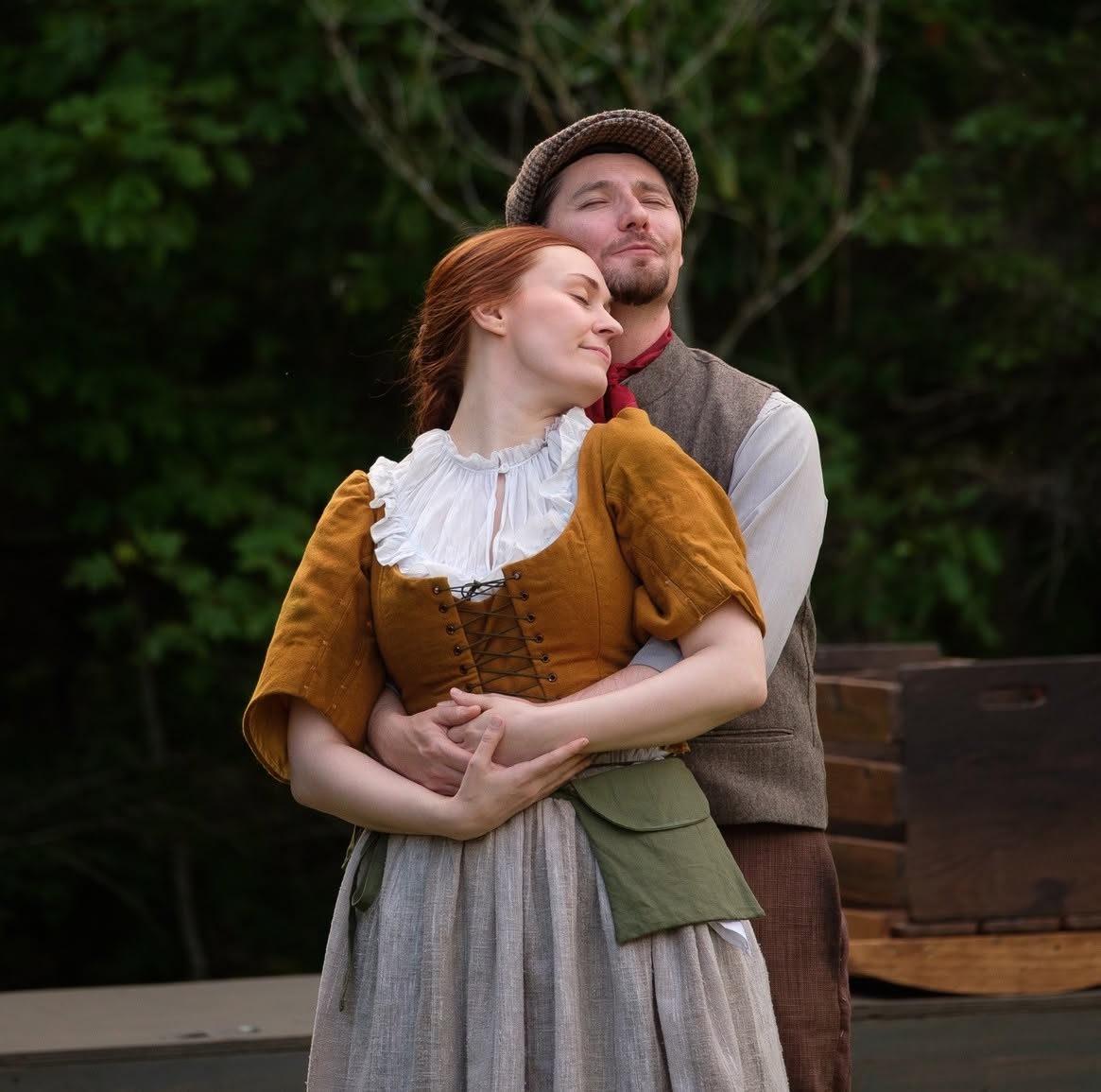
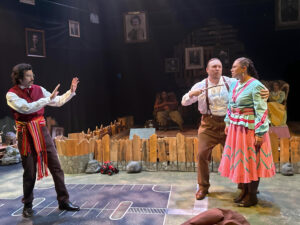
Becca Guilderson and Hugh Ritchie in The Wind Coming Over the Sea by Emma Donoghue. Costumes by Diego Cavedon Dias. Photo by Memo Calderon.
In the Spring of 1847 my great great great great grandfather Henry Ruth donated to a relief fund in Eastern Prince Edward Island that had been set up to help the poor of both Ireland and Scotland affected by a deliberately manufactured famine catastrophe that killed over a million people in Ireland alone. My ancestor emigrated from Ireland to Canada earlier; by 1836 he was living in Priest Pond, a tiny part of Lot 47 on PEI, but the community pulled together several times to help their relatives, friends, and neighbours back home.
Emma Donoghue’s play The Wind Coming Over the Sea on stage until August 15th at Two Planks and a Passion Theatre, is also a story rooted not just in Canadian history but in real family history telling the true story of another Irish Henry, Henry Johnson, who emigrated to Ontario one year after the relief from Prince Edward Island was sent. Johnson left his wife, Jane, and their two very young children, Alex and Mary, in Antrim, hoping to find work and to be able to set up a a home for them in the New World, and then send for them to follow him. The letters that Henry and Jane wrote back and forth to one another over the next thirteen months have been preserved and form the basis of Donoghue’s play.
Henry and Jane run a grocery store in Antrim, Northern Ireland, but their debts are mounting as they find it difficult to stop extending credit to their impoverished and dying neighbours who are desperate to buy the necessities of life. Henry finds solace sometimes in alcohol, which also gets him into trouble. At the same time, both he and Jane are young and genuinely love each other, and both of them want a better life for their children. The trek from Ireland to Ontario by way of New York City is even more perilous (and expensive) than Henry expects, and with no fixed address, and at the mercy of 19th Century mail service, it’s a miracle that any of the letters Jane sent to Henry found him. She decides of her own volition to take Alex and Mary to Canada to meet him. Her parents are of a higher financial station and they see to it that she travels with relatives in a much more comfortable middle class situation than his own experience in steerage. She trusts that her letters will find Henry and allow him to meet her boat when it docks and they will be reunited and make their way as new Canadians together. Unfortunately but unsurprisingly, things don’t go as Jane hopes, and we wonder how two people could ever find one another in an expansive wilderness in those decades (and centuries) before Confederation.
Hugh Ritchie plays Henry and Becca Guilderson plays Jane, and this is perfect casting. Ritchie plays Henry as a genuinely good hearted person, and the love between Ritchie and Guilderson is effortless and poignant, but Henry has a bit of an edge to him as well that keeps the audience on their toes about how successful he will be turning his goals into reality. Guilderson, on the other hand, as Jane, is sturdy, and ferocious in the steadfast way that she will provide for Alex and Mary, come Hell or high water, or both. The rest of the ensemble play a myriad of characters- notably Chris O’Neill plays Jane’s mom, Mary, and Tim Machin plays her father, Arthur, and I am not sure whether these two characters came from real letters or more from Donoghue’s imagination but they are very generous parents- perpetually giving their daughter money- and her father doesn’t impose an iron fist on her. Instead, he tells her that she must make the decisions that she feels are right for herself and her children. They feel a little bit convenient sometimes because they only ever solve problems; they never provide any real conflict or complicate the narrative, but I was really struck by a wordless moment between Mary and Jane where they were saying goodbye, and Mary was saying goodbye to grandchildren who would never remember her, and I really felt the depth of that sacrifice- for Jane to choose to leave her parents forever- and for Mary to, helplessly, full of anxiety and deep, profound grief, watch her go.
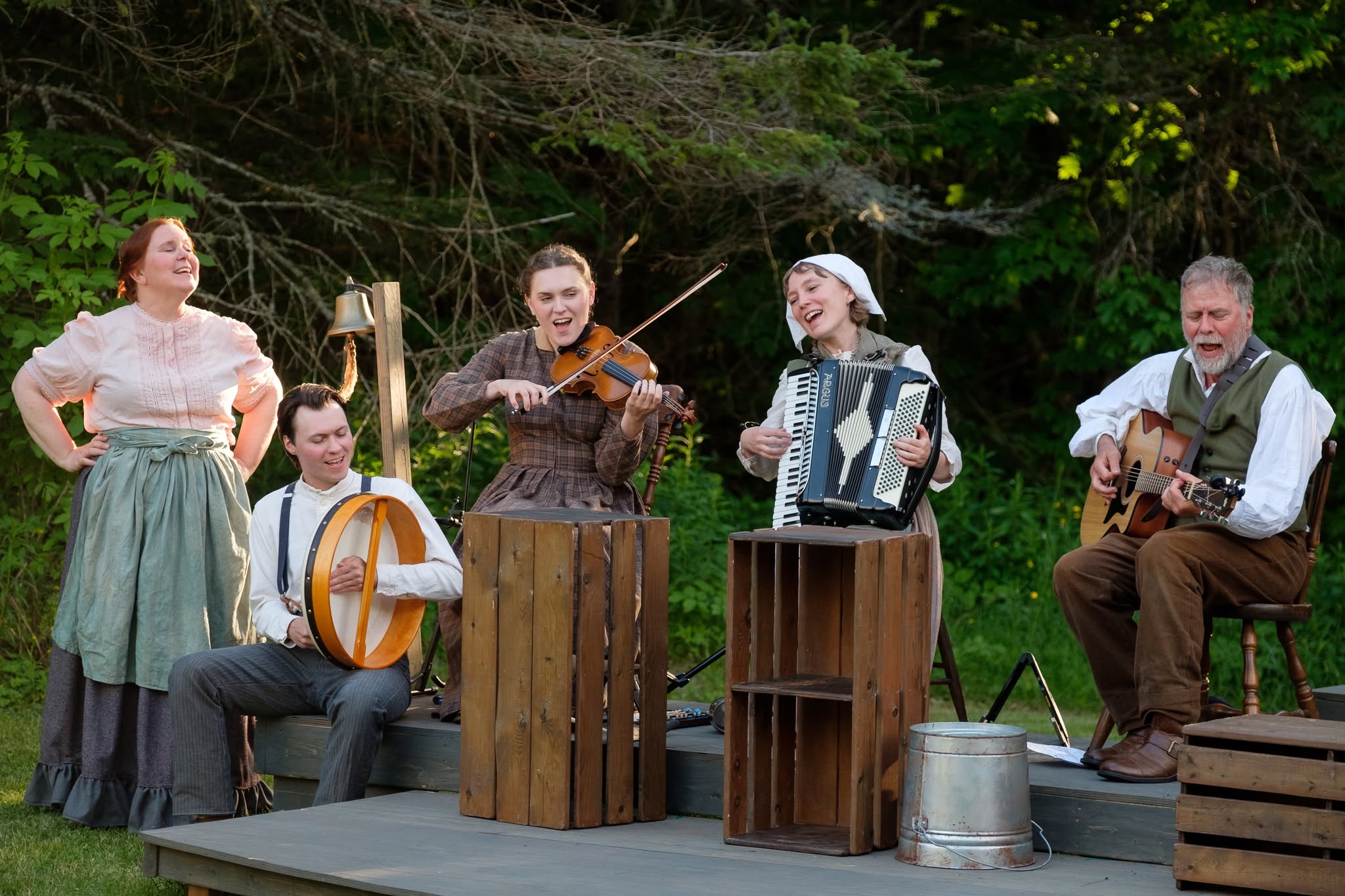
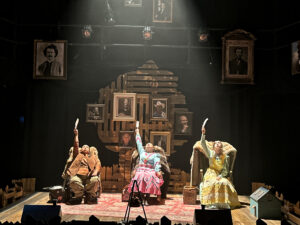
Costumes by Diego Cavedon Dias Photo by Memo Calderon.
The most soaring aspect of this play are the traditional Irish folk songs arranged by Allen Cole. While they don’t move the plot forward linearly like in a conventional musical, they do capture the sense of when the emotions are so heightened the characters begin to sing- and these are the types of songs that these characters would have turned to to help them express things that they may have had trouble putting into words themselves. The ensemble- which includes Sophie Schade and Lily Falk and Sam Vigneault- sound absolutely gorgeous together as they accompany themselves on fiddle, guitar, accordion, and bodhran. Ritchie and Guilderson’s voices are especially gorgeous in harmony together, symbolizing a marriage between two people who fit together so naturally.
Structuring a play around letters being sent back and forth can be difficult because the act of both writing and reading limits the amount of action the audience is seeing. Overall, both Donoghue and director Ken Schwartz do a good job of balancing the letters with creating the worlds both in Antrim and in North America in ways that help the audience feel invested in the secondary characters, and to feel the push and pull this family feels between a fresh start and the magnitude of homesickness and disorientation in their new lives. There is so much of this play that works really beautifully. There are a few times where the pacing seems a bit strange. I wanted there to be higher stakes for the pocket watches that Henry sews into his clothes before the voyage- thinking of them as a worse case scenario insurance policy- and while we do see a little bit of hostility toward Irish immigrants (and immigrants in general), I felt like that could have offered Henry (and Jane) a bit more of a hurdle to overcome. It is also quite a somber and sober story, where the only real moment of joyful frivolity is marred by the fact that Henry is drunk, and we know there will be consequences for his indiscretion. I wonder if there could be a few more moments among the sisters, or in reference to all the children, where we could see how these people were finding moments to laugh, to experience happiness and fun- if only in glimmers. I don’t know how the children could be made to feel more present without making Alex a bit older, but it made me think of that stunning moment in Ragtime where Mother, the WASP, and Tateh, the recent immigrant, watch their small children playing together and sing “Our Children,” and for just a second they both get a tiny glimpse of the best the future promises.
The direction by Ken Schwartz is a bit of a mammoth undertaking. He has the ideal natural environment for when Jane and Henry are roaming around Canada, but he needs the audience to use their imaginations to create the backdrop in Ireland. He does well to create a clear separation between the worlds, and the transition between the narrative of the story and the music is very fluid. The only thing that really distracted me was how a year elapses and Mary, Jane and Henry’s child, never grows beyond an infant-sized baby. Apparently this was the case when the show premiered at the Blyth Festival too, which is curious.
Donoghue wrote this play based on real people and true circumstances- Henry and Jane Johnson were real Protestant Northern Irish who emigrated to Ontario in this exact way during the Famine in Ireland. I do wonder if other Catholics will bristle a smidge on behalf of their ancestors like I did, since an Drochshaol, as its known in Irish, affected the Western and Southern parts of Ireland even more severely than the North, and the Catholics were discriminated against in North America all the more viciously- especially in Ontario. The Catholic St. Patrick’s Day Parade was banned in Toronto, after all, until the 1980s. I’m not suggesting that Donoghue, who is Irish and Catholic, shouldn’t have told this story- not at all- but it is worth thinking about whose letters were never preserved- or who couldn’t even afford to send letters home in the first place- and to make sure that we continue to fill in our sense of history with all the nuance that we can. My ancestor Henry Ruth and this Henry Johnson likely would have been enemies to one another, even though they were in the same storm of colonial violence, land theft, poverty and hardship- they were in two very different boats, and that made all the difference. Despite my understanding of my own family history, I felt nothing but empathy for the Johnsons and the MacConnells in this play, a testament to how far we have come to put certain ancient grudges and prejudices behind us (although I’m sure they haven’t been entirely eradicated). This progress does bode sort of well for the future, as we have seen wave upon wave upon wave of folks arriving from a myriad of different places and experiences being met by racism, xenophobia, panic over fear of diseases, of communities being “overrun,” but then within a few generations most become folded seamlessly into the Canadian experience, even sometimes held up as a model example, and a new group of folks are demonized instead. Both the Protestant and the Catholic Irish immigrants brought their grit, their culture, their music, their tenacity, their humour, their talents, and skills, and their innovative ideas to Canada and helped to shape it into a better country by being here. When we look back at all the folks who have arrived more recently in Nova Scotia from all over the world- in a generation or two I know we will be saying the exact same thing about how they are an essential part of our communities, our diverse culture, and our own continuing story.
My favourite aspect of this play is that Mary Louise Wyatt, a descendant of Mary and Henry Johnson, who worked as a teacher in London, Ontario, knew her family’s history and helped to bring it into the 21st Century. The more we know about where we have come from, and who we have come from, the more it helps us to question when the history being taught or parroted isn’t messy, contradictory, and complex, and I think it can help us develop empathy too. The Wind Coming Over the Sea isn’t about “the Irish” or “the Protestants,” it’s about Jane, and it’s about Henry, and seeing them as unique, individual humans with their own distinct trajectory is the first step.
The Wind Coming Over the Sea: A folk musical by Emma Donoghue runs until August 15th. Performances run on Tuesdays, Wednesdays, Saturdays, and Sundays. The Monkey’s Paw, adapted by Ken Schwartz, opens June 27th at 9:00pm and also runs until August 15th. Performances for this show run on Tuesdays, Thursdays, Fridays, and Saturdays. Tickets range in price from $15.90 for children, $26.50 for Artists/Underwaged Folks/Students and $$37.10 for General Admission. For more information or to book your tickets please visit this website.
Ross Creek Centre for the Arts is wheelchair accessible, and there is a golf cart available for those who may need help moving around the outdoor space. Please let the staff know when booking your tickets if you need wheelchair accessible seating or will require the golf cart. Sunscreen and bug spray and dressing in layers is advised for all theatre patrons. For more information about what to expect when you arrive at Ross Creek please visit this website.
Canadian Theatre Criticism is an essential part of a healthy and thriving theatre community. It helps theatre companies find new audiences for their shows, deepens audiences’ engagement with local artists and the work being created in their communities, and it is one of the best ways to preserve a snapshot of an ephemeral art form for future generations of theatre lovers. TWISI relies on support from its Subscribers, folks like you who care about the survival of local and independent arts coverage. Please consider becoming a Subscriber today, or click here for more information. Thank you so much for supporting TWISI.
Incoming search terms:
- https://www twisitheatreblog com/?p=6679


2 thoughts on “The Wind Coming Over the Sea is an Emotional & Musical Ode to the Irish Immigrant Experience”
Comments are closed.