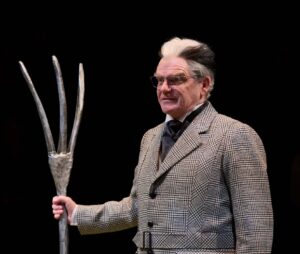

Burgandy Code as Julius Caesar
It is an interesting choice in structure for William Shakespeare to delve right into the action in his play Julius Caesar, particularly in the 85 minute adaptation by Drew Douris-O’Hara that is onstage now at Shakespeare By The Sea. Does Shakespeare assume that his audience knows the history (or at least the lore) of Caesar so well that they don’t require a lot of exposition in order to have an informed opinion on the deeds of the Conspirators who murdered their colleague on the Ides of March 44 years before the Common Era? Does that, then, put modern audiences at a disadvantage? Or, does Shakespeare want you in the audience to focus less on why this event occurred, and more on the unintended consequences that arose from it, especially for Brutus, who not only betrayed a fellow senator, but a friend.
Julius Caesar doesn’t just tell the story of Caesar’s assassination by a group of senators who felt that he was amassing too much power and would someday crown himself king and destroy what in Roman times constituted a democracy. It also explores the, often terrifying and cruel, power vacuum that often emerges when a powerful leader is suddenly ousted, especially violently. Mobs roam the streets looking for scapegoats. If ambition was Caesar’s undoing, it is a metaphorical snarling pack of ambitious wolves that emerge circling around the centre of power, ready and willing to attack and devour one another to be the last one standing. The pathway toward the public good and the people’s best interest and, indeed, justice, is usually completely shrouded in carnage- and this is certainly the case in Shakespeare’s tragedy.
It is also interesting for Shakespeare to choose Brutus as the tragic figure and not Caesar, or not only Caesar. Caesar is characterized as a grandiose figure who speaks of himself in the third person, and who professes to have no fear of death, for those who fixate on it die over and over in their anxious imaginations, but he, who has no fear, dies only the once. It is Brutus who is much more relatable, and much more human. He is unsure of his choices; he exerts himself with confidence, but then backs down when someone with a larger personality counters him. He has to talk in circles to convince himself that he made the right choice, but the doubt remains in him. Unlike Caesar his entire motivation is based in fear- he is afraid that Caesar has grown ambitious, and that his ambition will lead to further tyranny in Rome. It is through Brutus’ lens that we see the events in the Second Act unfold, and him having to face the reality that he has become a murderer and Caesar’s death has failed to circumvent the political upheaval the Conspirators told themselves they were preventing.
Rosie Callaghan plays the vengeful Cassius, who appears as the leader in the plot against Caesar, and along with Chris George’s Decius Brutus they are the most bloodthirsty to see his rule come to a definite end. Matt Lacas’ Casca, and Seb Reade’s Cinna are more intellectual, and their means of ridding Rome of Caesar is more methodical and bureaucratic, but no less effective. It is only Patrick Jeffrey as Brutus who requires convincing, and we hear passionately from Portia, Brutus’ wife, played by Jade Douris-O’Hara, that the Brutus she knows is a kindhearted and gentle man, and we can see in Jeffrey’s portrayal the tension between his empathetic nature and his joining the Conspiracy.
Douris-O’Hara as Portia doesn’t have a lot of stage time, but her monologue to Brutus where she begs him to treat her as his equal and to confide in her because she knows he is deeply troubled is performed with ferocity. Caesar’s wife, Calpurnia, played by Liliona Quarmyne, is also desperate for her husband to listen to her and to stay home from the Capitol, but for Calpurnia it is not a deep knowing of her husband that has alarmed her, it’s a prophetic dream. This is another way that Shakespeare makes Brutus’ narrative more immediate and keeps Caesar at an emotional distance from us. We don’t know for sure how Portia might counsel Brutus if given the chance, but it is interesting that Shakespeare presents this discarding of the female perspective as part of Brutus’ tragedy.
Jade Douris-O’Hara also plays Marc Antony, the person who remains true to Caesar after his death and who rallies the people surreptitiously against the Conspirators. Douris-O’Hara is equally dexterous in commanding her audience for this political speech where Antony is both saying that Caesar’s murder was unjustified, and that the Conspirators are honourable men, hoping that the latter will be an effective cover to express the former giving him plausible deniability when the violence erupts later. Shakespeare doesn’t give the audience a Fortinbras character like he does in Hamlet, someone who the audience assumes will pick up all the broken pieces of the kingdom and somehow provide the people with a fresh slate. Antony and Octavius Caesar will lead a new chapter in Rome’s history, but it’s unclear whether it will be better or worse or just different from all that has come before it.
Burgandy Code plays Julius Caesar as a blissfully ignorant person gliding through life on sheer confidence and faith. We do not see him raise so much as his voice to anyone, and he puts his full trust in the hands of his colleagues in bewildering vulnerability, but he also has a supreme belief in his ability to handle whatever is thrown his way. This illusion is smashed for him at the very end of his life as he utters his famous last words to Brutus.
Drew Douris-O’Hara’s signature rollicking pace works really well for this story, especially because most of the audience members have an idea of where the plot is headed, and you really feel like these characters are on a runaway train that they cannot stop, and that will dictate all their fates, and indeed, in many ways the history of much of the world. The painted backdrop by Brenda Duran gives the park’s natural ambiance just a touch of Classical urbanity to root us in a city. Schuÿler Edgar Holmes’ costumes, similarly, are very effective at establishing time and place. I especially liked the use of masks in this production, and the way that they were linked to themes of death and ghosts, but also concealment, and the Classical Theatre tradition. The use of the drums, as well, helps to add a sense of tension, and danger, and the flute, played by Siya Ajay, adds an element of pathos, while continuing to evoke the Roman world around us.
You can almost always find a way to connect a chosen work of Shakespeare to the contemporary world of politics and culture, but what makes Julius Caesar an interesting show to do this year is that there seems to be a multitude of very different ways to see the play as it relates to our current reality. My biggest takeaway is that from one of the oldest democracies in the world, Italy not the United States- comes this important lesson in not allowing your leaders (elected or otherwise) to govern without constraints, especially on time. If there are no legal ways for the people to oust their leader, or if there are but they have been corrupted to the point that they are no longer functional and only exist in the theoretical for decoration, then the people will become desperate, and when the people become desperate violence is often seen as the only solution. If Caesar had a four year term limit it is very possible he would have been voted out of office instead of stabbed to death in the Senate. You can feel the desperation in the people in the United States right now escalating, slowly, but still surely, as more and more people feel skeptical about the prospects of having a free and fair election in 2028. The warning for them too is in the aftermath of Caesar as well- it’s in the Reign of Terror that followed the French Revolution. It’s not about not striving for radical change (and through radical means if necessary), it’s how to do it while also minimizing the fallout- or is that not possible?
I will admit to being a bit distracted for about fifteen minutes during Act Two when three beautiful deer wandered into the field right next to the audience area and the stage and started really chowing down on their supper of grass and leaves. One of the deer in particular was wagging his tail so merrily he looked like a cartoon character. I was fascinated in watching them when the actors would yell or start to run, or they would be playing the drums, and the deer would look at all of us with such intensity in their dark eyes. I wondered what they were thinking we were all doing there. Do they hear the noise from this spot with such regularity in the summer that they come to expect it? It was clear that none of them had any fear of any of us or the ritual we were performing in their woodland home.
I will happily admit to being distracted by the deer because I think that is what makes live theatre so special, and unlike anything you can see at the movies or at home on Netflix- anything at the theatre is possible- it is human, it is alive, it is immediate. When the deer walk out of the woods you are wondering what they are going to do. Will they come up on stage with the actors? What would happen if they did? The actors are living the life of these characters in utter peril at this point, fighting for survival and supremacy in government and power, but the actors are also all now navigating a new element in their space- these three deer. This is what makes magical moments, and events that you won’t ever forget. I won’t ever forget that third deer peaking its head out from the trees and then ambling down to join his friends, and the awe I felt to be there for that moment.
Did the spirits of Julius Caesar, Marc Antony, and Octavius Caesar appear to us in the form of three mighty stags to see that the Conspirators got their just desserts this night? We can always choose to believe this is so. The melding of the real natural world here in Kjipuktuk around the stage at the Cambridge Battery and this troupe of actors channelling words from an Elizabethan bard retelling a story from Ancient Rome is a big part of the connective magic that makes Shakespeare By the Sea shows so engaging for audiences.
Julius Caesar runs in repertory with Beauty and the Beast until August 29th, 2026 at the Cambridge Battery Site at Point Pleasant Park (5718 Point Pleasant Drive, Halifax). To reserve your Sweet Seats please visit this website, or you can bring your own chair, or a blanket and PWYC at the door. Performances begin at 7:00pm. There are no performances on Mondays.
For more information about Accessibility and the logistics of theatre in the park please visit Shakespeare By the Sea’s Frequently Asked Questions Page.
Canadian Theatre Criticism is an essential part of a healthy and thriving theatre community. It helps theatre companies find new audiences for their shows, deepens audiences’ engagement with local artists and the work being created in their communities, and it is one of the best ways to preserve a snapshot of an ephemeral art form for future generations of theatre lovers. TWISI relies on support from its Subscribers, folks like you who care about the survival of local and independent arts coverage. Please consider becoming a Subscriber today, or click here for more information. Thank you so much for supporting TWISI.