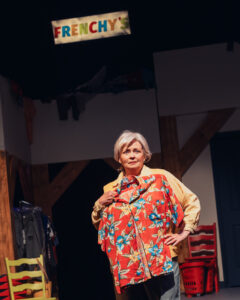
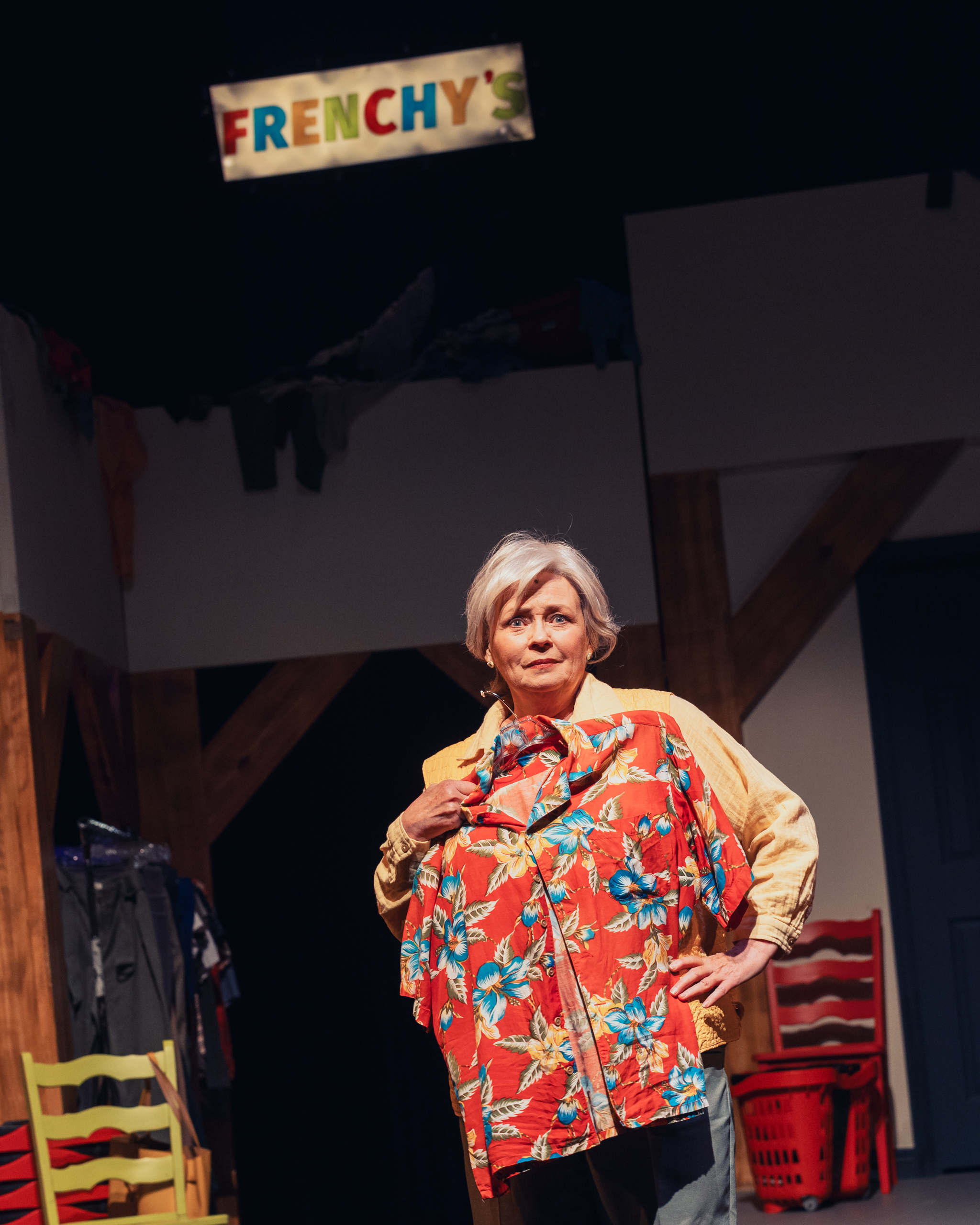
Martha Irving as Sally. Photo by James Arthur MacLean Photography
Martha Irving plays the matriarch Sally in Frenchy’s: The Thrift Musical, on stage at Alderney Landing Theatre just until November 1st, 2026. Sally has something important that she wants to discuss with both her daughters, Gail, who lives in Dartmouth like she does, and Marjorie, who lives in Toronto. So, she flies Marjorie to Nova Scotia for a Girls’ Spa Day, which also includes Gail’s young adult child Tessa, and the four of them accidentally get trapped at a rural Frenchy’s in a snowstorm, where suddenly they cannot escape their family drama or themselves. I sat down with Martha Irving via Zoom to chat with her about bringing this quintessentially Nova Scotian musical to life, and to the enthusiastic crowds who have seen the show so far in both Dartmouth and in Parrsboro earlier this year.
The play does a great job of capturing the dynamics of generations within a family. Gail and Marjorie represent the concept of the “Sandwich Generation,” as they are both mothers and daughters at the same time. They are also the only two characters in the same generation, and as sisters there is quite a bit of tension and unresolved animosity between them dating back to childhood. Tessa finds her mother overbearing and cringe. Gail finds Tessa’s stubborn nature vexing. Yet Sally and Tessa have a deep connection grounded beautifully in unconditional love.
“[Playwright] David [Craig] handles the generations and the textures of their relationships really well,” says Irving. “There is that balance of ‘I will hold you, and I will provide for you what you need, and now you will hold me, and you will provide me with what I need,’” she says of Sally and Tessa specifically. “I love the balance he’s created there because it’s true that you can do that… I think as a grandparent you get to have that step backwards, [you] don’t always have to have the teaching moment, whereas if I’m your parent, I’m your guardian, I have to take care of you, I have to watch everything that you say, and judge it, as a grandparent you don’t have to do that, so you can end up having a really lovely gentle relationship with your grandchild.”
Irving is a mom, but not a grandparent in real life, but she has recently become a grandaunt, which she is very excited about. She says that when her child was small Halloween was a big deal in their household and that they would go to Frenchy’s to put together their costumes. “When you’re in theatre and you’re in a precarious industry you don’t go shopping at the big box stores. It’s the same thing that Sally says [in the show], I got a whole year’s worth of clothing. I used to take [my child] Maddy to the little Frenchy’s on Russell Street and stock up on September’s clothes for school, and Maddy got to really experiment with who they were and what they wanted to be. Maddy always wore pants and dresses together, and would create outfits- they still do to this day- they turn out an outfit like nobody. All of that was developed through Frenchy’s, and being able to choose whatever you wanted to wear, and it really helped develop their personality. I still love Frenchy’s. Just before we closed [in Parrsboro] Mara [Teare, who plays Tessa], had never been to Frenchy’s [because they’re] from Saskatchewan, and they kept saying, ‘Can somebody take me to Frenchy’s?,’ so finally their boyfriend had to go catch the bus, and I said I’ll drive [your boyfriend] to the bus station, then we’ll go to Frenchy’s and get you something, and we did. It’s a great Frenchy’s in Amherst. I highly recommend. You can bring your dog in if you have a dog.”
Irving says that she is so excited for both Ship’s Company Theatre and Eastern Front Theatre because it is clear that this show is bringing in new audiences to the theatres by appealing to Nova Scotians’ love for Frenchy’s. “The other thing that I love about the show is that it’s set up in the first act as a very fun, light generational comedy, and then David actually does dig in and have a story arc for each of the characters in the second act that’s serious and real. So, I think for people who haven’t been to the theatre before you get the accessibility of the silliness off the top, and then you get to delve into the stories and the characters and find the universality of the characters, and have what I think is a true theatre experience, and I find that very exciting- not just for the ticket sales, but for the audience. I am thrilled that at this time when things are precarious for arts organizations that we have, thank you David Craig, we have found branding that is bringing people into the theatre.” Artistic Director of Eastern Front Theatre Kat McCormack asks the audience before the show if anyone is wearing something they found at Frenchy’s and if they would like to stand up and model it for a moment. Irving says that she and her cast mates, who are each standing behind their respective door at the back of the stage, wish that they had peep holes so that they could see the fashion show component too.
Irving says that composer John Roby and musical director Allen Cole were both in the rehearsal hall with them when they were rehearsing the show in Dartmouth for the run at Ship’s Company Theatre this past summer, and playwright David Craig would join them via Zoom. They didn’t have a long rehearsal period in Dartmouth, and Irving was still performing in Come From Away at Neptune Theatre in the evenings and weekends, but she says that having the rehearsals and those first audiences at Ship’s Company was really advantageous to the development of the new work. “The playwright stayed for a week and watched every show and took notes. And then after our run at the Ship we were able to provide feedback to the playwright. We were very lucky that both David and John were open to our feedback because sometimes that’s not the case. But they welcomed it, which was super helpful. Then, we got another rehearsal period [before opening in Dartmouth] with a new draft of the script, a couple days around the table to discuss things- to just massage things because we knew the play at that point and the characters- and we got to do more scene work the second time because the first three weeks was really like ‘we have to learn these lyrics, we have to learn this choreography,’ and that takes up a lot of brain space…. It was really nice to come back to it in a kind of a relaxed way.” She says that in the second round of rehearsals she felt more able to make suggestions and try out her own ideas. “I think it’s a better show, I’m so happy we got to do [this second run], and I think David’s really pleased, and the audiences are- you can just tell they’re satisfied by the show. They’re really happy at the end.” She says that working on developing a new Canadian musical is “such a gift.”
It is a much longer process than audiences might realize. Irving says that the idea came about around 12 years ago. During Covid John Roby, who is married to director Patricia Vanstone, had her sing the music he was writing for the show, and she is the voice on the demo tape. It was also during Covid when Irving was sent the first script that she read. “They’ve been working on it for so long, and I could just see their delight on Opening Night in Dartmouth, the way things were received and how it went.”
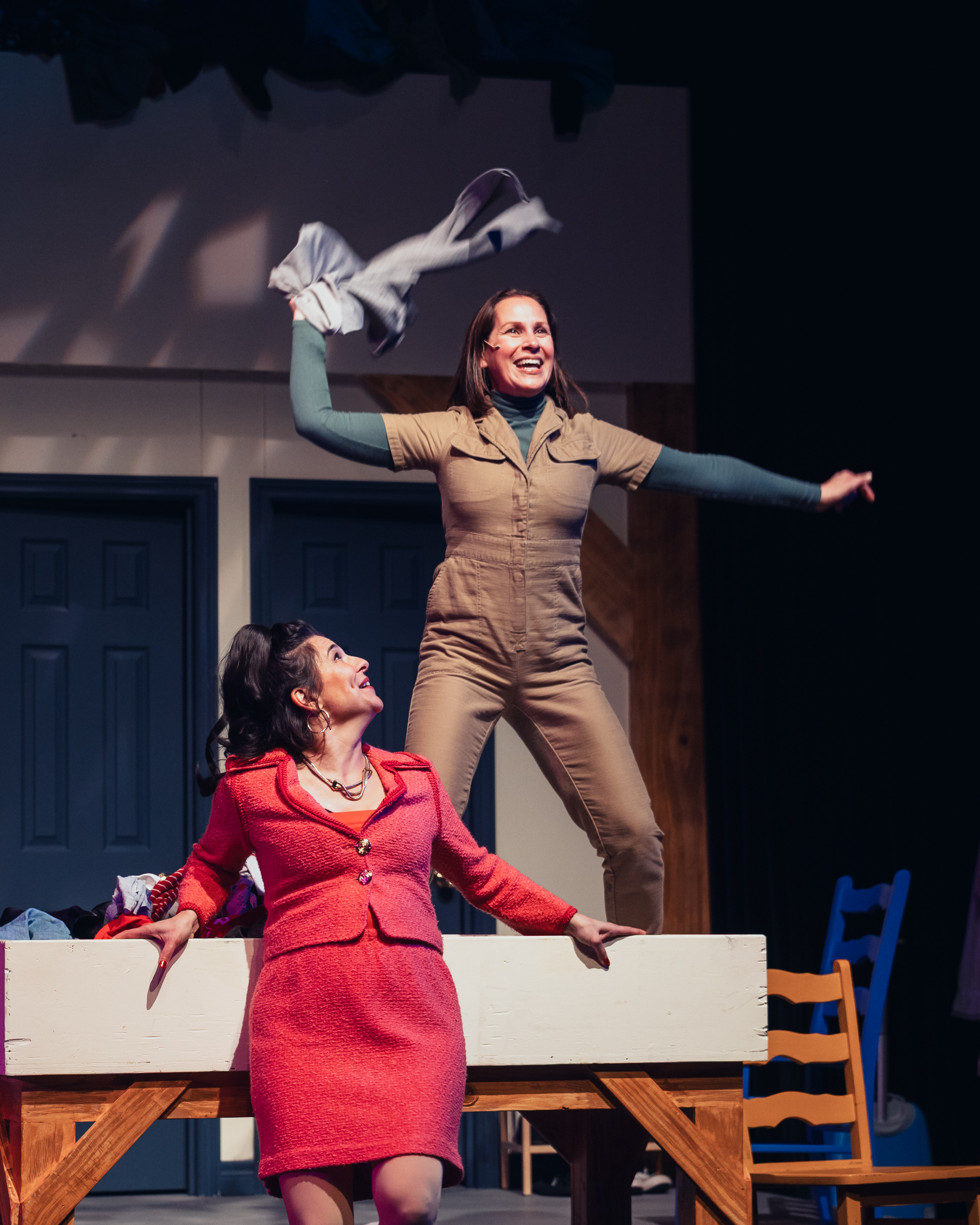
Irving quotes her cast mate Julie Martell, who plays Gail, and says that for the writers, actors, and the director one of the biggest dramaturgical questions that they are perpetually asking of their choices is “how does this serve the story?” “We are there to serve the story,” says Irving of actors. “If that is to take this song that we don’t quite understand [at first] and explore it, then that’s what we do. Even with great [established] text you’re still exploring and finding your way through it. So, with new text, it’s the same thing. You’re exploring new music, you’re figuring it out, because the writers and composers have far more depth of knowledge.” She said there was one song that there was a question of whether it was working in the context of the whole, and whether it might need to be cut, but ultimately it just took a one line change to have it make more sense and need to be there. “Tiny details make all the difference,” says Irving, “it’s so fascinating to me, and being inside it you don’t always know what those changes need to be, and the writer is on both the inside and the outside… because they can stand back once the performers are there doing it and go, ‘oh. I know what it needs.’ So you are instrumental in that way [as an actor] that you can provide them with the experience of watching it and getting an outside perspective.”
Irving says that she hopes that the show will continue to have a life beyond the end of this run at Eastern Front Theatre on November 1st because it’s such a crowd pleaser. She says that someone from Ireland wrote a letter saying that they weren’t familiar with the Frenchy’s chain of stores, but they really enjoyed the show- which shows that the musical has a broader appeal. David Craig and John Roby both have long and eclectic careers in the Canadian Theatre. Craig’s musical adaptation of Jacob Two-Two Meets the Hooded Fang, created with composers Anika and Britta Johnson, will begin previews April 28th at the Stratford Festival next season. Irving first worked with John Roby and Patricia Vanstone in 1987 at the Blyth Festival on a musical called Girls in the Gang that Roby wrote with Raymond Storey about the rise and fall of the Boyd Gang who robbed banks in the Toronto area in the early 1950s. The musical centred on the wives and girlfriends of the robbers, and told the story from their perceptive. Vanstone was the lead in that production. “It’s kind of neat almost 40 years later to come back and do another show [together],” says Irving. She says that Roby’s music is so memorable that she can still sing songs from that show nearly four decades later. “His melodies, his phrasing, his jazz mind comes up with really brilliant and memorable, singable melodies.” She says that audiences at Frenchy’s are coming out of the theatre singing and humming those melodies too. “John’s just an amazing composer that way,” she says.
In musical theatre she says that one of her favourite things to do as an actor is to sing what she calls “crunchy harmony,” and there’s a lot of beautiful harmonies in this show. “I love listening to “Guaranteed,” the song that Mara and Julie do as the mother/daughter duet, and their voices from backstage sound so- the timbre of them is so similar- they sound like mother and daughter to me.”
We talk about how the audience loves to come to the theatre to see local stories- that those are the stories that have sold really well, at Eastern Front and Ship’s Company Theatre, where that is the crux of their mandate, and at Neptune Theatre too. She cites Catherine Banks’ play Downed Hearts, which did so well a few summers ago at Ship’s Company as an example. That play was about the Swissair Flight 111 crash. “You think that’s going to be a tough sell because of the subject matter, but in fact that’s what people are interested in.”
Although Irving plays the matriarch in this fictional family, she is lucky to be in the “sandwich generation” in her real life, and we talk a bit about her experience helping her elderly father navigate a changing world with technology that increasingly is becoming a frightening and dangerous minefield for senior citizens. There is humour too in witnessing her father’s stage of life. She says that she took inspiration from the way that her dad’s cold fingers can’t always activate the buttons on the iPhone properly for Sally when she first comes out to meet Marjorie at the airport and there is all sorts of humorous business with her phone.
“Poor Sally,” says Irving. “She’s got the cold fingers.”
Frenchy’s: The Thrift Store Musical by David S. Craig and John Roby and directed by Patricia Vanstone plays at Alderney Landing Theatre (2 Ochterloney Street, Dartmouth) until November 1st, 2026. Performances run Wednesday to Saturday at 7:30pm with 1:00pm matinees on Wednesday, Saturday, and Sunday. Tickets are General Admission, and are very reasonably priced (just like Frenchy’s) on a sliding Pay What You Can Price Scale between $35.00 and $55.00. Tickets are available online here. November 1st has ASL Interpretation. The show runs 2.5 hours including an intermission. AUDIENCE NOTES- some mature content and flickering/moving lights.
Accessibility Notes from Eastern Front Theatre:
Transit Access
The Halifax Transit Dartmouth Ferry arrives directly at Alderney Landing, and Alderney Gate is serviced by Halifax Transit buses #5, 6+, 53, 54, 55, 62, 158, 159, 161, 165, 168+.
Physical Access
The Theatre is on the second level of Alderney Landing, accessible by passenger elevator and stairs. Parking is available onsite, with curbside dropoff and automatic doors at the main entrance to the building. Alderney Landing is connected to Alderney Gate by pedway, accessible by elevator, escalator and stairs.
Seating
Fixed stadium seats fold down and are 16.5 inches deep and 20 inches wide from the inside of each (shared) armrest. Front row seating is on the same level as the entrance and can be reserved in advance by emailing info@EasternFrontTheatre.com. There are stairs leading to the rest of the rows, 7 inches high and 17 inches deep. There is no handrail. Armless chairs are available upon request and will be placed in the front row, they are 16 inches deep and 15.5 inches wide. For assistance, or to request priority seating before the house is opened, please check in with EFT Staff or Volunteers.
Bathrooms
There are two all gender bathrooms in the rotunda lobby, one with toilet stalls only, and one with toilet stalls and urinals. Both bathrooms are equipped with various hygiene products.
Environmental Sensitivities
We aim to provide a scent-free environment, and make every effort to use products that are scent-free where possible (including alcohol-based hand sanitizer). We encourage all patrons to be mindful of the effects of strong scents, and ask that patrons avoid wearing or using scented personal products while onsite.
If you have any questions about the accessibility measures in place, please email us at info@easternfronttheatre.com.
Canadian Theatre Criticism is an essential part of a healthy and thriving theatre community. It helps theatre companies find new audiences for their shows, deepens audiences’ engagement with local artists and the work being created in their communities, and it is one of the best ways to preserve a snapshot of an ephemeral art form for future generations of theatre lovers. TWISI relies on support from its Subscribers, folks like you who care about the survival of local and independent arts coverage. Please consider becoming a Subscriber today, or click here for more information. Thank you so much for supporting TWISI.