

Julie Martell and Mélanie LeBlanc Photo by James Arthur MacLean Photography
Last night at Alderney Landing Theatre in Dartmouth Kat McCormack, the Artistic Director of Eastern Front Theatre asked the crowd who had gathered to see David S. Craig and John Roby’s new musical Frenchy’s: The Thrift Musical, which is on stage there until November 1st, how many had been to an Eastern Front Theatre production before. A handful of folks clapped. This show has gotten a little bit of press, but nothing above and beyond what musicals tend to get in Nova Scotia- what’s different is that folks are coming to this musical for the title alone. Nova Scotians love Frenchy’s, and they want to see a musical about it. That’s the power of telling local stories.
What is the show about? It tells the story of a fractured family- Sally, the matriarch played by Martha Irving, lives in Dartmouth, as do her daughter, Gail, played by Julie Martell, and her grandchild Tessa, played by Mara Teare. Sally’s other daughter, Margie, played by Mélanie LeBlanc, lives in Toronto with her husband and three children, and they do not visit frequently, and are very much set apart from the family in Dartmouth. Sally invites Margie to come to Nova Scotia for a girls’ “spa weekend,” and to Margie’s horror they end up in one of the rural Frenchy’s thrift stores in the middle of a blizzard. Margie finds the concept of thrifting embarrassing, but she also found her style as a sever in a bar in the 1990s and hasn’t updated it since. Tessa is a social justice and climate activist at nineteen, and is balking against having to buy corporate clothes for a job interview in an office their mother has set up for them. They are struggling to communicate clearly to their mother (or even, it seems to themselves) what they want to do in their future, and this is causing some major stress as Gail is also going through a complicated and painful divorce. Frenchy’s isn’t just a fun hook for the show’s title, but it serves as the backdrop for this particular family’s story, and all the ways that buying new clothes at very affordable prices allows you the freedom to take risks and try on different identities- to explore different sides of yourself.
Diego Cavedon Dias has chosen great costume pieces for the actors. I loved Julie Martell’s army green jumpsuit, and Margie’s very specific lewk (especially just coming off an airplane and into a blizzard), it says a lot about who she is. I wondered if there was room for Tessa’s outfit to be a bit more goth, or outrageous in a different way- she’s certainly not dressed for a corporate job, but for all the attention she gets for her clothes- especially from Gen Xers who grew up with kids looking like Spike and Liz from Degrassi High, Tessa looks like a fairly ordinary teenager to me.
There is a lot to love about this musical, and it’s obvious that audiences are having a ball. The cast is excellent; they sound gorgeous together in their four part harmonies, and each of them has done a great job at grounding their characters’ relationship with every other character in a lot of truth, warmth, nuance, and humour. I especially love the relationship between Sally and her grandchild Tessa. On the surface they couldn’t look more different- Tessa is sort of in a 90s skater grunge lite phase, and Sally’s clothes look like they’re from 1990s Cotton Ginny. Yet, when Tessa speaks from their heart about the problems in the world that they care about Sally listens with a big open heart and mind. Similarly, when Sally admits that there have been some changes in her life too, it’s Tessa who is the quickest to champion and support their beloved Nana. John Roby’s music is tuneful and catchy, and he uses a variety of different genres of music like Andrew Lloyd Webber does in Joseph and the Amazing Technicolour Dreamcoat, in a way that embraces a lighthearted silliness that balances some of the more serious family scenes. I really like the arc of the story- the way the characters are thrown together during the snowstorm, and how the clothes do serve as plot points, especially throughout the second act- not just for Tessa, but for all the characters.
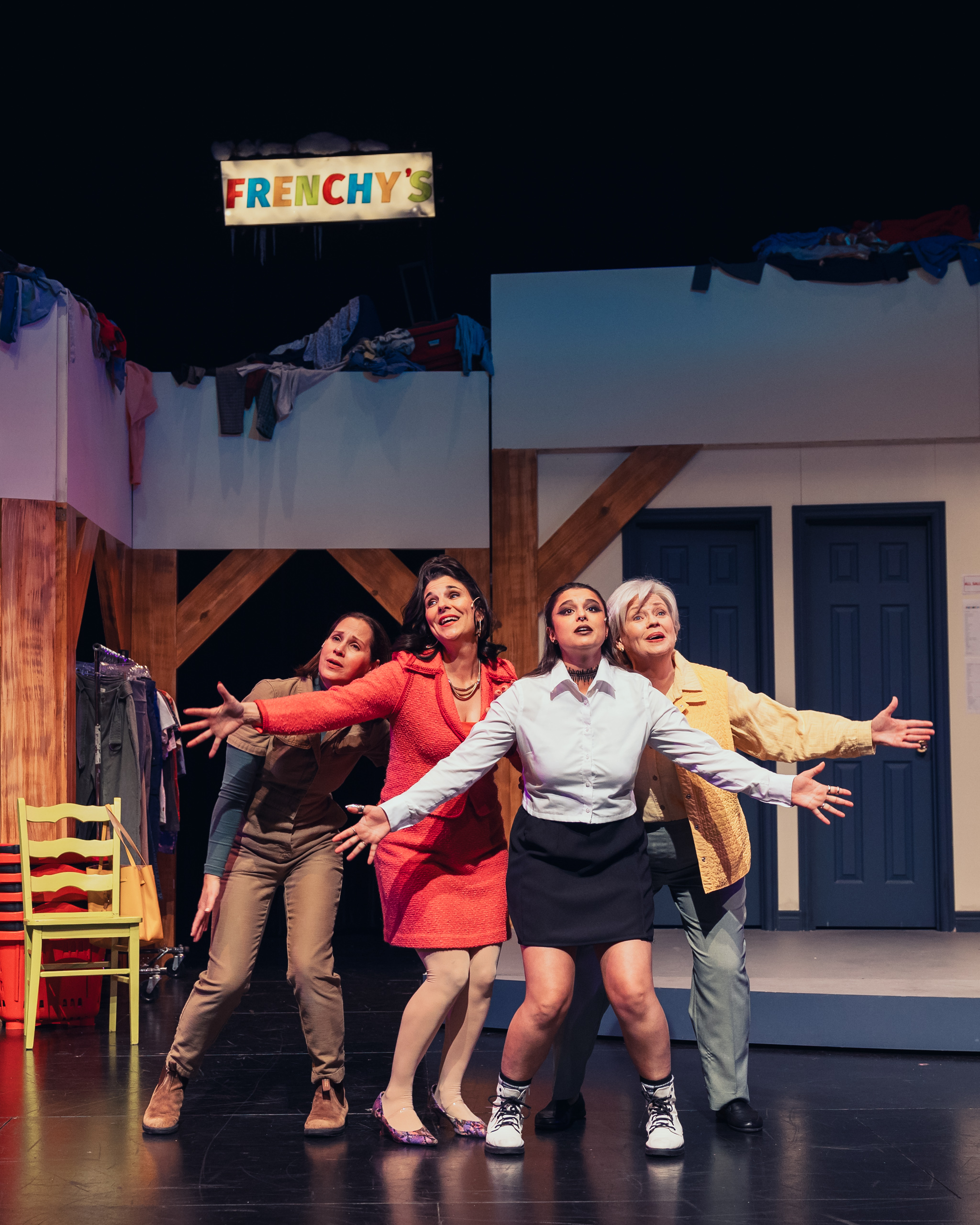
Audiences have been loving this show just the way it is, but I did have a few dramaturgy questions in the spirit of it being a brand new Canadian musical. Tessa drops a bit of a bombshell on Gail when she says that she has been living with an angry woman for her entire life- but Gail doesn’t come across as very angry at all- in fact she is the opposite- she is repressing her own feelings in attempt to manage her sister and her child- the exact same way as Sally. Might it help to boost the tension between Gail and Margie if we really get to see some of Gail’s unbridled anger so it makes more sense why Tessa wants to move out? Given how distant Margie is to the family her judgement bordering on cruelty to a nibling she barely knows seems inappropriate beyond her just having a policy of frankness- I wonder if establishing a specific high stakes falling out they had around the funeral of Sally’s husband might give the audience more insight into why Margie is so hostile toward Tessa from the moment she arrives? I also think there’s room for director Patricia Vanstone to clarify the concept around the actors being able to get up and move through the car during the musical numbers like it doesn’t have a physical form- maybe with more dramatic lighting changes? The songs do seem to exist on a different plane of reality from the scenes- do they come from the collective family imagination or are they coming from one specific character?
There is so much in this play that is easy for audiences to relate to- whether its being the matriarch and trying to balance having your own life with helping your children and grandchildren, or being the sandwich generation- still raising a child while also worrying about at what point you might have to also parent your mother? Sally is starting her life over in a way too after the death of her husband. Gail, at a different stage of life, is also starting over after her divorce, and she is about to become an empty nester. Margie has the opposite problem, she has to contend with the fact that maybe her life has become a little bit too rote and predictable, and that she may actually be stifling the people she loves most.
There’s also a lot of humour in the play. Julie Martell has one song in particular that really brought the house down, but there are many silly interludes of singing and dancing, choreographed by Lesley MacLean, that are so fun and joyful to watch the whole cast givin’ ‘er. This silliness is also reflected in the band sometimes, like when Musical Director Allen Cole brings out a kazoo. The band all play instruments that could conceivably show up in a Frenchy’s, which gives the score a very specific playful flavour.
I had a really fun time at Frenchy’s: The Thrift Musical. You couldn’t ask for a better group of actors to bring these characters to life. The audience was so engaged and delighted, and you could feel a real sense of Nova Scotian pride in folks that this was a story about the women in their community navigating the current political hellscape and one another, and in times of stress and tumult they were turning to Frenchy’s for a rush of adrenaline and dopamine, and a fresh new [out]look on life.
Frenchy’s: The Thrift Store Musical by David S. Craig and John Roby and directed by Patricia Vanstone plays at Alderney Landing Theatre (2 Ochterloney Street, Dartmouth) until November 1st, 2026. Performances run Wednesday to Saturday at 7:30pm with 1:00pm matinees on Wednesday, Saturday, and Sunday. Tickets are General Admission, and are very reasonably priced (just like Frenchy’s) on a sliding Pay What You Can Price Scale between $35.00 and $55.00. Tickets are available online here. November 1st has ASL Interpretation. The show runs 2.5 hours including an intermission. AUDIENCE NOTES- some mature content and flickering/moving lights.
Accessibility Notes from Eastern Front Theatre:
Transit Access
The Halifax Transit Dartmouth Ferry arrives directly at Alderney Landing, and Alderney Gate is serviced by Halifax Transit buses #5, 6+, 53, 54, 55, 62, 158, 159, 161, 165, 168+.
Physical Access
The Theatre is on the second level of Alderney Landing, accessible by passenger elevator and stairs. Parking is available onsite, with curbside dropoff and automatic doors at the main entrance to the building. Alderney Landing is connected to Alderney Gate by pedway, accessible by elevator, escalator and stairs.
Seating
Fixed stadium seats fold down and are 16.5 inches deep and 20 inches wide from the inside of each (shared) armrest. Front row seating is on the same level as the entrance and can be reserved in advance by emailing info@EasternFrontTheatre.com. There are stairs leading to the rest of the rows, 7 inches high and 17 inches deep. There is no handrail. Armless chairs are available upon request and will be placed in the front row, they are 16 inches deep and 15.5 inches wide. For assistance, or to request priority seating before the house is opened, please check in with EFT Staff or Volunteers.
Bathrooms
There are two all gender bathrooms in the rotunda lobby, one with toilet stalls only, and one with toilet stalls and urinals. Both bathrooms are equipped with various hygiene products.
Environmental Sensitivities
We aim to provide a scent-free environment, and make every effort to use products that are scent-free where possible (including alcohol-based hand sanitizer). We encourage all patrons to be mindful of the effects of strong scents, and ask that patrons avoid wearing or using scented personal products while onsite.
If you have any questions about the accessibility measures in place, please email us at info@easternfronttheatre.com.
Canadian Theatre Criticism is an essential part of a healthy and thriving theatre community. It helps theatre companies find new audiences for their shows, deepens audiences’ engagement with local artists and the work being created in their communities, and it is one of the best ways to preserve a snapshot of an ephemeral art form for future generations of theatre lovers. TWISI relies on support from its Subscribers, folks like you who care about the survival of local and independent arts coverage. Please consider becoming a Subscriber today, or click here for more information. Thank you so much for supporting TWISI.