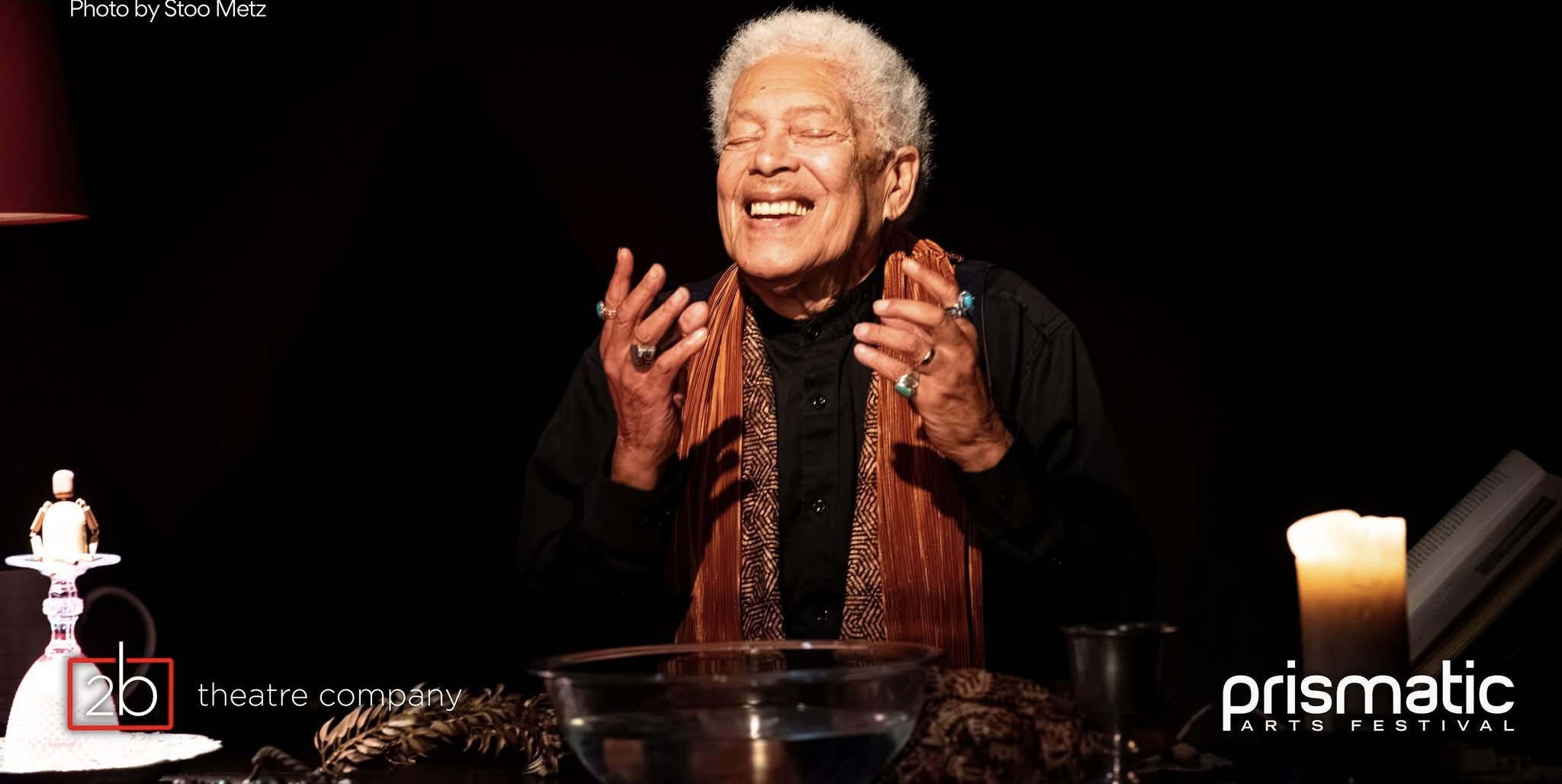
Walter Borden Photo by Stoo Metz
2b Theatre had a big hit during the Prismatic Arts Festival with Walter Borden’s Metamorphoses directed by Christian Barry and Jacob Sampson, and featuring Hilary Adams as the musician, and kinetic art design by Chris Little. I sat down with Jacob Sampson to speak about the process of creating this work from his perspective. The run at the Bus Stop Theatre was very short, only five days. I know a lot of folks here are hoping for another opportunity to see Walter Borden bring these stories from Ovid to life in the future.
Jacob Sampson says that the original concept came from Christian Barry who has always loved this text. The Metamorphoses, is Roman poet Ovid’s “mythico-historical” narrative poem and “magnum opus” from 8 CE. It “chronicles the history of the world from its creation to the deification of Julius Caesar,” and it is comprised of over 250 myths, 15 books, and 11,995 lines. “He loves it for its ideals about pre-Christian morality, and how it understands the world, how people in Ovid’s time understood the world, and when he read The Metamorphoses he kept hearing Walter Borden’s voice. … I grew up in the Valley, so Chris, being from the city, [he] watched Mr. Borden work at Neptune [Theatre], so he was even more aware of his prowess on stage before I was.” Sampson says that around 2023 Barry and Borden had their first conversation about him doing an adaptation of this epic poem. Initially they thought they might do the show as part of their Great Little Works series, taking epic works and condensing them into smaller packages for 10-20 people. Sampson says that Borden was “very enthusiastic” about Barry’s ideas, and Barry kept hearing his voice, and he heard the work with guitar, and as they sat down to start creating the piece the table image came in. “We had this big table from Revisited, and then pieces, as they do, kept falling into place. We have the space on Quinpool, and Chris Little of LoHiFi Productions has a workshop in our basement, in the basement of the Video Difference building, and there’s this beautiful piece that Chris has created, we call it “the swimmer,” where you press a button and [a figure] swims down to this beautiful classical music, and it’s really stunning to watch, and [Barry] was like, ‘I think those [figures] may be the visual offerings in this play, cause we were always wondering what those would be.” He says Little dove into the project too “in the most enthusiastic way.” Sampson says that whenever Little was asked whether he could make one of the figures move in a specific way, Little was always quick to figure it out. “He’d always go, ‘no, I think I can do it. I think I can do it better.’ He’s such a hard worker.”
They also brought Stewart Legere on board who composed some of the music, and Hilary Adams who composed some music, and took what Legere had written and “put her own voice and spin on it.” “All these pieces started falling into place from this original vision that, like I said, it’s probably ten years ago that Chris was reading the text and he hears Walter Borden, and that was the start of it really,” says Sampson.
Sampson says that classical work is “in the pocket of [Walter Borden’s] passion.” He says at a talk back after the show Borden spoke about the responsibility he feels as an actor reading texts that still resonate and are still beautiful thousands of years after they were written. “It just makes me hungry for more,” says Sampson.
In Metamorphoses Borden plays all the parts in the story, including the narrator, and Sampson talks me through the way that, as an actor, it can be really difficult to navigate in and out between providing the audience with the narration, and then getting into the depths of these extremely complex and heightened characters. Yet, Borden makes it look seamless.
“The way he transitions, emotionally, between thoughts. That’s tough to do in classical texts. Sometimes the text will spell it out for the audience because it’s using poetic language, like in Shakespeare, like ‘I’m going to repeat this four times so by the time you get to the actual emotional shift of the character, sometimes it can be tough because it’s mostly exposition, exposition, exposition— and now watch. Watch me weep, or watch me be in love, watch me discover this moment, or discover this person, or discover Juliet across the room- He’s got no problem with that. He’ll ride the exposition in an active way, not in an explanatory way. Then you’ll watch that character come up, come to life, and change emotions on the dime convincingly, genuinely…” Sampson says that he has done a lot of classical work as an actor, “it’s a passion he shares with [Borden]”, but that he, like many other younger actors, can experience a feeling of overwhelm or even inadequacy with the text when they first enter the rehearsal hall. “We’re all like ‘whew, I don’t know as much as maybe I thought I did about this business,’” he says, “watching [Borden] work has been a real lesson… Walter Borden’s voice and craft, watching him on stage, feels epic, even when he’s in a solo performance.”
Sampson notes that even with the immense table situated between Borden and the audience, it still feels intimate, like we are all gathered around a table with him. “It still feels that communal, the idea and the hope is that it offers that communal feeling of sitting down and breaking bread, or getting a story, because the stories in our life, at least in my life, have been around a big table with, I’ve got a big family, so sitting around the big table, and watching good storytellers tell stories- if that’s not the base of theatre, I don’t know what is.”
He says that the crux of the performance is also the “beautiful and the simple.” “I don’t say simple because I could do it,” he clarifies, but he says that Chris Little’s figures have motors that do either one thing or two things, they aren’t doing ten things. It’s not “robotics” like you’d see in the robotics club at a school do, where they are using computer programs to create very elaborate tasks for the robots to accomplish. Little’s figures are much more basic, and they are paired with the shadow play of lights designed by Christian Barry. “It takes me back to the fire,” says Sampson, “like a campfire and some shadows, and some images on a wall. All of a sudden you have a play, you have a good story. … I’ve been at dinner parties where it’s as good as a well-rehearsed show… and some of these stories are well-rehearsed because they’re the same story uncle tells at every family dinner forever, but we still want to hear it… it’s so perfectly connected to these old myths that have been baffling people for centuries.”
There are a few moments in the piece where Borden tells his own personal stories, which share a magic realism theme with Ovid. Sampson says that in watching Borden perform the Ovid texts the play was working, noting that he’d be happy to hear Borden read the phone book, but Sampson, Borden, and Barry were also asking themselves “what’s the hook?” “On breaks we started talking to Walter about his life, and about his transformation as an activist, as an actor, and he speaks, innately, poetically. He speaks very epically.” Sampson said they were a few stories in before someone realized that they should be recording him. “We started noticing the through line, how grounded his experiences were throughout his life in metamorphosis and transformation in a way that I think sometimes many of us avoid. … He has so much wisdom in his decades of life not pushing against transformation- because it’s inevitable. So, that was the biggest lift from a writing perspective, taking his words in conversation and crafting [them] into something repeatable, that feels authentic at the same time… for a moment we’ve stepped out of the epic world and stepped into the community of New Glasgow and a little boy by the riverside.” Sampson mentions again how incredible it is to watch the transitions in the way Borden performs, where he can drop into himself, into Walter, to tell these personal stories directly to us around the table, and then snap immediately back into Ovid. “When you have the opportunity to sit down with Walter, he’s a teacher, and not in an admonishing way, just in a way that he has 80 some years of experience, and he don’t mind being generous with that wisdom. Hopefully [his stories] will resonate with different moments of transformation in our own lives. In that first story of him down by the riverside, [he’s talking about] that discovery that the world is bigger than a four year old boy’s world, which is pretty small. I remember the moment, on certain times in the summer at night when all the lights are off, and you’re in the middle of a farm field [in the Valley], and you look up and you can actually see the Milky Way. It does a bunch of things to you. You think it’s beautiful, and then if you think too much about it, about how small and insignificant you are, but at the same time significant, if you start thinking about the light that you’re seeing, in some cases tens of thousands, hundreds of millions years old, that the star may not be there anymore, but you’re just getting the light now,” he whistles. “It freaks you out! And all of a sudden your world expands out, and then it has to collapse back in at one point, just for your safety of your brain.”
“You’re watching Mr. Borden at four years old discover that the world is bigger than New Glasgow, bigger than our planet, bigger than our universe, and then you watch that world collapse back in, the base of transformation is our world expands and collapses, the universe is expanding, and will eventually collapse, it’s very heady, but at the same time, it’s not, it’s very simplistic in that transformation throughout someone’s life is inevitable, sought after, pushed away, but hard to fight. So, adding that wisdom was important to Chris and I and Mr. Borden as the writing team to offer a link between the stories of Ovid and the stories of Mr. Borden’s life.”
Sampson says that they have spent time discussing the ways that some of these myths that were created to explain specific natural phenomena, like the medicinal properties of the myrrh tree, for example, that have since been borne out by science. He also notes that in a different adaption of the story of Narcissus the pool that he’s gazing into could be replaced by a cell phone camera. “We need to love ourselves, but there’s a threshold with all of this. [The story] still resonates 2,000 years later.” He notes that the older folks are, like Walter Borden who is 84, and Sampson’s grandmother who is 100, they have seen first hand both the cyclical route of progress, and how cultural, societal and political change is inevitable. Sampson says that he sees in his grandmother both a feeling of resolve, that the younger folks need to mobilize and be activists pushing for change because she has seen this work in the past, but also a knowledge that change is unavoidable too.
“When you’re with an actor as experienced as Walter who’s been activist his entire life, there’s that resolve. ‘We did this work to make the world a better place, you will have to step up [now] and do some work, and it will change [again].’” Sampson notes that as someone who loves history it can be incredible, but also frustrating, to realize that some knowledge that we think has only been recently acquired or proven or known, has actually been buried in these old texts from thousands of years ago- and that these people who lived in ancient civilizations likely knew a whole lot more about the natural world and what we today consider science than we give them credit for. “That’s why I love history.” He says that sometimes he does feel like beating his head against a wall because we seem to keep needing to repeat and learn the same lessons over and over again instead of truly progressing to something better, and new where all those old issues are finally resolved. “Things haven’t changed as drastically as we think. Pentheus’ speech, in particular, in Bacchus and Pentheus, you could word for word take it to people who are holding power, who are choosing to hold power in a way that instills fear and a resistance of change, right now- that’s it for me, that’s why we go back to these epic tales, and these ancient texts, we have to go back to remember, remind ourselves, that we’re not as different as we think we are from 2000 years ago. It can be heavy sometimes.”
As an actor, Borden said that when he does a text like this one, it connects him to every other actors who has previously said these words- and, I would add, all those who will say them in the future. Sampson says it’s important for us all to not forget the humanity of historical and mythic figures, to not let the time between us and them create an objective distance that doesn’t allow us to see ourselves in their experience.
“It’s such a privilege to watch [Mr. Borden] work his craft that he cares so deeply for. Watching Hilary throw energy at him is one of my favourite parts of the play. She so wants to be there, and wants to be there for her colleague- watching those two interact with each other is one of my favourite parts of the whole process… Everyone who’s worked on this show has chosen to lean in- there’s a lot of care that’s gone into the table, the figures, the lights, the sound, the haze, the Bus Stop team, Prismatic, Zach Faye, the production, manager, I’m just really grateful.”
2b’s Metamorphoses has closed its run at The Bus Stop Theatre, but keep checking their website for more information about where this production might pop up again in the future.
Canadian Theatre Criticism is an essential part of a healthy and thriving theatre community. It helps theatre companies find new audiences for their shows, deepens audiences’ engagement with local artists and the work being created in their communities, and it is one of the best ways to preserve a snapshot of an ephemeral art form for future generations of theatre lovers. TWISI relies on support from its Subscribers, folks like you who care about the survival of local and independent arts coverage. Please consider becoming a Subscriber today, or click here for more information. Thank you so much for supporting TWISI.