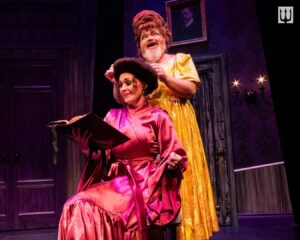
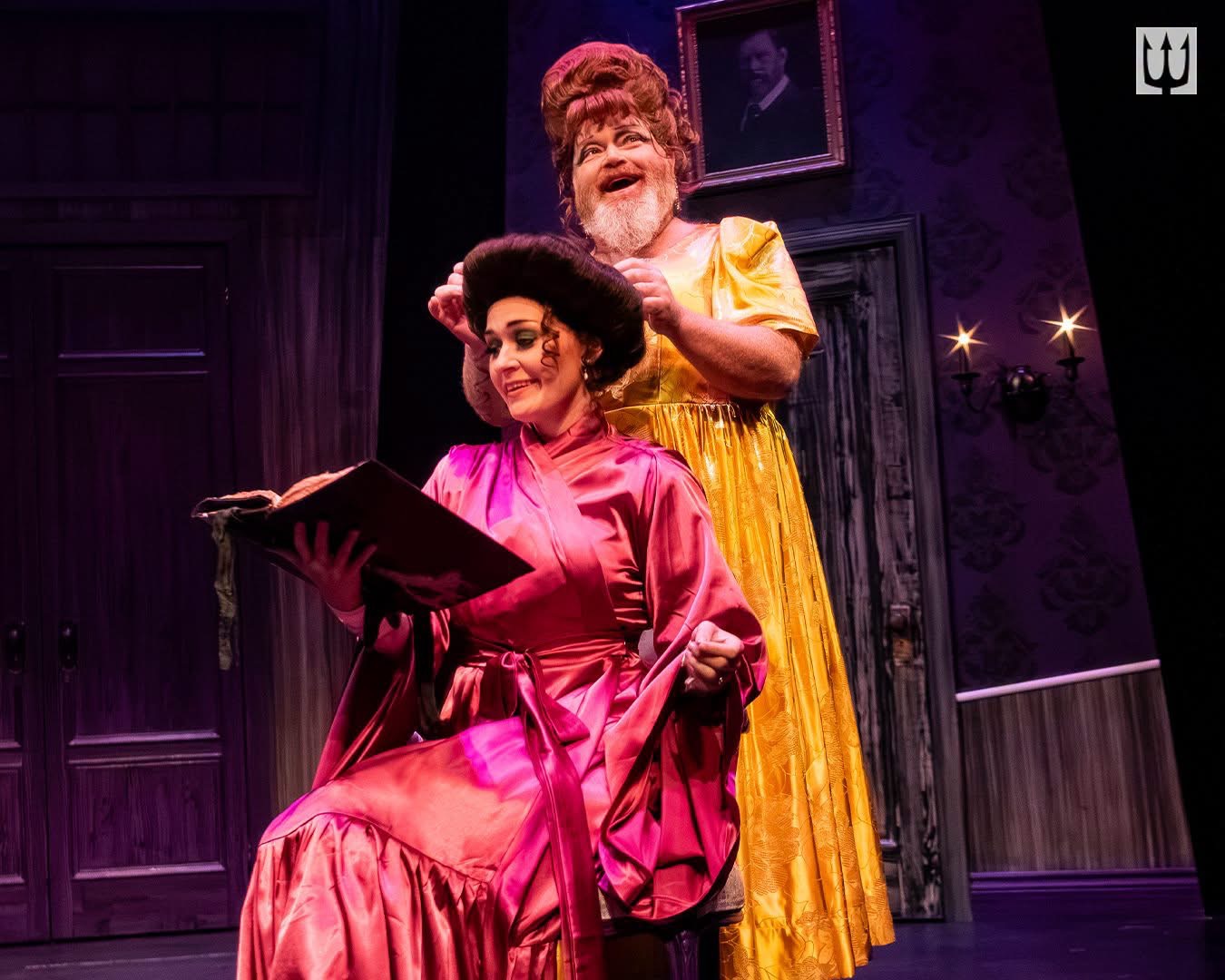
Becca Guilderson as Lucy and Ryan Rogerson as Mina Photo by Stoo Metz
Allie MacDonald spent his summer portraying Roger in Rent, a haunted young musician in grief over the death of his girlfriend who is perpetually confronted by his own mortality and the mortality of nearly everyone close to him at the height of the HIV epidemic in New York. Becca Guilderson and Hugh Ritchie spent the summer portraying a Northern Irish couple at Ross Creek Centre for the Arts separated in the 1840s during the emotional perils of emigrating to what is now Ontario. Stephanie MacDonald was just at Festival Antigonish playing a grieving ghost tour kiosk worker at the very end of her rope, and Ryan Rogerson was last on stage at Neptune playing the mayor of Gander having to contend with thousands of newcomers arriving traumatized and frightened on September 11th, 2001. From now until October 25th this cast has gathered together at Neptune Theatre’s Fountain Hall to do a hard pivot from the harrowing and the dark to Dracula: A Comedy of Terrors, which is absolute silliness for the joy of silliness’ sake.
Written by Gordon Greenberg and Steve Rosen, first performed in 2023, adapted (loosely) from Bram Stoker’s 1897 novel and the many adaptations which have followed, and directed by Jeremy Webb Dracula: A Comedy of Terrors gives Count Dracula a similar treatment that Mel Brooks and Gene Wilder gave to Frankenstein in 1974. We are introduced to Jonathan Harker, a young real estate agent, played by Hugh Ritchie, who is extremely high strung and avoidant of pretty much everything on the grounds that it might be dangerous or unpleasant. Nevertheless, motivated by financial success, he embarks on an ambitious adventure to Transylvania, where he meets Count Dracula, played by Allie MacDonald, a campy strange fellow with a meticulous fitness regime. Jonathan is excited by the prospect of selling Dracula a number of lucrative properties in London, including a long abandoned one near his fiancée’s home that he’s been trying to offload for ages. Dracula is excited by the prospect of Jonathan’s fiancée, Lucy, played by Becca Guilderson, who he falls in love with the moment he sees her photograph. Dracula follows Jonathan back to England where he finds that Lucy and her unfortunate sister Mina (played by Ryan Rogerson) essentially live in a mental asylum where their father, played by Stephanie MacDonald, is the doctor. Here, Dracula meets an impressionable patient, Renfield, hilariously also played by Stephanie MacDonald, and uses him in attempt to lure Lucy to his bed. When Mina gets bitten by Dracula the household is visited by Dr. Jean Van Helsing (also Ryan Rogerson), and they attempt to put an end to Dracula’s evil deeds for good. There is an unexpected twist, which further complicates the relationship between Lucy and Jonathan, and all the characters are challenged in some way and forced to confront something uncomfortable about the world, and about themselves.
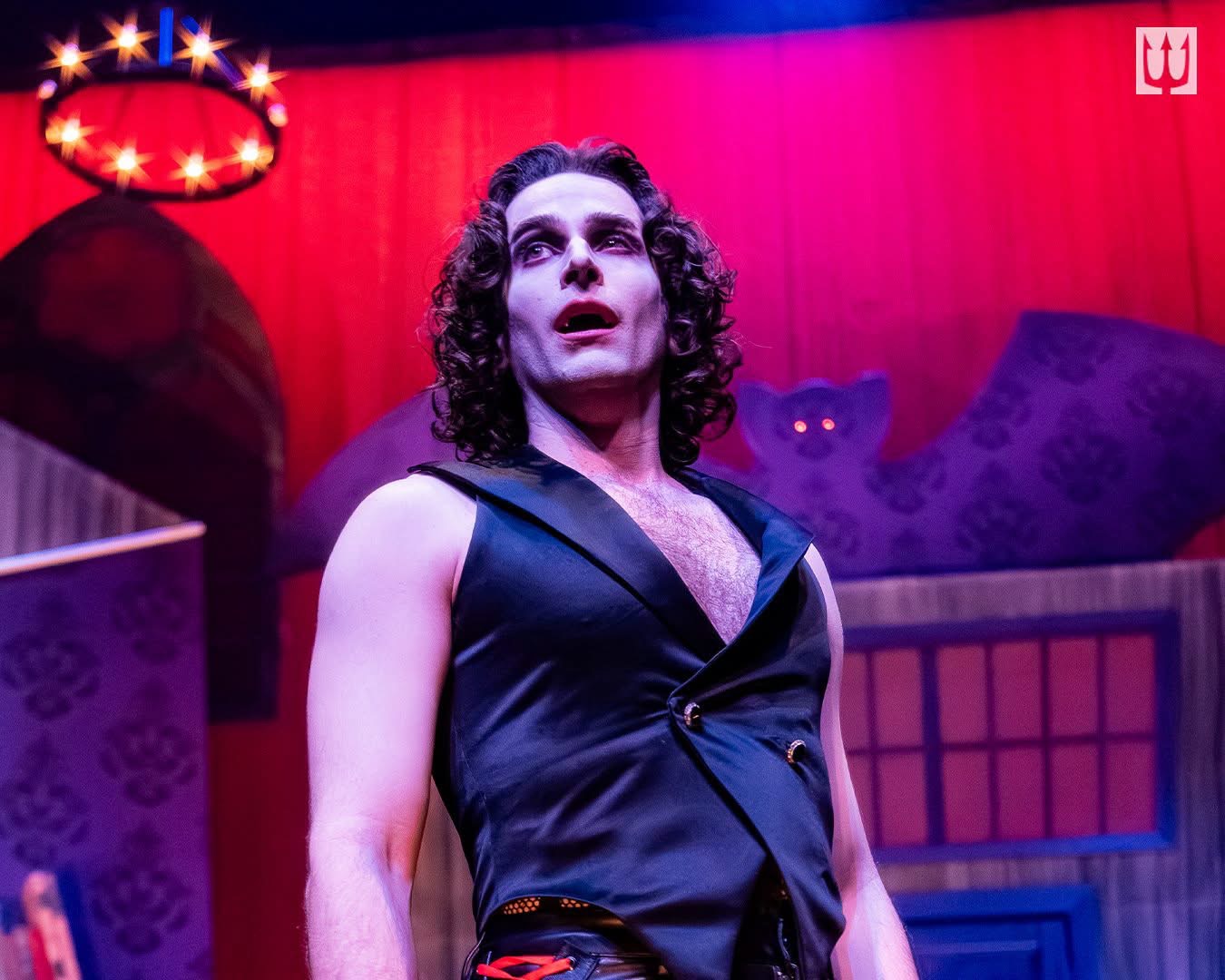
The comedy in this show is rapid fire, in the writing, and in Webb’s direction, and, especially, in his sound design, which peppers the play with cartoon-level sound effects, and apt pop culture and theatrical references. The entire vibe of the play is very reminiscent of the self referential cartoons that were popular in the early 1990s- The Simpson’s Treehouse of Horror, and shows like Tiny Toon Adventures where botanist Lucy can bring an Audrey II style plant into the room, cut her finger, and immediately draw Dracula to her like a moth to a flame. Allie MacDonald’s Dracula is, in fact, very moth-like, in the way that he enters each room flapping like a frazzled winged creature trapped inside a house he can’t remember the way out of. There are strong allusions, of course, to MacDonald’s portrayal of Frank-N’Furter in The Rocky Horror Show here, especially in the way that, while Dracula is the most captivated by Lucy, there is also chemistry between him and Jonathan, in a similar way to Frank seducing both Janet and Brad. MacDonald plays Dracula as audacious, menacing when angered, but also with a bit of a tender earnestness where you see the loneliness of his life really taking a toll.
Ryan Rogerson’s Mina, like a stepsister in a pantomime, is looking for anyone who will look past her unorthodox looks and love her for the bold, confident, ambitious woman that she is. Rogerson, dressed pretty much like Belle but with a… bountiful bust, excels especially at his wild physical comedy- pushing Mina to the absolute bounds of absurdity in a quest to make the audience, but also his cast members laugh. As Van Helsing he is much more repressed and staccato, presenting the gravitas of Jean’s dignity as a female scientist in the face of the misogyny of Stephanie MacDonald’s Dr. Westfield, who is, at least initially, Victorian men distilled into one Saturday Night Live style parody. Stephanie MacDonald switches between this ridiculous “pillar of the Empire” character and Renfield, who is one hump away from being Igor. Her switching between the two in rapid succession, and running behind the scenes to make different entrances in different costumes, is a large part of the fun of the play.
It’s more fun, I think, if the audience knows that Becca Guilderson and Hugh Ritchie are a couple in real life, watching Jonathan and Lucy become more and more right for one another (and hot for one another) in unexpectedly bonkers ways. Lucy is a modern adventurous spirit who also has a genuine deep love and concern for her sister. Guilderson is adept at showing Lucy’s fondness for Jonathan, her knowledge that he is a smart match for her, but also her impatience with his failings. Ritchie strikes a nice balance too between being charming and likeable and being whiny and selfish, so the audience too is anxious to see some growth from him.
Lucas Arab’s set plays on the conventions of the genre so that Dracula’s original spooky house, his new spooky house, and Lucy and Mina’s spooky house are all identical to one another, and wooden doors are brought in to allow the actors to show the passage through various identical rooms, chasing one another from one place to the next. Leigh Ann Vardy makes excellent use of foggy blue light to root us even further in the world of the gothic and the macabre. JB Nelles’ costumes reflect the pastiched nature of the show.
Dracula: A Comedy of Terrors lets you forget about the current political and cultural moment. It isn’t offering a metaphor or an allegory to the contemporary human experience- it exists entirely as a way to take a very familiar story and, for fun, make it as silly, and random, absurd and zany, madcap, and wildly entertaining, and as joyful as possible. The scariest thing I can offer you is this tidbit I just learned about Bram Stoker. Like me he was also a theatre critic, and actually he was known more for being a theatre critic than he was known as a novelist in his lifetime. Like me, he struggled to make enough money from writing theatre reviews, and that was part of the reason why he wrote Dracula, as an attempt to supplement his income. Unfortunately, Dracula wasn’t a huge commercial success either until after his death. You can subscribe to TWISI here to help support the survival of theatre criticism in Nova Scotia. “There is in the world no more honourable, no more responsible position for any man than to sit in judgement, and such an one should always feel the gravity and the weight of such an earnest task.”– Bram Stoker, “Dramatic Criticism.” The North American Review, 1894.
Gordon Greenberg and Steve Rosen’s Dracula: A Comedy of Terrors plays at Neptune Theatre’s Fountain Hall Stage (1593 Argyle Street, Halifax) until October 25th, 2025. Performances run Wednesday to Saturday at 7:30pm with 2:00pm matinees on Saturdays and Sundays. Tickets range in price from $35.00 to $70.00 based on seating. They are available to purchase online here, by calling the Box Office at 902.429.7070, or in person at the Box Office at 1593 Argyle Street.
Masked Performance
Sunday, October 11 – 2:00pm
Talkback
Thursday, October 15 – 7:30pm
Audio Described Performance
Saturday, October 24 – 7:30pm
Run Time: This performance is approximately 95 minutes (with no intermission)
Content Advisory: This production contains fog and haze, frequent flashing lights, loud noises and music, mature themes, occasional strong language, sexual innuendo, fangs, dodgy British accents, and, somehow, even more fog. This show may not be suitable for individuals with Chiroptophobia.
Neptune Theatre has a range of Accessibility Options for folks (Both Fountain Hall and the Scotiabank Stage are accessible for wheelchairs. Patrons can now purchase wheelchair seats for individual shows online with the promo code WHEELCHAIR. For more information, please contact the Box Office.). Click here for more thorough information.
Canadian Theatre Criticism is an essential part of a healthy and thriving theatre community. It helps theatre companies find new audiences for their shows, deepens audiences’ engagement with local artists and the work being created in their communities, and it is one of the best ways to preserve a snapshot of an ephemeral art form for future generations of theatre lovers. TWISI relies on support from its Subscribers, folks like you who care about the survival of local and independent arts coverage. Please consider becoming a Subscriber today, or click here for more information. Thank you so much for supporting TWISI.