

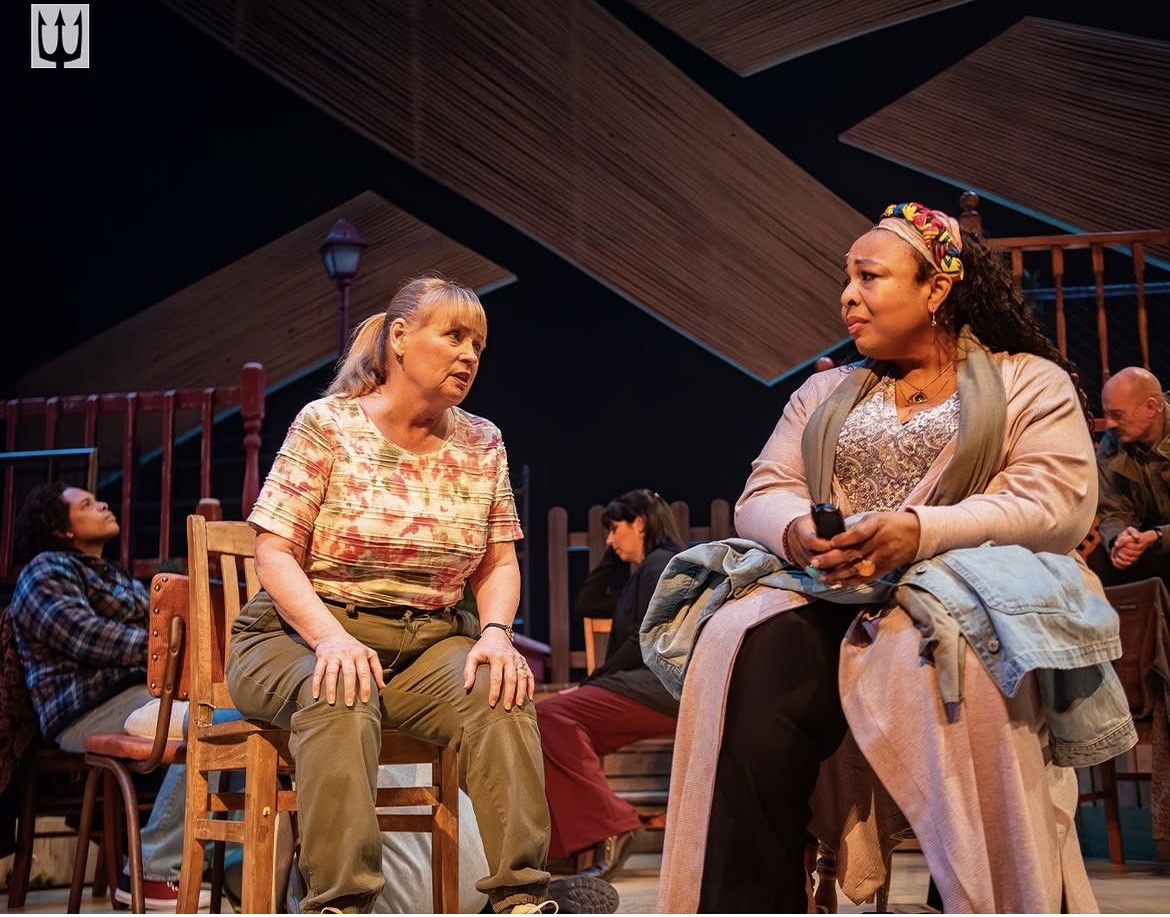
The Cast of Come From Away at Neptune Theatre directed by Jeremy Webb Photo by Stoo Metz.
In his Director’s Message in the programme for Come From Away Jeremy Webb writes about the interactions he has had over the last eight years with folks coming up to him at the Superstore asking him when Neptune was going to program the show. I have also been known to bug him about it- asking when he thought “we” here in Halifax might be able to get the rights. The show has become a global phenomenon since it opened on Broadway in 2017, but it started with producer Michael Rubinoff in Toronto and writers Irene Sankoff and David Hein premiering their 45 minute workshop script as part of the Canadian Music Theatre Project in 2012, and then with the first full production at Sheridan College a year later. There is no way to overstate what a massive Canadian success story this musical is. I was newly back in Halifax by 2012, having lived in Toronto for three years where I wrote about new Canadian musicals, and suddenly I felt like I was watching this mammoth smash hit unfold through a window. At some point I decided that if I couldn’t get to Gander to see the show in the place where it was set I would wait and see it in Halifax because I wanted to be in an audience full of East Coasters. I knew that that would be an experience you could never replicate “somewheres else.” It’s been one hell of a wait since the show first came on my radar back in 2013, but sitting in Fountain Hall this afternoon with a sold out crowd of fellow Haligonians seeing this cast bring this story to life I knew I’d made the perfect choice to wait.
In the thirteen years between when I first heard about this musical and seeing it for the first time today I have had lots of time to develop some not-fully informed opinions about the show. I think my initial reaction, though, before I even really knew the premise, is probably a typical one- I couldn’t believe anyone thought setting a musical on September 11th, 2001 was a good idea. The musical focuses on the 38 planes that were diverted that morning out of the precarious skies to an airport in Gander, Newfoundland and Labrador after the US airspace was closed following the terrorist attacks that occurred in New York City and Washington DC. Gander wasn’t the only place in Canada to receive these “plane people,” as folks here will proudly tell you Halifax Stanfield International Airport received 40 planes filled with over 7,000 people, but Gander received special media coverage given its size- the town’s population was less than 10,000 and there were about 6,500 “plane people” to accommodate- and did the folks there ever rise to the occasion. It was this story, the people from Gander opening their hearts, their town, and literally their homes to stranded scared strangers that gave Michael Rubinoff the idea that this moment might offer the world something to sing about.
While not all the characters in Come from Away are based on real people (some of them are composites of several different people) Irene Sankoff and David Hein have really excelled at giving Come from Away a real verbatim theatre feel- we get the sense that a lot of the lines that actors speak in the show have come directly from interviews that the writers have done with real people, both those who were working in Gander during these few days in September, and those who were on the airplanes that landed there. This is especially important because not only do folks from Gander have a very specific accent and also a way of speaking that would be hard for writers from elsewhere to replicate themselves, the folks on the airplanes were from places all over the world with equally unique speech patterns and their own colloquialisms. Capturing all these nuances in the show verbatim really grounds the story in the truth, which I think is important given the gravity of the context for the show. Sankoff and Hein aren’t trying to sensationalize the story or capitalize on this tragic situation, they are really beautifully humanizing the scope and magnitude of the shockwaves that touched almost all of us that day, and finding these moments of immense generosity, care, and goodwill that emerged from a day that began so full of darkness, hatred, and intense sorrow.
The way the music works in the show is unique as well. Musicals are often written, like Wicked for example, so that the songs are inter-spliced into the scenes riding the waves of the characters’ emotions, or they are written like Les Misérables where the musical numbers transition seamlessly into one another with bits of dialogue spoken overtop a sea of music beneath them. Come from Away is more of a Concept Show- not only do all the characters speak directly to the audience but almost all the songs and scenes seem to bubble up from the collective foundation of the cast oscillating between singing “You are here” and “I am an Islander” in the opening number- two disparate realities- some adjusting to a new identity as “plane people,” and others affirming strong long-held identities as Newfoundlanders- now colliding together. The way the stories come up out of the collective suggests the strength of this unprecedented shared experience. The only exception to this is “Me And the Sky,” which is arguably the most conventionally musical theatre song in the show, sung by pilot Beverley Bass in a quiet, separate reflective moment as she is physically separated from her passengers- having been put up in a hotel, and also, being a pilot, having a markedly different perspective on the events that preceded her touching down here. The show is beautifully compactly constructed.
I found it interesting that while the characters in the story are, of course, glued to listening to radio and television broadcasts as the events on September 11th are unfolding we the audience don’t hear the broadcasts, presumably because most of us don’t need to be reminded of what those broadcasts were like. It also helps Sankoff and Hein walk a delicate balance between holding the events in New York City, Washington DC, and Pennsylvania at a respectful distance while still showing how these events have touched everyone’s lives in the play. It’s interesting also that David Light has a brief moment where he plays President George W. Bush giving a speech, and having Bush be portrayed by an actor instead of us just hearing the real footage of him from that day brings him too into the Come From Away world so our focus remains in Gander with these characters.
There are twelve actors in the show, and as the construction of the show suggests it is a true ensemble with each person playing multiple roles and everyone working together to evoke the frenetic and chaotic atmosphere of 6,500 bewildered and anxious passengers and an entire town scrambling to accommodate both them and those anxieties in as loving and friendly a way as possible. The musical requires this ensemble to similarly work in tight collaboration with one another both vocally and physically. All twelve actors shine brightly both in the ways they tell their own story arcs and in the way they support one another, and this is mirrored in the way that Jeremy Webb has directed their movements.
Brandon Michael Arrington plays Bob, a New Yorker who is at first skeptical about how selfless the Ganderites he’s encountered are- assuming there must be some kind of angle. Sankoff and Hein also do a beautiful job, especially within such a small cast, of showing how, of course, the New Yorkers who were away from home on 9/11 were having a dramatically different experience than even their other fellow Americans- as they worried not just for people they knew who may have been affected, but for the city itself that they love. At the end of the show Arrington gives a heartbreaking performance of Bob seeing the smouldering skyline for the first time. Similarly, Jenni Burke plays Hannah, the mother of a New York City firefighter who is frantic not just waiting to hear news of him, but wanting to be there actively looking for him. Burke’s performance is also heart wrenchingly powerful.
This disparate experience is illuminated clearly in the relationship between Kevin T, played by David Light, and Kevin J., played by Gryphyn Karimloo where Kevin T, from Los Angeles, is moved to seize every positive moment he can find from this sojourn into Newfoundland culture, while Kevin J., from New York City, can’t move on from the thoughts of the horrors occurring in his hometown. It is a poignant bit of casting for David Light to play Kevin T. since he himself has become an East Coaster over the last decade and I feel he really embraces our culture too. Karimloo also plays Ali, an Egyptian airline passenger who becomes the subject of suspicion and additional scrutiny because he is Muslim- reminding us how quickly the Islamaphobia ramped up in the aftermath of the terrorist attacks and that the plane people in Gander were not at all immune to it.
In contrast to the Kevins Michelle Langille and Ian Sherwood play Diane and Nick, two passengers who unexpectedly found a romantic connection with one another during their short time together in Gander. Langille’s character is from Texas, and while in Gander she is drinking more than she normally would so she has a sheepish off kilter vibe that is very charming- we really see her as a woman who is daring to have a bit of an adventure, maybe for the first time in her life. Sherwood’s Nick is British and obviously intrigued by her, but diffident and unsure how to proceed on his feelings in a way that feels very British. This is the storyline that benefits the most from Sankoff and Hein rooting the whole show so securely in reality, because if the show felt too fictionalized Diane and Nick’s arc would seem contrived. However, knowing that they are based on real people their story becomes like the proverbial green plant growing, against all odds, out of the ashes.
Ryan Rogerson plays Claude, the Mayor of Gander, who begins his rounds each morning scouting out the “lay of the land” at the local Tim Horton’s. Rogerson does a skillful job of capturing the way this man, in a town where most people know and are connected to one another, helped orchestrate and manage likely a hundred different initiatives happening simultaneously when everyone was flying by the seat of their pants- barely having time to digest what had happened, and running on pure adrenaline. Sankoff and Hein dramatize the fact that Gander was in the middle of a school bus strike on September 11th and this required even more diplomacy between the municipal government and the union leaders under impossible amounts of pressure. Clint Butler, this production’s resident Newfoundlander, plays eight different roles in the show, all of which really help to showcase the diversity in experience- including his portrayal of a Rabbi struggling to find a way to keep his meals kosher while sleeping in a shelter with hundreds of strangers.
Kih Becke plays Janice the local news reporter who was thrown into a harrowing first day on the job. Becke really shines at oscillating between the way Janice rises to meet what she knows will be a defining moment in her career, and also struggles with emotional burnout. Martha Irving captures so much of the pinnacle of the Atlantic Canadian spirit as Beulah, who converts the school into a shelter and connects with both Hannah and Ali in ways that make her truly exemplify the best of us. Similarly, it was Becca Guilderson as Bonnie who started my waterworks today as she fiercely advocated for the defenceless animals that were at risk of being left to die in the holds of the airplanes before the RCMP could be sure that none of the aircrafts were carrying explosives. Guilderson in real life has this beautiful face that just exudes friendliness, and warmth, and it is a real asset to her in this role. Julie Martell plays both boy crazy Annette, who is working with Beulah taking care of the plane people, and Beverley Bass, an absolute rockstar of American aviation: the first woman to become a captain as a pilot in United States history. Bass provides some important context to the audience about the risk of the immobile planes sitting on the runways. The American airspace was only closed for two days, although it took a bit longer to coordinate the mass exodus; I never would have known that just sitting there on the runways could cause damage to the airplanes. Martell really captures the strength and the calm and the resolve of Bass, while also showing us someone who is quietly shaken- not just having to contend with the immediate loss of life of fellow pilots and flight attendants, but also considering the fallout that is certain to impact the entire industry- now the vocation that has brought her so much joy and pride is a source of widespread logical fear and anxiety. Sherry Smith, also a Newfoundlander, has done an impeccable job with the dialect coaching, and so much of Bass’ character especially comes through the particular way she speaks, and Martell is able to execute this flawlessly.
Sankoff and Hein, of course, drew large amounts of inspiration from Newfoundland’s flourishing music scene and the Irish folk-infused flavour that is so popular there and throughout Atlantic Canada. Neptune has six musicians playing in the pit for this show including Musical Director Avery-Jean Brennan, who has really created a gorgeous layered sound with this ensemble. Liliona Quarmyne’s choreography works in tandem with the music to remain very rooted in the real world situations that our characters have found themselves in as they unwind in pubs and legion halls in Gander. Another reason I wanted to wait and see this show with Haligonians was to get to experience the communal joy that erupted when the characters started singing and dancing to a version of “Heave Away.”
I have always associated Come From Away with a very sparse set, often just with plain tables and chairs that get rearranged to suggest different locations, but Andrew Cull has created something much cozier and the stage has been rigged with a revolve. On the parameters of the stage we see pretty little wooden steps that make you think of a cute little deck or a front porch in a neighbourhood. The sparse set could be viewed as representative of how the Americans think of Gander, and Newfoundland in general, as being remote, isolated, and not heavily populated. I have never been to Gander, but it seems to me that it probably is more like Cull’s set- a community of backyards and parks where people’s gardens were still in bloom that infamous day in early September. The revolve too captures both the way that these people’s lives have taken a turn beyond their control and that they are being moved in directions dictated by fate and circumstance, but also the amount of cooperation and care needed to adapt to this type of precarious situation. I also liked that the chairs that were used were all mismatched- echoing how the relief effort in Gander for the plane people was a hodgepodge of donated items and whatever else could be rounded up as quickly as possible.
Quite a few years ago I worried about the way the term “Come From Away” has become globally synonymous with the absolute best in humanity because of this show, when here at home in all four Atlantic provinces being called a CFA often comes from a problematic xenophobic place. I don’t want to suggest that we don’t have our problems and that this isn’t one of them, we absolutely do and it is, but after experiencing the “Atlantic Bubble” during Covid I am much more willing to embrace the way we East Coasters have been depicted by Ontarian Sankoff and Sakatchewanian Hein here as being largely accurate. It’s a strange time to see this show, and I don’t know that I left today thinking philosophically about how we and the Americans are interconnected as much as I left knowing that regardless of who the Americans are, who they were on September 11th, 2001, and who they are today, this is who we Atlantic Canadians are- what we value, how we see the world, how we live our lives- and we have remained unshakenly this through a truly gruelling and soul crushing couple of decades- and thank friggin’ god.
It is a good time for all Canadians right now, as we are squinting at the fine print on labels trying to figure out where every step in the process of growing and shipping and packaging organic green beans is taking place, to consider the immense success of Come From Away: a truly Canadian musical. This is what can happen when we invest in our own stories, our own talented artists, and our own cultural institutions. Come From Away didn’t come from Mirvish and it certainly didn’t come from Broadway, it came from the Canadian Music Theatre Project founded in 2011 at Sheridan College in Oakville, Ontario, whose mission statement is to nurture and foster new Canadian musicals. Every province in this country should have one. The Americans do not and should not have a monopoly on this art form, and their stories should never be our own cultural defaults. As Come From Away comes up on the tenth anniversary of its Broadway run let’s make sure it is like Captain Beverley Bass, a trailblazer that pushes the door open for countless others to reach the same heights. We deserve it.
Irene Sankoff and David Hein’s smash hit musical Come from Away directed by Jeremy Webb with Musical Direction by Avery-Jean Brennan and Choreography by Liliona Quarmyne plays at Neptune Theatre’s Fountain Hall (1593 Argyle Street, Halifax) until June 21st, 2026. Performances are Tuesday to Sunday at 7:30pm with 2:00pm Matinees on Saturdays and Sundays. Tickets are selling fast. You can purchase yours online here, by calling the lovely folks at the Box Office at 902.429.7070, or visiting them in person at 1593 Argyle Street.
Please note: this production includes some instances of coarse language and haze.
Important: Neptune Theatre is unable to validate, refund, or exchange tickets purchased through third-party resale websites. Tickets must be purchased directly at neptunetheatre.com or through the Neptune Theatre Box Office to guarantee entry and customer support.
Neptune Theatre has a range of Accessibility Options for folks (Both Fountain Hall and the Scotiabank Stage are accessible for wheelchairs. Patrons can now purchase wheelchair seats for individual shows online with the promo code WHEELCHAIR. For more information, please contact the Box Office.). Click here for more thorough information.
Canadian Theatre Criticism is an essential part of a healthy and thriving theatre community. It helps theatre companies find new audiences for their shows, deepens audiences’ engagement with local artists and the work being created in their communities, and it is one of the best ways to preserve a snapshot of an ephemeral art form for future generations of theatre lovers. TWISI relies on support from its Subscribers, folks like you who care about the survival of local and independent arts coverage. Please consider becoming a Subscriber today, or click here for more information. Thank you so much for supporting TWISI.
Incoming search terms:
- https://www twisitheatreblog com/?p=6375




2 thoughts on “Neptune’s Come From Away Well Worth the Wait”
Comments are closed.