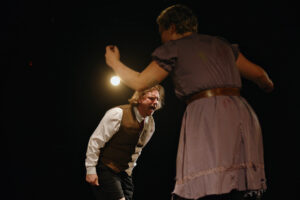
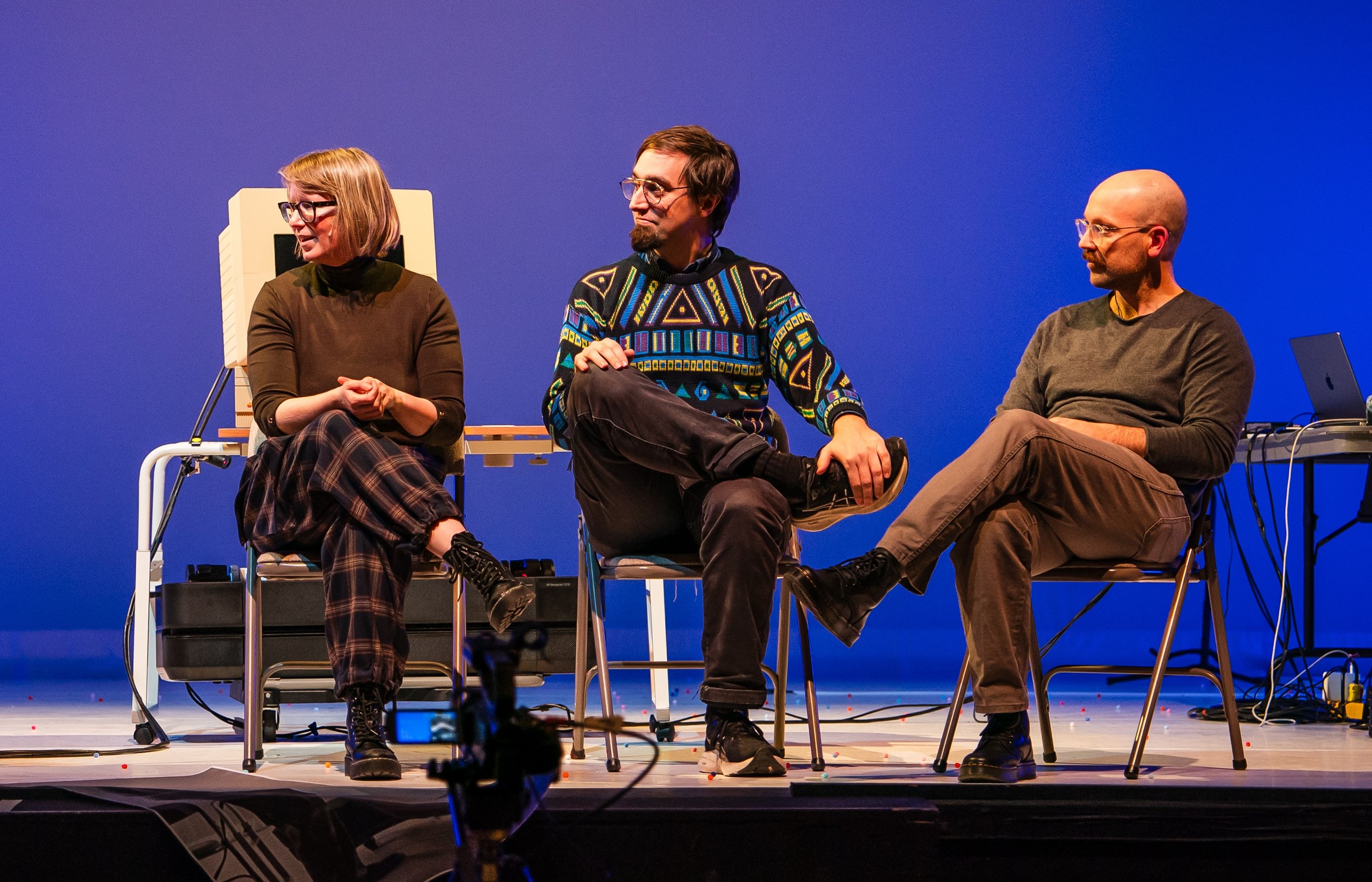
Cole Lewis, Sam Ferguson, Patrick Blenkarn. Photo: Elana Emer
Eastern Front Theatre’s Stages Festival kicks off with Manual today, June 3rd, at the NSCAD Library and continues with seven other pieces at venues mostly in and around Alderney Landing Theatre until Sunday June 7th. There is also an Industry Series, co-produced by Richie Wilcox and Dustin Harvey that begins tomorrow. Two of the shows that are coming in from other provinces, Mass For Shut-Outs, which comes from Prince Edward Island, and 2021, which began back in 2022 at the Yale Centre for Collaborative Arts and Media, and was developed in Residency at Tarragon Theatre in Toronto, at Theatre Mitu Artists at Home Residency in Brooklyn, at Playwrights Workshop Montréal Residency, and Theatre Im Pumpenhaus in Münster, Denmark, among others, feature artists who have lived and worked here in Halifax in the past. I had the opportunity to chat with Tanya Davis, about Mass For Shut-Outs, and Patrick Blenkarn, along with his collaborators Cole Lewis and Sam Ferguson, about 2021.
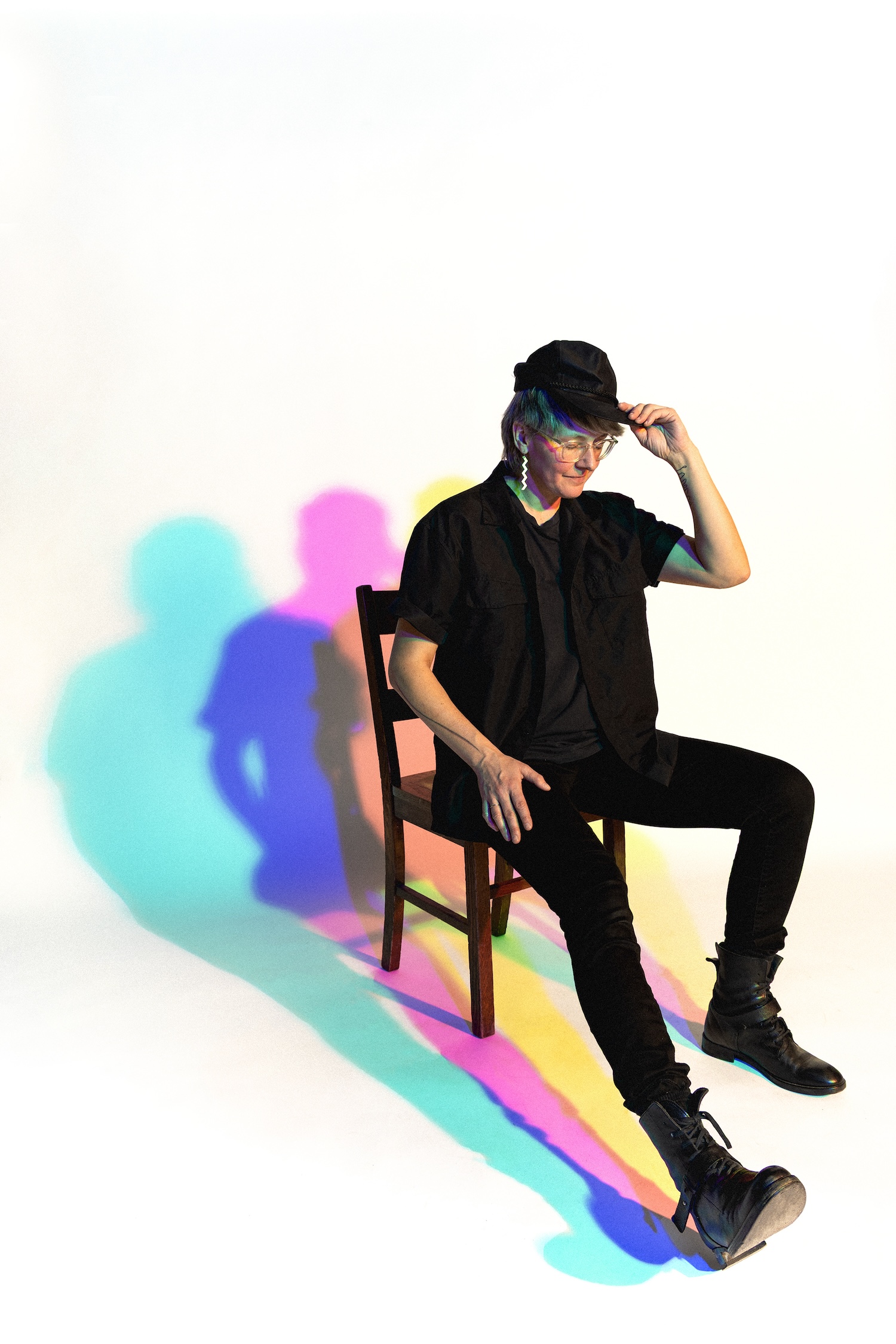
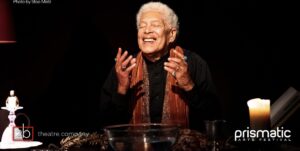
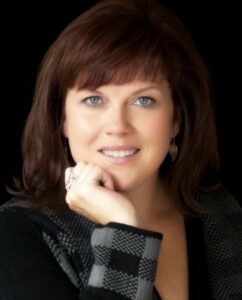
Tanya Davis is a poet, spoken word artist, and singer songwriter from Prince Edward Island, who moved to Halifax in 2005. She was Nova Scotia’s poet laureate from 2011-2013, and she just ended her tenure as poet laureate for Prince Edward Island this year. She became internationally known in 2010 when How to Be Alone, an animated film directed by Andrea Dorfman illustrating her spoken word piece of the same name, went viral on YouTube.
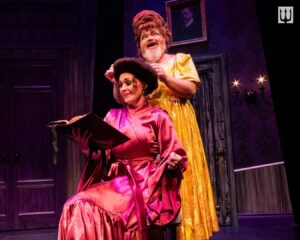
Explaining Mass for Shut-Outs Davis says, “I grew up Catholic, and I’m not anymore, and I realized that I kind of liked the framework of Catholic Mass, because it’s kind of theatrical, and there were some things about it that moved me, even as the content really bothered me. So, Mass For Shut-Outs is sort of my take on a communal experience that brings people together, that critiques the Catholic Church a little bit, and also asks questions about why we are drawn to religion in the first place. What about it is interesting? What about it is problematic? So, there’s a few things that are direct plays on what happens at Catholic Mass, and the rest of it is a lot of commentary, poetry, music, and [is] very loosely based on the framework of that kind of service.”
Davis’ earliest iteration of the piece was developed while she was still living in Halifax. “My first attempt at it was that I took the Mass and every single part of it, all 26 parts, in order, and I kind of rewrote them, frame by frame. It was fun, but I don’t know if it accomplished what I wanted to do at the time… Then, years later I wrote this version, which is a lot lighter. I think at the time when I first worked on it I was feeling heavy about the concept of not having a God, and what is God, and all this stuff. Now, I don’t feel heavy about it anymore. Maybe the grace of being older and a bit less ensconced in my own ruminative mind that I’m just like ‘there’s some things about it that are interesting.’ There’s some things about it that are frustrating. There’s some things about it that are funny. So this show, Mass for Shut-Outs, is a lot lighter than the first time I tried it. There’s a lot more levity and jokes, but there’s a couple serious points where I am maybe questioning a little bit like why is it that we have these religions, and since Catholicism is the framework I was raised in, that’s the scaffolding on which I can play.”
After Davis left Halifax she went to Montréal and then to Ottawa, where she wasn’t doing very much art and was contemplating a career change. She returned to Prince Edward Island, where she grew up, in December of 2019, with the plan to spend the winter there, and then, of course, Covid helped her change her plans.
“It was a very good place to be during Covid, and then since then I’ve been busier than ever, and it’s been really unexpected and lovely. I feel like I’ve had some really cool opportunities in the last few years that I didn’t think I would get by moving back to this very tiny place. I’ve been writing a lot of poetry. I got to go to Australia to perform, and Japan to perform, and so, I’m kind of not pursuing the arts in the same way I did when I lived in Halifax- I still play music, there’s music in the show, but I really sort of embraced that what I love most is words, and so I’m writing a lot more things. I’ve written a solo show that I performed here last summer, and just stepping more into poetry and stage work as a words person… it’s taken me down a different path, and it’s been really great and unexpected.”
Davis says the title is inspired by the ‘mass for shut-ins,’ where Catholic masses are televised for those who can’t make it to church in person. “I took the play on words ‘mass for shut outs’ for people who have been shut out of the church.” She started writing audio poems during the lockdowns, and when the world opened back up she realized that what she had written was a show.
“Being back here during Covid and realizing that I still had things to say, and I had to say them in a new way, and just the access of living on PEI, it’s a tiny place, so the audiences are small, obviously, there’s not as many people, but you can, if you have an idea here, kind of just make it happen in a different way because there’s also not as many gatekeepers. Lots of people know me here, so I can kind of just be like ‘I’m going to try this show, I’m going to try this new thing, and kind of make it happen.’”
The show premiered at a small festival called Radiant Rural Halls, organized by This Town is Small, an artist-run centre on PEI. “Their festival was specifically to put shows in rural places on PEI, like small community halls, not necessarily in downtown Charlottetown. So I wrote it initially for that. It was very well received, and people loved it. It felt good. It felt like a new way for me to work where I intentionally brought my poetry back to the centre.” She says that she likes offering an audience an “extended thought process,” rather than performing or publishing one poem at a time. “I like to explore serious content, but my life got better since I moved back to PEI, and I didn’t expect that. I like living in a small place again. I’ve been able to feel happier, which made me realize I’ve spent a lot of time purposefully ruminating and feeling really heavy. And the world is really heavy. The world is worse than it was ten years ago when I was more morose, Now I’m less morose because I’m like, ‘well, here I am. I want to work. I want to make art with people. I want to try to help. It doesn’t have to be so dour all the time.’”
Davis says that the arts scene in Prince Edward Island is very spread out, and continues to spread more and more beyond the city centres of Charlottetown and Summerside. “People live all over the island… There’s just people everywhere. I think there’s starting to be more art happening in other places. In the summer there’s so many festivals all over. There’s a fiddle festival over here, and a bluegrass festival over here, and an Acadian festival up there.” She says, like everywhere, money is tight and folks are hesitant to spend money unless they know they are going to enjoy themselves. Davis points out that Islanders have loved tribute shows for this reason. “I think that’s happening in lots of places because coming out of the pandemic and into this global crisis of the cost of living, people want to know that they’re going to like what they go see. They don’t want to take a chance to spend $40.00 on something that they don’t know for sure. Whereas, they know that they love Fleetwood Mac… We could use some more funding for the arts too, just like I know Nova Scotia has been having lots of crazy cuts lately. It’s not pristine and Golden Era, but there’s still lots of people here working to live in the arts.”
Davis says that when she initially left PEI she never wanted to come back. “Of course, a lot has changed since then,” she says, “way more people live here now, there’s been more immigration; there’s been more acceptance; it’s just cooler than it used to be. I think I had this sort of big city mentality, and this worry that if I couldn’t make it in somewhere like Montréal that I would fail, that it was a certain kind of failure.” She says she remembers marvelling over folks she knew when she lived in Halifax who were moving back to smaller Maritime cities wondering why they would ever do that. “I feel bad for my younger self [for thinking that way], but I don’t think I was alone in thinking that you had to make it in this certain way. It’s just not true. Life can be whatever you want it to be. And people live everywhere, and I love that.”
Davis says that one of the reasons that she loves performing this show inside a church is because she loves the architecture. “I know they’re complicated, and I know they’re triggering, and there’s a whole wealth and privilege thing. It’s complicated; I want to acknowledge that. And I don’t want these buildings to get torn down, and put up as parking lots, which has happened to churches. When I lived in Halifax I went to a church that was getting torn down. We snuck in at night and got some things because it was already in the process of being razed to the ground. Another church by me now is a condominium. It mostly doesn’t even look like a church anymore. And that’s fine, we need housing, maybe we don’t always need these churches, but sometimes I wonder if we use them differently, and they weren’t just for Sunday mornings for people who celebrated this one kind of God… they’re beautiful buildings, and we don’t build beautiful buildings anymore. We build shitty plastic buildings. It makes me sad when work that people have put so much time into gets demolished, even though it represents this kind of oppressive history. I still would rather revamp the oppressive history and keep these buildings.”
“I like doing [the show] in churches because I think they’re beautiful spaces. I can say that now because I don’t feel as burdened by being in them as I used to. For awhile when I was younger and really angry at church and what I went through to leave it, I wouldn’t have wanted to go in a church, so I recognize that not everyone will want to go into a church to watch a show… I also think I want to reclaim them a little bit, and take the edge off them a little bit. I think part of the motivation to do this show in a church is rooted in that. Like, we can be in here too. It doesn’t mean we’re buying into their rules.”
Davis says that beginning with their first performance at the Radiant Rural Halls Festival it seemed important to have a space for the audience to gather and chat after the performance, like a little church reception. “People were so animated after, and they really wanted to talk because it’s just like a conversation starter, whether or not people are religious, have had religious experiences, it’s still in our culture to either have had them or to see the iconography or to feel fucked up about it… so there’s always something to talk about. During the show are are a couple of opportunities for participation- there’s a couple sing alongs and prayers that people can read, and then afterwards, I feel like it’s sort of nice to have this casual debrief where people can chat about the show (or not), or about their history (or not). [People] had so much to say, and because there’s food and snacks, that puts people at ease. It felt like an important part of the show because a little bit of the show addresses collective gathering. One of the things that I liked about church, even though I thought the content was boring, was being in a room with a bunch of people. Culturally, we have some spaces like that- especially if you go to music, art events, sports, we have some times for that, but we don’t have that many, and I think it’s an important part of us being social creatures, and I think our ability to socialize is being compromised lately in the world because of social media and just the way we live our lives.”
“I’m excited to do [the show] in Halifax because I love Halifax. I haven’t performed there much in the last bunch of years, but it’s an important part of my artistic life, and it’s definitely where I started and got a lot of buoyancy from my beginnings there, and had such a beautiful community of artists, and, at the time, mostly musicians, but also poets, and because I did an early version of the show there it feels like kind of a homecoming to come back at this more grounded place in my career and to be presenting the show in a way that feels more like it’s landed for me… [and] that [it] represents me as a bit more of a mature artist.”
Patrick Blenkarn, one of the co-creators of 2021, also began his career here in Halifax while he was here attending King’s College. He is currently based in Vancouver, and he says that when he looks across the country for a place where artists aren’t just doing work similar to 2021, non-traditional work that play with narrative, and are interactive, and technologically innovative, but that has a history of artists playing with these ideas, Halifax, with artists like ZUPPA, Dustin Harvey and Secret Theatre, and HEIST, stands out. He also says that when he is looking for a “door that [he] can actually knock on” to form a collaboration, “especially at an indie level, a hyper-experimental level” it’s Eastern Front Theatre’s Stages Festival where he knows he will find a kindred spirit in the “strongly laughing Kat McCormack, who is ready to try something crazy, whether it’s the Frenchy’s musical or what we’re doing.”
For 2021 Blenkharn is a co-creator, programmer, and performer. His collaborators are Cole Lewis, a co-creator, writer, data curator, and performer, and Sam Ferguson, a programmer, and music and sound designer.
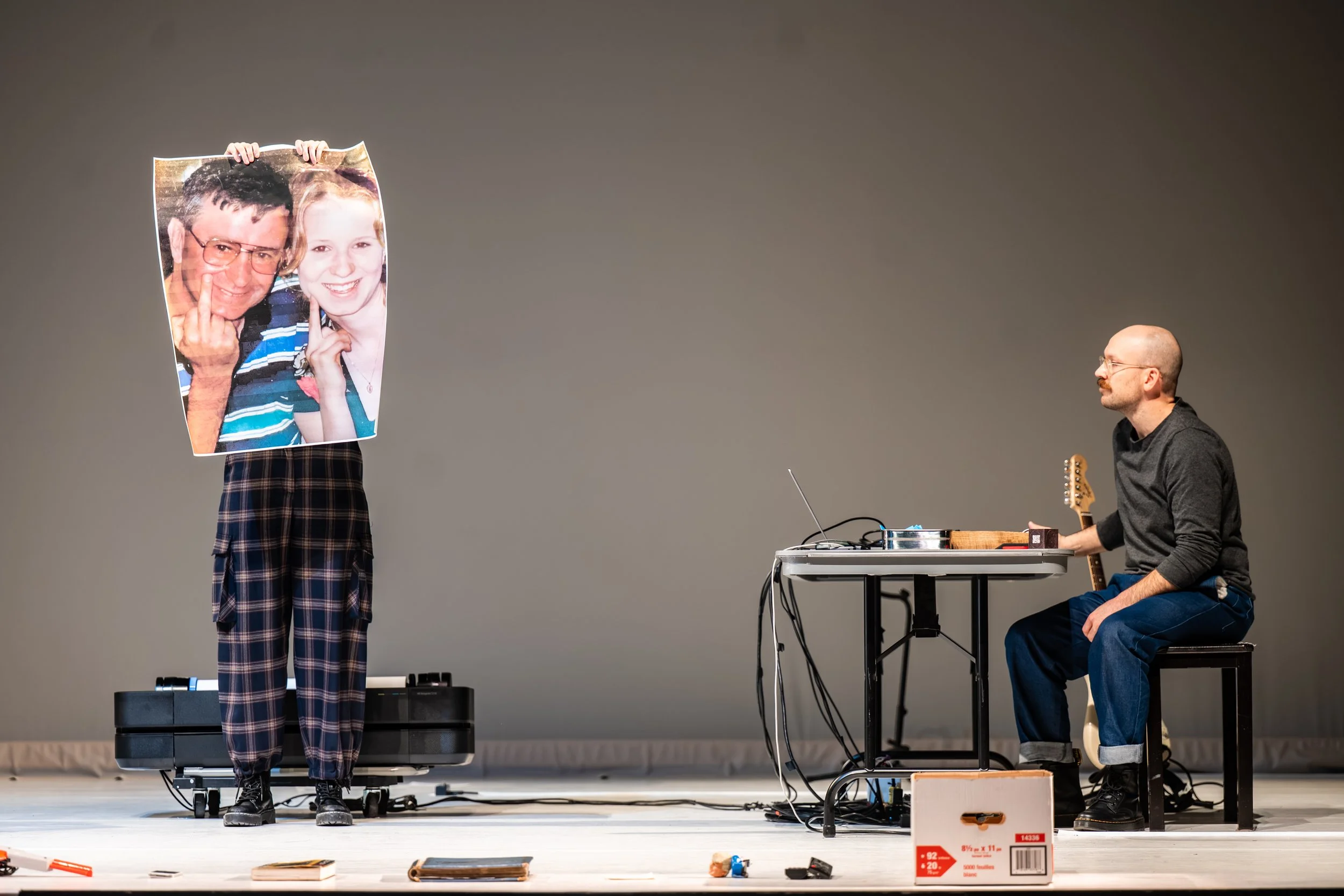
During the Covid-19 pandemic, with the borders closed, Cole Lewis was caretaking for her father, and would text funny anecdotes about her experience to Blenkarn and Ferguson. Following this there was a period of time when Lewis wasn’t making theatre, the only stretch in her adult life when that was the case, and Blenkarn was encouraging her to make something new, and he suggested that they create something about that significant year in her life. “We were interested initially in the idea of caretaking and caretaking across borders, and also what it was to caretake for somebody whose politics are extraordinarily different than my politics,” says Lewis. They got together and applied to the Greenhouse Residency at Tarragon Theatre in Toronto. At first they were considering a “collage style on a table, and maybe filming little houses to tell this story of being lost in the healthcare system across borders in two different systems.” Blenkarn had an idea for a video game, coming from his earlier work Asses Masses, and how that “might better represent being lost in the maze of a hospital.” Then Lewis was invited to do a talk at Yale’s Collaborative Centre for Arts and Media, and they asked if she could relate the show to AI. “I was like, well, there’s no AI in the show.” They thought perhaps they could relate the idea to Alan Turing, widely considered to be the “father of theoretical computer science,” and they gave Lewis a passage from Turing that ended up being in the show. “Those two things, Patrick’s drive for a video game and that invitation for AI are ultimately what the form then of the show arose. We started to play with that. And so we are all self-taught in different ways… Sam and I worked heavily on the AI, and taught ourselves to build this little model.”
Before the pandemic Lewis, Blenkarn, and Ferguson worked on a shadow puppet live cinema piece called 1991. “That was the most recent thing we had known how to do, but also all of our lives have changed [since] Covid, and a lot of skills have been picked up in different departments… we’ve been super juiced by a certain technical literacy that we didn’t have before, and that opened up new avenues to exploring the project, but also was very pertinent to the subject matter. And, increasingly, we started to spin on this idea around technology’s role in both facilitating care, but also making it impossible, kind of undermining the sort of clinicality of technology, the clinicality of the clinic, as in a hospital, and imbuing it with a kind of social and collaborative warmth. So, the form that we ended up landing on is a live narrated game, preceded by Cole telling a story about material objects on stage, and each of those objects used to belong to her father. We work through the material remains of a person, and we get a certain image of them. And it’s complicated… and all of that [complexity] feeds into why maybe those politics or that psychology is there represented in the same. So, through those material objects then we do a treatment of digital, like digital world, digital simulation, and then we say, okay, so we’ve met the person through their material artifacts, now we are going to meet them through this sort of virtual simulation where we take on their perspective inside of that space. And as they’re exploring this place, the story of their last few weeks is narrated by none other than their real daughter, who, during those times in their life, was in dialogue with her as one of the sole bridges from across the border. And upon winning that game, however long it takes us to beat it, we are rewarded with data and abstracted data, pure data, where we meet an AI resurrected version of the man as accurately reconstructed by Cole and Sam. And then we have a chat with him, and he’s everything that maybe we hoped he’d be? Like we work all this time to save someone and then we get to live with them,” explains Blenkarn.
“1991 was shadow puppets and kind of overhead projector and kind of this layered media. We were experimenting with technology there. Sam was doing live voice modification, so it’s a continuation, I would say, of that kind of work, and I also narrated that show live, and performed a character in that show live, and it was loosely based on my life, so this becomes a continuation- and because, in 2021, all my caretaking was mediated by screens, so I had to attend doctor’s appointments this way [on Zoom], and I would try to arrange for homes, my dad was unhoused, so I would try to get him housing. I’d be trying to get him healthcare… everything was through a telephone or a screen. So, this kind of media relationship conceptually actually really works and makes sense for us inside the world…,” says Lewis. “When we are trying to share someone that we know and we love with other people sometimes we share through stories, sometimes we share through objects kind of [a] show and tell, and here we kind of go a step beyond that and say, ‘why don’t you now come in and play him and get a sense of who he is’, and then that also becomes a different version of show and tell. Then the data through an AI is mixed in, another version of show and tell, and in all these different versions we’re kind of building him together, and because you can’t ever share your own father or mother or guardian with anyone in the way that you intimately know them, it’s always going to be a different version of [him]. One of the lines in the show is ‘the exposure changes depending on who holds it.’ So, the idea of who my dad is changes depending on that evening’s show, and who we all are together in that space. And there’s danger in that, but there’s also really good possibility.”
Blenkharn explains that someone from the audience is invited up to play the game, and that both he and Lewis are there for that audience member, making sure they feel safe and taken care of. “If someone is chosen to play the game, they have the option to play the whole show, that’s up to them, or they can tap out and switch with someone… I’m not looking for the person who is necessarily most like my dad or anything, and we try to make that very clear to the audience. We have people of all ages, we’ve had children come up, all genders, all races, all sorts of intersections are welcome on stage. One of the lines in the play is ‘you don’t have to identify with my dad. He could have benefited from other perspectives,’” says Lewis. It’s also important for the audience to know that there is no possibility of failure. If at any point they want to stop, they can, and that just offers up an exciting new opportunity for how the game continues.
Sam Ferguson composed the sound design, and says that he was inspired by some video game music, specifically citing the score from Hollow Knight (2017). “We got a lot of synth sounds, but there’s also guitar and drums, and Patrick’s a real kind of virtuoso of a musician.”
Lewis’ dad was a Trump supporter, a Canadian Vietnam veteran, was unhoused at the end of his life by choice; he loved Canadian healthcare because he hated to pay for anything, but he didn’t want to live here. “As we’ve taken this show already to two very different places, New York City and Vancouver, it’s amazing how many people have this kind of bifurcation in the family. And one of the things that we really want to show is- how do we talk about it? How do we talk to them? How do we support or explore the reality that so many people find themselves in when you have a kind of communication breakdown about certain things. Some things can transcend that breakdown. There’s moments in life that can call you to transcend those crunchy bits,” says Blenkarn.
Lewis said that she’s encountered confusion from others about how she could maintain any kind of relationship with her father, or even how she could continue to love him, given his political beliefs. “One of the core questions from the beginning for us, from our Tarragon application, was how do you give dignity in death to somebody you fundamentally disagree with. I can honestly say I love my dad, but I didn’t love his politics. I didn’t love his racism. I didn’t love his misogyny. I didn’t love some of the choices he made. It’s interesting because for some people that brings out, they want me to bring him down.” She says that the show gives folks the opportunity and “permission to have their own experience and feelings.” It also allows them to think about what they might do if they were in Lewis’ situation.
Lewis also stresses that it’s a funny show too, despite it’s more serious themes.
Some of the humour can come from the audience, especially the person who is playing the game. If they are not particularly skilled at playing video games, for example, this can make, Brian, Lewis’ dad, move in stilted or roundabout ways, that can make him seem disoriented and confused, which can be apt for someone wandering around a hospital. “Someone who is really empathetic and cares about all the choices is a Brian who is wistful,” says Lewis. “Their choices actually impact the narrative deeply each night, and then some of those choices get fed into the AI, so they even feed the AI conversation that ends the show.” “There’s a lot of rooms in a hospital,” says Blenkarn, “there’s a lot of Easter eggs that we’ve put in just for fun, and there’s a lot of opportunity for a mischievous Brian who does not listen to his daughter.”
This allows for the participants to really play with the performers in collaboration, because whatever the audience member does on stage, Lewis narrates the story live, and Blenkarn plays Ferguson’s music in a way that mirrors the action. The audiences also often yell out in attempt to help the person playing the video game, and the player has the opportunity to either listen to the crowd or to go their own way. “And that fits our character too,” says Blenkarn, “so being able to create performance that is a container for this kind of variability, but also where it just genuinely feels like doing something together- we’re here together, we’re going to play out this story- let’s see how it goes- let’s see what happens.”
Lewis says that she has heard past audience members arguing with one another that the version of the show they saw was better. “They feel like they saw the same show, but their understanding of [Brian] is slightly different. Since the audience is such an essential part of the performance, as much as they can simulate it on Zoom, they have learned what works, and what doesn’t, and what can work better, through running the show in front of an audience. “We’re always surprised,” says Blenkarn, “I don’t think it’s ever fair to say that we know entirely what we’re doing.” You can never entirely predict what might happen. During one show in Vancouver a participant poured water all over the desk and nearly short circuited all the equipment. “You don’t learn that stuff until it goes wrong,” he says. But, he says, that is also all part of what makes the show feel so alive.
“There’s no audience participation with the AI,” says Lewis, “but at that point they’re so engaged, they feel like they have built the character of Brian, they feel like they know him so well, that that arc of that conversation, which has this structure of questions, but is improvised because I never know what the AI will say…. Hopefully it raises important questions about caregiving beyond the grave. How do we care for that data? How do we care ethically? What are we doing right now in this moment going forward? Because it’s, unfortunately, these questions on AI and data and ethics are not in the future. They’re now.”
Lewis says that when her father was dying in 2021 there were articles in The Guardian about creating these AI “grief bots.” “That horrified me,” she says. In creating this show they have met folks working on technology to improve these kind of bots. Video games have introduced the idea of the “meta human,” where folks can 3D scan their face to create these digital avatars so much more easily. “So that year of 2021, the technology and our relationship to it, just really shifted.”
Lewis said that one of the players they had was only eleven years old. “Watching an eleven year old at the very last moments of breath for the character of my dad’s life in the show, you got to see both, you imagine him as an older man dying of cancer, and also see the child still inside him very visibly in front of us at the same time. It was amazing. And if it’s a young woman, then we see the potential of him towards me as his daughter. There’s so many ways we get to read the player of the audience complicating him. I love that. My favourite part of the show is getting to sit back and just enjoy and narrate and watch the players… I would argue, my dad would totally disagree with me, but there’s also a young 26 year old woman in him that he can’t be misogynistic about, and there’s probably a 78 year old woman in him, and all these kinds of variations that he could learn more about himself if he had more time and opportunity to pay attention.”
Eastern Front Theatre’s Stages Festival runs June 3-7th, 2026 with the Main Stage shows happening at Alderney Landing Theatre (2 Ochterloney Street, Dartmouth), and other shows popping up in venues on both sides of the harbour. Festival Passes are $60.00 and provide access to all the productions. Industry Series Passes range in price between $40.00 to $60.00 on a PWYC scale. Both are available here, along with more information. Prices for individual performances vary from free to $26.00.
There is a very thorough Accessibility Guide Available Here (Scroll Down). Alderney Landing Theatre is accessible for wheelchair users, there are two all gender washrooms, Phonak Roger FM/DM System available at Alderney Landing Theatre. Automatically connect via Wall Pilots or borrow a Telecoil device to sync with hearing aids and cochlear implants. Devices with headphones are also available. Please see the Box Office for assistance onsite. ACCESSIBLE TICKET PRICES: All performances have pay-what-you-can-afford pricing. If cost is still a barrier, please email info@EasternFrontTheatre.com. Volunteers see shows free of charge! Sign up here!
Canadian Theatre Criticism is an essential part of a healthy and thriving theatre community. It helps theatre companies find new audiences for their shows, deepens audiences’ engagement with local artists and the work being created in their communities, and it is one of the best ways to preserve a snapshot of an ephemeral art form for future generations of theatre lovers. TWISI relies on support from its Subscribers, folks like you who care about the survival of local and independent arts coverage. Please consider becoming a Subscriber today, or click here for more information. Thank you so much for supporting TWISI.