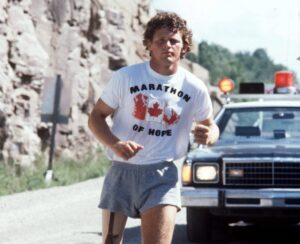
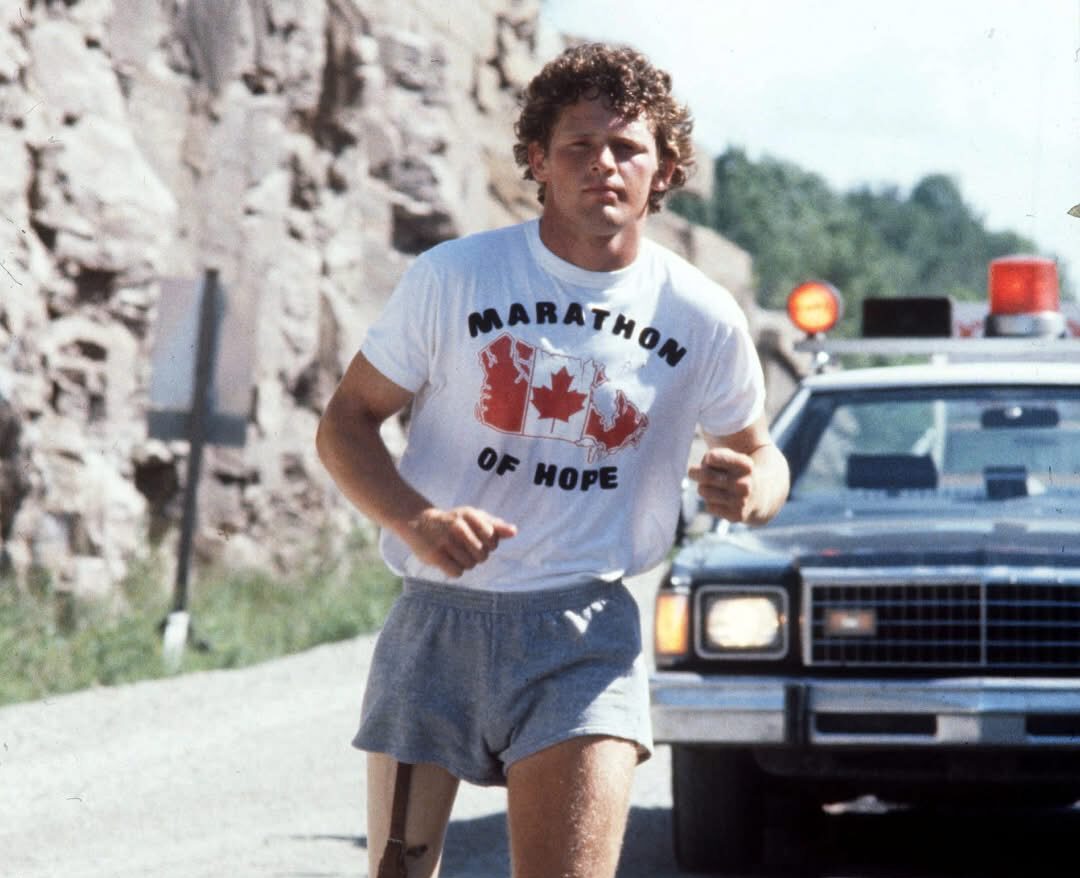
Terry Fox (via the Terry Fox Foundation)
The thing that really struck me about Sean Menard’s documentary about Terry Fox, Run Terry Run, which I saw as part of the Atlantic International Film Festival, is that all the visuals in the film are from Fox’s 1980 Marathon of Hope; it is only the voice overs that provide us with additional context through a contemporary lens. Visually, it looks like a film that should have already existed, and yet, much of what Menard has cut together is made up of previously unseen footage, including some taken by filmmaker John Simpson, which had been sitting forgotten in storage for the past four decades.
Terry Fox is always on the shortlist of Greatest Canadians Who Have Ever Lived; his name has become synonymous with the run for cancer research in his name that both adults and schoolchildren take part in every September. Yet, it is strange that someone who is so beloved, such a hero in our culture, still also remains a bit of a mysterious figure. Terry Fox died on June 28th, 1981 of osteosarcoma. This was three and a half years before I was born. I don’t remember when I first heard of Terry Fox; I think like most Canadian children he is there in the ether of our lives from the time we start school. I have a Terry Fox shirt, and I often get compliments on it when I wear it from strangers who yell things out to me like, “Terry Fox, right on!” Yet, when I was watching Run Terry Run, I realized I had never really heard Fox speak before at any length. I didn’t know anything about the other people who accompanied him on his Marathon of Hope, and beyond knowing his goal to run a marathon a day, that he had to cut the run short when he got sick again, and that he died shortly afterward, I really didn’t know anything about the logistics of this incredible journey that he undertook because he didn’t want Canadians to keep sweeping cancer diagnoses under the rug or to feel defeated by this grisly disease. He wanted Canadians to feel empowered to hit back with their wallets.
The other voices we hear in the film are Doug Alward, Terry’s best friend who accompanied him on the Marathon of Hope, Darrell Fox, Terry’s younger brother, who rushed to join Doug and Terry early on when tension was rising between the two friends, Bill Vigars who was brought on as a publicist once Terry’s story caught the Canadian imagination, and Leslie Scrivener, a young journalist for the Toronto Star who was the only reporter to cover the story from its very beginning. In fact, she says that when she first expressed interest in Fox the others in the newsroom, mostly men, scoffed at the idea saying that no one would be interested in reading about Fox because his goal to raise money for cancer research by running across the country, on a prosthetic leg no less, was “boring.” Thankfully, Scrivener followed her shrewd instincts and wrote a small column every week called “Running with Terry” where she kept folks up to date with where in the country he was and how things were going. By the time he got to Ottawa and Toronto, of course, he was front page news for all the papers, but to his credit Fox didn’t forget who it was that had been by his side from the start.
It’s hard to believe that the Marathon of Hope wasn’t all anyone was talking about when Fox started out in Newfoundland on April 12, 1980, but he was at the mercy of print and television media, of course, which, as Scrivener describes, was really slow on the uptake. Every day as he ran through wind and stormy winter weather on slippery, dangerous roads he slowly built modest momentum of awareness, and at each stop he made along the way he told the story about how he had lost his leg to cancer and his goal to eventually reach his home of Victoria, British Columbia, and how he and Alward were collecting donations for cancer research along the way. It struck me in the footage from all of these stops how many of the people engaging with Fox, especially early on at these ad hoc gatherings along his route, are children. While the adults may have been slow to recognize Fox’s pluck and bravery, the kids seem to have been on board from the start.
Fox is characterized in the documentary in his own words as someone who simultaneously doesn’t want to become famous, or wealthy, or for his own story and celebrity to eclipse the more important goal of eliminating cancer, but also any criticism or dismissal of the Marathon of Hope he took deeply personally, and he would become hurt and angry in a way that was difficult for him to shake off. He talks a lot about his mental health too, and Alward speaks about the ferocity and depth of his belief in himself, but then that is juxtaposed with the reality of someone running for 42.2kms brooding on a feeling of injustice and maybe also inadequacy. There is some stunning footage in the documentary where you really can see the expansiveness of the landscape in contrast to the tiny figure of Fox running on a road that seems to extend into the distance forever. It is little wonder that he and Alward spent time fighting with one another when he was experiencing such an emotional as well as, obviously, a physical rollercoaster every day.
He slammed into a whole wall of indifference in Quebec where most people were unaware of who he was or why he was running because the French media had largely not yet covered the story. This was another aspect of the Marathon of Hope that I’d never considered before. It was a long way to run while being incredibly demoralized. Menard also connects Fox’s Marathon of Hope to the fact that the first Quebec Independence Referendum took place at this exact same time- May 20th, 1980. This may have contributed to some Quebecois folks feeling that Fox didn’t represent them, but it also may have appealed to other Quebecois folks’ feelings of national pride, of being connected to the rest of the country in this tangible way of seeing Fox literally running through their province as part of a national campaign. Cancer, unfortunately, is a great unifier- it doesn’t discriminate between borders or languages.
The other thing that really struck me about the footage is the amount of times that we see Fox cry, and not in private moments where he is being caught unawares by the camera, or just when he is pushing through the pain during his runs, he cries during the speeches that he makes in front of thousands of people at scheduled stops, and he doesn’t apologize or act awkward about it. It is stunning to see a young man who is lauded as being one of Canada’s greatest heroes being so in touch with his emotions in a healthy way, so nontoxic in his masculinity long before that was a common concept. When he has to stop running in Thunder Bay and go to the hospital because he knows something is really wrong in his body someone asks him if he’s frightened and he responds immediately, “Of course I’m frightened.” He isn’t pretending to be untouched by the reality of his situation in the name of stoicism; he is willing to wear his heart on his sleeve, to be vulnerable, authentic, and human, and that’s exactly why the country rallied around him, and continues to rally around him to this day.
I find it difficult to conceptualize the idea of running a marathon a day, even as a healthy person with two legs, and I find it even harder to imagine the idea of someone walking or running, or even biking, from St. John’s to Thunder Bay. It feels impossible to me, and in that impossibility Terry Fox can feel like someone who was superhuman, a real live superhero, but this documentary gives the audience a better sense of the sobering reality. The chemotherapy from Fox’s initial cancer treatment had damaged his heart and he was supposed to receive regular doctor’s appointments along the way which he refused to do. Both Alward and his brother Darrell expressed that it was difficult often to look at Terry as he was running because it was clear he was pushing his body so beyond what most people would endure. Alward says that he had to accept that Terry was willing to literally die for this cause, and it would be futile to try to convince him to be any less unflinching in his resolve.
I found this documentary to be extremely emotional. I was moved to tears several times throughout the saga, despite knowing, of course, how the Marathon of Hope and Fox’s life would end. In a way we honour Terry Fox’s own wishes to raise a billion dollars for cancer research in his name through his foundation but to not treat him like he’s an American celebrity. Yet, I also agree with filmmaker Sean Menard when he says that Canadians aren’t great at centring our own stories, and that that has meant far too many children here are growing up without a concrete sense of who Terry Fox was, what he did for this country, and why they’re running in his name. I hope that everyone will watch this documentary and immerse themselves back in 1980 for 109 minutes, and that they will marvel over this story as though they are seeing it for the very first time.
The film also features a new song by Bryan Adams called “The Ballad of Terry Fox.” It’s a perfect addition to your Canadian Music Playlist that will make you even more proud, if possible, to call this great country home.
You can watch Run Terry Run at your local Cineplex on October 9th.