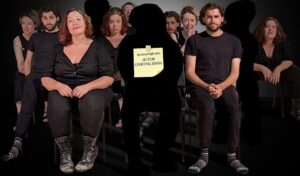
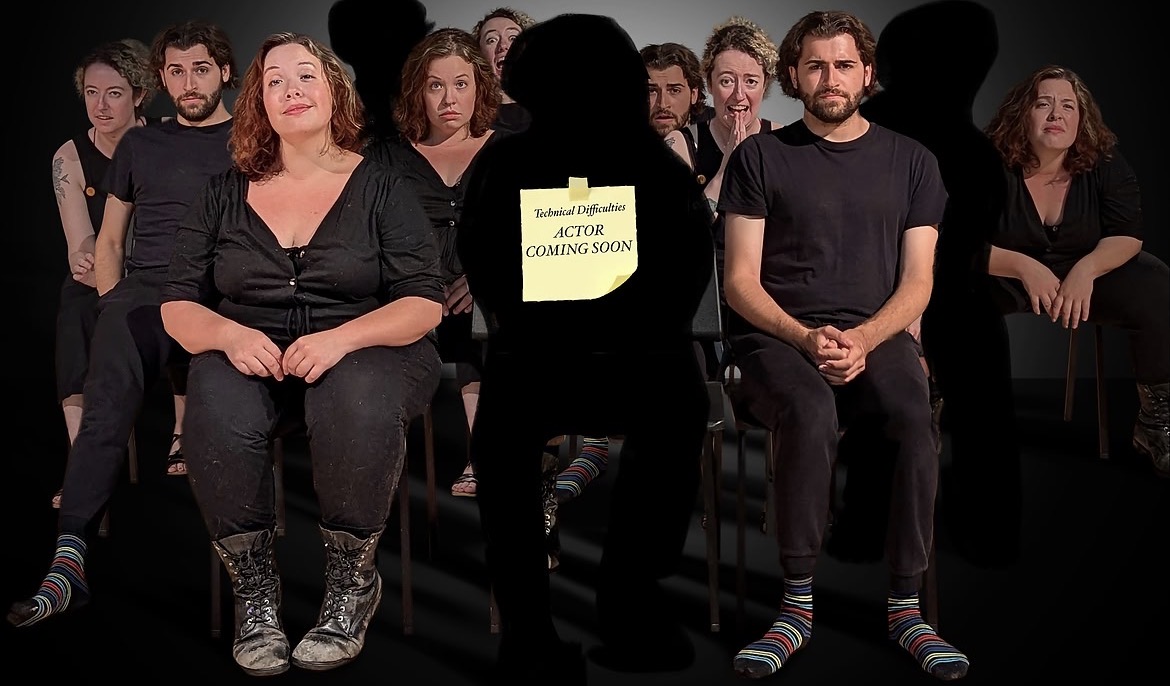
In August Van Meekeren’s play Dedicated to You, The Wonderful Audience, now playing at the Bus Stop Theatre just until November 12th, 2026, the framework of the theatre becomes a means of terrorizing Van Meekeren’s character, named One, who is going through a serious mental health crisis. They perpetually see an audience and other theatre characters who are tormenting them, and they are unable to escape the stage no matter how hard they try. “Stop looking at me!” they yell, desperate to get away from us, and we feel empathy for their plight, but we have been made to be complicit- we remain in our chairs. We keep looking.
One and Two, played by Laura Spencer, are in an undefined relationship where One is staying with Two and One is very dependent on Two because they literally have nowhere else to go. When we meet Two they are an extreme stereotype of a theatre kid- everything revolves around them, their process, their creativity, and the show that they are rehearsing for. In their infatuation with their own artistic journey they fail to see the very obvious signs that One is struggling, which puts One in a very dangerous situation, and they end up being admitted to the hospital. As soon as Two realizes that One’s mental health issues are extremely serious they immediately begin to brainstorm about how they can use One’s real pain and struggles as the basis for a new play that they will write and star in- in which they will be the virtuous hero who sweeps in and saves One from themself.
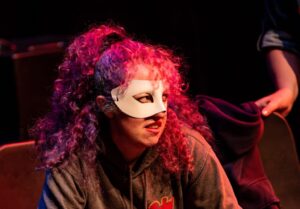
One is not a reliable narrator for the audience, so it is difficult for us to know whether Two’s behaviour is really happening, or whether this is the way that she is being perceived by One in their head. Two can also be seen as a deliberate caricature of how insensitive and dense folks can be when faced with someone with a diagnosis they don’t have any experience with, as well as satirizing how problematic both the world of the theatre and the culture in the theatre can be in creating a toxic feedback loop of narcissism, hustle culture, and performative positivity. We also meet Zero, played by Cat McCluskey, a theatre director character certainly in One’s head, who thrives on pushing One to be self destructive to themself to create drama for the benefit of the audience. To Zero the worst fate is to be “boring,” so they are always trying to manipulate One for the “good of the show.”
All of this works really well to dramatize intrusive thoughts, and to keep the audience off-kilter, mirroring One in questioning what is real and what is not- how their perception is or is not skewed. Spencer’s over the top portrayal of Two at the beginning of the play also brings some levity, as we recognize the truth in her- although exaggerated- she is showcasing a lot of the ableist behaviours that exacerbate the isolation that folks with mental illness often feel.
About three quarters of the way through the play the tone begins to shift, and suddenly Two starts to behave more like a real person and the play starts to ground itself a little bit more in realism instead of heightened parody. This might be the audience experiencing the effects of One’s new medication, as Zero does retreat quite a bit during this period. I like the idea of the audience dropping down with One into more of a reality, but it is jarring to go from Two being an absolute nightmare of a friend with very few redeeming qualities, even if this is more how One is seeing her during their own crisis and less who she is more objectively, to suddenly being encouraged to see things from her point of view, and even root for the success of her problematic play. The reality of the play too is a bit distracting because when we see bits of it being performed it is intentionally terrible- not just insensitive to One, but dramaturgically flawed- but then we are led to believe that Two has all these exciting opportunities from this hot mess workshop to jumpstart her career. Again, does the dramaturgically flawed play, which is a hilarious parody of how insensitive selfish people do exploit their friends for creative content, happen in One’s mind? Is the real play more nuanced and tactful and well crafted, and we are seeing One’s overreaction and sensitivity or even paranoia ? The fact that this isn’t clear makes it hard for the audience to make the transition between being horrified by Two to being led to try to see One from her point of view. Or, are we supposed to feel livid on behalf of One for feeling like they have no other option but to sacrifice their valid feelings for Two because they have no one else? That’s bleak, but I am sure that is also a reality for some folks.
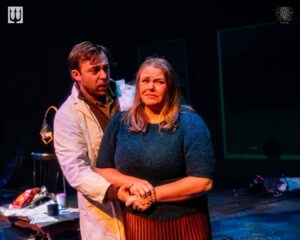
Similarly, Ben Burchell plays a nurse whose behaviour most of the time doesn’t seem grounded in realism either. Is he being conjured by One as a way to begin to use their mental illness in ways that are also conducive to them being “productive” and “healthier”? While the ending of the play evokes more questions for me these seem more psychological than dramaturgical. It’s just the pivot in the relationship with Two that I think could use some further clarification and emotional guidance for the audience.
The actors are all giving strong performances. McCluskey is an unflinching tyrannical menace as Zero, Burchell is affable but strange as the nurse, and Van Meekeren gives such a heartrending performance as someone who is terrified and mystified almost all the time so you just want to go up onstage and help them. Laura Spencer has huge swings as Two, but she hits the right tone in both the heightened and the absurd moments to make the character exasperating, familiar, and humorous. Kaitlyn Thompkins does a good job directing the piece- using minimal set pieces and very well mimed props (especially Burchell’s blood drawing scenes), and with Thunder Defayette’s technical design creating a good sense of tension and disorientation that really conveys the mood of the piece.
The thing that really struck me at the end, though, was that Van Meekeren is writing this play from their own perspective- dramatizing a version of their own story- and doing so in a way that is genuine and true, creative, brave, intentional, and mindful- and they are playing One. Shouldn’t One, then, have the opportunity to write their own story too?
Dedicated To You, The Wonderful Audience plays at The Bus Stop Theatre (2203 Gottingen Street, Halifax) just to November 12th. Performances are at 7:30pm. General Admission tickets are $10.00, you can also get $25.00 tickets that further help to support the artists and the work. They are available here. Tickets are also available (in cash) at the door before the performance on a Pay What You Choose scale.
Canadian Theatre Criticism is an essential part of a healthy and thriving theatre community. It helps theatre companies find new audiences for their shows, deepens audiences’ engagement with local artists and the work being created in their communities, and it is one of the best ways to preserve a snapshot of an ephemeral art form for future generations of theatre lovers. TWISI relies on support from its Subscribers, folks like you who care about the survival of local and independent arts coverage. Please consider becoming a Subscriber today, or click here for more information. Thank you so much for supporting TWISI.