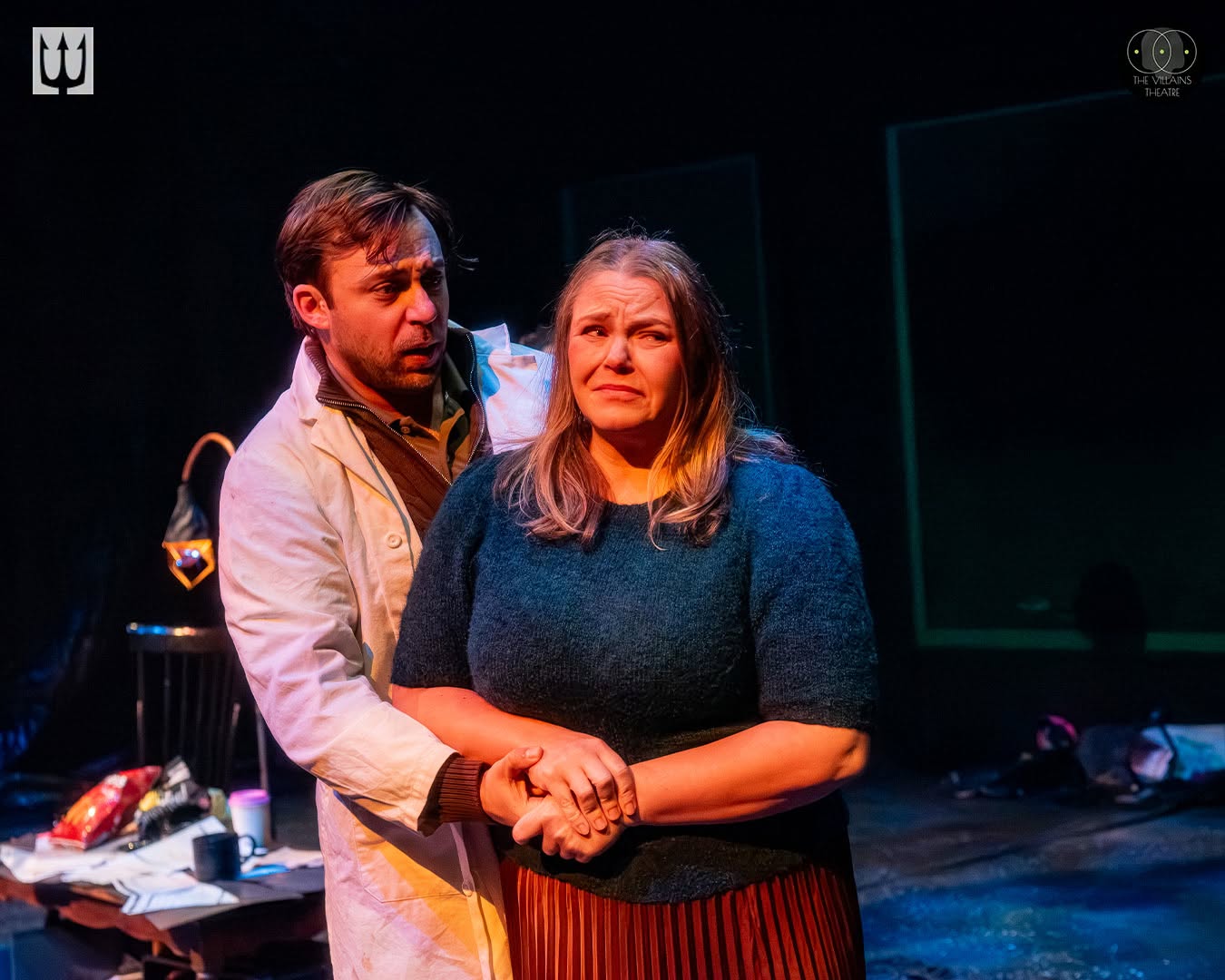
Chris George and Amy Reitsma Photo by Stoo Metz
Dan Bray’s play Deepwater, which closed its short run at Neptune Theatre’s Scotiabank Studio Theatre yesterday has been perpetually described as a “surreal procedural,” and I really felt the surrealism swirling around in the darkness of the stage in Burgandy Code’s new direction in this new space.
Liliona Quarmyne plays Questa, a dogged RCMP investigator who is driven to solve cold cases involving missing children. We meet her in her office where she is often cramming food into her in a way that seems subconscious. Swirling around her are bits and pieces of memories and imagined parts of the case file dramatized centring on May, played by Amy Reitsma, and Casper, played by Chris George, whose daughter Lucy has been missing for years. From the very beginning we in the audience notice that the way Questa is bringing these characters, especially May, to life, is not always realistic. In fact, May often behaves in ways that are strange and jarring, and we are left to wonder why Questa’s brain either remembers her that way, or thinks of her that way. Is it that there was something more subtle that Questa noticed when she visited May that seemed off to her, that her mind has now exaggerated for emphasis? The relationship and vibe between May and Questa too is odd- it’s very familiar and casual- even sometimes playful. Is this a part of Questa’s own work process- to break down the layers between them and seek to delve deeper into the intimate parts of May and Casper’s past to find the answers there, or was there really some unexpected chemistry or even flirtation between May and Questa during the interrogations? In the first iteration of this play that I saw at the Bus Stop Theatre two years ago there was more of a mystery left for the audience about what happened to Lucy. In this version I really enjoyed that mystery being a bit more secondary to that surrounding how Questa was (or was not) coping with a tragedy that haunted her own life.
The context of Lucy’s six years at home comes alive very clearly. She was born out of a union between two very ambitious and passionate scientists- marine biologists- and May especially was at the top of her field when she unexpectedly became pregnant. She had run as far away as she could in her research from her hometown on the Kempt Shore and her zealous evangelical mother, Christine, whose faith seems to bleed over into severe mental health issues that have made her abusive and, frankly, dangerous. May is guilted both into having the child and returning to her childhood home to care for her abusive mother when she becomes terminally ill. With so much caregiving landing on May’s plate Casper feels like he has to work twice as hard (and twice as much), which means that he is hardly ever home to help with raising Lucy or looking after Christine, and May begins to show signs of a severe mental health breakdown as well. In all this Lucy is often neglected and sometimes shows signs of physical abuse, although it is never clear whether this is at the hands of her grandmother, her mother, or even her father, or a combination. May doesn’t want to become her mother, but she is obviously drowning, and Casper can’t see the stakes of it until it is too late. As far as cold cases go, it’s interesting that its this one that is Questa’s white whale because it does seem likely that one of the most likely scenarios that we imagine are indeed the answer- as much as we might like to imagine Lucy being able to run away. It’s more likely that May was experiencing some kind of psychotic break and that her version of the events on the day Lucy disappeared are either invented or imagined. Does Questa’s desire to make the events in Lucy’s story more complicated suggest that she relates to May’s mental illness, and does that shed any light onto her own mystery? Certainly Questa has a very vivid inner world. Is that only when she is working, or does that bleed over into her home life too? Bray and Code give us many different layers to consider here.
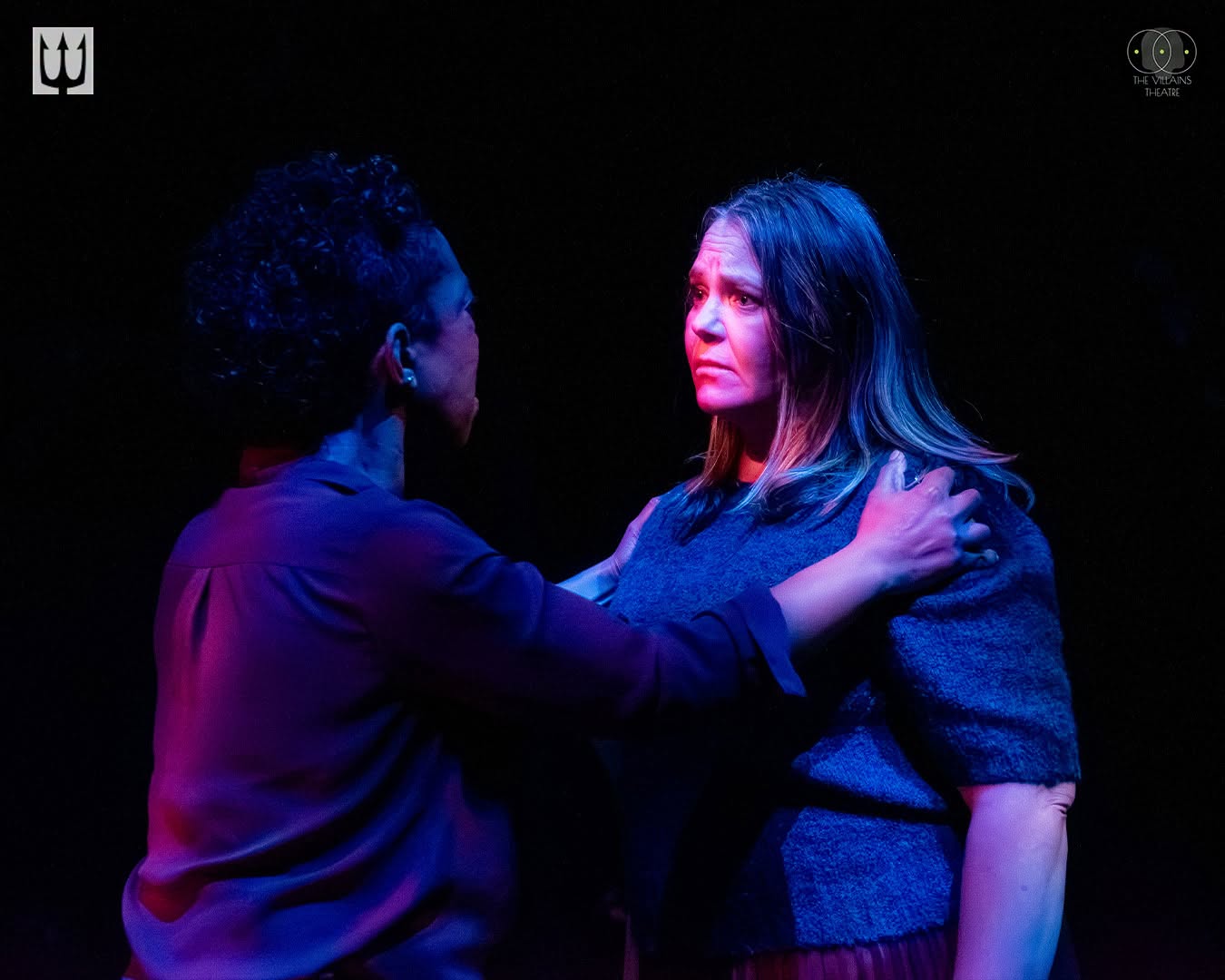
This is a challenging play for the three actors, especially Amy Reitsma as May, and all three of them do an excellent job of oscillating between the strange, the darkly whimsical, and the naturalistic- sometimes even within a few lines of dialogue. Liliona Quarmyne remains likeable throughout the piece with a sort of buoyant confidence and affable spirit that seeks to get under every piece of evidence, and to always keep an open mind. Amy Reitsma has this birthing scene that is both excruciating and captivating to watch because it looks so real. There are moments with May where the unflinching truth of the story suddenly shines through and the entire play seems to ground itself suddenly in realism, and Reitsma does such an excellent job of piloting these moments, even if they seem to come out of nowhere. Chris George too oscillates between making Casper a tender self deprecating charmer that May falls in love with, but then his ambition and some chauvinistic ideas about what May’s role as wife and mother should be once Lucy arrives keep him from seeing the reality of their situation. It’s also unclear, of course, how much of Questa’s own perception of Casper are fuelling the dramatizations that we see. All the characters’ motivations are rife for speculation from the audience.
The layer upon layer upon layer of these questions have been meticulously mined by director Burgandy Code, who has guided this cast through every disjointed emotional pivot to create a riveting world for the audience to feast their imagination, brainpower, and cleverness upon. The scenic design by Katrin Whitehead, lighting design by Jess Lewis, sound design by Jackson Fairfax-Perry, and video/projection design by MacKenzie Cornfield also create such an immersive experience of being in the depths of the ocean- the metaphor that Questa seems to have latched on to for this case. I really liked the use of the way back of the stage as May and Casper’s laboratory- as it gives the past a more naturalistic, tangible space- but it is the furthest removed from us in the audience- where we see those days when May and Casper’s lives were relatively ordinary. Later in the play everyone floats about in among the lurking dangers in the unknown at the front of the stage.
Dan Bray didn’t re-write the play at all between its premiere and the opening night at Neptune, and yet in the way that Burgandy Code has shifted the focus and really brought out the surrealism it seems like a very different piece. It’s the perfect example of why it is so important for Nova Scotian plays to not just be shelved indefinitely after their first run, but to be continually mined and explored and restaged in different venues with different concepts, even with the same creative team. Three weeks should never be the entire life cycle of a play. I hope Deepwater has a long life ahead of it. It deserves it.
This run of The Villains Theatre production of Deepwater by Dan Bray directed by Burgandy Code at Neptune Theatre has closed.