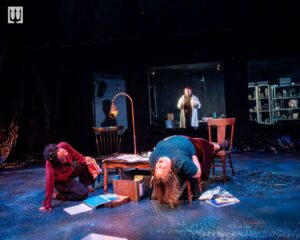
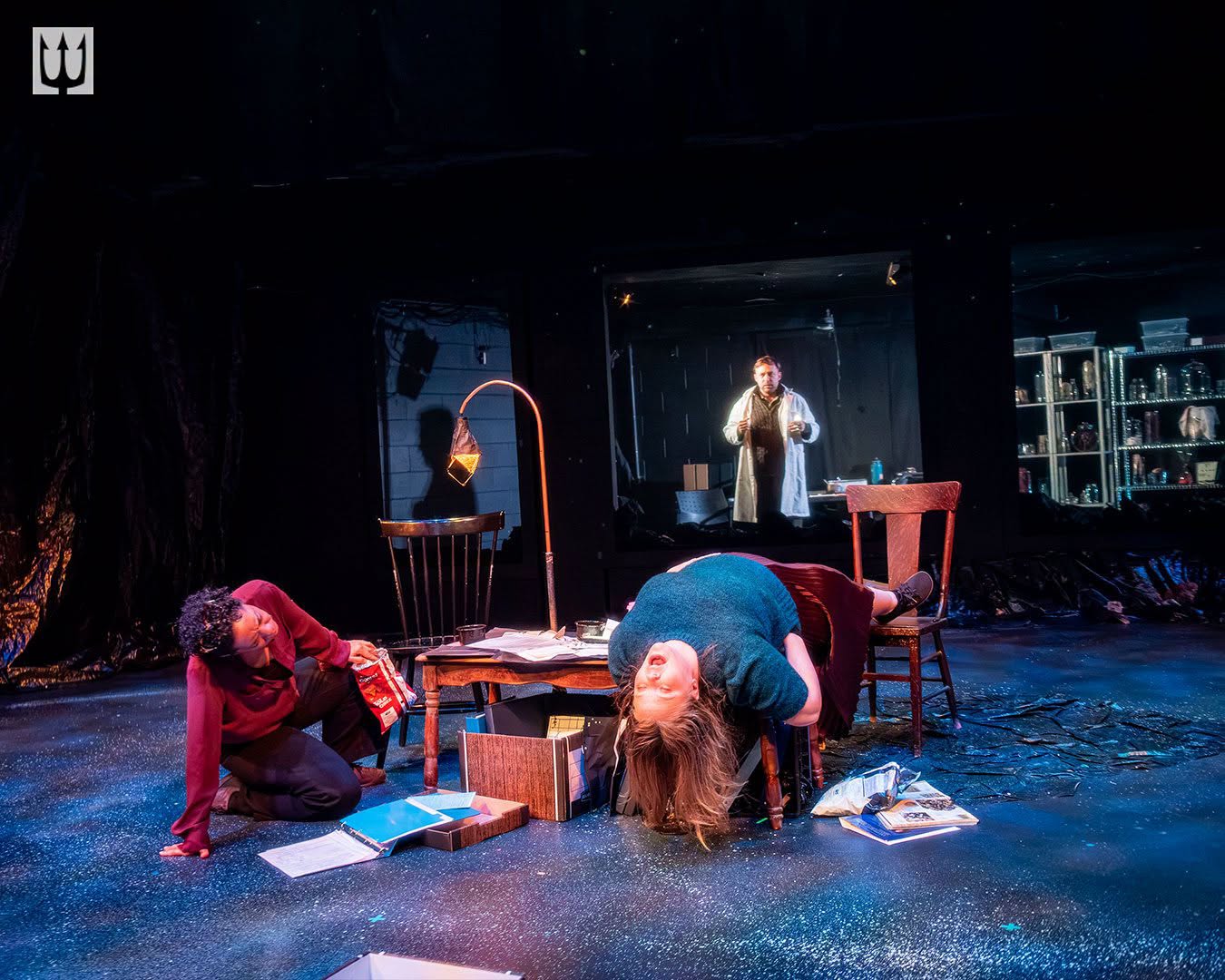
Liliona Quarmyne, Amy Reitsma, and Chris George Photo by Stoo Metz
I was listening to the Stratford Festival’s Everyday Forum podcast and the panel was discussing Stratford’s production of Arthur Miller’s Death of a Salesman, which closes this weekend. It’s directed by Dean Gabourie and stars Tom McCamus and Lucy Peacock. Death of a Salesman was written in 1949. A remount production just closed on Broadway, on August 9th. It starred Nathan Lane and Laurie Metcalf. It was directed by Joe Mantello. I saw the play at Soulpepper back in 2010, starring Joseph Ziegler and Nancy Palk, directed by Albert Schultz. The play was produced here at Neptune Theatre in both 2004 and back in 1970. This is how many American plays work, of course; they are written, and then they continually get revived. It’s an old conversation, but a no less important one, about how Canadian plays don’t often have this same trajectory. Not only is it extremely rare to have a Canadian play revived, like Death of a Salesman, upwards of 75 years after it premiered, it can be a miracle for a Canadian play to make it just to a second run at all- anywhere- ever.
All this to say that it is significant that Haligonian playwright Dan Bray play’s Deepwater, which premiered at the Bus Stop Theatre in 2024, is now being remounted and produced by both the Villains Theatre and Neptune Theatre in the Scotiabank Theatre to allow this work to reach a wider audience. I sat down with the cast of the play- Amy Reitsma, Chris George, and Liliona Quarmyne to chat about bringing these characters to life for a second time in a much expanded theatrical world on the Studio Stage.
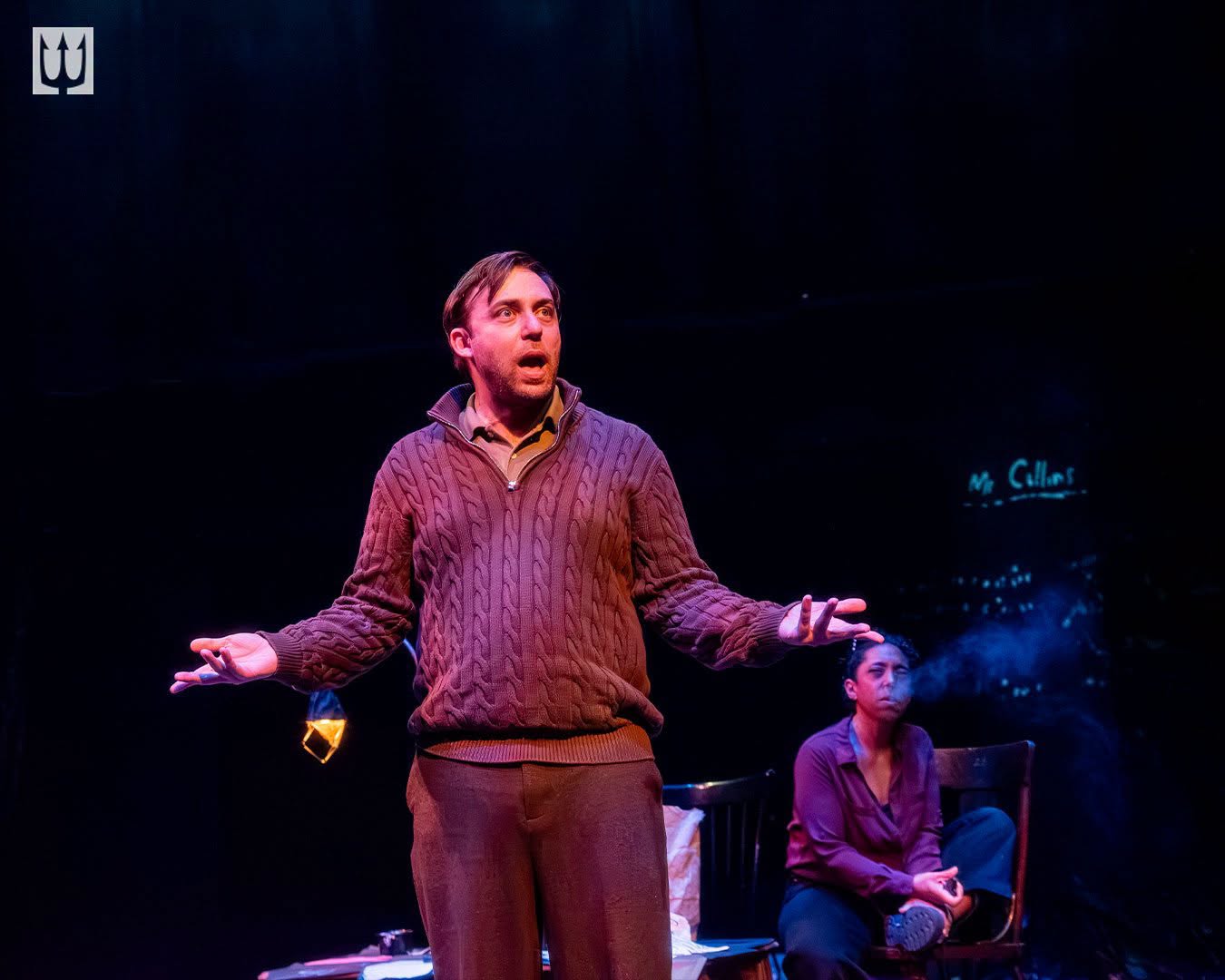
Liliona Quarmyne plays Questa Bennett, an inspector with the RCMP “who is the best at what she does. She is unparalleled- the really difficult cold cases always get sent to her because she’s extremely good at her job, and she thinks the way that other inspectors and investigators do not think. [She’s] specifically good at finding missing people, and specifically missing children. There is only one child that she has never found in all her career. She will do whatever she needs to do [to find them],” Quarmyne says. Amy Reitsma plays May, a “marine biologist, mother and partner” and Questa is investigating the disappearance of her six year old daughter Lucy. “My mother has also died,” says Reitsma of May’s experience, “and so there’s a bit of a mysterious circumstance surrounding this, like there is with any child that goes missing, and so I’m not necessarily being interrogated, but I’m being interviewed by Questa, and together we are trying to figure out- where is Lucy– and that involves going through my life and exploring my history, and kind of fleshing out the character of May.” Chris George plays Casper Collins, the partner of May, and the father of Lucy. “I’m also there to provide more of the history and more of the history of our relationship, and build out the profile, and see what happened over the course of our relationship and life together,” he says.
Since Dan Bray started writing this play ten years ago the subject matter of missing children has become an even more delicate one for Nova Scotians. Lilly and Jack Sullivan disappeared from Lansdowne Station on May 2, 2025, and Dylan Ehler has been missing from Truro since May 6, 2020. We discuss how the impact on the community can both be a situation where the parents are desperate to keep their child from fading from the headlines and their case being forgotten, and one where amateur online sleuths put forth their own theories and speculations about the case- sometimes in ways that create more trauma and pain for the child’s loved ones. “There’s something that happens with missing kids,” says Quarmyne, “where it’s like the public and the community- everyone wants to have a theory, and everyone wants to solve [the case], and know what happened. That they have a sense of who these humans are, and what their world was, and what the relationship with parents and teachers and friends and community was…” “It’s almost nice to be able to do that in the context of a show where- yes! You can come to the play, and you can try to solve this mystery… and you’re not ruining someone’s life,” says George. “It’s heavy subject matter. It’s a heavy process. It’s definitely something where there’s always some sort of fascination with the public- that’s why murder mystery documentaries exist- I think it’s because the stakes are so high too, because you say ‘oh- this is something worth my attention, this is something worth my knowledge’, and it does consume you because it is such a horrible thing to happen when it happens.”
“And anyone can relate to the fear of it,” adds Quarmyne, “the potential of it. The knowledge that nothing is guaranteed. The children that we love in our lives are vulnerable beings.” Both Quarmyne and Reitsma are mothers, and both relate stories of a few minutes where their sons were out of their sight, and how terrified they felt. Reitsma says that when her son was momentarily lost in an elaborate corn maze in France she felt “rage and fear… in that instant we [didn’t] have time to think that it’s going to be okay, we just have to find him because… there’s so many things that could happen to him.” The actors bring their own life experiences into inhabiting these roles, and the play draws a poetic connection between the profound mystery surrounding Lucy and the profound mysteries in the depths of the ocean that her parents study.
The actors say that reimagining the play in this larger space has meant that while the words on the page haven’t changed the concept here at Neptune is different than it was at the Bus Stop Theatre. “It was so immersive in the Bus Stop, and here it doesn’t necessarily feel like as much of a fishbowl, but it does feel more like you’re in the ocean, because there is so much more space, but then we have maintained some of that intimacy of certain scenes that we had established at the Bus Stop, which is an interesting challenge because when you’re in a big space and you’re doing really close scenes it’s being able to still communicate that message out to the audience without having the benefit of having them right by you to watch,” says Reitsma. “The work that the designers have done, and the imagination and creativity…” she says. “It’s really incredible,” adds George. “I remember in the first run thinking that the tech was the fourth character, and it absolutely remains true [here]. There’s a reason why MacKenzie [Cornfield] was nominated for a Merritt [Award] for projections, Jackson [Fairfax-Perry] was nominated for a Merritt [Award] for sound design- we’re working with the top people in Halifax- they’re so good at what they do, and it felt so delightful to get to go on stage and start to play in the space that they’ve created, and adding in all those textured elements is really phenomenal because they’re just all so good. Katrin [Whitehead]’s set is amazing- every aspect really is the fourth, and fifth, and sixth, and seventh character of the show because it creates the atmosphere and creates that sense of depth and space, which is lovely to get to play in- and it really helps the story, and makes us more confident on stage doing potentially weird theatre,” says George.
“There’s this really challenging, but also playful, space- it creates this kind of liminality- I feel, for me at least, where I’m in the world, but I can’t see the world- we know that there are projections playing on us, behind us, around us, but we can’t see them necessarily, so you’re sensing their presence, and there’s this delicious play between what might be happening and what’s actually happening, which, technically, can be quite challenging,” says Quarmyne. She gives an example of director Burgandy Code telling her that she needs to find a new way to move during a specific moment because of something that the projections are doing. “It might not be a way that is initially intuitive to the character, but it is the way that serves the story, so it’s interesting to learn to interact with this tech [like it’s a character] that you can feel, see, sense sometimes, but not always.”
“It doesn’t overpower the story,” says Reitsma of the tech. “It’s very supportive of the story, and it feels very unified that we’re all telling the same story.”
Burgandy Code directs the piece, and she directed the premiere at the Bus Stop two years ago as well. Quarmyne and George just recently worked with her as fellow actors this past summer at Shakespeare By the Sea, so it’s interesting to now be working with her in a different capacity.
“She’s honestly one of the most creative directors I’ve worked with; she’s also one of the wordiest,” says Reitsma, and all three burst into laughter. Reitsma says that Code set up this room where she wanted the actors to feel empowered to give feedback and to have open communication and a more equitable room than the typical hierarchical theatre structure. “That was really hard for me,” admits Reitsma- to change her approach in rehearsal to a space where she has a bit more agency. She says that one day in rehearsal she was trying something, when Code interrupted to say something and she told her to stop talking. “I was mortified because I’d never spoken to a director like that, but it was fine, and it was funny, and we all moved on, and it was actually a really nice experience to be able to have those little bubbles that we all get in in rehearsal, and to be able to express that, and then move on. We’ve had some difficult conversations in a fairly open way, I would say.” “She is unafraid to swing hard with the full knowledge that we could fall on our butts. We could all fail, but she has deep trust in us, and deep trust in the vision, and deep trust that we won’t fail– it’s entirely possible that we will, but she goes for it anyway, and she pushes, like with love, but she pushes hard, and there’s never a point of settling. There’s never a point of ‘oh okay, we’ve got there.’ It’s like, ‘okay, we arrived at this point, and now we’re going deeper, and deeper, and deeper, and we just keep peeling and peeling and peeling and peeling,” says Quarmyne. Reitsma says this can be frustrating as an actor too, “there are moments when your ego is challenged.” “It requires a lot of bravery,” agrees Quarmyne, “It’s very scary.” “And patience from her, and from us,” says Reitsma. “I’ve definitely had moments where I’ve been like, ‘can we just decide when is good enough?’ But the answer is never, of course, it shouldn’t be.”
“On the surface Dan has written a murder mystery,” says Quarmyne. “Chekov, it’s Chekhov,” says Reitsma, referencing the dense layers of famed Russian playwright Anton Chekhov who wrote The Seagull in 1895. “When you crack the play open the themes that are in this play are so relevant to how we live in the world, and live in Nova Scotia, there’s such important themes that really speak to the times we’re living in, and that’s pretty neat,” says Quarmyne.
“I had the great pleasure, along with Liliona, of getting to work with Burg as an actor this summer. We’ve gotten to spend so much time together, and you don’t often get to work with the same people back to back, which is really nice. I remember the first time I was cast in Deepwater I had not met Burgandy, but I had asked around, and was like, ‘hey, tell me about Burgandy,’ and all I heard is that ‘she is deserving of her Halifax icon status’, and oftentimes I hard from multiple people that in a show Burg will be the stand out actor because she is very raw and vulnerable, and is an incredible talent as an actor, and I think she really brings that sense, having seen her go through the acting process through multiple steps of play, and trying out different ideas, that’s how she is as a director, in terms of bringing forward these different ides, and wanting to play, and wanting things to be different, and wanting you to do different choices, and to experiment, and to play around, and so really being able to dive in and engage with that is definitely sometimes a challenge… but the benefit of this being a remount is that we definitely have a little more time to play- already coming in with that foundation of experience- and to be able to really change the show in a very different way from its original inception. It was definitely exciting to go through that progress,” says George.
“It’s pretty special to be in the room with someone who is so deeply caring about their work and holds onto it both tightly and loosely at the same time,” says Quarmyne of playwright Dan Bray. “Especially in the reworking we’ve done in this process. I think there’s a lot of potential that a playwright could really hold it and be like, ‘no, it’s supposed to be this– this is the vision, this is the shape, this is what I was going for,’ but I think Dan has managed this really beautiful balance of saying, ‘here is my work, here are my words, my framing, then Burgandy, you’re the director, now you take it and you make it yours- and by extension ours.”
“I think it’s awesome to see the new generation of playwrights come forward,” says George. He references the posters of this current season on the walls around us in the Neptune Studio lobby, and he says, “You have your hits, you have your Les Mis, you have your Grinch, Little Women, you have these well known properties that you have to program because people will come see them, people want to see them, but huge shout out to Jeremy [Webb] for also caring enough to invest in the new Nova Scotian playwrights who are coming out. Dan’s a great playwright. It’s so awesome to see Nova Scotia investing in itself, and people coming out and supporting that, and wanting to see the talent that Nova Scotia has to offer. It makes Halifax one of the most special places that I have worked, and there’s a reason why I keep coming back here, and I’m likely going to move here. It’s just a beautiful environment for creativity.”
“It is really fantastic to be working on a new play at Neptune written by a local playwright in this time when the arts are literally fighting for their lives in Nova Scotia, and to have the privilege of being able to work on a new play like this is something I don’t take lightly, and I just want to see more of this happening, because there is so much talent here, and we often have to fight so hard for what we get, and we’ve always had to fight hard for what we’ve received, but there is so much potential here. I really feel that if we had more investment, real investment not charity, investment in the arts in Nova Scotia, it would just bubble, bubble, bubble, and grow because Dan is the tip of the iceberg- he’s a wonderful playwright, and he’s very talented, and there’s so many other [talented folks who live here too],” says Reitsma.
Neptune Theatre and The Villains Theatre’s production of Dan Bray’s Deepwater directed by Burgandy Code opens October 23rd, 2026 and runs until November 1st at Neptune Theatre’s Scotiabank Studio Theatre (1589 Argyle Street, Halifax). Performances run Tuesday to Saturday at 7:30pm with 2:00pm matinees on Saturday and Sunday. Tickets range in price between $29.00 and $49.00 based on seating (but all seats are good!). They are available for purchase online here, by calling the Box Office at 902.429.7070, or visiting in person at 1591 Argyle Street, Halifax.
CONTENT WARNING: This production uses haze, flickering lights, water-based vaping, and mature content. For a full list of content warnings please click here.
Industry Night
Tuesday, October 27 – 7:30pm
Masked Performance
Sunday, November 1 – 2:00pm
Talkback
Thursday, October 29 – 7:30pm
Neptune Theatre has a range of Accessibility Options for folks (Both Fountain Hall and the Scotiabank Stage are accessible for wheelchairs. Patrons can now purchase wheelchair seats for individual shows online with the promo code WHEELCHAIR. For more information, please contact the Box Office.). Click here for more thorough information.
Canadian Theatre Criticism is an essential part of a healthy and thriving theatre community. It helps theatre companies find new audiences for their shows, deepens audiences’ engagement with local artists and the work being created in their communities, and it is one of the best ways to preserve a snapshot of an ephemeral art form for future generations of theatre lovers. TWISI relies on support from its Subscribers, folks like you who care about the survival of local and independent arts coverage. Please consider becoming a Subscriber today, or click here for more information. Thank you so much for supporting TWISI.