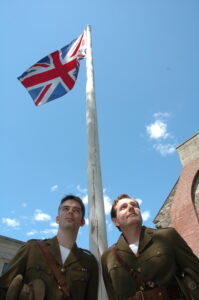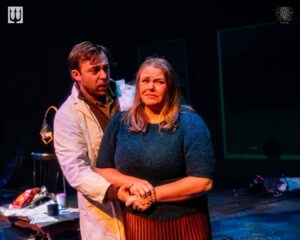
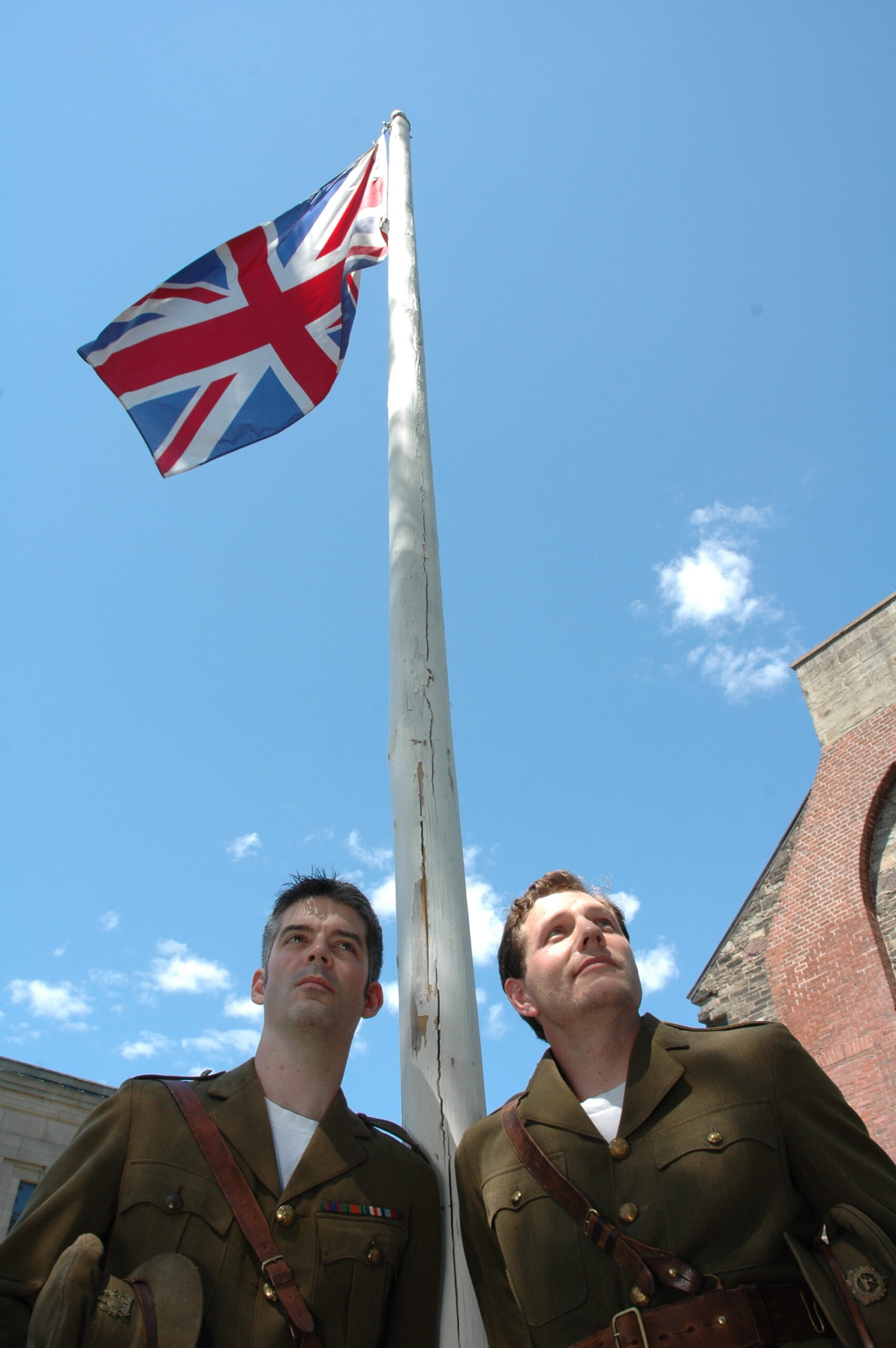
Caleb Marshall became Festival Antigonish’s Managing Director in the Spring of 2024, but in his thirty year career in the theatre he has worked in a variety of different capacities- he has been an actor in Toronto and at the Stratford Festival, he’s also worked as a theatre director and playwright. It has been a long time since he has been on stage, almost a decade, although he has acted in a bit of film and television in the interim, but tomorrow, November 11th, 2026- Remembrance Day- he is going to bring 18 characters to life at the Immaculata Hall for a one night only concert presentation of Eric Peterson and John Gray’s musical Billy Bishop Goes To War with his friend and collaborator piano player Michael Doherty. I had a chat with Marshall this morning via Zoom about this event, which supports the Bridge the Bauer Campaign and the Legion Poppy Fund.
Billy Bishop Goes to War premiered at the Vancouver East Cultural Centre co-produced by Tamahnous Theatre on November 3rd, 1978. It dramatizes the life of Canadian World War I fighter pilot Billy Bishop. Bishop (1894-1956), who hailed from Owen Sound, Ontario, was officially credited with 72 victories as a flying ace during World War I, which made him the top Canadian and British Empire ace of the war. For his achievements he received a Victoria Cross. Peterson and Gray performed the musical across Canada, in Washington DC, on Broadway and Off-Broadway, at the Edinburgh Fringe Festival, in Los Angeles, and in London, and they have continued to revive the production in Canada over the years. The play has also been produced and performed countless times by others across Canada and in the United States since 1978.
For Marshall, whose mother was a history teacher, he grew up listening to the recording of the music on vinyl saying, “This show has been part of my understanding of remembrance since childhood.” He and Doherty performed in the musical together once before nineteen years ago. Marshall says that he has been listening to the old rehearsal track from that production to get not just the lines back into his body, but the rhythm and the timing. “Initially I’d be a second or two behind the recording,” he says. “I was, like, repeating myself. Then within a week or two I could say it with the recording, or almost be ahead of the recording.” He says that Doherty arrived in Antigonish just yesterday, and that they ran through the First Act, and they are running through the Second Act this afternoon, and then they will keep running through it tonight, and with tech tomorrow ahead of the 7:30pm performance.
“It aligned a number of things for me- because the Bauer is under construction there’s not as much theatre festival activity this Fall, so there was a window of opportunity [to do this play]. I have a personal and family connection [to World War I], I wrote a play on World War I about 27 years ago adapted from 45 letters, and it was actually published last week, so digital copies will be on sale [tomorrow], and anyone who purchases a copy of the script on November 11th the proceeds will go to the causes as well. There’s always been an element of me finding some kind of theatrical way to honour Remembrance Day.” He says that as an actor and theatre maker often he has been in rehearsal on Remembrance Day, as theatre workers don’t always get the same days off, and he says that he was the person in the room who would ask the director or the stage manager if they could pause for a moment of silence at 11AM to honour Canadian veterans.
There is also a bit of a Remembrance Day event around the main event which allows him to collaborate with his wife, Meredith Zwicker, a formidable musical director, singer, piano player and actor in her own right. “When I was [Artistic Executive Director] at Sudbury Theatre Centre we had a cabaret space not unlike our green room here at the Bauer, and Meredith put on a war song cabaret that instantly became a war song sing along, you can’t gather that audience and not have them sing along to “White Cliffs of Dover” or “I’ll Be Seeing You,” and it was actually quite magical in a way. So, we wanted to do something similar here [for this event]. Immaculata doesn’t have reserved seating, and often audiences will come a little early to choose their seats, and we wanted people to really feel like they’re walking into a war-era YMCA canteen or something.” He says that folks can feel welcome to come in as they normally would- but Zwicker has gathered some friends who will be providing some entertainment around the piano, and the folks arriving will be welcome to sing along if they’d like. “It’ll give that feel of music in the background. It’s more about creating atmosphere and vibe and ethos in the room.”
There will also be historical artifacts that audience members can see from Marshall’s own collection of wartime history and family heirlooms. “I’m a bit of a collector,” he says. “I’ve always felt that objects hold energy, hold history, hold memory, and so I don’t look at some old thing and just see it as an old out of date thing, I see it or imagine the lives that it witnessed- that it lived through. So, for the first time I have assembled a World War I exhibit.”
Marshall says that one of the things that he loves about doing wartime stories in the theatre is that it brings out other people’s memories, and often they too feel moved to share a story from their own family, which builds a connection. For this reason, he has included his own family’s story as part of the exhibit as well. His great grandfather, Thomas McMenamon, from New Brunswick, was an infantry medic who was gassed during World War I at Ypres. “That’s the first time the Germans used gas. He was sent to Glamis Castle in Scotland- it’s the childhood home of the Queen Mum, and you may remember it from the Scottish Play [Shakespeare’s MacBeth], Shakespeare made that castle famous. But they converted that castle into a convalescent hospital during World War I. A lot of big castles, cathedrals, those kinds of things, were converted. Mary Ann Smith was a nurse at Glamis Castle and her and Thomas met, fell in love, got married, and became my great grandparents. So, had he not been gassed I would not be here today. It’s a really strange thing to be kind of oddly grateful for.” McMenamon never recovered from the injuries he sustained from the gas at Ypres. He died in 1932 of lung disease. Marshall’s grandmother was only 13 when her father died. “Four years later, in 1936 they unveiled the Vimy Memorial in France and my great grandmother travelled to that unveiling.” Marshall has some photographs from that voyage and also a copy of the speech that Mary often recounted about that journey to various women’s groups and parishes upon her return. “There were definitely veterans on that trip, there were war widows on that trip, but she was in a unique place of being a recent war widow in 1936.” During the 90th Anniversary of the Battle of Vimy Ridge Marshall was living in England, and they had a huge 90th Anniversary ceremony where the Queen attended. “My younger brother inherited my love of World War I history, so he’d actually spent the previous two summers as a guide at both Beaumont-Hamel and Vimy Ridge.” So Marshall and his brother and their father went over to France for the 90th Anniversary and his brother was able to be their tour guide through all the battlefields of Flanders. Some of the objects that he has collected came from that experience.
Some of the items in his collection include a bullet encasing, a shell bottom base and shell cone and shrapnel that it would have been full of. The shell cone is stamped “1916” and was found at the Somme. There’s a bayonet from 1887 that was the style that was still being used in 1914. There’s a Leeds police whistle. “It’s got that unmistakable sound- that blast that sent soldiers over the top.” He also has more domestic items from the time like a spoon, some toy soldiers, and his great grandfather’s straight razor. He shows me a note of a hundred German marks from 1910. “By the end of the war a wheelbarrow full of those would not buy you a loaf of bread.” He has a number of coins spanning the timeline of the play, a hat, a little statuette of a nurse holding a solider, cap badges, and buttons. He also has a number of old books including what is likely an original English publication of All Quiet on the Western Front (1926) by Erich Maria Remarque, a book Rudyard Kipling wrote in 1915, just a year into the war, called France at War, the 1910 Rules and Regulations for the Military as it was updated in 1914, which immediately became obsolete with the advent of machine guns, and a Canadian book called The Kaiser’s Guest by Frank C. MacDonald published in 1918. “It is about a young Canadian in World War I who was taken prisoner and escaped,” Marshall says. He also has a guidebook that he bought while at the Kremlin in 2007 and he realized that the edition had first been published in 1914. “They hadn’t updated it,” he says, floored. “It was published when they still had a tsar.” You can also find a list of more Canadian World War I plays, and you can learn a bit more about Billy Bishop. Marshall opens up the jacket of the original recording of the show on vinyl and shows me how the entire inside photograph is just of Bishop’s many medals.
He has gotten some uniform pieces and caps from Theatre New Brunswick. “There’s two professors from St. Francis Xavier University’s history department who are experts on World War I, and they’re going to stand by the exhibit to answer questions that folks might have, or to give any of the items shown further context.
“Billy Bishop was made an air Marshall in World War II more to help with recruitment and propaganda, but there’s a speech at the end of [the play] where he’s almost a bit surprised that we find ourselves here again. You kind of wonder what it was all for, but we aren’t the ones that get to decide those things.” He notes that with all the conflicts in the world today the experiences being characterized in Billy Bishop Goes to War aren’t as distant as we may think. “I think history is just one great play, and we occasionally get to unpack a chapter of that, as theatre practitioners we get to carve out a small piece of that story.” Marshall also says that as Canadians we tend to “downplay our successes, our contributions, our heroes. This show offers a chance to explore and celebrate the life of a Great Canadian.”
Marshall got to see Eric Peterson and John Gray perform the piece during one of the remounts in the late 1990s. He notes that the piece is often thought of as a one person show, but the piano player, and the relationship that is established between the performer and the piano player is vital to the play as well. “One of the themes and takeaways is that unless you had friends [when you were in the military during wartime]… it was the only thing that could keep you sane in a way.” He also notes that all the underscoring and the sound effects that the piano does in the show makes it another character. “It’s also an underdog story, which is what people are drawn to, right? He’s on record as the worst student RMC ever had. He can’t believe he was made an officer… he almost gets kicked out a couple times, he’s constantly getting injured, he makes a complete mess of his life in the first couple of years. Then he sort of finds an outlet, with some support, finds the outlet where he can excel. I think there’s a lesson in that too. Sometimes people aren’t working in the right kind of structure, or environment for them to excel. I think it’s nice to watch this small town boy, self-proclaimed screwup became an international superstar hero by the end hopnobbing with Kings and Queens and the world elite.”
About Bridge the Bauer
Bridge the Bauer is a community fundraising campaign supporting essential fire and life-safety upgrades to the Bauer Theatre, home to Festival Antigonish Summer Theatre and Theatre Antigonish. The campaign helps preserve a shared stage for professional and community theatre, youth education and accessible arts programming while plans advance for a future Antigonish Arts Centre. It protects both a cherished gathering place and the creative opportunities it offers artists, students and audiences throughout the region. For more information or to donate, please visit festivalantigonish.ca/support/bridge-the-bauer.
About the Legion Poppy Fund
The Royal Canadian Legion Arras Branch 59 in Antigonish administers a Poppy Fund supporting veterans and their families in need. Donations help provide financial assistance, care and educational bursaries, turning remembrance into practical support for those who have served and their loved ones. For more information or to donate, visit antigonishlegion.ca/poppy-campaign.
PERFORMANCE AND TICKET INFORMATION:
Billy Bishop Goes to War — In Concert
By John Gray and Eric Peterson
Featuring Caleb Marshall and Michael Doherty
With the presentation support of Michael Steinitz and the Antigonish Performing Arts Series
Wednesday, November 11, 2026
Immaculata Hall, Antigonish
General admission seating
7 p.m. — Doors open with classic wartime songs
7:30 p.m. — Performance
Approximately two hours, including one 15-minute intermission; evening concludes around 9:30 p.m.
Tickets:
· $60 Supporter: for those wishing to give a little more to the cause.
· $40 Regular
· $30 Access: available to students, seniors, veterans, service personnel, arts workers and anyone experiencing a barrier to attendance.
Advance tickets are available, cash only, at Antigonish 5¢ to a Dollar on Main Street, beginning Monday, October 19. Cash, debit and credit will be accepted at the door on performance day. The artists are donating their time and talents so that, after minimal production costs, every dollar raised will support Bridge the Bauer (80%) and the Legion Poppy Fund (20%).