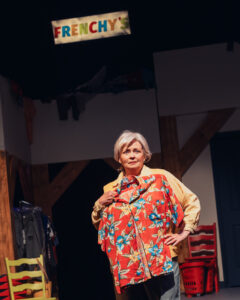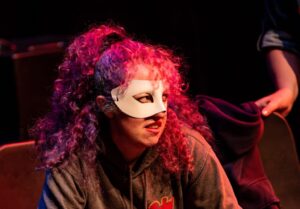
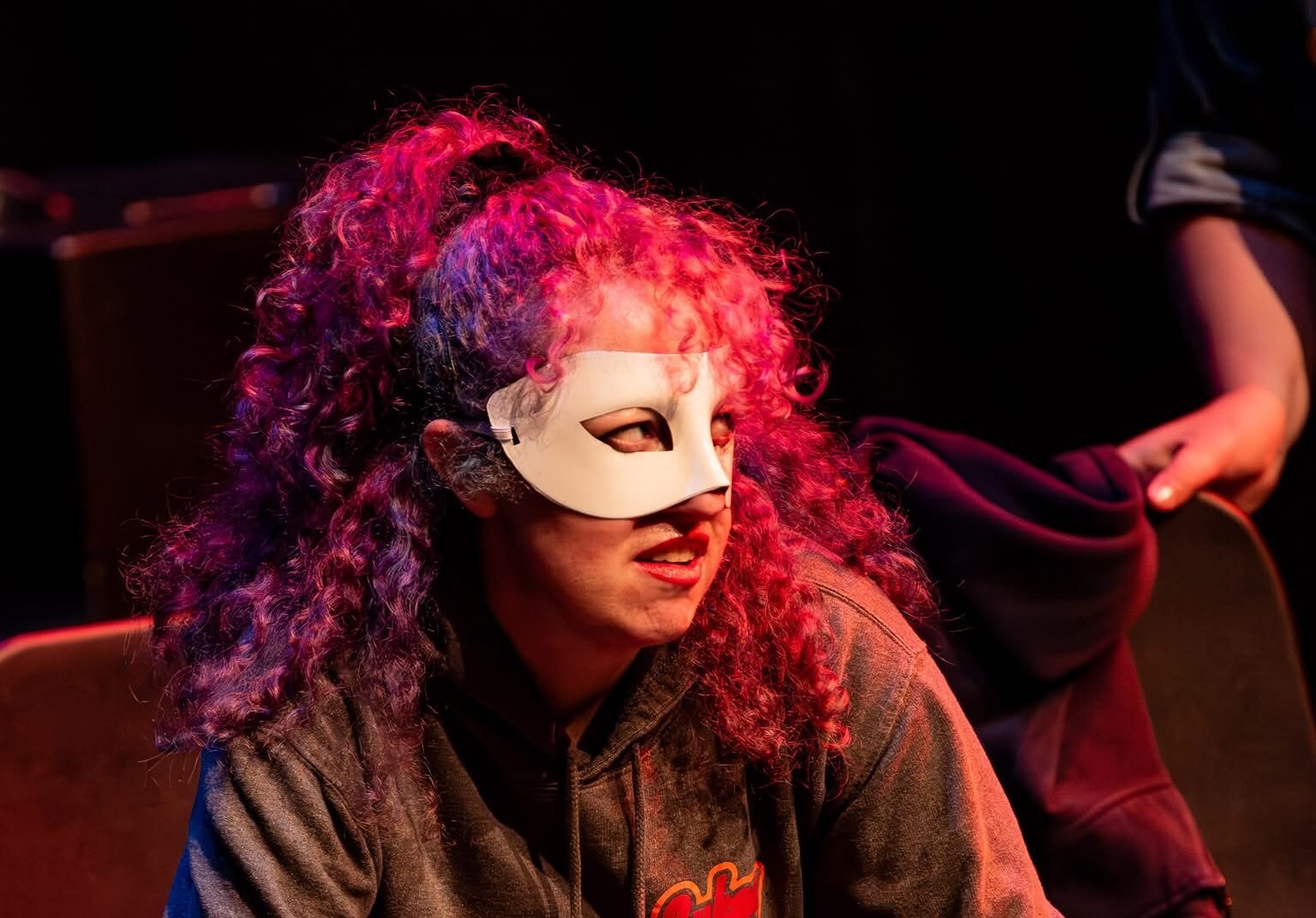
Cat McCluskey as Zero in the Workshop Production Photo by Stoo Metz
One of the characters in August Van Meekeren’s play Dedicated To You, The Wonderful Audience writes a problematic play about a character experiencing extreme mental health issues. The play explores questions of ownership over experience, and the ways that the well intentioned (and the not well intentioned) can cause real harm when they take creative liberties and dramatize diagnoses that they know very little about. In contrast, in creating this real play Van Meekeren has taken great care to craft something that is rooted in truth and accuracy and giving dignity to their protagonist. I chatted with Van Meekeren and director Kaitlyn Thompkins via Zoom about how the play first came about before its premiere at the Halifax Fringe in 2024, and bringing it to the Bus Stop Theatre for a very limited run with just two shows left- tonight and tomorrow at 7:30pm.
Van Meekeren says that the play came about from a long process of them struggling with their own mental health, contending with the medical care system, and then also being frustrated by the representations of mentally ill people they were seeing in film and television. “I noticed that every story that had a person with a psychotic illness was usually used like a murderer or somebody who tragically dies, like a message of morality. And [the mentally ill character] never really gets a chance to just explore [their illness] and still be a person at the end. They always get transformed into something else. This was my way of grabbing the narrative and making it mine.” This is also the first time that Van Meekeren will be playing the role of One, the protagonist in the show.
Kaitlyn Thompkins has also been brought aboard for this remount as the director. The two have known each other since they were quite young. They are both from the valley, they both grew up doing shows with CentreStage Theatre in Kentville, and they were a year apart in their schooling at Dalhousie. “I was a very hyperactive kid,” says Van Meekeren. “My parents noticed very early on that I had ADHD.” They say that their parents noticed them mimicking the drummer at church and realized that perhaps they needed to have some outlets for their energy. They signed them up for drum lessons and for an audition for a local production at CentreStage called Snow White and the Seven Dorfs [when they were six]. “I was Springy. I walked with a spring.” Their sister was Sneezy. They gotten bitten by the bug because they were able to make the audience laugh with their funny walk. “Normally in my real life being weird was ostracizing and people didn’t like that. But in this format, I could be weird and it was a way of connecting people to me instead of pushing them away.” They did every show that they could from there, and by the time they were in High School becoming an actor was the only option they could see for themself. “It’s just the thing I loved, and I didn’t want to do anything else.” They say that as an adult finding their way to the Fountain School they have fallen more in love with the collaboration, and the storytelling aspect of the theatre. Thompkins’ first play at CentreStage was called Biggity Bad and the Three Little Pigs and she played Biggity Bad. Her mom was her biggest early supporter. “I was one of those little kids who would play with Barbies, but I was dead serious. You were on set, and I would create these whole elaborate stories for them.” She says that she relates to Van Meekeren having a hard time connecting with others as a young person, and says, “[theatre] felt like a safe place to become myself.” The two of them went on to work on many shows together at CentreStage.
Van Meekeren says that because Thompkins is “very compassionate and empathetic” they thought that she would bring an advantageous perspective to this project. Thompkins says that she has a long history with this work because she remembers seeing a very early draft when they were both students in the Acting Program at Dalhousie’s Fountain School of Performing Arts, and then she saw the show at the Fringe as well. “I think the overarching thesis [is] what does it mean to live with yourself? What does it mean to walk through this world, existing as you are and accepting who you are? I think that on its own is so universal, and anyone can latch on to that feeling.” She says that even though One’s trajectory is so specific, she thinks that it will resonate with folks in broader terms.
Another theme that is explored in this play is the idea of sitting in the discomfort. “People are always trying to avoid uncomfortable things,” says Van Meekeren. Even in conversations about mental health they point out that there are topics within this conversation that folks find easier and more comfortable to talk about- like Anxiety and Depression, and then there are topics that are scarier for folks that they don’t even want to have to consider. “What I think this show does is it kind of throws that [discomfort] in your face right at the top. It’s like ‘okay, no, you are uncomfortable. Bam. And then we pull it back slowly throughout the show as a way of responding to that response.” They say that accepting that it’s uncomfortable is the first step; “if we all can manage to do this, we will probably in the end be kinder people to the ones around us.” “It punches you right in the face with the obstacle of these mental health crises, and these mental health illnesses, and I think what it does after that is it shows you that the root of all those things, it’s all the same. Those things that we’re not so scared of, the root of these scarier topics, it’s still there. It’s still anxiety; it’s still depression; it’s just a new format. It’s just a new way that we’re not used to talking about. Because of that, you can relate to that person on the bus [who might be visibly experiencing their mental health issues], and you can feel for that person on the bus. We all have the capabilities to do that,” says Thompkins.
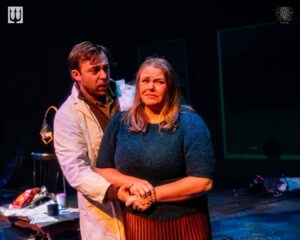
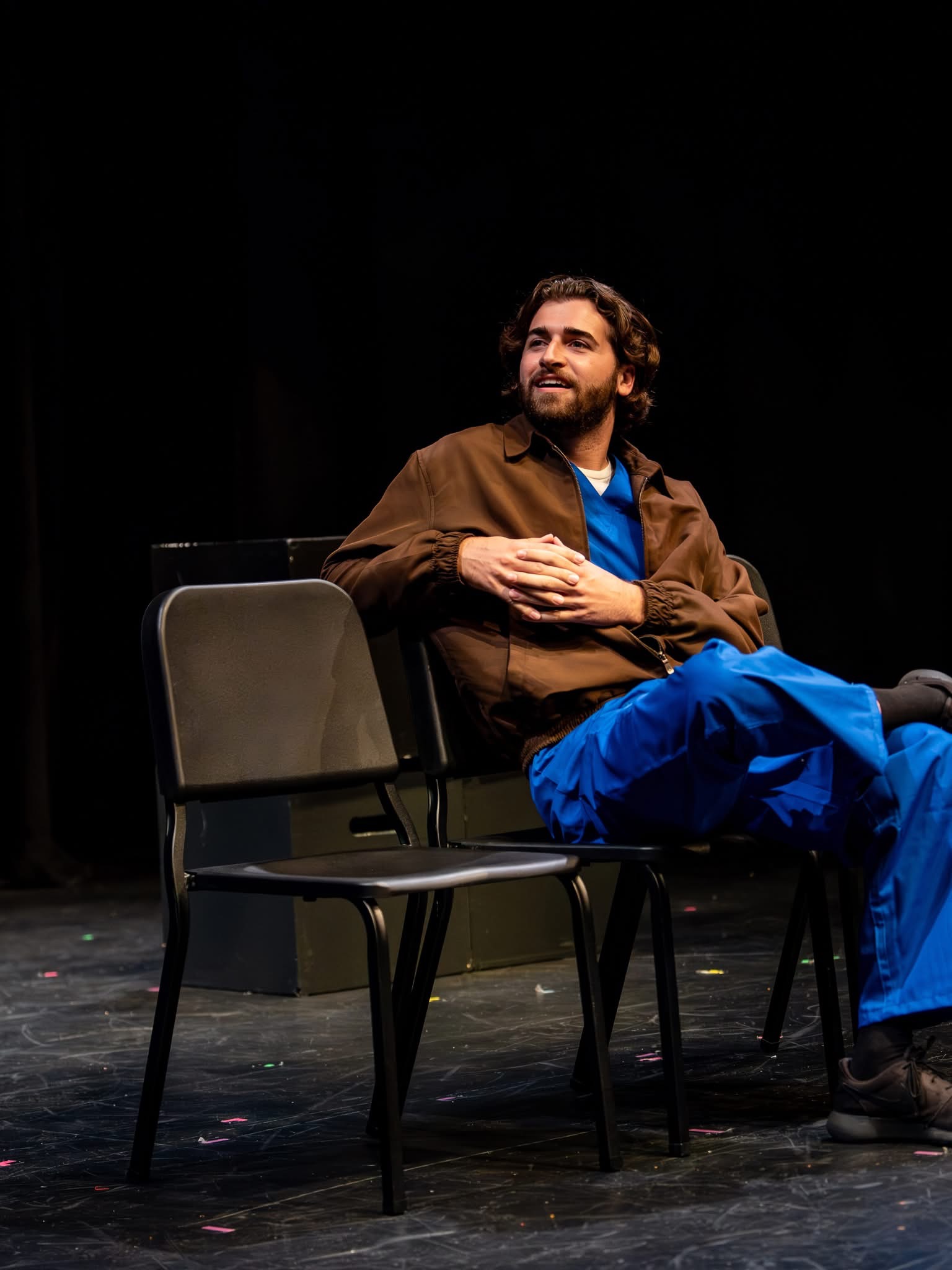
The choice to name the characters One and Two is a further consternation to One, who doesn’t want to be a part of this play, as their function as the lead character is inherent in their name. “Initially the writing was to kind of constantly throw it in that character’s face and be like, ‘No. You are the star of the show. You are the one. And the person who you want to be the star, the person who’s okay with it, the person who’s part of theatre- they’re Two.'” Zero, the play’s director, gets their name because they are not a performing part in the play at all. “They’re still a part of it, but they’re outside of it.,” says Van Meekeren. The Nurse, Ben, brings the medical system into the conversation. “I think it’s important that we analyze that connection and relationship that happens between somebody who’s going through an episode and the people who are on the other side of it in the hospital- so that we can get the full perspective of the people who are around people who have these illnesses. You’ve got the people inside of it, the people slightly outside of it, and then the people who are very outside of it, but are in the system that deals with it. Then we can explore all the aspects of how this affects people’s lives,” says Van Meekeren.
They say that they really wanted to give the audience a happy story, to eventually get to a brighter place with the characters. “There’s a really long period of time where [the mental illness] is confusing because it’s new. It’s very disorientating because it’s forcing you to look at the world differently. You can’t do things the way you could before. You have to figure out new ways to do them. For me specifically, I was doing work, I was going to school, I was trying to put myself through theatre the way I normally did, and now instead of just hearing other actors talking to me, I’m hearing other things, and it was really getting in the way. The choice in the end was to not ignore it, not to make it go away. Sometimes these narratives position medication as the thing that solves the problem, but I don’t think this is a problem that gets solved. So, I wanted to create a story in which somebody finds their way through the problem and realizes that the problem doesn’t go away. You just have to change your perspective on it, and accept it as now being a part of who you are are, and kind of reconstruct yourself. It’s a difficult process, but you do have to do that. So, in this show I wanted to show somebody who’s starting in that ground zero of complete unknowability, and gets to a stage of knowability such that they can find a little bit of comfort again. Again, one of the theses is- you can’t be comfortable all the time, but getting to an amount of comfort is the main goal of the show,” Van Meekeren says. “The other big thing that I wanted to explore with this is sometimes shows that are about things like these have these grandiose final moments. They try to bring you into this gigantic crescendo, and I thought, ‘people are just living their regular lives and they don’t always get that.’” There is still often an assumption that with therapy and/or medication mental illness can be cured, but that isn’t always the case. “I think some people will say, ‘I hope it gets better,’ but in my opinion the thing to say would be, rather, ‘I hope it gets easier.’” They say that regardless of whether the symptoms have remained the same or even gotten worse, finding ways to manage more easily can feel like better. Van Meekeren points out that often knowing that someone else is struggling, whether with mental illness or chronic pain or grief, makes people feel uncomfortable, and they don’t want to have to contend with this discomfort. Therefore, the hope is that the other person will get better so they can go back to not having to think about the struggle. “I think this show is a dedication to grief, and the grief process,” adds Thompkins. “With grief comes a rediscovery, and then redefining of your own self and your own worth, and learning what the new normal is.”
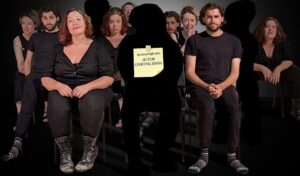
The other dedication, as the title suggests, is to the audience. Van Meekeren loves the theatre and has been involved in it for most of their life. “I came up with this concept of somebody in a play who knows they’re in a play, and isn’t happy about it, but then I realized that that was a great medium to also talk about what I think theatre does, and why theatre is so special, and the way that it could connect. So, the title is one of the revelations that happens in the show where the audience, who has been terrorizing the character, is just part of the situation now, and it’s going to be okay… but also that the show is talking about the ways that theatre can really bring us together.” They refer to the sort of tug of war between One and Two when it comes to whether mental illness can be represented in a mindful way onstage. This mirrors their own process writing the show when they too had to navigate what the best way was to tell the story. “The show can’t happen without [the audience],” adds Thompkins. “That’s why it’s so special that they’re there. They get to not only witness magic, but be part of magic. I think that’s why it’s for them and with them.”
Van Meekeren also shouts out the Laing House in downtown Halifax that offers excellent and helpful services for youth and young adults between 16 and 29 experiencing mental health challenges. They brought the first draft of the script there because they are a community service group that offer programs specifically for those who are more discriminated against within the mental health community. They wanted to make sure that the leaders at the Laing House they spoke to agreed with the way they had chosen to tell this story. These leaders highlighted that some of the language that was used in the script was important because Van Meekeren wanted to make sure that they weren’t perpetuating any harmful ideas, stereotypes, or terminology. “I was very cautious about how I put it together.” They say that initiatives that have gotten huge traction in our culture, like Bell Let’s Talk Day, are just the first step, and that folks need to keep having the more difficult conversations, and making connections and creating relationships that may not be easy, but that are nevertheless enriching and worthwhile.
Dedicated To You, The Wonderful Audience plays at The Bus Stop Theatre (2203 Gottingen Street, Halifax) just to November 12th. Performances are at 7:30pm. General Admission tickets are $10.00, you can also get $25.00 tickets that further help to support the artists and the work. They are available here. Tickets are also available (in cash) at the door before the performance on a Pay What You Choose scale.
Canadian Theatre Criticism is an essential part of a healthy and thriving theatre community. It helps theatre companies find new audiences for their shows, deepens audiences’ engagement with local artists and the work being created in their communities, and it is one of the best ways to preserve a snapshot of an ephemeral art form for future generations of theatre lovers. TWISI relies on support from its Subscribers, folks like you who care about the survival of local and independent arts coverage. Please consider becoming a Subscriber today, or click here for more information. Thank you so much for supporting TWISI.