
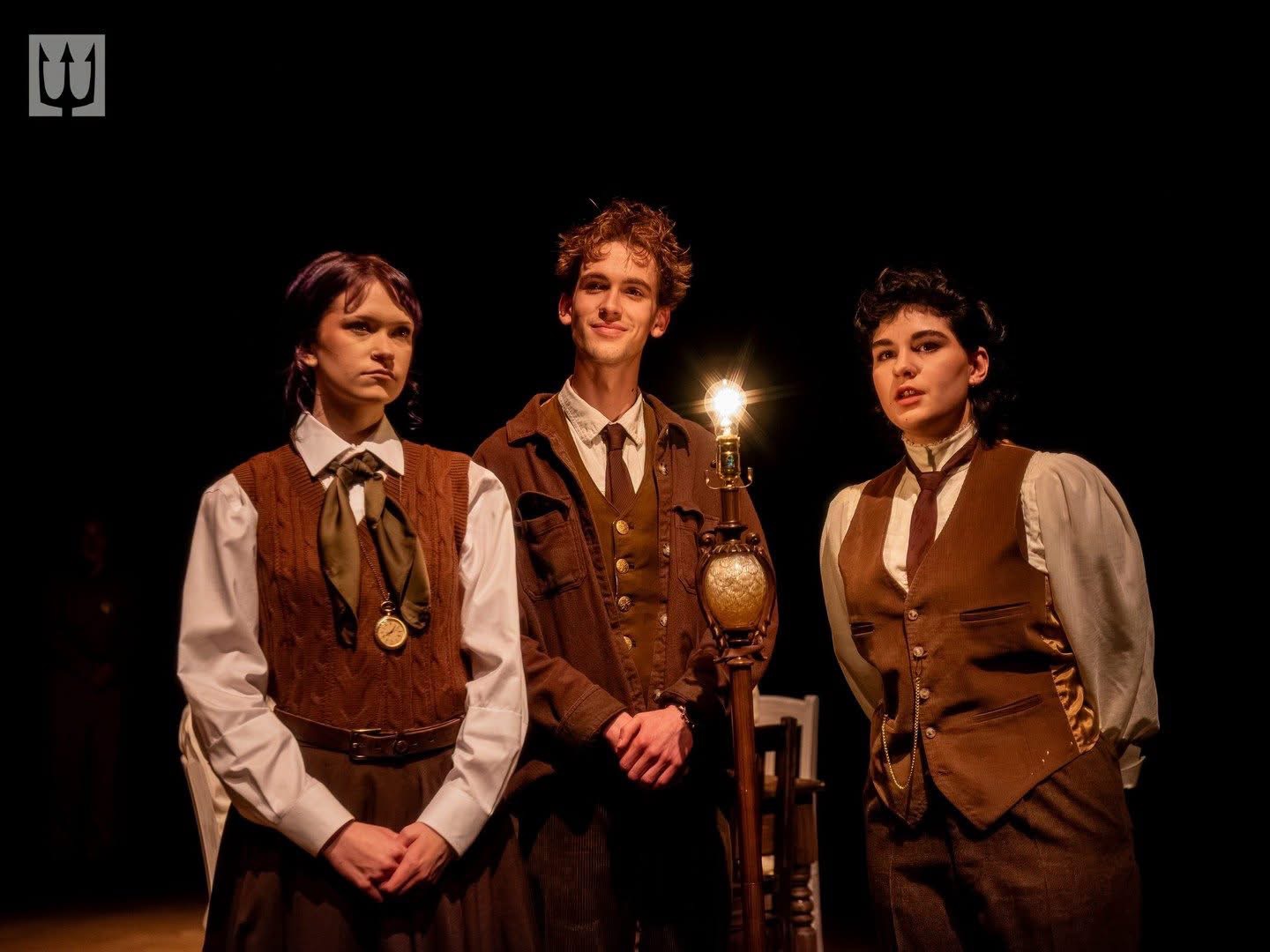
The Three Stage Managers Elise Blackmore, Joel Chiasson-Lewis, and Kaya McKenna Photo Stoo Metz
Nova Scotia has the opposite challenge of many of the other provinces in Canada where we actually do have an incredible amount of new Canadian work being performed here, which is amazing. What’s actually often harder to find are the plays of the erstwhile “canon” like Thornton Wilder’s 1938 “Great American Play” Our Town, which must be one of the plays most referenced in popular culture. This was my first time seeing the work, last night at Neptune Theatre’s Scotiabank Studio Theatre, performed by this year’s Youth Performance Company. Given that I’ve been reviewing theatre for nearly twenty years, and seeing plays for over a decade longer than that- it’s surprising that this play and I haven’t had a much longer history with one another. I’m grateful to the cast and crew for bringing it to such beautiful life so I can finally cross it off my list of canon plays that I actually, weirdly, haven’t seen yet.
Thornton Wilder is very famous for the set up of this play because it has a narrator character, here played by Elise Blackmore, Joel Chiasson-Lewis, and Kaya McKenna, and the narrator is characterized as being the Stage Manager. Having a stage manager suggests that there should be a cast of players, but the characters within Grover’s Corners, the world of the town from the title, aren’t portrayed in a meta theatrical way, despite their meta-theatrical framing. It does work, though, to provide the audience with a bit of distance from the going’s on in Grover’s Corners- it’s like the people who live there exist for us in a snow globe, something nostalgic from the past that we pick up and peer into with curiosity and, I think in 1938, wistfulness.
I was immediately struck by the pacing of this play in the context of the contemporary world. It is divided into three acts; the show has two intermissions, and the first act especially is slow, not in that it is boring, but that it is deliberately languid. Wilder is introducing us to a town in New Hampshire in 1901 where, as he says, remarkable people don’t live there, and incredible things aren’t happening. This play mythologizes the every day moments of ordinary families, like Wilder says, the folks who have been forgotten throughout history because no one whose work survives bothered to write about them. We see the newspaper boys (Milo Meuse and Charlotte Chadwick) saying good morning to the milkman (Sol Miller), and the constable (Izzy Corcoran) having stern words with the person who would, back then, have been known as “the town drunkard (Jonah Furmidge).” A father (Rylan Hislop) is upset that his son isn’t helping his mother enough with the outside chores and opting to play baseball instead. A mother (Charlie Mairead Ladutke) can’t connect with her daughter’s love of knowledge. A child hates the dress that has been laid out for her to wear. The first act, especially, is a tapestry of tiny moments that capture the truly everyday lives of working class folks.
In our own culture, of course, we tend to prioritize the exact opposite. It’s the biggest most cinematically dramatic moments that will assault all our senses (and ones we didn’t even know we had) that are usually the money makers. Our social media feeds too are filled with the bizarre, the amazing, and the rare. But, in a way, the contrast makes Our Town dramatic. There is no choice, really, but to clock into Wilder’s poetic language and to immerse yourself in a slower paced era. The second and third acts move faster, as we centre more on two young people, George Gibbs, played by Paul Fawcett, and Emily Webb, played by Haedyn Fotheringham, whose love blooms into marriage. Interestingly, Wilder characterizes a lot of secret doubts, if not in the entire institution of marriage, definitely in the prevailing attitude that children should get married as soon as they have finished High School, suggesting that giving young people time to come into their own selves, finish growing up in their own right, and explore the world beyond their homes and their town first might be preferable. In the Third Act Wilder gives us his own imagining of what happens to us after death, a quite bleak and poignant warning for us to stop taking even the monotonous and the ordinary bits of life for granted.
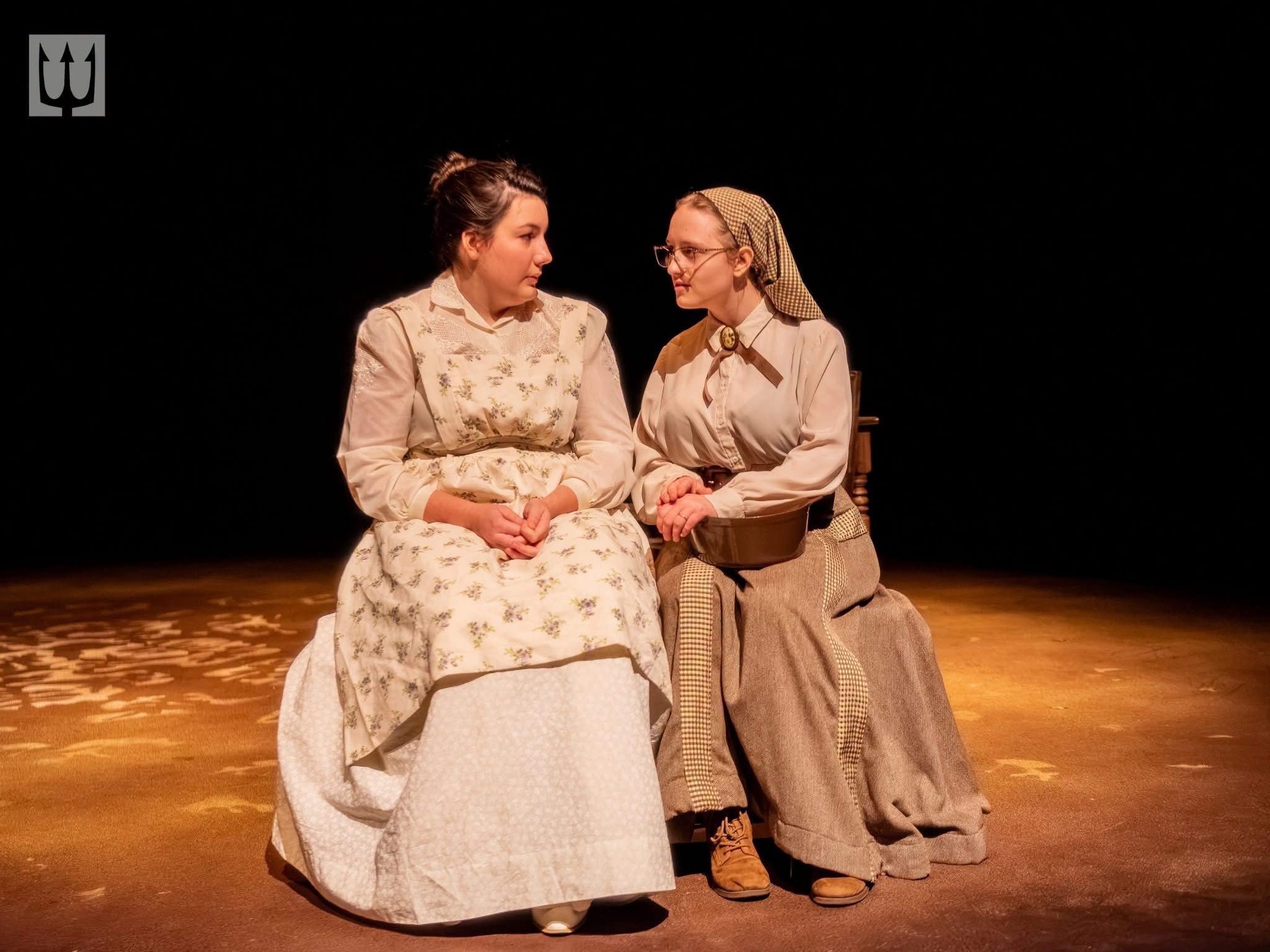
It’s interesting too to notice the ways that audiences receive this play differently in 2026 than they would have in 1938. Wilder is writing very specifically for an audience that would have been alive during the time that the play is set. For context, if Our Town premiered today the first scene would open in 1989 (sorry). I think there’s more humour in the play for audiences who are looking back on their own childhoods or their own young adulthood and chuckling over the ways that things then were old fashioned or naive with a warmth of subjectiveness that no one in the audience has the same access to today. With our own objective hindsight there is more that is uncomfortable, problematic, and even disturbing, especially in terms of the rampant misogyny, and so the humour gets more muddied.
The YPCo cast are doing a beautiful job bringing all these characters to life in ways that feel grounded in Wilder’s rich language and the first few years of the 20th Century. Haedyn Fotheringham plays Emily with a bright confidence where you can see her potential bursting out from the constrains the town have placed on her. Paul Fawcett is charming and sweet as George, but also captures his immaturity, and the absurdity that he will all of a sudden inherit all the burdens of a farm and a family, and be forced to grow up and take responsibility for all of it so suddenly. What impact will this unrelenting pace have on what kind of man he becomes? Josie Cull plays George’s mother with a heartbreaking sense of restraint, as someone who has long learned that her actions are more valued in her house, and indeed the town, than her words. There is a riveting tense scene between Paul Fawcett’s George and Mr. Webb, Emily’s father, played by Wolfgang Foster, on the morning of the wedding where Emily’s immediate fate makes both the men feel incredibly awkward. MJ Massey brings some needed levity to the play as the town gossip, Mrs. Soames,- really capturing this kind of Edwardian small town grand lady motif. Josephine Alarakhia also brings a sunny precociousness as George’s younger sister Rebecca. All three narrators do a great job of drawing us into this story, and making us care deeply about the fate of this town.
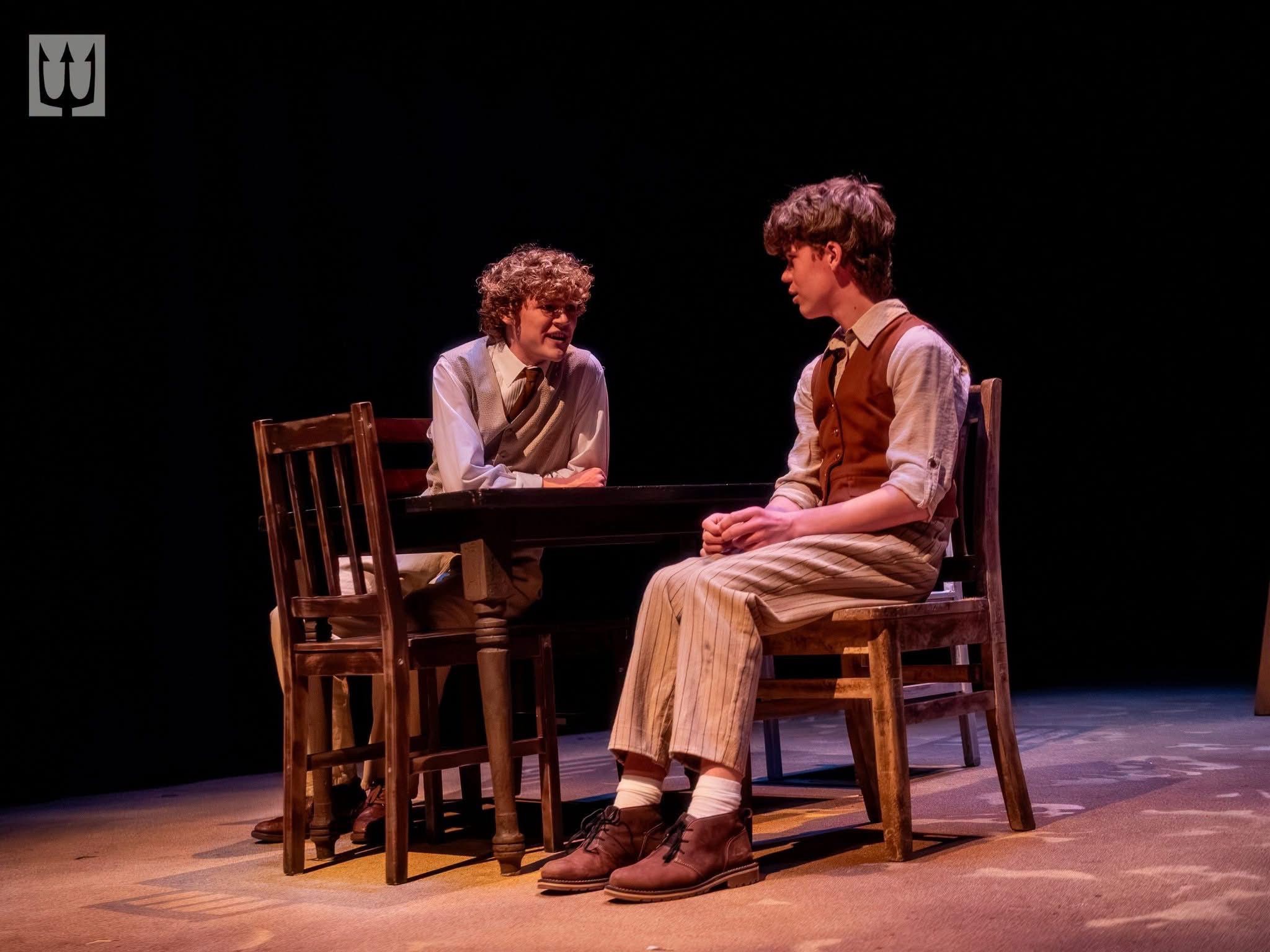
Director Gina Thornhill uses the entire space of the theatre, bringing the actors into the audience, to give us a more immersive and expansive sense of our surroundings. The actors mostly mime their set and prop pieces, as is specified by Wilder, and Thornhill has helped the actors mine these moments for specificity, depth and heft. The rehearsal process is very short for YPCo, and this is a dense piece with a lot of text that is written in an unfamiliar vernacular. The cast have done such a great job with the limited time they’ve had to work on this piece. There is still some room for them to keep finding the characters physically in their bodies. I loved the use of music in the piece, directed by Maddie Maitzen. There are some church choir scenes, and some violin and cello being played by members of the ensemble as well. Eden Reshef’s costume design is beautiful- the muted tones really give you a sense of that American melting pot concept.
It’s funny to have waited so long to see this play and then to watch it through the lens of the current political situation between Canada and the United States. There is so much in this play that is of its time, both 1901 and 1938, but the line that stood out for me the most is, “Oh, earth, you’re too wonderful for anybody to realize you.” This sentiment becomes even more relevant and immediate for a population that knows, at least on some level, that we are often actively ignoring the wonder of the earth, to our own peril. Wilder is calling on all of us to consider with gravitas and care all that is beautiful about our town- the clean water and air, the trees, the historic buildings, and the connections that we forge with both nature and one another.
Our Town plays just until November 15th, 2026 at Neptune Theatre’s Scotiabank Studio Theatre (1589 Argyle Street, Halifax). Performances are at 7:30pm today November 14th and at 2:00pm tomorrow November 15th. Tickets range in price from $28.00-$36.00 based on seating. They are available online here, by calling the Box Office at 902.429.7070, or visiting in person at 1589/1591 Argyle Street.
The Run time is 2 hours and 15 minutes (including 2 intermissions). Content Advisory: This show contains themes of death and loss. Please note: this show is recommended for ages 12+ Babes in arms and children under four (4) years of age are not permitted to attend live theatre productions; please consider this rule when purchasing. Due to factors, like run time, our productions are not designed for very young children. All patrons must have a ticket. Children under 14 must be accompanied by a parent or guardian.
Canadian Theatre Criticism is an essential part of a healthy and thriving theatre community. It helps theatre companies find new audiences for their shows, deepens audiences’ engagement with local artists and the work being created in their communities, and it is one of the best ways to preserve a snapshot of an ephemeral art form for future generations of theatre lovers. TWISI relies on support from its Subscribers, folks like you who care about the survival of local and independent arts coverage. Please consider becoming a Subscriber today, or click here for more information. Thank you so much for supporting TWISI.