
Kelly Wong
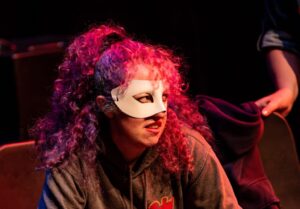
Audiences at the Shaw Festival in Niagara on the Lake are very familiar with Kelly Wong as an actor who is in his 18th Season with the festival. He is also, along with Nova Scotian Alexis Milligan, one of the first voices you hear when you listen to the Shaw podcast Let’s Get This Shaw on the Road, which he also produces and edits. He also creates digital content for the festival as one of their Embedded Artists. Now Wong, who is in the ensemble of Rodgers and Hammerstein’s Cinderella, which is in previews and opens November 21st at the Festival Theatre, has also developed a new app for actors to help them be able to learn their lines in a more intuitive way. I sat down with Wong via Zoom for a chat about Line Run, a new app he developed that was recently featured at the top of the list on New Discoveries in Canada and Our Latest Discoveries in the United States.
“I’m horrible at memorizing. It’s always been a real weakness of mine,” he says. He has been using apps faithfully for years, but he found that they all fell short in one way or another. “I thought: I think I can do better,” he says. It has taken him over a year to make Line Run, what he has considered his “pet project,” among all the other work he has going on throughout the year at the Shaw. “I thought, ‘I can make something that works for the way my brain works.’ As I started making it and getting my friends to beta test it- they started actively using it. Now they are saying that they’ll never be able to rehearse or memorize without it. It’s become that much of a foundation for them in their process.”
One of the features that makes this app stand out for actors is that while you import your lines from your script you don’t always have to be word perfect when you are rehearsing for it to move on to the next line. “I began making it so that it had to be word perfect, but then I realized that’s not the way that actors rehearse. That’s not the way that our process is. Maybe some actors can be word perfect right out of the gate, but it takes me the journey of paraphrasing to get through in order to reach the word perfect goal. So, when I was figuring out how loose or tight I wanted to make that listening engine, I put a certain amount of fuzziness- so it listens to ‘close enough’ in the way that if you were working in a room with an actual scene partner, they would know that you got the gist of the line, and then move on to the next cue.” Wong says that the app uses Apple’s own technology ecosystem, and, as anyone who has used voice to text or Siri on their phone before knows, most of the time the phone can hear exactly what you say, but sometimes it misunderstands you- especially if you were dealing with a slew of Russian names from Anton Chekhov, for example. “Loosening up and giving it a bit more forgiveness allows [the app] to actually work better than if it had been word perfect,” he says.
Line Run also helps to take actors’ eyes completely off a screen. You can record yourself saying both your own lines and your scene partner’s lines, or you can use an automatically generated voice that uses the technology already built into an Apple Smart Phone. Wong says that he used to have to cover up his own lines, read the other character’s cue line, and then say his own line, looking away from the phone, and then uncover his hand. “That isn’t actually me listening,” says Wong, of the importance of not just practicing saying the right lines, but learning how to fully inhabit each moment, every conversation, in a realistic way. “That’s me in reading mode. I’m not actually listening to the scene, or taking in the information of the scene, or what my scene partner is giving me because my brain is in thinking reading mode. Whereas when I take reading out of the equation then I can just hear the words. I can hear what the other person is saying to me… [and] I can respond to that in the way that you and I would respond to this conversation right now.”
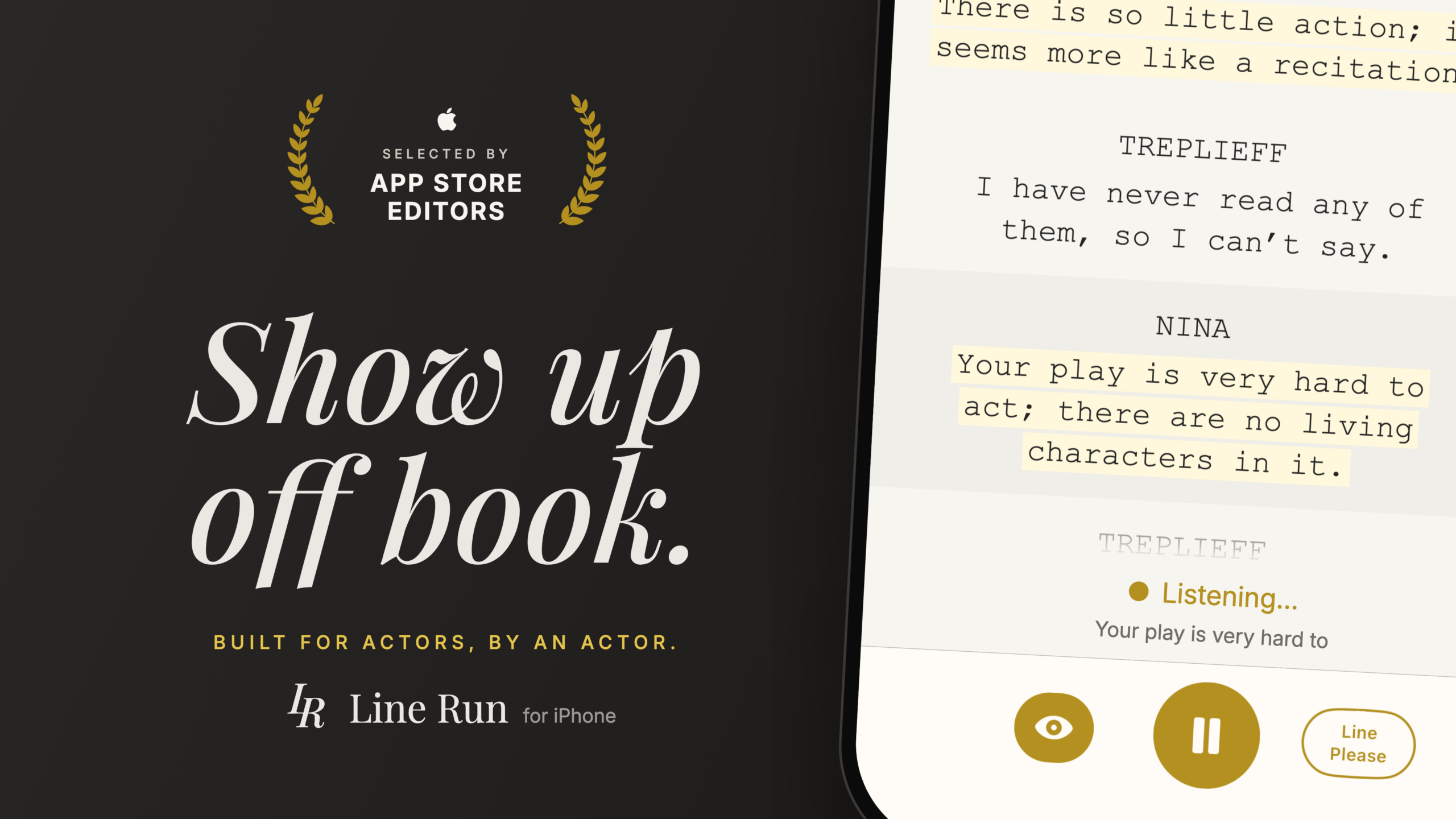
Wong says, “I’ve done my best to keep the app as on device as possible. Meaning that if you choose to have voices generated for you, which some people prefer to record their own voice so they can hear a human voice talking back to them, but some people prefer to not have to worry about that at all. It’s just another step of the process that they don’t like to do. So, when you do have those voices generated for you, I have built it so that that voice generating engine is on the phone itself. It doesn’t make a call up to some data centre; it’s not draining lakes or burning down the rainforest just to generate those voices. When it imports the script it does as much of the work that it can on device as well to automatically import it.”
For actors, running lines at home has often meant enlisting friends and family members to help. “I say I’m making a tool for myself, it’s also making a tool for my wife to not have to read all the lines and rehearse with me,” Wong says. Line Run also gives him the freedom to steal away during little pockets of time in rehearsal to work on his understudy track. He can also practice the lines while he’s driving, or whenever else he has five minutes to dedicate to it. He doesn’t have to worry about making an appointment with another person. He says sometimes it is helpful to book the stage manager to run lines, of course, but for those like Wong for whom the memorization itself takes a bit longer this is a game changer. He says that while some actors can be relatively off book after three read throughs of the scene, for him it takes “hours upon hours upon hours” just to get to that same level of preparedness. “I lean upon this type of tool to get myself ready to be able to walk into the room so that when I’m in the room the director and the rest of my cast aren’t watching me memorize- they’re actually rehearsing with me.”
Audience members are often fascinated by the fact that actors are able to hold that much text in their minds during the run of a show- it’s why questions about memorization during post-show talk backs are so common. Wong says that actors don’t usually have a super human ability. “It’s a muscle that you get better at the more that you use it. I had to memorize a very challenging part as an understudy earlier this season, but because of that work I am able to do a more manageable part a lot easier because that muscle has been going to the gym.”
The app that Wong had been using for close to a decade had the ability to record the other characters’ lines, and it would then leave a gap for you to say your lines. “The technology in our phones and how we think of our relationship to our devices has changed [since that app was developed]. As I continued to use it the user interface and the way that it operated left me wanting more. The first thing that I wanted to do when I built this was to have the active listening component of it. When you have the timed gaps, when you have it regimented so exactly the same amount of time and silence that you have to say your lines, you get locked into a pattern. If you are struggling to find those lines your brain starts to panic, and then you can’t come up with the line, and then the cue has moved on before you get the chance. That was where I started wanting the app to come from. Having a way to actively listen, and actively respond. On top of that I wanted it to look beautiful.” He wanted it to look clean, uncluttered, and intuitive. He was inspired by magazines like Harper’s Bazaar or Vanity Fair and their sleek editorial look.
“The more I started to play with it the more I started to realize there are different things I could put in here. There is this setting where you can do first letter cueing, which basically is a strategy that a lot of actors will use where they take a piece of paper and they’ll write out the first letter of every word in the sentence. Then when they are running those they’ll just have that sheet of all these letters. The app does that automatically, and that was really easy to build. A simple feature like that makes it a stepping stone for your progress. You don’t have to go from 0 to 100. You can go from 0 to 20 to 50 to 100.”
The aspect of the app that Wong spent the most amount of time on was actually the import engine, especially in terms of working seamlessly with the PDF format that actors usually receive their scripts in. “Every PDF has different quirks and ways that the information is interpreted by the computer. When I would feed in one script versus another script one would completely fail if the other one completely worked. I spent a lot of time refining it so that not only can scripts as a whole be imported automatically, but that when people get sides [that are] annotated by the casting director (start here, stop here, ignore these lines) the app will be able to interpret these faithfully, and only import the lines that you need.” He says that the generated voices sound very good, even just compared to the technology available a few years ago. “There’s a whole bank of different voices, depending on the quality of the character that you have reading them, it’s going to sound like you’ve got a cast of characters in there. It is virtually effort-free to import and generate these voices, which I know is important for about half of the actors that I’ve polled.” He found half preferred to record their own lines. “Half of them said that the reason [they] don’t use these apps is because it takes too much effort to create the script. I wanted to solve that problem for actors as well.”
Memorizing sides for an audition is a completely different experience than memorizing lines for a show that an actor is rehearsing. Sometimes actors will get their lines at 4pm and have their audition at the beginning of the following day. “It’s superhuman what we’re asked to do sometimes,” he says. He also notes that as soon as he closes a show his lines are completely erased from his memory to make room for the new ones.
He finds George Bernard Shaw’s text more challenging than film or television scripts because the language is so different in Shaw from how we speak in our daily lives. “That’s also the fun of doing classical work in that, yes, it’s harder. It is a bit more work. But then once you get it, you’re thinking and talking in a way that you don’t get to talk and think like in everyday life. You get that gift of being able to truly say someone else’s words, or speak someone else’s thoughts.”
He’s seen a surge of interest in the app since the App Store editors featured it at the top of their New Discoveries List. He has kept the price low because he wants to make it an accessible tool for actors to use. “Times are tough for everyone, and they’re especially tough for self-employed contractors who might not have a gig, and might be spending their resources on a tool like this to get the gig.” There are other apps out there that are $100 to $150 a year for a subscription. “I just think that’s prohibitive,” he says. So, he’s priced a Line Run subscription at $39.99 a year. Actors can also use the app for free with a limit of one script with three scenes for auditions or less demanding roles. You can visit his website to find out about how high school students, theatre students in university, and community theatre groups can access a free version of the app, which unlocks everything except the imported scripts with generated voices. “I have set up partnerships with some of the major theatres across the country to give this app to their actors as a gift, so that when they are entering rehearsal they feel prepared, and they are able to do their best in the room instead of watching each other memorize lines on their feet. The goal is just to help people.” He says that a lot of the feedback that he’s gotten has been from folks saying that they wish that they had had this app when they were in theatre school or much earlier in their career because maybe then they wouldn’t have struggled so much with the text.

Of Richard Rodgers and Oscar Hammerstein’s musical Cinderella, where Wong is performing in the ensemble until December 23rd, 2026, he says that Cory Sincennes’ design is “incredible… I think it’s one of the most stunning shows that I’ve ever seen on the Shaw Festival Stage… I also get to be the Illusions Captain for the show because there’s a bunch of magic and illusions that happen, so that’s a lot of fun to be able to do that. We had our first preview, and there were so many kids out there in their princess dresses. It was just so heartwarming. I think that it’s the perfect show for this time of year, but also where we’re at with the world right now, and everything that’s going on, the show talks a lot about kindness and believing in yourself and believing in others, and I think that’s something that we could use a little bit more of day to day.” The Shaw Festival also has A Year with Frog and Toad playing at the Court House Theatre, and A Christmas Carol, which is playing at the Harbourfront Centre in Toronto, which is a new partnership. He says that it is so important for the Shaw to find ways to to get younger folks into the theatre, because even though it’s often older folks who have more disposable income that they can spend on tickets, it’s risky to assume that older folks who have never attended a play before will start just because they have reached this older stage of life. “We get younger audiences into the theatre so that they learn what it means to go to a theatre, but also so that they can explore and see what live performance is all about, because we’re so addicted to [our phones], and they provide us with so much- let’s get these kids into the audience and help them discover, like you and I both know, why theatre is so magical.”
If you have an Apple Smart Phone and want to try Line Run for a free three month trial click here for an exclusive TWISI offer, or go to the App Store, then to Settings on your phone, and enter code TWISI where it says “Redeem a Code.”
Rodgers and Hammerstein’s musical Cinderella is on the Festival Theatre stage (10 Queen’s Parade, Niagara On the Lake, Ontario) until December 23rd, 2026. The show is directed by Kimberley Rampersad with Music Direction by Paul Sportelli. There are performances at 11:00am, 1:00pm, and 7:00pm. Please visit this website for more information about the specific performance time each day. Tickets range in price from $28.25 to $129.34 based on age (Youth, Student, Under 35, Senior, or Regular Seating). They are available online here, by calling the Box Office at 905.468.2172 or 1.800.511.7429, or in person at the Box Office at 10 Queen’s Parade in Niagara on the Lake. Approximate run time is 2 hours and 20 minutes including one intermission. Age recommendation is 6+.
Mini Manners Matinees Workshop and Children’s Tea
November 14 – December 19
Prior to Saturday matinees of Cinderella. By royal decree you and your family are invited to tea. Learn about royal etiquette and play make believe. Cookies and punch are provided. $10 with a ticket to Cinderella. Recommended for ages 6-10. Call 1-800-511-7429 to book.
For Accessibility Information for the Shaw Festival please visit this website.
Canadian Theatre Criticism is an essential part of a healthy and thriving theatre community. It helps theatre companies find new audiences for their shows, deepens audiences’ engagement with local artists and the work being created in their communities, and it is one of the best ways to preserve a snapshot of an ephemeral art form for future generations of theatre lovers. TWISI relies on support from its Subscribers, folks like you who care about the survival of local and independent arts coverage. Please consider becoming a Subscriber today, or click here for more information. Thank you so much for supporting TWISI.