Chela Davison
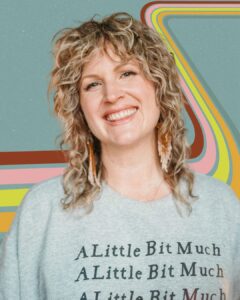
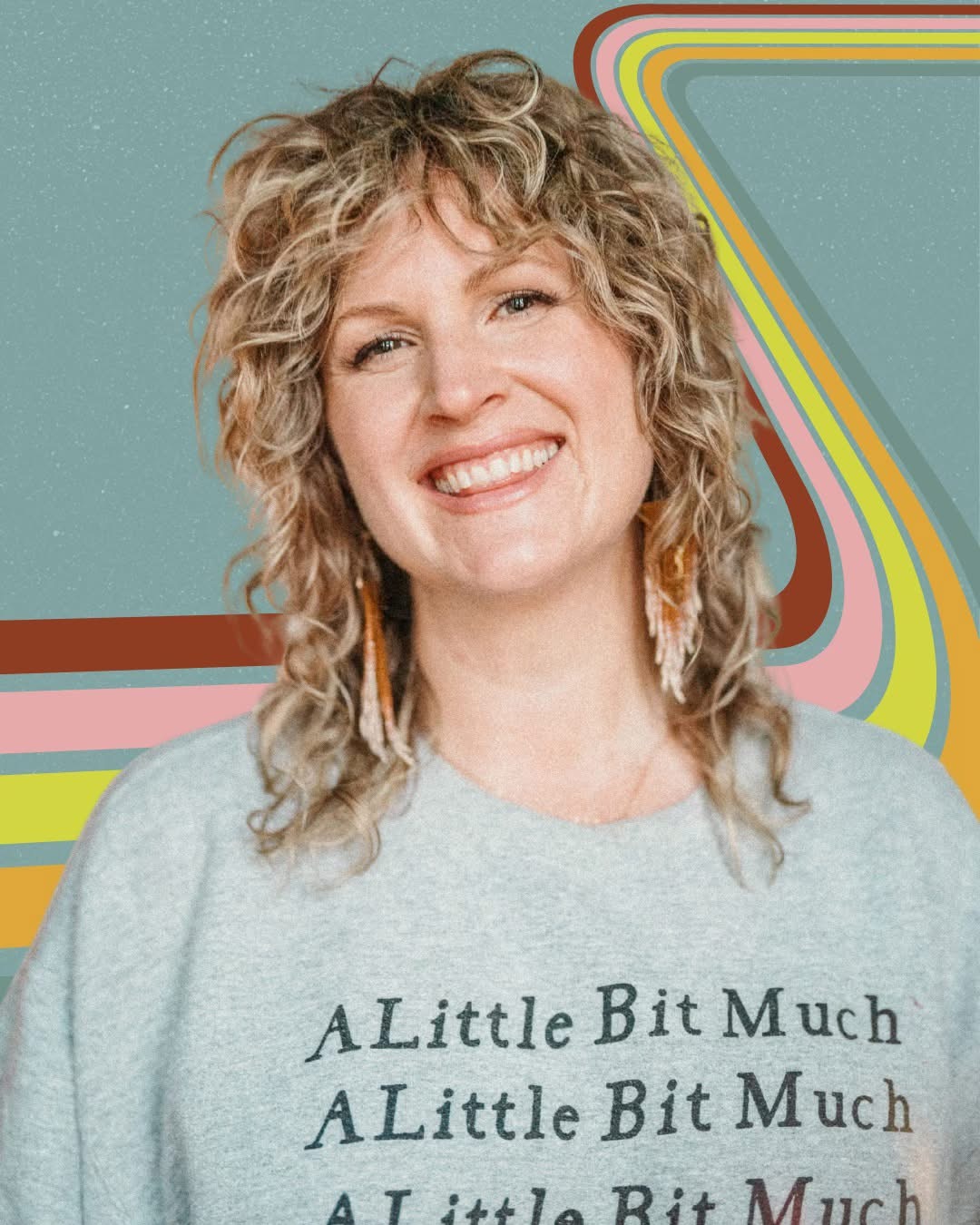
Chela Davison is bringing her show A Little Bit Much to the Sanctuary Arts Centre in Dartmouth this weekend. The tag line for the evening on her website says, “Think stand-up meets soulwork. Memoir meets monologue. Cringe meets catharsis.” Davison is based in Vancouver, British Columbia, and for twenty years she worked as a coach working with community builders, artists, authors, CEOs, “and witches,” according to her website, while also always being a writer. Feeling burnt out as she entered her 40s she decided that she needed to prioritize her own deep creative work, and that led to the creation of this piece, and a desire for her to get up on stage and perform it herself. We chatted via Zoom about this transformational time in her life, and how excited she is to bring this work to the Lunenburg Opera House Tonight, The Al Whittle Theatre in Wolfville on October 2nd, and to Dartmouth on October 3rd.
Davison knew of TJ Dawe, the Canadian theatre director and playwright who has toured his Fringe Festival shows extensively around Canada, the US, and to Edinburgh and Adelaide. They had written for the same online publication a number of years ago so Davison decided to hire him for some creative coaching. “I wanted to do something that had nothing to do with my work,” she says. He told her that he was running a course for folks interested in developing their own solo shows, and she jumped at this opportunity. “I had no plan to perform it or anything, and then I took the course. Then I started a thing called the Creative Cauldron, which was just a small group of people to come together, basically like a co-working, co-writing group [to help keep each other accountable to the practice of writing new material each week]… and then a show came out of it, and I was like ‘okay, well, I guess I will try performing it.’ And then I really loved it.”
In her previous work she was used to public speaking, and she’d taken a stand up comedy course, but she says that the first time she performed the show for an audience she thought, “oh. This is what I do now. This is what I want to do now.” She says that so much of the coaching work that she was doing was about helping to encourage folks to pursue their calling, especially when it seemed like the impractical or risky thing to do. And here she was having to have the same encouragement for herself. She’s performed the show at festivals, and many times locally, and now she’s been heading east with it, and she is coming to Nova Scotia for the first time.
Of the show itself she says, “It’s an autobiographical monologue. It explores identity, the internalization of stories that we kind of accumulate along the way… people have resonated a lot with it. Certainly a lot of stuff around self expression, being told you’re too much, reckoning with that- a lot of perspectives around the female experience, which, of course, is diverse, but a lot of things around media narratives, about what it means to be who we’re “supposed” to be as women.”
She says that while working in the solo performance course she had to confront the feeling of being self indulgent. “I was like, ‘why would anybody want to listen to me just talk about myself for an hour?,’” but when she saw how much the material she covered resonated with folks in the audience she started to see the performance as a means of service.
She says that the duality of the experience for women in midlife is interesting in how on the one hand folks are dealing with perimenopause symptoms “from people being like ‘I’ve lost my nouns’, to increases in anxiety and depression, and brain fog, and executive functioning loss, and all these challenges that I think are sort of blindsiding women [because older generations never spoke as openly about them], and then there also seems to be this real reclamation of power and kind of awakening. [We are realizing that] we actually have a lot of wisdom, and capacity, and learned experience, and we’re still in a patriarchal system where women are going like, ‘get the fuck out of my way.’ We’ve actually got something to bring to bear here.”
The way that Davison tackles many of these themes in her work is through comedy. She says that Dawe’s dramaturgical work helped her see how and why the comedic structure was working in the ways she was naturally writing the show. “It’s been cool to get that feedback and understand better what I’ve been doing.” She cites learning how to build tension and then diffuse it with a laugh versus catching the audience off guard with something serious in the middle of a more humorous stretch of storytelling.
She says the crux of the show is exploring this idea of being “too much.” She says that her teachers in school told her that she talked too much, she was told she was bossy, or that she was too masculine in the way she presented herself. “I was a lot as a kid,” she says. “I was a lot as a teenager. I was a lot in my early 20s. I was a lot. How does this conflict with the how people want women to be? How [does] it conflict with just even how to take up space and be a leader as a woman?… I go through ‘what are the other identities that I kind of picked up along the way?’ Being a leader, being outgoing, being a seeker- I have a whole arc around spiritual and personal development.” She also speaks about the cultural landscape that she grew up against in the mid-late 1980s and through the 1990s- the douche commercials, the diet industry, “and the media gaze and the male gaze, and all these ways that I’m learning that I’m supposed to be making my body smaller, and controlling my body, and managing my body, and I have disordered eating- bulimia through my teens.” She says that from there “becoming a personal development glutton was my solve. I’m going to try and find a healthier way to deal with my ‘muchness.’ I’m going to move into self help and personal growth and spiritual development, but still as a lens to try to shape myself into the person that I’m supposed to be for society.” She says the show allows her to take this internalized story that she’s told herself for so long and to “deconstruct the story to be free of it.” She started her first business, a hair salon, when she was just nineteen years old, and she says that at that point she had really internalized the story of “you got to land a man, got to have a family, got to have it all. The pursuit of having it all from family, partner, career pressure, apparently getting it all, but not being able to even regulate my nervous system, and that’s another failure because we all need to be evolved,” is also explored. She says there is this endless pursuit of unmeetable goals and “demands of culture…. There were all these messages [in the 80s and 90s] about being empowered,, and how we could have it all, we could be anything we wanted to be, while [we] were still, simultaneously, getting all these messages around, ‘but really you need to be skinny, and pretty, and land a man.’ They were both happening at the same time, so it was almost this delusion of empowerment.” She says her parents encouraged her self expression, and she’s been an entrepreneur following her own mind and heart her whole life, but still the toxicity of the culture around all of us seeps in.
She says in a way things for younger women and girls have gotten harder and worse, in that they also have to develop their own online personal brands. Having to market your own work, for authors for example, she says, is a whole extra job that requires time and skill on top of everything else, when many folks just want to be writing their next book. “Having it all keeps morphing- you’ve got to have depth and expertise, you’ve got to be an expert in PR, you’ve got to be able to do all of the creative self-made stuff, and have a family, and pay your bills, when everything is exponentially more expensive. It’s just bananas.”
She tells me that what moves her the most in doing the show is the connections that she makes with folks in the audience afterwards. Many express their appreciation for a piece that allows them to both laugh and feel and think deeply- and even sometimes cry. “People want to stay and linger and talk to each other [after], and strangers make connections. One of my favourite moments was a man came up after, he wasn’t there with his partner, but he came up after and he said, “I can’t wait to go home and get to know my wife better.”
She says despite a staunch feminist lens, there’s no man-bashing in the show. “I like it because it feels like it connects people, and it connects people around humour, but it also connects people around subjects that are inescapable and deeply meaningful.”
A Little Bit Much plays at the Al Whittle Theatre (450 Main Street, Wolfville) on October 2nd at 7:30pm. Tickets are $36.75 and are available online here, or at the door at 450 Main Street. A Little Bit Much plays at the Sanctuary Arts Centre (100 Ochterloney Street, Dartmouth) on October 3rd at 7:30pm. Tickets are $35.00 and are available online here, or at the door.
Canadian Theatre Criticism is an essential part of a healthy and thriving theatre community. It helps theatre companies find new audiences for their shows, deepens audiences’ engagement with local artists and the work being created in their communities, and it is one of the best ways to preserve a snapshot of an ephemeral art form for future generations of theatre lovers. TWISI relies on support from its Subscribers, folks like you who care about the survival of local and independent arts coverage. Please consider becoming a Subscriber today, or click here for more information. Thank you so much for supporting TWISI.