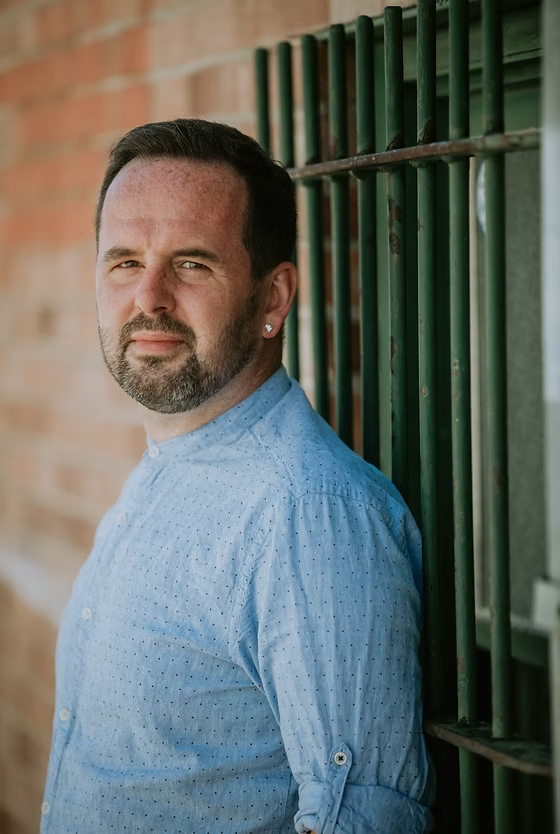
Jay Whitehead Photo by Jaime Vedres Photography
This Pride Atlantic Canadian audiences are being treated to a play based on Queer Canadian history, an event that doesn’t seem to get the recognition or memorialization that the New York Stonewall Riots have garnered down south. Jay Whitehead’s play 333 is set during “Operation Soap,” the bathhouse raids in Toronto in 1981 that led to one of the largest mass arrests in Canadian history, mobilized the local queer community to protest this injustice, and became the catalyst for our own Pride movement here in Canada.
I chatted with Jay Whitehead about the play and its Atlantic Canadian tour, which kicks off in Charlottetown June 18th to 20th at the Arts Guild, and finishes up July 1-4 at the Bus Stop Theatre in Halifax- with stops in Sackville and Parrsboro in between.
Whitehead mentions being inspired by iconic queer Canadian playwrights Sky Gilbert, Brad Fraser, and Daniel MacIvor, beginning when he was coming up in theatre school reading political plays like Gilbert’s Drag Queens on Trail (1994). It was also in his undergrad that he learned about these bathhouse raids. “It fascinated me as a young gay theatre artist. It’s a story that we still don’t really tell. In 2016 there was an apology issued from the Toronto police… but we don’t really talk about the roots of our own gay rights pride movement in Canada. I often wonder if that’s because, for many, it was sparked by something that is shameful to them, which was being caught in a bathhouse.”
In Greenwich Village the Stonewall Inn, a gay bar, was raided on June 28, 1969, which launched the infamous riots there. The Toronto bathhouse raids came eleven years later, on February 5th, 1981 when police raided The Barracks, The Club, Richmond Street Health Emporium, and Roman II Health and Recreation Spa. Over three hundred men were arrested, and most were later found innocent.
“Even just exploring the time with the cast and crew you realize how far we’ve come in such a short time, but also how fragile it is still.” He says this fragility makes the play especially timely. “At the outset it was meant to be a period piece to share a piece of history, but it’s become an exploration of current identity politics through viewing this historical moment.”
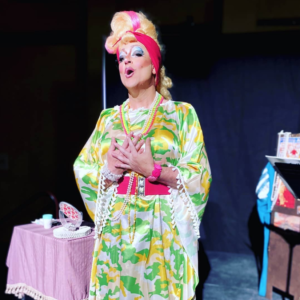
The story depicts the experiences of three fictional men that Whitehead has placed within this real historical context. “Honey is an aging queen we’re calling a femme man- their journey is about identity, and public versus private, and what being exposed at the bathhouses means for their ability to present as they wish in the world at that time. Then there’s Darren, who’s a married closet case from Alberta. And then there’s Eddie, who works in the bathhouse, and is a recent immigrant to Canada from Latin America. So, the play tells a story of how these three men end up together when the raids occurred, and then the fallout that happens after that, as the raids happen quite early in the play. The majority of the play is exploring how each of these three individuals reacts, responds, how the community responds and kind of an open-ended sort of ending [that asks] what next? What now? Which is kind of where we’re at, I think, in 2026. I think we always have to be asking ‘what next’? Who’s being left behind? Who are we forgetting in our revolution?”
Whitehead found firsthand accounts in interviews in the database of queer Canadian history that inspired the storytelling. “I did a little digging into the movement that arose out of the bathhouse raids, the rallies and the protests, and kind of the beginning of this kind of mainstreaming and assimilative priorities that strategically the gay community embraced in order to be accepted in the community at large. I’m asking questions about queer spaces versus public spaces, and who is invited into that conversation when we want to become more public. And who are we hiding so that we can put ourselves higher up in the hierarchy of community and culture and society.” Whitehead mentions that coming out of these protests predominantly white gay men and lesbian women sought to present queer Canadian life to heterosexuals in very safe and “palatable” ways- as the “sweater vest wearing suburban picket fence [queer couples who are] just like [straight couples].”
“Now I think we’re coming around, and this is kind of what I’ve been exploring for the past several years, actually- who else is in our community? We see the friction that’s causing in the world when people who don’t uphold the status quo step forward into the light and say, ‘well, I’m here too, and I deserve the same rights as everyone else’… I think the fact that the bathhouse is the place where this all started really raises issues and questions about fearing gay sex… or gay as an action as opposed to just a fun identity we see on TV.”

Whitehead says that bathhouse culture plays a significant role in how queer folks have developed as a community. “I had some of my first sexual experiences in bathhouses and they were beautiful,” he says, “It was a safe place I could go to explore that and make acquaintances. I guess to someone who doesn’t understand a bathhouse or see the need for it, it might seem seedy and immoral, but really I’ve made so many beautiful connections with people in that environment because you’re stripped away, like you’re in a towel, there’s no pretence, maybe there’s a sexual connection, maybe there’s not, but it’s really just about being in a place where that can be possible, and where no one is going to judge you. I think that’s what made these raids, Operation Soap, so insidious and cruel because these men were in such a vulnerable state, and the raids themselves, when you hear the firsthand accounts and see the photographs of the aftermath, were unnecessarily violent and destructive. I think it’s an important story in Canada’s history to shed light on, and I think we’re at a time where this story needs to be highlighted again.” Whitehead mentions that while it is easier for many queer folks in Canada to connect with one another in more public spaces today we are seeing how high the stakes still can be for trans folks, especially trans folks of colour, just to meet each other in public spaces.
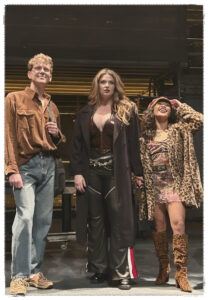
333 stars Diego Guerrero as Eddie, John Tasker as Darren, and Whitehead plays Honey. The play is directed by GaRRy Williams. Tasker, who is from Alberta, was one of the first actors that Whitehead brought aboard during the first workshop of the piece during Covid. He says that all the actors, including Andrés Moreno, who originated the role of Eddie, have contributed to how the characters have evolved in the script. “Everyone’s brought so many ideas and thoughts. It helped me to feel safe to explore, for example, Eddie’s voice- because [since he is a Latin American immigrant] I struggled to feel like I could tell that story, but also I felt like it was an important inclusion. In a city like Toronto, of course, it’s not going to be three white men. Diego has really helped, as well as Santiago Guzmán, who did some dramaturgy, giving me the courage, and kind of granting me the permission to explore that territory with them and in concert with their input.” Whitehead is now based in Prince Edward Island, but he is originally from Alberta, so he says that he understands the character of Darren. “John brought so much depth and sensitivity that I didn’t see at the outset that brought so much humanity to this character that I kind of saw as a trope when I initially started the play…. 333 has really developed into a play about three very distinct individuals in this difficult time.”
GaRRy Williams has been involved in the piece since the very first Zoom meeting. “When it came time to put together the team for the show I knew that it was time for me to step into the role of Honey, but I couldn’t move forward without GaRRy on the project. I’m so happy that he agreed to take the role of director. As folks who have worked with GaRRy know, he’s one of the most thoughtful, intelligent, but also emotionally intelligent, [people]. He treats my play with such respect and dignity, but also a real curiosity that pushes me both as an actor and a writer. It’s a great combination of voices in the room. With GaRRy at the helm, I can already see that the process is going to unfold in a very gratifying, collaborative, and beautiful way in a room that can only be created by the environment that GaRRy can create with his combination of smarts and heart.”
The set and lighting design is by Ian McFarlane, who is from New Brunswick, Aaron Collier, originally from Prince Edward Island now based in Nova Scotia, is the sound designer, costume design is by Diego Cavedon-Dias, and fight choreography is by Dylan Brentwood. “The Merritt nominations came out and I’m like, ‘Oh my God, I have this award winning team!’ It’s humbling. Everybody is responding to the material in such a thoughtful but creative way that as a writer I didn’t even foresee. I’m so excited to inhabit the world that they’re imagining from my writing. It’s surreal… I am so freaking excited, but also terrified of the responsibility of telling this important story… we’re all really passionate about telling the story and feel that responsibility in our bones. And it’s been really fun.”
Whitehead notes that the play is intended for adult audiences (19+), as it has mature content, full frontal nudity, and violence.
333 plays at The Arts Guild (111 Queen Street, Charlottetown), June 18-20th, 2026 at 8:00pm. Tickets are $25.00 and are available here.
There is a performance at the Motyer Fancy Theatre (62 York Street, Sackville) at Mount Allison University on June 25th, 2026 at 8:00pm. Tickets are $25.00 and are available here.
There is a performance at Ship’s Company Theatre (18 Main Avenue, Parrsboro) at 7:30pm on June 27th, 2026. Tickets are $25.00 and are available here.
And the show runs in Halifax at the Bus Stop Theatre (2203 Gottingen Street) at 8:00pm July 1st-4th, 2026. Tickets are available here.
Canadian Theatre Criticism is an essential part of a healthy and thriving theatre community. It helps theatre companies find new audiences for their shows, deepens audiences’ engagement with local artists and the work being created in their communities, and it is one of the best ways to preserve a snapshot of an ephemeral art form for future generations of theatre lovers. TWISI relies on support from its Subscribers, folks like you who care about the survival of local and independent arts coverage. Please consider becoming a Subscriber today, or click here for more information. Thank you so much for supporting TWISI.