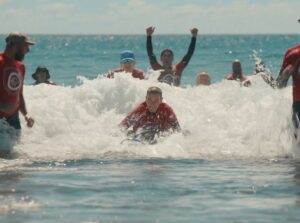
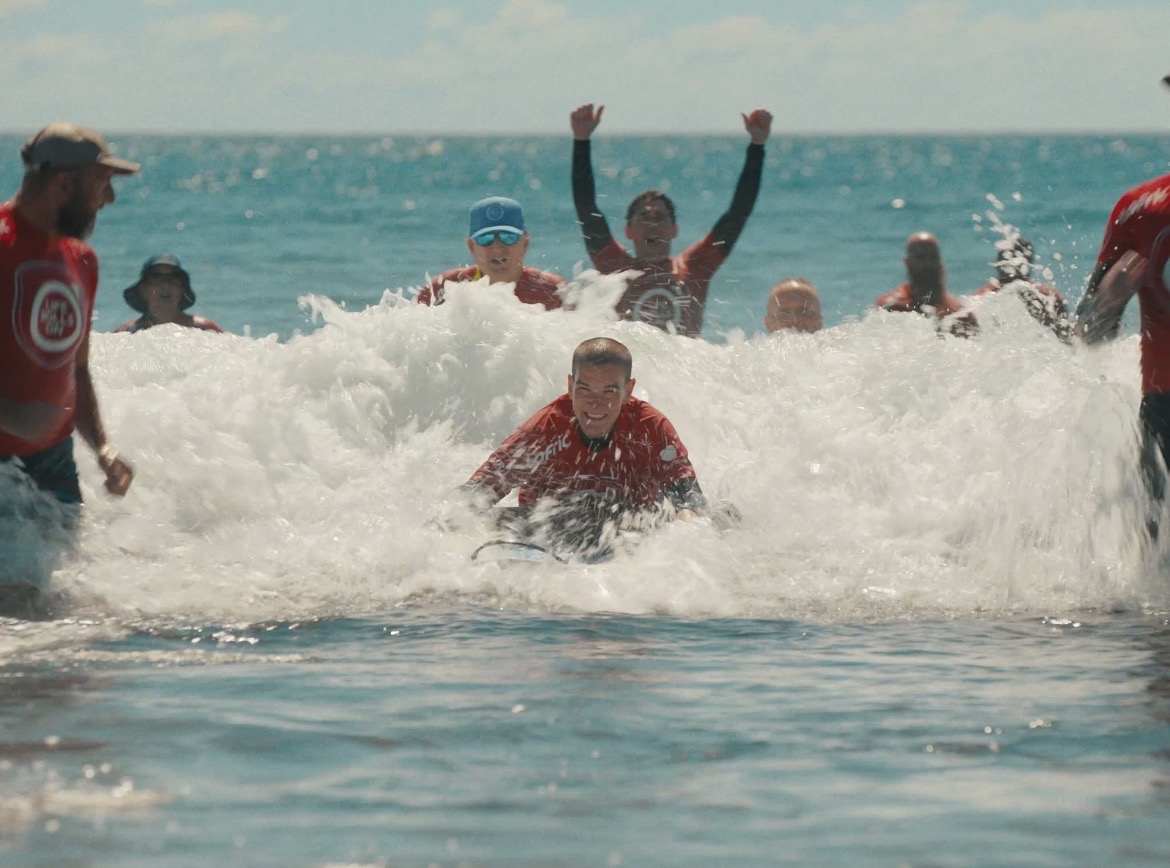
April Hubbard adaptive surfing surrounded by a team of joyful helpers in the waves of the ocean.
I have always heard that adage about documentary filmmaking that the creators never really know what story they’re telling until they’re cutting all the footage together, and that was certainly the case for Ree and Meaghan Wright when they were making the film The Last Days of April, which screened Friday night as part of the Atlantic International Film Festival.
We meet April Hubbard at a time in their life when they were feeling extremely lonely and disconnected from the communities that they had spent over a decade previously cultivating in the theatre and circus in Halifax. They have been disabled from birth due to being born with the condition spina bifida, and when they were in Grade 11 they were diagnosed as also having a tethered spinal cord. They are known in their communities as being an ambulatory wheelchair user, but they are also known for their indomitable passion, energy, and advocacy. When I met April it was in their role of volunteer at the Halifax Fringe Festival, and just as I showed up everyday to see my block of shows to review them, April was there every day too- for hours. Later, as Fringe Board Chair, April wasn’t just seeing an array of Fringe shows every day, but they were going home and writing about them too. April was always a welcome voice of recommendations, and someone who spoke up, always first, about the inaccessibility she was facing, or other concerns she had about how disability was being represented (or not at all) in the shows that she was seeing. Shortly after the Covid-19 lockdowns April’s level of daily chronic pain has dramatically increased, and it’s drastically affected her ability to engage in person with all the aspects of arts, culture, and adaptive sport in the city that she loves. The film opens with April discussing coming to the choice of accessing Medical Assistance in Dying (MAiD), and looking to end her life on her own terms.
We meet April’s partner Matt and learn a little about their polyamorous relationship. Matt is April’s main support system. One thing that they say early in the film that hits me directly in the chest is concerning the amount of medication April is taking to just be able to function at a baseline that most of us take for granted. Matt says that none of us who have known April since they were in Grade 11 have known them not being on the highest levels of medical-grade opioids- stronger than morphine. I had never thought about April’s experience through this lens before, and how much this alone continues to colour and inform her perspectives and her reality, not to mention her relationships with others.
When April writes a Facebook post informing most of the people in their community about their decision to start the process of applying for MAiD it elicits a huge outpouring of complicated emotion from folks. A big immediate benefit seems to be that it gives them a way to connect back with their communities, as folks begin to reach out- including Ree and Meaghan Wright, the directors/writers/and producers of this film. We hear from Andrew Gurza, a podcast host and fellow disability awareness consultant and activist in Toronto, who voices one of the main concerns about disabled folks whose deaths aren’t imminent accessing MAiD- questioning how much of the untenableness of life for folks is the pure physical chronic symptoms, and how much is living without proper access to resources and supports that could help make living life as a disabled person more manageable? April speaks about how profoundly unjust and infantilizing the bureaucracy of being disabled is, and how it needlessly complicates so many different aspects of their life. Andrew is primarily interested in advocating for change in these areas to address the underlying stresses and traumas that plague disabled people in their daily lives. It’s clear that April cares about this work too, and they voice that they do worry that choosing to end their life will somehow devalue the decades’ worth of advocacy work that they have done in their life. April very eloquently and passionately lays out to Andrew her perspective on why it is important for disabled folks to have MAid as a choice, and we see two very compelling perspectives that are both at odds with each other, but respectful too of the other’s point of view and lived experience. Andrew admits what seems to me to be the bottom line, they don’t know what it’s like to live in April’s body and experience that level of chronic pain.
The film progresses with the focus very much on April making sure that everything is in order for the end of her life. We see her talking to a death doula, relishing in traditions during what she thinks could be her last Christmas, planning and experiencing her living funeral. Yet, at the same time, things outside of her control are happening in the life around her. Matt has to go to Newfoundland for a time to take care of their father who has unexpectedly gotten a terminal diagnosis. Matt has to figure out how to switch their support to distance, and April needs to figure out how to shuffle things in their life around so they are still getting the in person support they need. Then, something completely unexpected happens, and April meets Jeff and falls in love.
I wish that this film could have a true uncomplicated ending- that April falls in love with Jeff and somehow that magically changes the reality of her chronic pain. Obviously, that is impossible. Yet, in this moment the crux of the documentary changes from one about an inevitable immediate progression toward this looming chosen death date, to the journey of deciding to put the date off, of someone choosing over and over to live just a little bit longer. As April discusses, though, it isn’t just that they are always making these choices for themselves because they want more time with Jeff, they are also considering the lives of their loved ones- when might it be more or less inconvenient for them to suffer a great loss and to be grieving? April is immensely generous and has a deep, profound well of empathy for others.
This idea of people asking April all the time “have you decided when you are going to end your life?” and feeling frustrated that they don’t have a clearer timeline is, in a way, I guess, human and understandable, but it also seems wildly absurd. I understand that folks are pre-grieving, I am too, but April is also giving folks a gift of perpetually living with them in the present. People die suddenly and without warning all the time- there’s no absolute guarantee April will be here next week, but there’s no absolute guarantee that any of us will be. The documentary touches a bit on how we as a culture are so terrible at talking about death, preparing for death, and navigating around profound grief and grieving. April has refused to shy away from this reality, and is doing everything in their power to lovingly curate an end of life experience that is uniquely theirs- beautiful, special, and celebratory of who they are and what they value the most.
Another thing that struck me about the documentary is that April speaks about her twin sister, Abby, who died shortly after their birth, and how she has felt a connection with Abby as she’s grown up. Now, Ree and Meaghan Wright, who are also twins, direct this piece. So much of the documentary is about both disconnection and connection- April fighting to really belong in spaces that have a long history of casting her and most other disabled folks aside, fighting to make the city accessible not just for her, but for everyone. It seems like twins might have very perceptive insights into the depths of being connected to someone else, so it seems very apt that Ree and Meaghan Wright helped to bring this story to the screen.
This is obviously an extremely intimate portrait of April Hubbard, and the choices of locations for the film reflect that- there are lots of scenes shot in April’s apartment- we are immersed in Matt’s beautiful green garden while they are in Newfoundland, but there are also shots from around Halifax, especially the North End of the city, and some stunning shots of Matt against the rugged backdrop of Newfoundland, which also ground us so specifically in the world that these folks are inhabiting during this time. April’s world is very small at the beginning of the documentary, but expands outward a bit more after meeting Jeff. There is a gorgeous scene where April is adaptive surfing at the beach, which feels so joyful and triumphant.
April’s story is, thankfully, ongoing. They were in attendance at the film screening, which they say was very much not something they imagined happening when they started filming the documentary three years ago. It means that the documentary doesn’t have a tidy resolution, and, yet, in that, for me, selfishly, that is the happiest ending I could wish for- the life of a beautiful person still in progress. All of their questions and concerns, all the complexities and contradictions are still very much in play. The Last Days of April is very much a film about the power of choosing for yourself what is right for you, and the gift of April Hubbard is that they have refused to let the status quo around them stand when the status quo doesn’t serve them and others- they have chosen to raise their voice, refused to be ignored, and have pushed and pushed and pushed for change. The work continues, our communities and our province are still far from being truly accessible, but our communities are better off because April Hubbard was here.
The Last Days of April, written and directed by Ree Wright and Meaghan Wright, with Mirror Image Media will be screened at a number of other film festivals including Lunenburg Doc Fest on September 26th at 4:30pm and the Parrsboro Film Festival on October 4th at 4:00pm. It is also available on OUTtv and AMI+ to screen from home.
The Atlantic International Film Festival runs until September 23rd, 2026 and features screenings of over 100 films, Q&As, receptions, panels, and industry events. “The festival champions both emerging and established filmmaking voices from Atlantic Canada and beyond, helping audiences discover new artists, uncover fresh perspectives, and connect through the power of storytelling.” The screenings take place at Cineplex Park Lane (5657 Spring Garden Road, Halifax). For Accessibility Information about this venue please visit this website. For more information about AIFF please visit this website.
Canadian Theatre Criticism is an essential part of a healthy and thriving theatre community. It helps theatre companies find new audiences for their shows, deepens audiences’ engagement with local artists and the work being created in their communities, and it is one of the best ways to preserve a snapshot of an ephemeral art form for future generations of theatre lovers. TWISI relies on support from its Subscribers, folks like you who care about the survival of local and independent arts coverage. Please consider becoming a Subscriber today. Thank you so much for supporting TWISI.