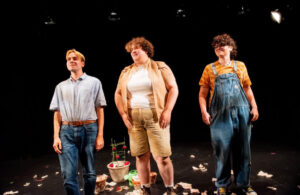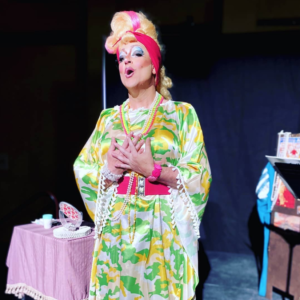

My last day at Halifax Fringe could not have gone better. I started out in front of the Central Library, early in the day, to see Mammalian Diving Reflex, and SINS (Sometimes in Nova Scotia) Dance’s interactive theatre experiment Everyone Is Interesting. In fact, today ended up being, by far, my most interactive day at the Fringe.
There were facilitators from the Mammalian Diving Reflex with us on our adventure, but in fact, much of the performance was led by two young teenagers and an eleven year old, which encouraged me to let go of any anxiety I felt, and to tap back in to the inner child that (let’s be honest) is never too far away from me. We started out all together doing a few activities to help us get to know one another- nothing too difficult- but all designed to help the audience members remove the barriers of shyness or propriety between us, and to find together the ways that we are all interesting. For example, when I was seven or eight my Aunt Carol and I did taste her dog’s bone-shaped Purina treat. It was disgusting. Once we were feeling emboldened and more connected with one another, we followed the young people, often with the youngest among us in the lead, and we approached strangers on Spring Garden Road and talked to them about aspects of their day and their lives, mining the information gathered for a portrait of each one as an interesting person. The first person we talked to was on a softball team, but also had just bought a house. The second had walked through a mountain of snow after White Juan to get to work. The third started playing hockey in her 30s, and had gone to High School with Ian Sherwood, who was one of the folks in the audience. They hadn’t seen each other since gradating from St. Pat’s over thirty years ago. Not only are the people in Halifax interesting, but, clearly, we are also often literally connected to one another. They couldn’t have scripted a better dramatic arc.
Then we went into the Public Gardens in two teams looking to compete a “human scavenger hunt,” again with the eleven year old valiantly in the lead. She, with politeness, poise and spunkiness, asked folks if she could read out a series of attributes to them, and if they would tell her if any of them applied to them. Did they have a tattoo they regretted? Could they do a back handspring? Did they have a pet goat (or a dog that looks like a goat?). Everyone was charmed, I think, mostly by the eleven year old, but also maybe by seeing a group of adults excitedly and joyfully following her lead, matching her energy, and allowing her to take the lead. I will admit to being impressed (and relieved) that we didn’t meet anyone who was cross, or rude, or who ignored us. Everyone was generous, and kind, and interesting.
At a time when we seem to exist in isolation together, with our earbuds in, engrossed in whatever horrifying new thing our phones are showing us, where, it’s true, Halifax has grown and maybe doesn’t always feel like the same small community it was twenty years ago, this kind of curated connection feels precious. I feel like our society sows discord amongst different generations, always painting the young (especially now with AI) as lazy, and rude, and disinterested in anything. These three young people couldn’t be further from that tired cliche. Everything Is Interesting was such a glorious antidote to all of it. If we want to connect more to our city, our community, to young people, to older people, we need to open our own selves up to real world possibilities, and walking around assuming the best of people sure feels a lot lighter and more freeing than bracing for the worst.
I went back to the Central Library to catch the second day of Kids Fringe, where I saw Spontaneity Improv Company’s Spelling Bee, which was a cool conceit. The performers played a series of eccentric characters that you might see at a youth spelling bee, and each one was given a word to spell by a volunteer from the audience. After the word was spelled, the character would tell a story inspired by the word, which was then acted out by all the other improvisers. There were quite a few funny moments, and inspired ideas that came out of this game, although some of the improvisers found it easier to stay in character as the narrator than others. At one point near the end chaos ensued when one especially exuberant child, who was having the BEST time all day, joined the scene as a duck, and pretty soon nearly every child in attendance swarmed the stage to take part in the improv. It proved difficult for the adults to then rally them all in as part of the scene, but the improvisers did make a valiant effort, and it was great to see the kids so excited for an opportunity to take part.
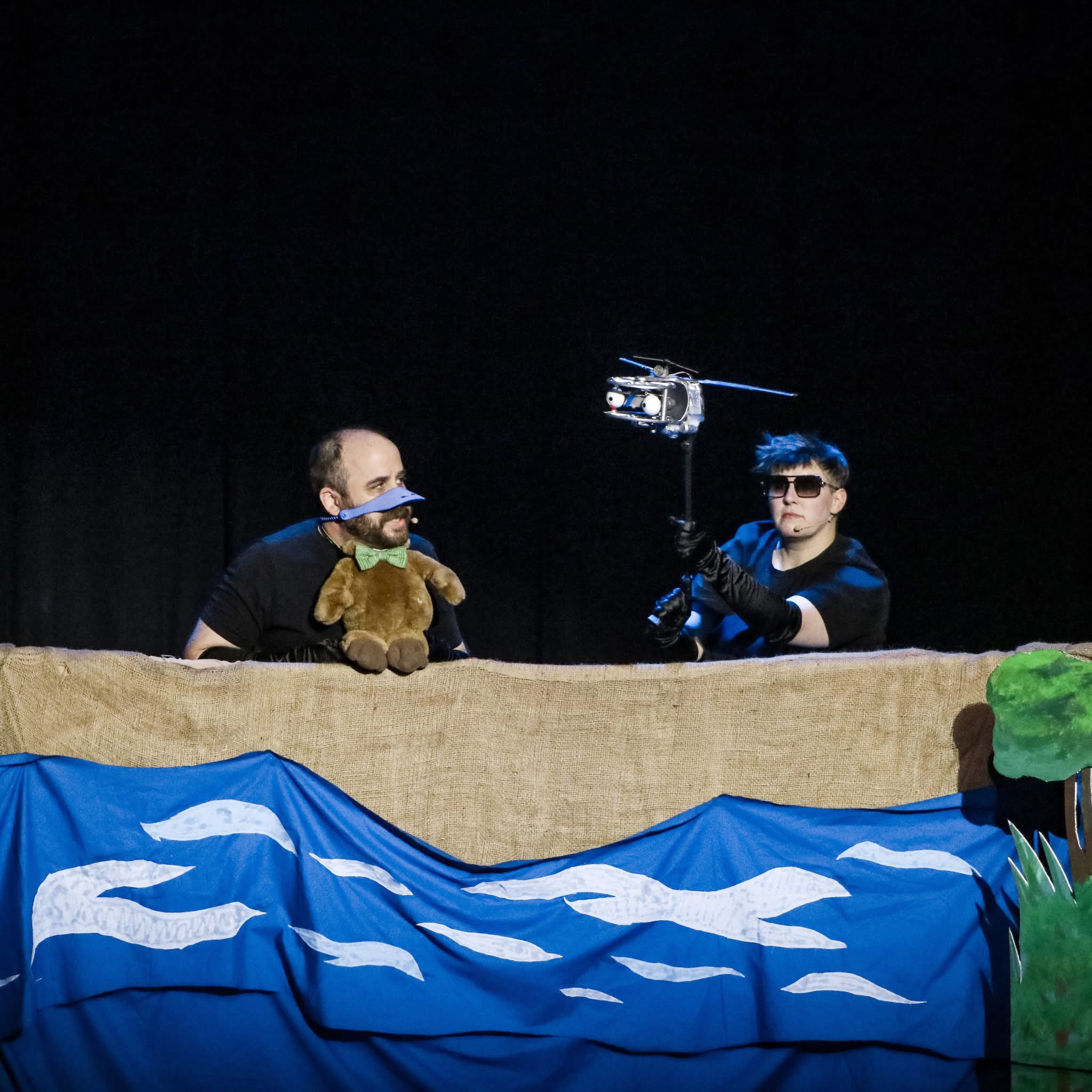
My niece, Bridgette, who is three, joined me for The Villains Theatre’s The Platypus Play and Gale Force Theatre’s Young Company’s production of Alfie’s Wish.
The Platypus Play is about a sweet and dapper platypus played by Dan Bray who encounters a strange new flying object. He is kind to the newcomer, who introduces themselves as P.A.L, but the AI powered drone is actually in Australia on menacing business, including drinking so much water from the river that by the time platypus realizes it the river has almost been sucked dry. What’s worse, the platypus then gets transported across the ocean to Mi’kma’ki where all the other animals think that he looks strange, and no one wants to be his friend. That is, until he meets a kindhearted bat, played by Colleen Arcturus MacIsaac (who also puppeteers and voices the other creatures, and puppeteers the drone). The bat knows all about the drones, and wants to work together with the platypus to save their ecosystem from further harm. They do so through ingenuity, teamwork, and singing.
Bridgette was very invested in watching this play. It’s a great length for kids her age at just 30 mins. Her favourite part was the singing, “but not when the animals sang bad songs,” by which she means that she didn’t like when the creatures were singing mean songs about how ‘different’ and ‘weird’ platypus was. I really liked the staticky chirpy robot voice that was used for the drone, and how well Arcturus MacIsaac and Bray have dramatized both the perils of AI (and surveillance) on our environment, and also xenophobia, in a way that is easy for young people to understand. The Beaver, especially, captures the way that xenophobia can be masqueraded in words that sound like friendliness or kindness, but that the result of isolating someone and making them feel self conscious is the same, regardless of the tone.
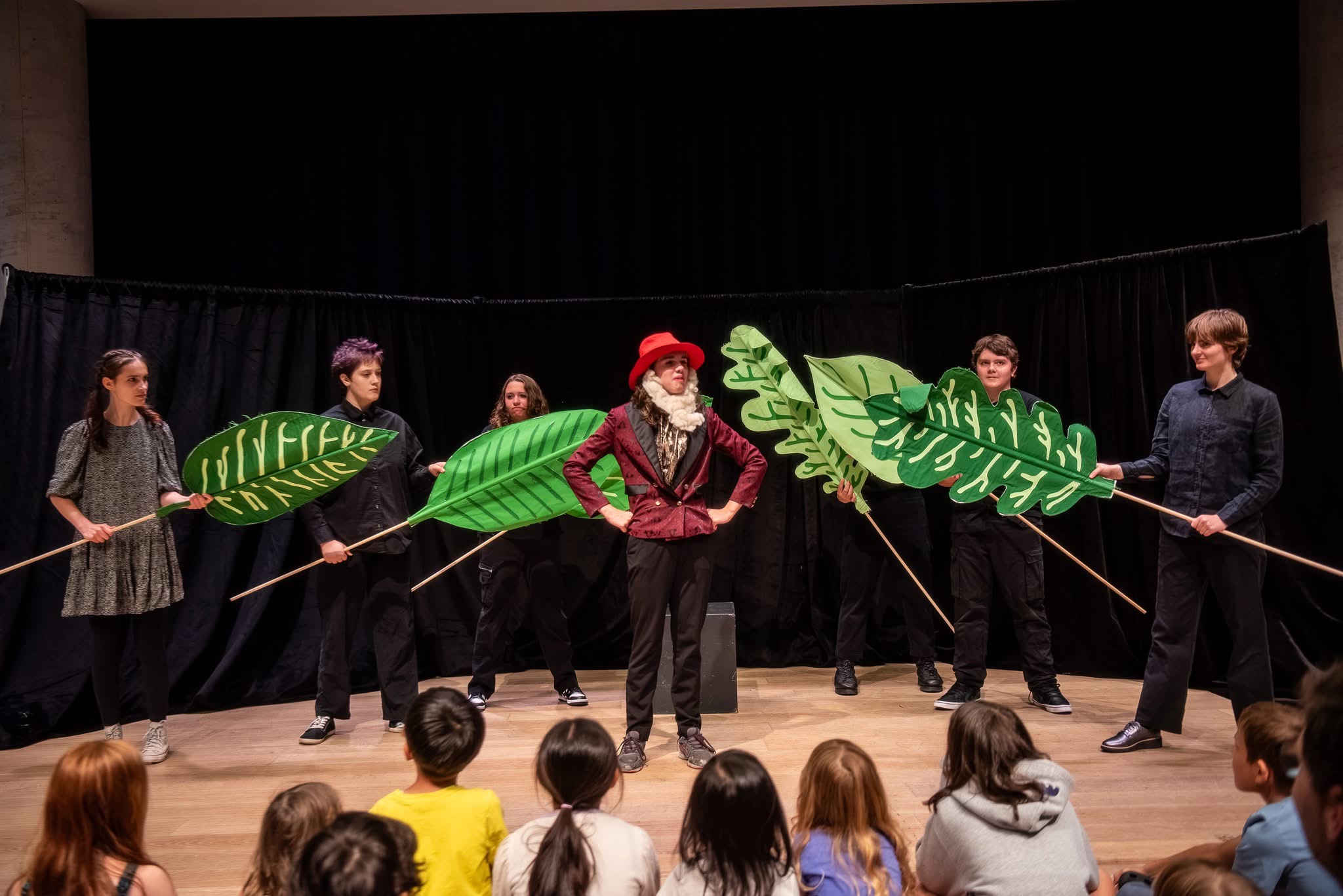
Next we saw Gale Force Theatre’s Young Company’s production of Alfie’s Wish, which is also an ideal length for someone Bridgette’s age. It was created and is performed by teenagers, and the story is very unique. A magical turtle has been cursed with granting a wish to the first person who finds it once every hundred years. An evil landowner is on the hunt for it, hoping to use their wish to further enrich themself at the expense of the surrounding community. Two siblings also set out in search of the turtle because Alfie believes that she has also been cursed because she perpetually lives in absolute fear of everything. Encouraged by her love of her sibling, she too embarks on a grand adventure, against her will.
I really enjoyed this story, and the vivid way that these performers brought it to life, and how well they all worked together as an ensemble. I was curious to know a little more about the world that they were living in- especially the role of the blue faerie who sort of flies on the periphery of the action, but gets drawn in at the end in a way that is really satisfying. Bridgette was very engaged watching this show too, and she went up to the teenagers after the show filled with awe and admiration for them. Her experience at Kids Fringe was excellent. She left wishing that there were more plays for her to see, so I know that she will be excited to come back for a new lineup of shows next year.
⭐️⭐️⭐️⭐️⭐️ to all the Kids Fringe programming & Everyone Is Interesting.
Next I went down to the Art Gallery of Nova Scotia to see Kian Diab’s play On Guard for Thee. The play is set in a dystopian future where Canada has been overthrown by extremists, and we meet four disparate real human characters who are also the four horsemen of the apocalypse: conquest, war, famine, and death.
There’s a lot that’s really interesting about this play. Diab has placed these characters into engrossing, high stakes situations, and much of the context of the world has been vividly imagined to create disturbing and memorable imagery for the audience. There is room to keep clarifying the narrative. The Four Horsemen of the Apocalypse are figures from the Book of Revelation that also exist elsewhere in the Old Testament. I wasn’t very familiar with these biblical figures, so I would have benefited from a bit more exposition. In the Bible each of the four is given authority over one quarter of the Earth, which makes sense to me, but in this play they all seem to be running roughshod over the same place. In the Bible their means of inflicting suffering and death are nuanced and different, but not in conflict with one another, where here the horsemen are continually trying to outdo one another. This is powerful when it is revealed that actually Famine, moonlighting as Capitalism, holds the power over Conquest, moonlighting as White Supremacy, but it becomes a little harder to believe when Death itself doesn’t always have the proverbial trump card in every situation. Watching Death struggle for status against any of the other horsemen is curious. I also found it confusing to know when the actors were playing their human characters and when they were being the horsemen, or if they were always one and the same. White Supremacy is very well played as a real deplorable racist misogynistic asshole, but he, the individual, is more vividly alive to us than the much more ephemeral idea of Conquest. I think it’s difficult for the audience to not be more invested in seeing the Indigenous character and the first generation Canadian kick the shit out of the KKK wannabe gang of white losers. The way the two narratives are placed on top of each other is complicated in a way that is still a bit muddy and difficult to follow.
I really like the idea of these four different characters- the white supremacist, the capitalist, the Indigenous matriarch, and the new Canadian meeting as the country has descended into political chaos, and I like the idea of the horsemen being somehow integrated into the concept as well. I hope that this team will keep on working on this play and really honing in on making the narrative as clear and precise as possible.
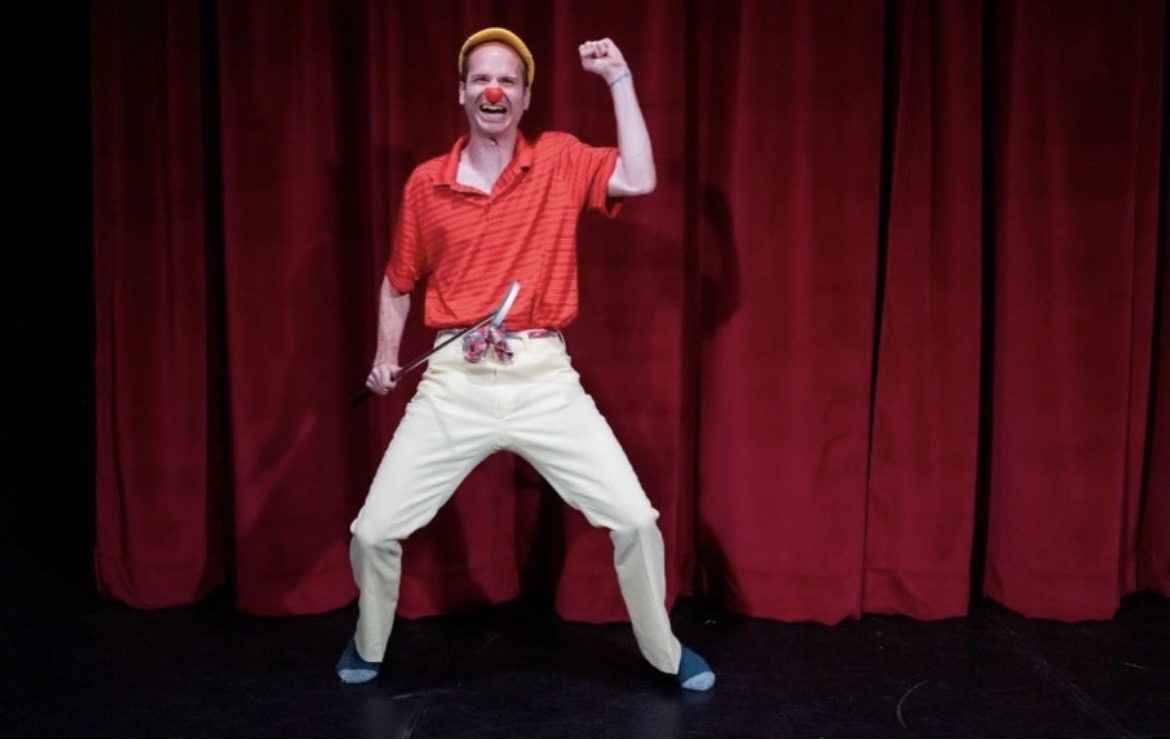
I then went up to DanSpace to see something completely different: Christopher Bugg’s Putt Putt Punishment. We meet Ehja the Clown and they are on the golf course. Their objective is to win the Putt Putt Trophy, and if they make any mistakes, they will punish themselves in ways suggested to them by the audience.
When I was thinking of a clown golf show the images that I was thinking about were those Walt Disney Goofy shorts where he’s learning how to ski, where the humour is in watching just how terrible Goofy can possibly be at something. Yet, in Bugg’s show it is not that Ehja is a bad golfer, in fact they’re quite proficient at it, it’s that there are obstacles stacked against them, and the way that they respond in the moment to all these acts of both skill and chance are very fun to watch. I think it’s the aspect of chance that really rivets the audience. There are moments when the ball should go into the cup, but doesn’t, there are moments where you expect the ball absolutely won’t get anywhere near the cup, and it does! You can feel the audience pulling together behind Ehja, while also at times helping to punish them, which creates an interesting tension in the room. Does anyone ever cry out and tell Ehja to stop hurting themself? Refuse to offer up a punishment? It’s a real audience experiment every show for Bugg as they then need to navigate around each of these moments in character.
We are further invested in Ehja when we are shown flashbacks to their youth, and meet their golf obsessed Papa, and we learn that Ehja has abandonment issues, and his father isn’t the only male role model who has so disappointed him. This explains, although sadly, why he has no grace for himself when he makes even a simple mistake; he is determined by any means necessary to be the better man- to be perfect. This clown show is both very funny and compelling and heartrending. The way that Bugg switches characters between the Papa and the child with a piece of electrical tape for a moustache is very clever.
Ehja communicates in a voice and gestures that is sort of a mixture between Elmo and Gollum, which is really great. I think there’s room for Bugg to make his communication with the audience, especially at the beginning of the show, a smidgen broader and clearer, but once we are all on board, we are there for the whole ride. I was so happy to see a clown show at the Fringe, and to have it be in the middle of my last day as a nice little palette cleanser.
TWISI Fringe Rating: ⭐️⭐️ ⭐️⭐️1/2
Then I headed up to the Bus Stop Theatre to catch Andrew Crabbe’s The Cult of the Comfy Wizard, which nicely mirrored, in some ways, Everyone Is Interesting, as it was a very small house and Crabbe incorporated nearly all of us into the action, so it felt less like watching a play and more like taking part in a theatrical experience, even though most of it consisted of us in the audience listening and watching Crabbe as they told their story to us.
This show really is a play on the idea of how one “misguided guru” (in this case the Comfy Wizard) can turn extremely appealing things, like wearing robes, drinking tea, and having a cozy time of it, into a dangerous cult. Our hapless protagonist is just looking for a whimsical alternative to the modern technological and political hellscape when he flies out of the pan and into the fire. This was a really fun and unique theatrical experience. I enjoyed watching Crabbe perform, and enjoyed taking part in bringing the world of the cozy commune to life. It was definitely an excellent show to see at nearly the end of the night on the last day of the Fringe, as focus was fraying and I think maybe the entire audience (or most of us) had reverted back to the eighth grade versions of ourselves.
TWISI Fringe Rating: ⭐️⭐️⭐️⭐️
The Halifax Fringe Festival, more than any other theatre event that happens here all year, is about sowing the seeds for the future of the theatre community. Halifax Fringe is where playwrights, of all ages, see their very first play up on its feet and in front of an audience. Halifax Fringe is where young actors who have just graduated from the Fountain School or other theatre schools in the country perform their first shows as budding professional performers. Halifax Fringe is where friends get together and establish theatre companies, sometimes with inside joke names, and some of those companies will last for decades (just ask 2b). Last February it felt very much like the Nova Scotia Progressive Conservative provincial government led by Tim Houston very much wanted to ensure that Nova Scotia’s theatre community didn’t have a future. In Jon Bennett’s show American’t he speaks a lot about that infographic that got shared a lot during the lockdowns of the pandemic where it rated all the jobs on a scale of whether or not they were essential, and artists were considered among the least essential. We all know, though, that that is actually bullshit, because what was one of the very first things that people did during the lockdown- they went immediately to Netflix and started to watch whatever entertainment created by artists they could consume- they joined Facebook groups like Nova Scotia Kitchen Party, where people from all over the province posted videos of themselves playing instruments and singing. I didn’t watch a lot of the pandemic art that saturated the internet during those two years, but even I watched an Alan Doyle concert, a Jann Arden concert, and streamed the entirety of the Rollo Bay Fiddle Festival, among other things. We need art. Art is essential. Full stop. But, in Australia where he was Jon Bennett felt unessential- unappreciated, uninspired, unwelcome, judged, and like the craft that he had dedicated his life to had disappeared and wouldn’t be coming back. That changed when he later found himself living in the United States- when he was in the United States he felt like he had a purpose, he felt important, he felt like a valued member of society. It made him want to stay there- in the United States, which is…. not without its own problems. …. Not without its own gigantic problems… including but not at all limited to perhaps being on the very brink of a substantial political and cultural and economic fall. Yet, it still feels better to Bennett to create there than it did in Australia.
As the country here is rallying together around investing in Canada, buying Canadian, supporting Canadian businesses, the people of Halifax got the memo and showed up at the Halifax Fringe Festival. The Fringe Festival had a very successful year, smashing attendance records, reaching new audiences, building a sense of connection between Halifax and the other small and moderate sized Fringes (and some of the larger ones too) across the country, and introducing Halifax to a lot of visiting artists who are leaving here having had a wonderful time. Why is the provincial government of Nova Scotia going out of their way to make artists here feel unessential, when we are supposed to be bolstering up all our local industries, of which the arts have perpetually been proven to be vibrant ones. We don’t want Canadians to have any reason to think that they can chase their dreams, like Jon Bennett, easier and more joyfully, in the United States (no offence to Bennett), we want all of those who are just beginning their careers in 2026 at Halifax Fringe to know that Nova Scotia is the best place for them to invest their time and their talents. It’s about investing here at home, it’s about not having to rely on the United States for our entertainment, it’s about putting an end to the brain and talent drain that sees our brightest stars leave this country to never or rarely really return. It’s about building Canada Strong. It’s about damn time that Tim Houston started following the Prime Minister’s directives, and stopped deliberately undermining the prosperity of this province. All the folks who took part in the Fringe Festival and all the many folks who came in and patronized the Fringe Festival over the last eleven days deserve better.