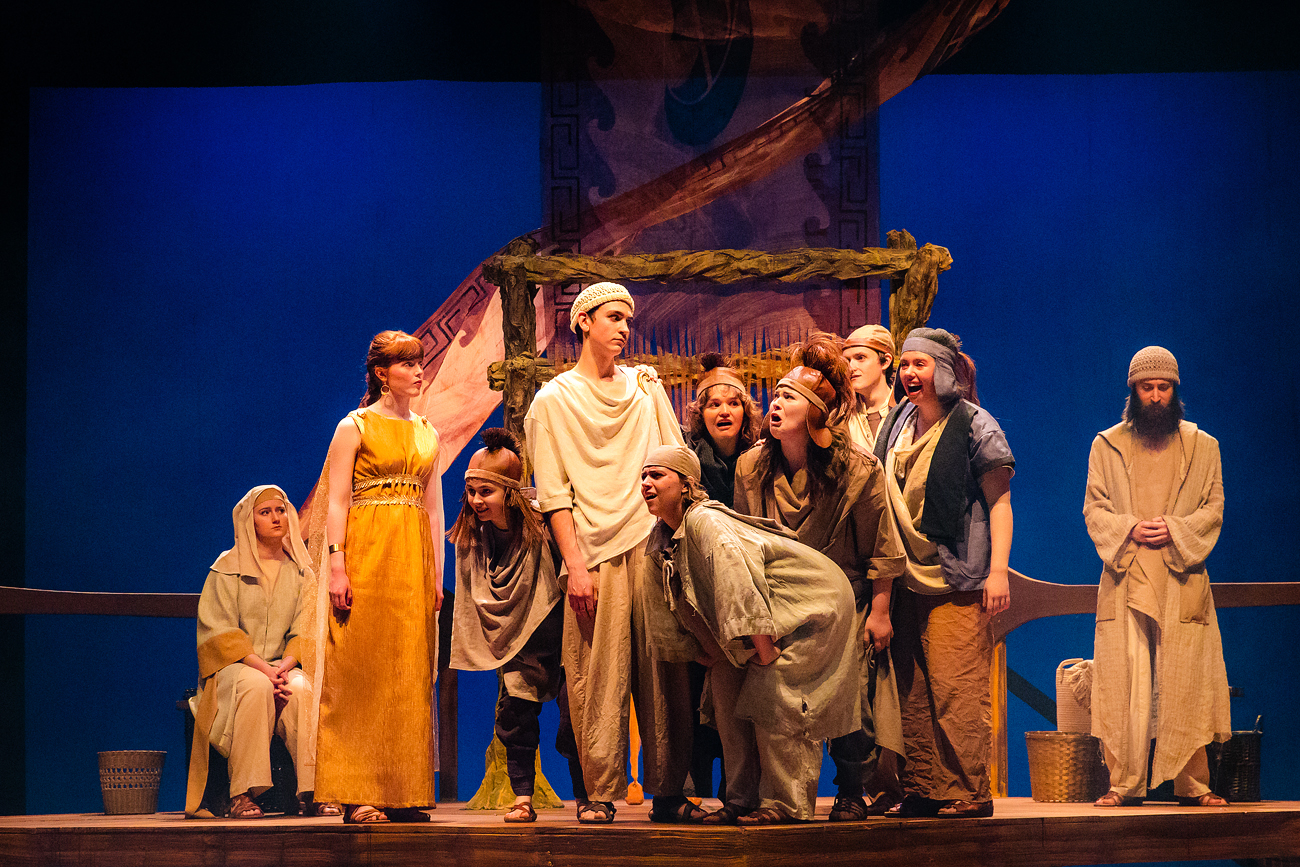
The Ensemble of The Odyssey directed by Ken Schwartz, Set Design by Eden Reshef, Costume Design by Sean Mulcahy, Lighting Design by Thunder Defayette, Photo by Kate Hayter.
The Greek myths continue to loom in the contemporary cultural landscape, but while we recognize certain iconic names: Helen of Troy, Achilles of heel fame, Odysseus and his epic journey, watching a theatrical adaptation of Homer’s The Odyssey may feel intimidating if we aren’t already familiar with the particulars of the story. Thankfully this adaptation by Rick Chafe performed by the graduating theatre students at the Fountain School of Performing Arts walks a careful line between modernizing, clarifying, and really rooting the story in Penelope and Odysseus’ points of view, while also still capturing a sense of both the ancient and the fantastical. The Odyssey plays at the Sir James Dunn Theatre until March 28th, 2026.
We meet the regal Penelope, Queen of Ithaca, played by Fiona Forsythe, who has been bearing the stress and the pain of having been left by her husband, Odysseus, just after their son was born, twenty years earlier. He didn’t leave of his own volition; he was dragged away to fight in the Trojan War, but, as we see throughout the play there are several instances where his greed, hubris, and ambition are directly to blame for him being so long detained. While she is grieving the loss of these two decades with her husband, all the while not knowing whether he is alive or dead, she is perpetually accosted by a gang of raucous young “suiters” who seek to use her body as a ladder to their own wealth and power. Instead of attempting to charm or ingratiate themselves the mob mentality takes hold and emboldens them to act like toxic entitled brutes seeking to intimidate Penelope into submission. It is out of this tense context that an old stranger arrives claiming to know Odysseus’ fate and Penelope starts to hear the story of how he was continually thwarted by monsters, the wrath of the Gods, his own poor choices, and curses, hurricanes, and seductresses every step of the way home.
While the Stranger, played by Aiden Bradshaw, speaks the scenes that he describes come to life around him and Penelope so that we the audience are also immersed in the tale that is being told. It is, by all accounts, a magnificent adventure- with a cyclops, a sea monster referred to as “Scylla the Devastation,” and Odysseus and his men even pretend that they are pirates at one point, but having Forsythe’s Penelope onstage alongside all the swashbuckling showing her steadfast stoicism and noble spirit doesn’t allow the audience to forget on whose shoulders all the responsibilities of home have been dumped. [Potential Minor Spoiler Alert] When her son, Telemachus returns home from his own adventure filled with an exhausting mixture of naïve ignorance and aggressive misogyny hurled toward his mother it is demoralizing to see that even without Odysseus present in his life, even being raised by this badass woman, he has been conditioned by his society to have all the same fatal flaws as his father, which are adjacent to what make Penelope’s suitors little better than Neanderthals.
It is perfect casting to have Jacob Ives play Telemachus because he has an unbridled charm and innocence about him, but he also brings a certain Joey Tribbiani quality to the character where the contrast between his air of machismo is hilariously undercut by his more vapid personality. This further cements Penelope as the power holder in the family and does suggest that Telemachus is more malleable and might actually learn a valuable lesson from his father’s story.
Ella Haefele also brings a lot of humour to the story as Eurycleia, an older woman who had been Odysseus’ nurse and who still lives with Penelope. She is characterized very much as the long-suffering common sense figure ignored by everyone else who lives perpetually shaking her head and tearing her hair out as she is dismissed and derided by those intent on ruining their lives and those around them. Haefele does a great job of making her plight both sympathetic but also absurd. Like Ives’ Telemachus she feels a bit like a familiar sitcom trope, which helps to give the play some of its modernity and comedy.
Most of the actors play multiple roles with the gang of suitors doubling as Odysseus’ crew, who are both haplessly dragged along at the mercy of their Captain’s sometimes unfortunate decisions, and who are also sometimes guilty of their own downfall. Malachi Jeffrey, Alina Kogas, and Samantha Longmore do an excellent job of creating the illusion of a large crew of men continually being eradicated by various catastrophes, and the beleaguered survivors growing more and more weary and desperate as the story goes on. In contrast their raucous energy outside the palace builds a menacing tension that Penelope can no longer hold at bay. I also appreciated how director Ken Schwartz brought out some moments of humour among Odysseus’ crew, especially with Samantha Longmore’s characters, to add a bit of levity here too.
Chafe has written that when the gods Athena, Rachel Chew, and Hermes, Alina Kogas, interact with Odysseus they do so in song. Chew has a beautiful ballad at the beginning of the show as Athena imparts an ambiance of warmth and care over him. Then much later, after we have almost forgotten the music that greeted us at the beginning, Kogas as Hermes bursts out with a much more theatrical number to give Odysseus warning in a way he can’t easily dismiss. Bree Torgrimson plays the seductive Circe who is almost able to overpower Odysseus with her allure, but he eventually does dig down to the depths of his soul and thinks of Penelope and she gives him the resolve to move on.
Young Odysseus is played by Benton Elliott and he does have a likeable heroic quality to him which is essential for the audience to care about his well being despite his problematic behaviour and sometimes laughable mistakes (like when he yells his entire genealogy in triumph after a narrow escape from the Cyclops; unsurprisingly that ends up coming back and biting him in the ass). Despite his flaws the audience has to want Odysseus to return home, and so Elliott needs to be able to continually find that redeeming quality in him and to make all that is so frustrating about his behaviour resonantly human. Similarly, the way Aiden Bradshaw’s Stranger reacts to having to tell this story with unflinching honesty to Penelope and then to Telemachus gives us insight into whether there has been any meaningful change, any reflection and growing self awareness to signal that the future for Ithaca might hold some promise, or whether history is doomed to repeat itself.
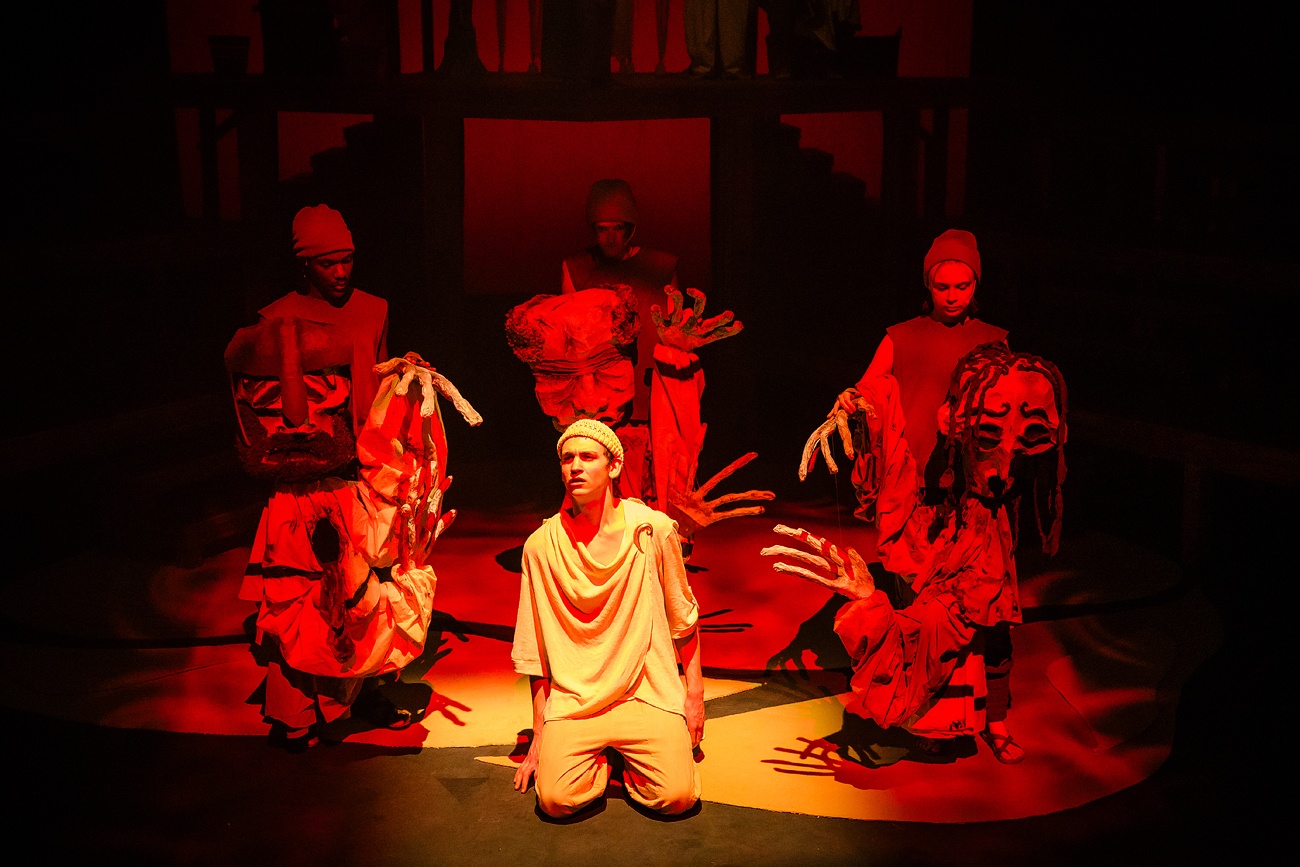
Eden Reshef’s layered set design works really well to double as both a palace and a ship and to give Penelope and those with her a top platform that feels physically removed from the rest of the characters, so that she both looms out over the rabble, and also looms out over the story. Thunder Defayette’s lighting design and Cadence Cook’s sound design both work together to create an immersive experience for the audience, especially evoking being at sea or surrounded by the sea. Diego Cavedon Dias created the magical puppets that also help to link this ancient story to more contemporary fantasy tales. Sean Mulcahy’s costume design works really well to evoke both what we think of as Ancient Greek attire, but also brings in imagery both from pirate and shipwreck iconography that helps root the story very much in the salt and the spray of the ocean.
Ken Schwartz does a great job keeping the pace of the story moving briskly and making sure that the story is always clear when the actors are playing a myriad of different characters and we are moving both backwards and forwards in time. Thankfully for a piece that Homer divided into 24 books this adaptation is short- the play doesn’t even have an intermission- but this furthers the need for Schwartz to be able to be clear and intentional at a rollicking speed.
Homer’s foundational works were already part of the Greek canon by the 6th Century BCE, which is, frankly, mind boggling. We keep coming back to these stories and to these characters because they still resonate with something deep inside us, despite the fact, as Burgundy Code mentioned to me after the show, our world would be completely unrecognizable to Homer. I wonder what he would think of The Simpsons? Anyway, the concept of peace being a “luxury” really screamed out at me, and the way the toxic masculinity pervades everything because of how systemic it is seems to really be the umbilical cord that tethers Homer’s world to ours. In fact, I think it might be the day when some future theatre artist or historian can look back at this story and it genuinely seems like a bizarre foreign other planet to them that maybe we will finally have succeeded in creating a fundamentally better world. Until then come see Odysseus navigate through the perils of vanity and greed at the Sir James Dunn Theatre.
The Odyssey plays at the Sir James Dunn Theatre inside the Dalhousie Arts Centre (6101 University Avenue, Halifax) until March 28th, 2026. Shows run at 7:30pm on March 27th and 28th and there is a 2:00pm matinee on the 28th. Tickets are $26.50 or $18.25 for students and seniors. They are available to purchase online here, by calling the Box Office at (902) 494-3820, or by visiting the Box Office in person.
Please note this show includes theatrical depictions of violent battles, killing of suitors, and features mythological creatures. Bright lights, loud sounds and music, haze, and fog are in use.
This show is 1 hr and 45 minutes with NO INTERMISSION.
For accessible seating, please contact the Box Office at (902) 494-3820.
Incoming search terms:
- https://www twisitheatreblog com/?p=6333