Pop Up Love Party at Alderney Landing
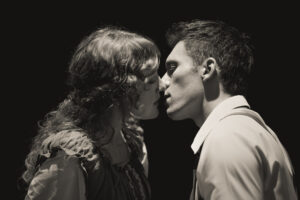
It is aptly cheeky for Zuppa to have adapted Plato’s Symposium into a theatre piece given that he supposedly once burned all his own creative works and became a harsh critic of the Ancient Greek theatre under the influence of Socrates, who felt that everything else paled at exposing the truth compared to philosophy. To be fair, though, Plato was kind of asking for it when he wrote such an innately theatrical dialogue piece, imagining six characters drinking at a party to celebrate the success of a playwright’s award winning play sparring with one another in words to see who could come up with the most persuasive toast to Eros (erotic love/desire). It was out of this that Zuppa created their own frenetic adaptation Pop-Up Love Party eleven years ago. As the name suggests the show has the tendency to pop up for short runs, not just here at home but across the country, at festivals, and in different places around the world, and audiences were delighted to have the show at Alderney Landing last Thursday and Friday in association with Eastern Front Theatre. They were also particularly delighted to have the chance to see Susan Leblanc onstage, as she has largely stepped away from her work as an actor lately to devote her time, energy, and her passion, eloquence and intelligence to representing Dartmouth North as their NDP MLA. She is also vehemently defending all arts, culture, and heritage every day inside the Legislature ever since the Progressive Conservatives’ Budget was introduced.
Plato wrote his speeches from the perspective of different characters: the aristocrat, the legal expert, the physician, the comic playwright, the tragic poet, and the philosopher. For Pop-Up Love Party the members of Zuppa didn’t just adapt and modernize these speeches by finding contemporary characters for them, they also wove aspects from their own lives and experiences into each one. For example, Stewart Legere, who is also a singer-songwriter, brings his own music to the speech adapted from the tragic poet and he speaks very much from the vantage point of someone who does write sad songs on the subject. As the socialite character taken from the aristocrat Leblanc speaks about her maternal lineage and her own daughter and the way that our very existence on this planet is usually due, at least in part, to Eros. They explore not only the way their real lives intersect with this conversation that started over 2,300 years ago, but they also play with the Zuppa personas that they have cultivated for themselves over the last two and half decades. Ben Stone, for example, dons a tinfoil hat to play the comic playwright and delivers a monologue rife with every morsel of conspiracy theory jargon that you’ve seen bubbling up from the Dark Web from the anti vaxxers and the Q-Anon, to the flat earthers (among others). He tells us a gruesome rendition of the “our soulmates are our literal other halves” story with his characteristic zany intensity of energy, but also all of his persuasive charm, which allows the audience to come aboard for the ride even though they know that what he is saying is absurd. At the end Legere, the youngest in the company who often plays the rockstar or deep introspective artist characters, says in a deadpan voice to Stone, “It’s not bad to be goofy,” and then, with even more of a sardonic edge, “everybody loves a clown.”
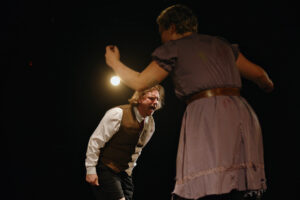
Stone becomes the comedic foil in Legere’s lawyer speech earlier too where Legere engages with the audiences trying to differentiate between “good” love and “bad” love, which ends up creating a kangaroo court where Stone keeps getting fed tablespoons of mayonnaise to which he reacts at the level of Charlie Chaplin or the Marx Brothers in absolute disgust- to the absolute delight of the crowd… who then tries to do everything in their power to make it to happen again. Ben Stone, notably, is no stranger to eating food in odd ways onstage for comedic effect; in Open Theatre Kitchen he eats an onion as though it were an apple.
For Plato it seems like the entire point of his writing this Symposium was for Socrates, the philosopher, to have the eleven o’clock number and to blow everyone else out of the water with his profound, dazzlingly original, airtight logical arguments, and that he would be the obvious winner of the contest, thus proving that philosophy is the superior form of persuasive discourse. It is interesting too that it is Ben Stone who gives this speech in Pop-Up Love Party.
We often see this connection between the clown or the fool and the sage in Shakespeare, and within this context of Plato it is funny to have the same actor play both the person Plato idolized above all else and a person who likely would have dismissed, maybe outright.
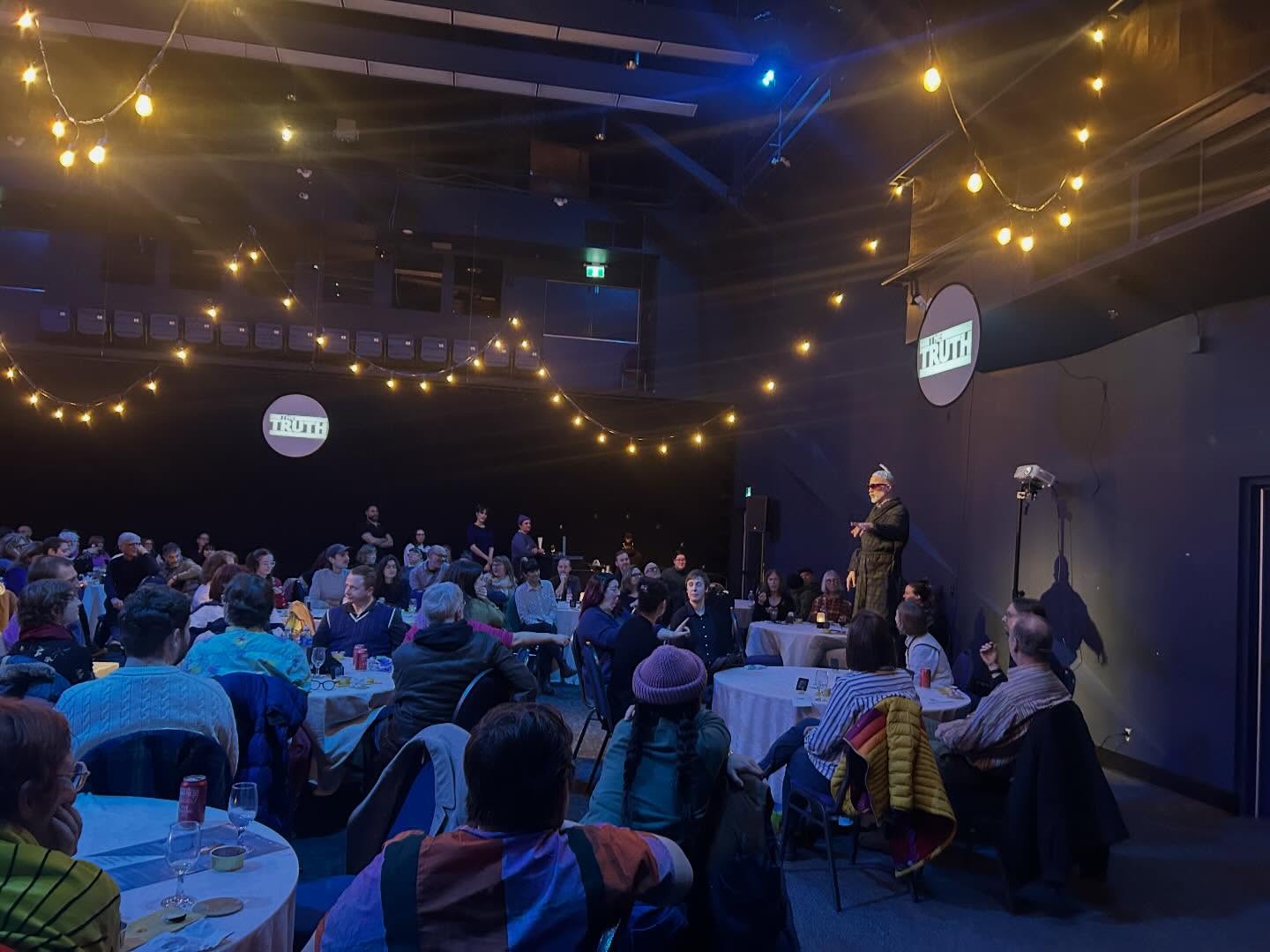
The performance is cabaret style, directed by Alex McLean, with the audience seated in tables around the space, and the three Zuppa performers run around this space, in between the tables, hopping up on blocks to give their speeches, and moving continuously- so no matter where folks are seated the action is always happening in motion around them. There are also projected images by Nick Bottomley and even an overhead projector to help illustrate various aspects of each of the speeches. The audience is also treated to an array of different snacks created by chef Jamie MacAulay, and the snacks are inspired by some aspect of the theme of the speeches. Especially for me, who has the palette of a toddler, I found the different tastes and textures of the snacks to be quite new and unexpected, and that there was a whole different stream of thought happening as I tried to taste them through the theme of the performance I was witnessing as I ate.
I find the original conceit of Plato’s Symposium to be interesting because the idea of having to sell an audience on love, especially erotic desire, lust and sex seems, frankly, moot, especially in a society where we are used to having debates about incredibly divisive topics. So, in Pop-Up Love Party I find that I’m less focused on asking whether I was swayed (do I now believe in the power of love?), and more focused on how I am being drawn into some sort of story. Legere has the audience writing the story with him as the lawyer, Leblanc has the audience moving along with her as the yoga instructor, Stone has the audience laughing at him as the playwright, Legere appeals to the audience’s heart through his music, and Leblanc offers us a window into who she is by telling us about her mother and her grandmother. These are all effective ways to draw an audience in and to help you connect with someone giving a speech.
At the end as the philosopher what really stood out to me was how a lot of these performative elements were stripped away and suddenly Stone, without his proverbial circus trunk of props, just sat down and spoke to us with a little more vulnerability, a little more rawness. The philosophy of love was there woven in very thoughtfully and systematically building that airtight argument, but what jarred me the most was when Stone asked Leblanc about her real life partner, fellow actor and activist Sébastien LaBelle, the father of the daughter whose photograph we saw projected earlier in the night, as well as their son. Stone, who was trying to establish that love is desiring something you do not yet have, asked her something about loving someone she, arguably already has, and as part of the answer to these questions she said plainly, “he could leave me,” and then, after a pause, “he could die.” I felt the air go out of the room for just a glimmer of a second in that moment because it landed like a boulder. Plato’s criticism of theatre in his own time was that the truth in the theatre gets obscured by the artifice and that audiences are too easily manipulated by what they see on the stage- that theatre was, in fact, dangerous. Yet, theatregoers do get these powerful moments of truth- whether it is someone telling their own story from their own heart or an actor portraying a story masterfully- and the connection that is possible with the audience in these moments can be genuinely transformative.
It is theatre’s ability to be dangerous that makes it a target for fascist, authoritarian, conservative, and wannabe draconian governments because of the power theatre has to build bridges between people from disparate classes and communities and to facilitate greater understanding, empathy, and a broadening of minds that makes it harder for cynical politicians to sow fear, hatred, apathy, and scapegoating amongst us. Even a show where we are giddy with glee to see a clown’s visceral response to a spoonful of mayonnaise can turn around and punch us in the guts with something real and unexpected. It can then dissolve just as fast into joyful nonsense. But even under that nonsense another truth peaks out, a bit awkward and inconvenient, inviting the audience to take that home with them too.
Pop Up Love Party has closed. Follow Zuppa on Facebook or Instagram (@ZuppaWorks) to find out when it might pop up again.