
The first time I heard Adam Baldwin’s song “Lighthouse in Little Lorraine” was when I saw him perform at the Scotiabank Centre when he was opening for Alan Doyle a couple of years ago. I’m not sure how it’s possible that his music had evaded me for so long, but before I got home from the concert I’d added his albums Concertos & Serenades and his self titled EP to my Music Library. Both albums are excellent, but there was something about “Lighthouse in Little Lorraine” that deeply resonated with me. I’ve played the song over and over so many times since I first heard it; it almost always makes me cry.
When I found out that Baldwin and Andy Hines were adapting the song into a screenplay for a film that would shoot on location in Cape Breton I was very intrigued to see the very specific world of the song come to life on the big screen. Little Lorraine is inspired by a real drug smuggling operation that folks in Little Lorraine, a village of 60 people, became embroiled in between 1986 and 1991, which saw “[boats] coming up from America/ with caskets filled with cocaine,” and as Baldwin writes in his song, “there’s a gold mine out on the ocean/ and a lighthouse in Little Lorraine.”
The film starts at the local DEVCO mine where our protagonist, Jimmy, works with his lifelong best friends Tommy and Jake. Following a disaster there the company decides to shut the mine down completely, throwing all the men who work there into unemployment. Jimmy, like his friends, is understandably stressed by this because he is married and has two children to provide for and his son, Jackson, is disabled and uses a wheelchair. Like an ominous figure blown in by the Santa Ana winds Jimmy’s Uncle Huey, known throughout the village for being an outlaw, returns home just when his nephew is too desperate to refuse his assistance. But at what cost? With a little bit of pressure from his wife, Emma, Jimmy- in good faith- ropes Tommy and Jake into helping Huey with his surreptitious enterprise too.
The film hits differently, I think, if you’re from Nova Scotia. I’ve grown up hearing about the perils of being a coal miner, reading about it and seeing it depicted onstage, but I’ve never seen the reality of it come to life like it does here. There’s something so visceral about seeing something that has lived in your subconscious all your life like that. There’s something tangible, too, in the details- watching the pickup truck drive down the unpaved dirt road in the parking lot, and those deep pools of puddles everywhere- even on a bright sunny day with a blue sky. There is a powerful bit of dramatic irony as well when we see Jimmy and his compatriots being forced to choose, in 1986, between remaining in Cape Breton and being unemployed or uprooting their families and moving to Plymouth to work at the Westray Mine. We here all know that in May of 1992 all 26 miners underground were killed when that mine was the site of a methane explosion. I was only seven but I remember sitting around my aunt’s dining room table in Tantallon with my whole family listening to the TV coverage of the disaster while we ate supper. It didn’t matter that we had no direct connection to coal mining in our family; we felt the sorrow in our bones.
Against the backdrop of the dissolution of the cod fishery, and generations’ worth of men working in the mines with the bosses’ feet on their backs the Cape Bretoners in Little Lorraine have been put in an impossible situation. At times you do want to believe in Huey as some sort of deranged Robin Hood.
Stephen McHattie is ideally cast as Huey, a man who looks like he has been through the wringer and is clinging to his last ditch shot. There’s a sadness in him too, as he skulks around in the background, tepidly reconnecting, not just with his nephew, but his whole extended family. There seems to be a glimmer in him that wishes he had some of that familial connection himself. It would be interesting to know what propelled him to leave Cape Breton in the first place, and whether his deep manipulative streak is just a defect of his character or if it came out of some sort of self preservation response to his own past trauma. McHattie, who was raised in Guysborough, effortlessly captures the rural Nova Scotian black sheep of not just the family but the entire village.
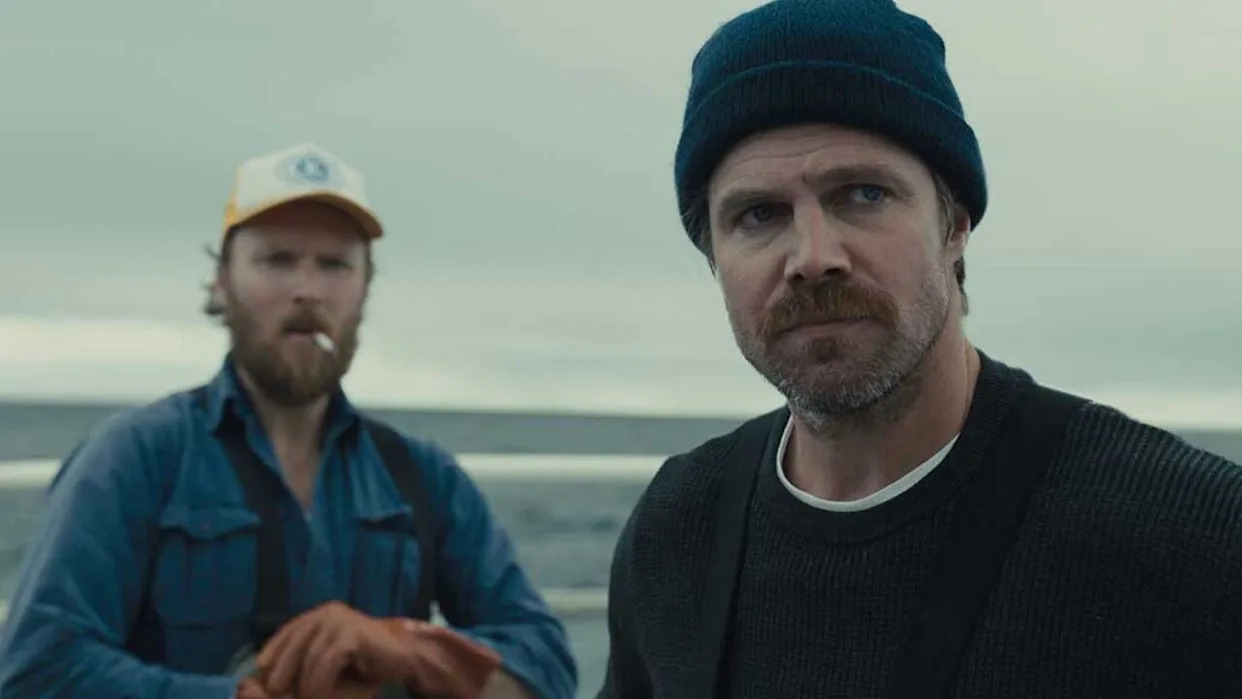
Stephen Amell plays Jimmy as a likeable, grounded everyman trying to do right by his family. We see him, along with Tommy, played by Joshua Close, and Jake, played by Steve Lund, spiral dramatically as the film progresses and each of them find a different way of showing the way their souls are cracking under the guilt and stress they’re feeling. Auden Thornton plays Emma, Jimmy’s wife, who seems on the one hand very stoic and pragmatic, but on the other has a bit of an inexplicable air around her too. Mike Dopud plays Thibault, Huey’s French associate, who is not impressed with the caliber of labour Huey’s hauled aboard. Hugh Thompson gives a great performance as Gordy, who is on the white collar tier of the operation, and showcases how even in a tiny village it’s easier for someone at that level to operate nefariously in plain sight. Sean Astin plays Father Williams, the village’s priest, and he too is perfectly cast. Astin, of course, is a highly recognizable figure, especially for his role of Samwise in The Lord of the Rings films, but also, more recently, as Bob in Stranger Things, and audiences tend to feel affectionately toward him on an almost subconscious level. In casting Astin as the Catholic moral authority in Little Lorraine director Andy Hines seems to be setting the audience up to empathize with Father Williams, even if that means complicating our relationship with Jimmy. This beautifully echoes the theme in the film which asks can you still be a good man if you are knowingly profiting off immoral acts.
In another poetic choice that might not be obvious to outsiders it’s worth noting that almost all of the humour in the film comes from Bette MacDonald and Maynard Morrison (who wears a sweater that should win an award), as the couple who run the local bed and breakfast and have absolutely not a clue what to do when a South American chap (J Balvin) arrives who won’t drink their tea. It would be more realistic for there to be some more dark Gaelic humour peppered throughout the stress and the sorrow coming from Jimmy and the b’ys, but showcasing MacDonald and Morrison this way also feels like an apt inside joke. There is also a fun cameo from Baldwin himself as a fisherman on the wharf that’s also “right comical.”
I found the dialogue to be beautifully written in a way that really captures the different ways that folks speak here, and Sarah English did a really fantastic job as dialect coach for the Come From Aways. I did have some questions about the specifics of Jimmy’s life before Uncle Huey arrived back home- especially surrounding Emma, who is an artist struggling to find a place to sell her work. She felt to me like someone who, when times were tough, would make whatever sacrifice she herself needed to make- whether that was putting her art on hold and getting a job working at a grocery store or doing odd jobs for neighbours, and I kept wondering why that was never presented as either a possible solution to their financial problems or as a bigger roadblock in their marriage. At first I wondered if she needed to be home with Jackson, but it’s clear that during the day he goes to school with his sister, so I thought perhaps this was an avenue that the film could have delved into a bit more clearly. I think there was room in general for the writers to have given the audience an even stronger sense of the perilous financial stakes that drove Jimmy to decide that working for Huey was his only option to save his family from ruin.
Of course, musically the film is rooted specifically in Cape Breton’s rich unique culture with The Men of the Deeps singing at the funeral for the slain miners at the beginning of the film to fiddlers and step dancers filling the pubs and the church dance as they do. Cape Breton was very much its own character in the film in a glorious way. We also get a strong sense throughout the film of the deep bonds- not just between Jimmy and his best friends- but also between them and Father Williams, who have all known each other since they were children. Their deep roots and connections to one another complicate the story in interesting and surprising ways.
As cast members have mentioned in interviews about the film Hines and director of photography Jeff Powers and their team haven’t made this movie to look like a glossy contemporary crime thriller- it harkens back to the grittier films of the 1970s that didn’t have the rollicking pace we are used to today. This film isn’t really about the narcotics ring or the tensions surrounding whether Jimmy, Tommy, and Jake will get picked up by the cops so much as it’s about whether this type of Robin Hood mythology can withstand its very dark realities in a tight knit, faithful, deeply Canadian place like Little Lorraine, Nova Scotia. And, if not- where does that leave people like Jimmy if they don’t want to leave, but can’t afford to stay? And where does that leave all of us when we have lost so many goodhearted, hardworking, decent folks who deeply love this place to opportunities elsewhere?
Everyone at the screening I was at today at Cineplex in Bayer’s Lake stayed through the end of the credits because no one wanted to miss the entirety of “Lighthouse in Little Lorraine,” but it was also worth staying to read all the names of all the local folks who worked on this movie. There was a gigantic block of names listed as Background Performers (so many people whose last names begin with “Mac”), and then a box just as long of Thank Yous signalling how projects like this one aren’t created in vacuums- the artists and their work are deeply embedded in their communities .
Throughout our lives we are conditioned to ignore the logo at the end of almost every film we watch which says the movie was Approved by the Motion Picture Association of America. We also ignore the icons for all the familiar American film studios that we know by heart: MGM, Warner Brothers, Twentieth Century Fox. We never think twice about it. It’s the way that our theatregoing experience almost always has been. Today, at the end of the credits for Little Lorraine there was a logo for Nova Scotia with a little Nova Scotian flag, and that made my breath stop in my throat. It’s rare to see that at the end of a movie at the Cineplex in Bayer’s Lake. Nova Scotia’s stories so rarely get told in this way, with this scope— with Sean Astin helping to bring this world, our own world, to life on a potentially international stage. Now that Canadians are being given the great opportunity, finally, to look inward, to invest inward, to appreciate what we have right here instead of being tricked into thinking there’s better beyond our borders, this is the perfect time to invest in Nova Scotian artists, and in our own storytellers. It’s not about one breakout film or television series, it’s about systematically building a foundation for an entire industry to be fostered and to flourish- exactly like the Americans did a century ago with Hollywood. To borrow from Jack Layton: “Don’t let them tell you it can’t be done.” I hope to someday become accustomed to the film ending with a beautiful little Nova Scotian flag.
Follow Little Lorraine on Instagram or look for it at your local Cineplex movie theatre. It is currently playing in theatres around Nova Scotia (Halifax, Dartmouth, Sydney, Truro, New Minas, New Glasgow), as well as New Brunswick, Prince Edward Island, Newfoundland, Montréal, and in Ontario. Check your local listings!
Canadian Theatre Criticism is an essential part of a healthy and thriving theatre community. It helps theatre companies find new audiences for their shows, deepens audiences’ engagement with local artists and the work being created in their communities, and it is one of the best ways to preserve a snapshot of an ephemeral art form for future generations of theatre lovers. TWISI relies on support from its Subscribers, folks like you who care about the survival of local and independent arts coverage. Please consider becoming a Subscriber today, or click here for more information. Thank you so much for supporting TWISI.
Incoming search terms:
- https://www twisitheatreblog com/?p=6392
- https://www twisitheatreblog com/?p=6392#:~:text=Little Lorraine is inspired by on the ocean/ and a
- https://www twisitheatreblog com/?p=6392#:~:text=The first time I heard a couple of years ago
- https://www twisitheatreblog com/?p=6392#:~:text=Hugh Thompson gives a great he too is perfectly cast
- https://www twisitheatreblog com/?p=6392#:~:text=There is also a fun for the Come From Aways
- https://www twisitheatreblog com/?p=6392#:~:text=There is also a fun thats also “right comical ”