
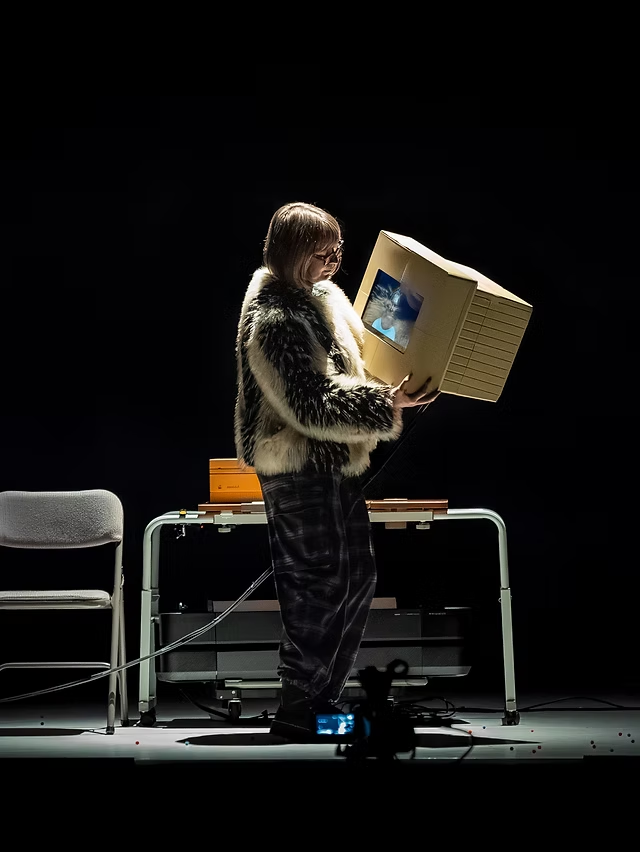
Cole Lewis
My experience at Eastern Front Theatre’s Stages Festival tonight began with Cole Lewis, Patrick Blenkarn and Sam Ferguson’s riveting theatre piece 2021 which explores both the theme of a digital legacy after death, and also coming to terms with how to memorialize someone we love who has died when our relationship with them in life was complex, and we disagree profoundly with many of their beliefs, values, and choices.
These are some of the questions that Cole Lewis has been left with after the death of her father, Brian, in 2021. She and her father lived in different countries for most of her life and they did not see each other often. She shares with us some artifacts from his life that highlight the love that he had for her, a daughter with multiple pet names he’d given her, the love that he had for his wife, Cole’s stepmother, artifacts that show a childhood and young adulthood marred by intense trauma for which we [likely] feel empathy. We are also shown artifacts that one could say were methods through which Brian was indoctrinated, although it feels dangerous to see him entirely as some sort of hapless victim whose unprocessed trauma and unstable childhood were corrupted and used to manipulate him into a paranoid MAGA rage machine. Surely, he has to be held to some accountability for being able to be convinced that rooting himself in racism, misogyny, and fear of anyone different from him was the answer to building a secure life for himself and his family. We see that this is why Lewis includes the Trump BobbleHead in her trove of her father’s treasured things. She doesn’t want to erase these parts of him, even though she could, because she wants to remember him for all that he was, or at least, all that she knew him to be- even if she finds it embarrassing or even shameful.
We the audience see that this is difficult for Lewis because she exudes warmth, kindness, endless patience, and we watch her show her father the ultimate in calm, measured respect under the most intense and stressful of situations: her father resisting help at the hospital as he is dying in a country she has no access to because it is 2021 and the borders are closed to international travel. We wonder whether she receives any amount of grace or gratitude in return.
Having met Brian through a few of his things, Lewis invites a volunteer up from the audience to play a video game that the team has created where the goal is to help Brian escape from the hospital. The audience is encouraged to yell out advice for the volunteer as they both wander through the hospital looking to accomplish a number of quests, and are presented with different options for how to proceed or what else to explore at different points in the game. I was most surprised by the fact that you’re able to turn down Brian’s racism and misogyny if you’d like, and so I spent much of the rest of the show wondering how much of a sort of watered down version of Brian we were meeting. Is it more empowering for us, the audience, to be able to exert some control over this simulation of a real person to make his personality more palatable for us? Or, are we showing some cowardice for not wanting to deal with the full-on reality of what this guy was capable of? Do we want to like Brian because we like Cole? Do we want to like Brian because he’s the protagonist of the play we are watching? Do we want to like Brian because it’s sad that he’s dying and that he is mostly all alone?
The audience watches the volunteer play the game on a large screen on the stage, Blenkarn provides music for the game, and Lewis narrates it, showing off her wry sense of humour. As someone who last played Mario Kart with the child I was nannying for eleven years ago and who grew up with the original Nintendo but didn’t play it very often (and wasn’t good at it), I wasn’t sure what my relationship would be to watching someone playing this kind of game, but I found that I was on the edge of my seat. I was surprised that it actually reminded me of a Muppet computer game that I had in the mid 1990s where you could explore the various rooms of the Muppet Theatre and Muppet Labs and play different games in different rooms. This piece completely unlocked the memory of this game for me, and so I was surprised to even feel a bit of wistful nostalgia for an experience with a game that looked a bit like this one from my own childhood.
The show ends with Lewis having a conversation with an AI model of her father- a sort of cartoon avatar that speaks in stilted phrases that sometimes make sense, but often doesn’t, taken from real data that Lewis fed the machine to attempt to teach it to carry on a conversation as her father would if he were here. This was the aspect of the show that I was most nervous about because I am deeply mistrustful of AI, and I was actually relieved to find that there was nothing real, human, or seamless about this model- not yet, at least, not now. Is he a “next best thing” though, or “good enough” if you are grieving, if all you want is to hear your parents say something to you that you haven’t heard exactly before? If Lewis is able to train this AI model of her father to say words that she longs to hear him say, something that might be redeeming, that might offer a deeper insight than he was able to give her in life, can that be healing, or will it always be wishful thinking because it’s not the real truth? Lewis asks the AI model what she should do with him once she’s finished with this show. Should she delete him? Would that be, in some way, like dying twice?
There is a stereotype about the MAGA movement that you see a lot of posts about on social media where critics say things like “they have made being Trump supporters their entire personality-” and I can’t say that that doesn’t seem to be true in many cases. It seems like it was likely at least partially true for Brian Lewis as well. This strikes me because it’s possible that it was Brian who was living his life in denial of his full self- in contradiction even- and that through her work in 2021 it is Cole who is trying her damndest to embrace the wholeness of him, with love and sadness, and a gentle tenderness that he seemed to maybe balk at in others, but depended on in her. He was immensely lucky to have such a caring child who has immortalized him in this profoundly human way.
I’ll be thinking about this piece for a long while.
Eastern Front Theatre’s Stages Festival runs June 3-7th, 2026 with the Main Stage shows happening at Alderney Landing Theatre (2 Ochterloney Street, Dartmouth), and other shows popping up in venues on both sides of the harbour. Festival Passes are $60.00 and provide access to all the productions. Industry Series Passes range in price between $40.00 to $60.00 on a PWYC scale. Both are available here, along with more information. Prices for individual performances vary from free to $26.00.
There is a very thorough Accessibility Guide Available Here (Scroll Down). Alderney Landing Theatre is accessible for wheelchair users, there are two all gender washrooms, Phonak Roger FM/DM System available at Alderney Landing Theatre. Automatically connect via Wall Pilots or borrow a Telecoil device to sync with hearing aids and cochlear implants. Devices with headphones are also available. Please see the Box Office for assistance onsite. ACCESSIBLE TICKET PRICES: All performances have pay-what-you-can-afford pricing. If cost is still a barrier, please email info@EasternFrontTheatre.com. Volunteers see shows free of charge! Sign up here!
Canadian Theatre Criticism is an essential part of a healthy and thriving theatre community. It helps theatre companies find new audiences for their shows, deepens audiences’ engagement with local artists and the work being created in their communities, and it is one of the best ways to preserve a snapshot of an ephemeral art form for future generations of theatre lovers. TWISI relies on support from its Subscribers, folks like you who care about the survival of local and independent arts coverage. Please consider becoming a Subscriber today, or click here for more information. Thank you so much for supporting TWISI.