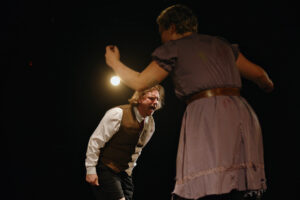
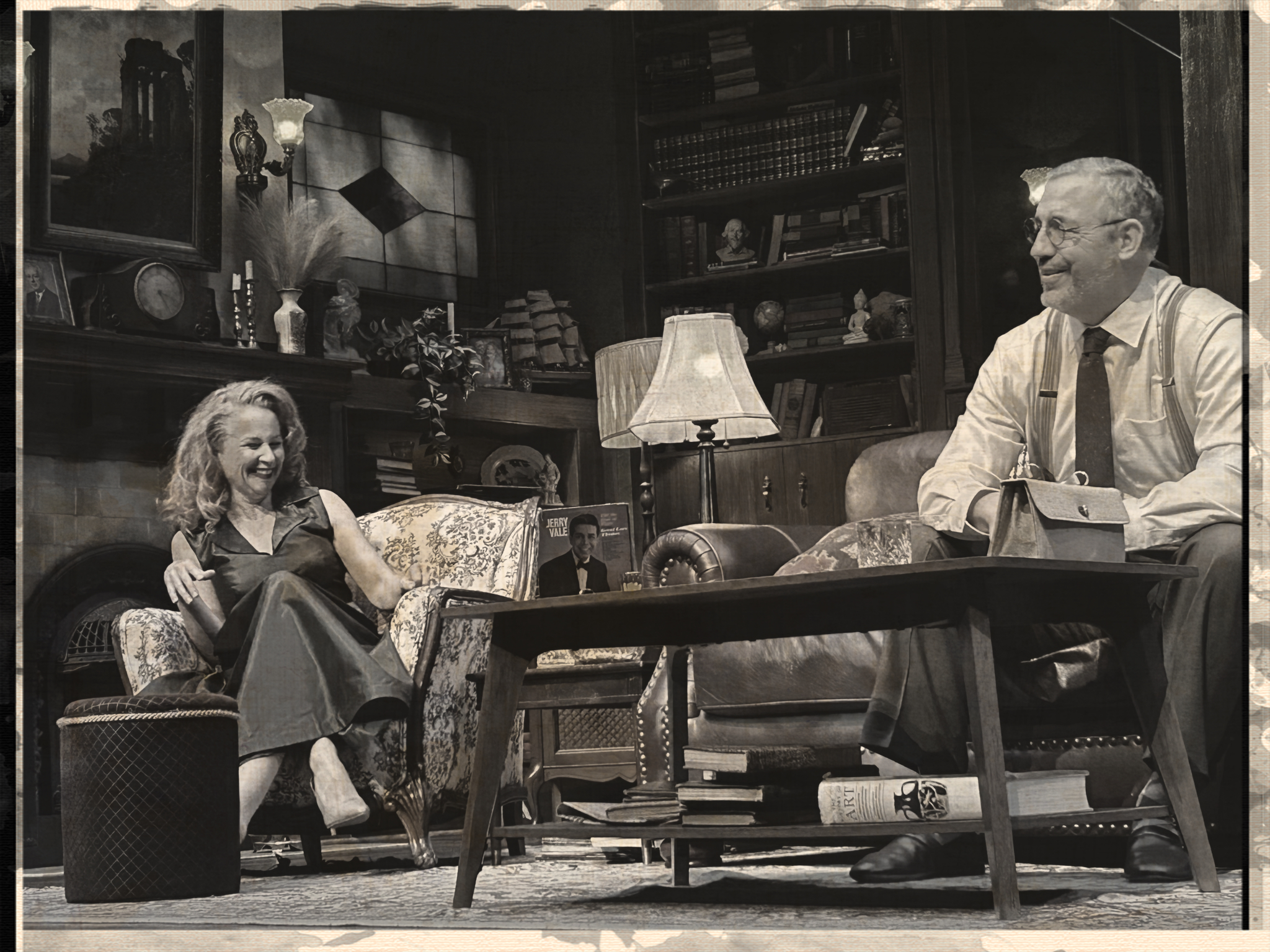
Raquel Duffy as Martha and Anthony Black and George in Who’s Afraid of Virginia Woolf by Edward Albee at Neptune Theatre directed by Ann-Marie Kerr
Raquel Duffy, who plays Martha in Neptune Theatre’s Who’s Afraid of Virginia Woolf, is one of the best Canadian theatre actors of her generation. She spent nine years as a resident artist at Toronto’s acclaimed Soulpepper Theatre, and she continues to work there, having been in the Canadian Premiere of The Welkin by Lucy Kirkwood there this past Fall. Duffy’s impressive career has taken her from the Stratford Festival to Mirvish, and she has worked with most of Toronto’s most prestigious theatre companies. Thankfully for us here in Halifax, though, this proud Dartmouthian returns to her hometown theatre of Neptune where she grew up seeing plays, worked at the theatre school, and where she built her professional career in shows ranging from Charlotte’s Web to Flying On Her Own and Gypsy.
The first professional theatre piece Duffy ever saw as a teenager was at Neptune Theatre: Ann Mortifee’s Welcome to the Planet, which she characterizes as a one woman music piece. “I didn’t really know what was happening, but I was really struck by it,” she remembers. Her father’s company sponsored the show so she got free tickets to see everything in that season. She also remembers seeing The Black Bonspiel of Wullie MacCrimmon by W.O. Mitchell.
Around the same time she was attending what is now Woodlawn High School and her art teacher, Sheila McLean (mother of Zuppa’s Alex McLean), ran an after-school extracurricular drama program where she did “the most amazing pieces,” and Duffy took part in these productions. The first play she was in was George Bernard Shaw’s The Man of Destiny, and they also did A Midsummer Night’s Dream, Six Characters in Search of an Author, and The Madwoman of Chaillot. “She’d always choose these gems that none of us could handle as far as skill,” Duffy laughs, “but that’s my foray into theatre.”
Anthony Black, who plays Martha’s husband George in this production, is also an incredibly esteemed and masterful actor, (and also a director and playwright and co-founder of Halifax’s 2b Theatre), who has deep theatrical roots in this city. When he was about ten he saw Sharon Pollock’s play Blood Relations at Neptune. The play tells the story of the infamous Lizzie Borden. “There was a blackout in that and I remember jumping out of my seat,” Black says. He also saw Brent Carver and Walter Borden in a production of Man of La Mancha at Neptune the following season. Duffy also remembers seeing Blood Relations saying, “I was also terrified when I saw that play. It was very scary and haunting, and just a great story…. To get into Dalhousie [University’s Theatre Program] we had to do two monologues and then a piece, and I did Blood Relations as a one-person,” Duffy says.
While Anthony Black and Raquel Duffy both grew up doing theatre here, and have known each other a long time, with their time working at the theatre school even overlapping, this is their first time performing onstage together. It seems a bit incredible when you see how seamlessly they are maneuvering around playwright Edward Albee’s intellectually and emotionally dense script together in a way that makes you really believe their characters have been married for twenty-three years.
Black characterizes the events of the play as “an after-party gone bananas.” He continues, “This couple comes home having been at a faculty party. They’re at a university, and Martha announces that she’s invited guests… it’s 2 o’clock in the morning. George has a moment of ‘incredulity tinged with hysteria’ and the couple arrives, and it starts off a little crazy and then it gets a lot crazier…. They’ve been married for 23 years and things have not been healthy for a while, but they really start coming apart as soon as this happens.”
Duffy says of Martha that she asserts in the play to her husband, ‘I’m loud and I’m vulgar, and I wear the pants in the house because somebody’s got to, but I am not a monster. I’m not,” but says, “I think having grown up in a male-dominated world, and being very bright, and watching her father, who runs a college, (but there’s no place for her in the college)… I think it speaks to women during this time period [the early 1960s] that were restless, and bored, and stuck.” Black characterizes George saying, “he’s a university prof, kind of a failure. His career growth got stunted and he’s been a great disappointment to his wife, as much fun as they have over the last 23 years, and I’m discovering there’s a kind of a sense of the ridiculous [about him]. He tells a little story about a saloon in West Berlin where the ‘stools are five feet high’ and he’s like, ‘it’s just so wonderful and I won’t give up things like that.’ So he has an appetite for the riduclous. I’ve been thinking about John Cleese in Fawlty Towers a lot in terms of that kind of mania. He’s like an American Basil Fawlty.”
Duffy says that at it’s core she thinks the play is about the relationship between George and Martha and “what I do believe is a love story,” she says, “a very messed up love story, but one nonetheless.”
The guests coming over to Martha and George’s are Nick and Honey, played by Patrick Jeffrey and Kya Mosey. “We kind of get to see George and Martha through the eyes of the young couple,” says Black. “They’re important witnesses… for the audience. This George and Martha relationship- they’re so cuckoo for Cocoa Puffs that it’s like, ‘what is happening?!’ and we get to see the young couple experience that ‘what is happening?’ It grounds it in reality.”
“What a gift this play is for actors,” says Duffy. “Absolutely,” agrees Black, “eventually to get to act it, but also just to contend with it, to try to puzzle it together. The play is a slippery fish. You kind of think you’ve got a hold on it, and then you’re like, ‘no, but maybe this, maybe that’ because there is ambiguity in the story and in the back story, like what is true and what is illusion- what is fiction that they’ve created, and the playwright doesn’t actually answer all of that. He leaves breadcrumbs all over the place, lots of breadcrumbs, so it’s fun to interrogate the play, and then also on some level it takes care of itself. Once you get it up to velocity a lot of questions get answered.”
“The other thing about Edward Albee in particular that is both fascinating and somewhat irritating is he’s very prescriptive with his stage directions,” says Duffy, “but they’re also very informative as well: when there is a pause, when there’s not, how to deliver a line…” she cites one in particular: “Pause, then a moment of incredulous disbelief hinged with hysteria.” “You just read that and go, ‘okay. Well how does one do that?’ So, infuriating and yet fascinating too- someone that just has something in his mind and he wants it to be that way.” Black says that the stage directions can be “very literary” as well, saying, “Sometimes you have to look up the words of what the stage directions mean.” He gives the example of ‘in a stentorian voice.’
Who’s Afraid of Virginia Woolf was first produced at Neptune Theatre in 1969 directed by Marigold Charlesworth, who was the first woman to direct a play at the Shaw Festival (1969) and the first woman to be invited to direct a play at the Stratford Festival (1977!).
There is also a formidably talented woman at the helm of this production: Ann-Marie Kerr. “She’s amazing,” says Duffy, “She’s just so great to work with. Not only does she come in so prepared, she’s just a true artist in the way of continuing to excavate the material and giving everyone in that room agency, which is rarer than one might think. Then, on top of that, she… can just feel the vibe of a room: what, when, where, why, how in a very, very graceful way, and beautiful way [that] I so respect and love.”
Who’s Afraid of Virginia Woolf by Edward Albee directed by Ann-Marie Kerr just started Previews at Neptune Theatre (1593 Argyle Street, Halifax) last night (February 27th, 2026)- it officially opens on March 6th and only runs until March 15th, so you are going to want to buy your tickets right now. You can do that online here, by calling the Box Office at 902.429.7070, or visiting in person at 1593 Argyle Street. Tickets range in price from $33.00 to $68.00 depending on seating. Performances are Wednesday to Saturday at 7:30pm with 2:00pm matinees on Saturdays and Sundays. There is also a show on Tuesday March 3rd at 7:30pm- and that is Industry Night.
Please be advised: This production includes coarse language, excessive drinking, smoking of herbal cigarettes, and instances of violence that may not be appropriate for all audiences.
Industry Night
Tuesday, March 3 – 7:30pm
Masked Performance
Sunday, March 8 – 2:00pm