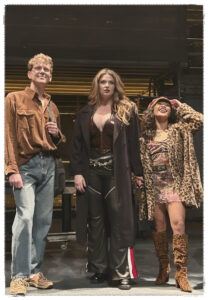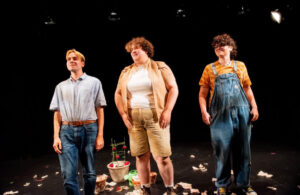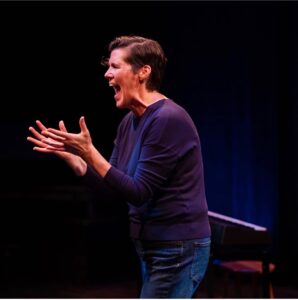
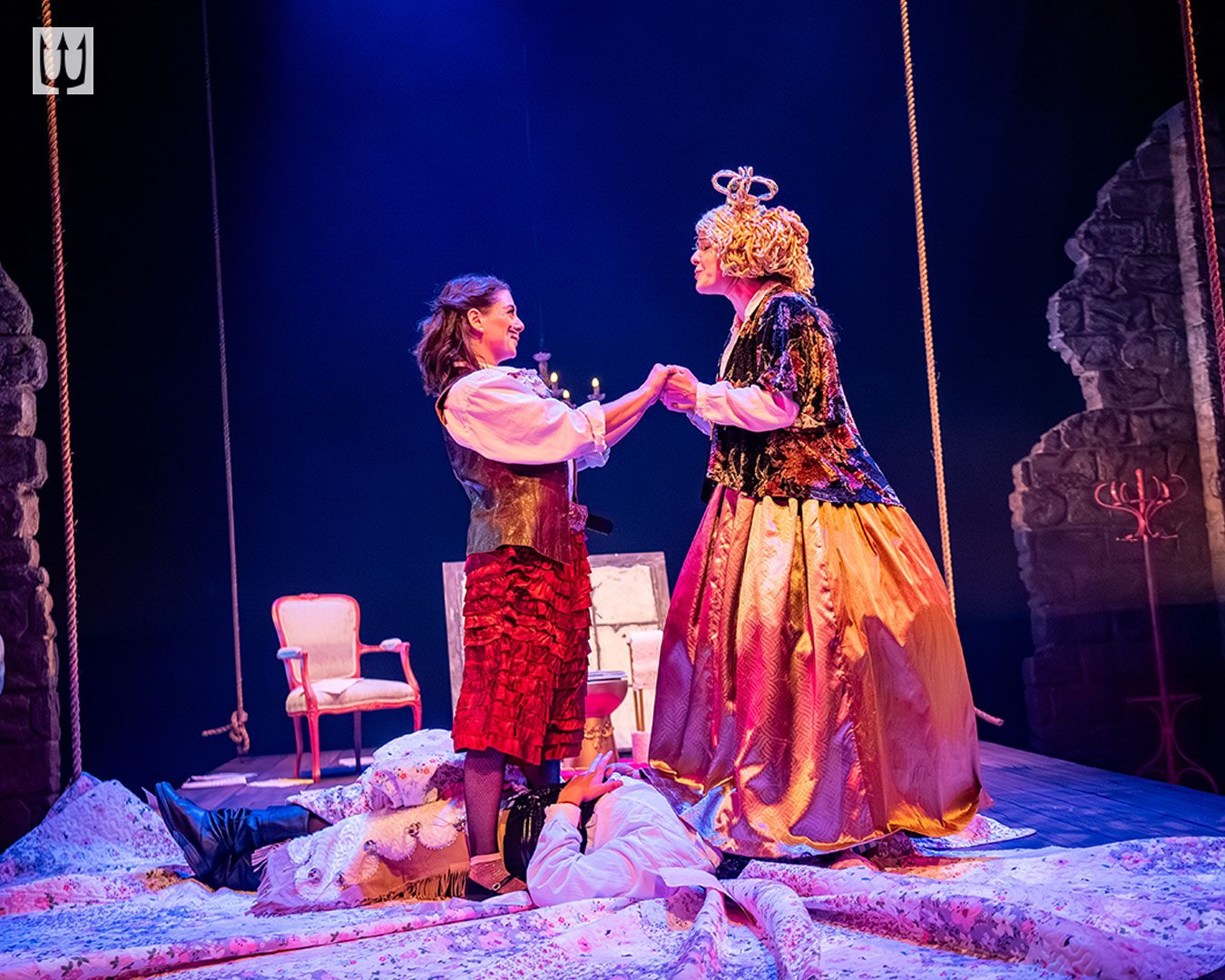
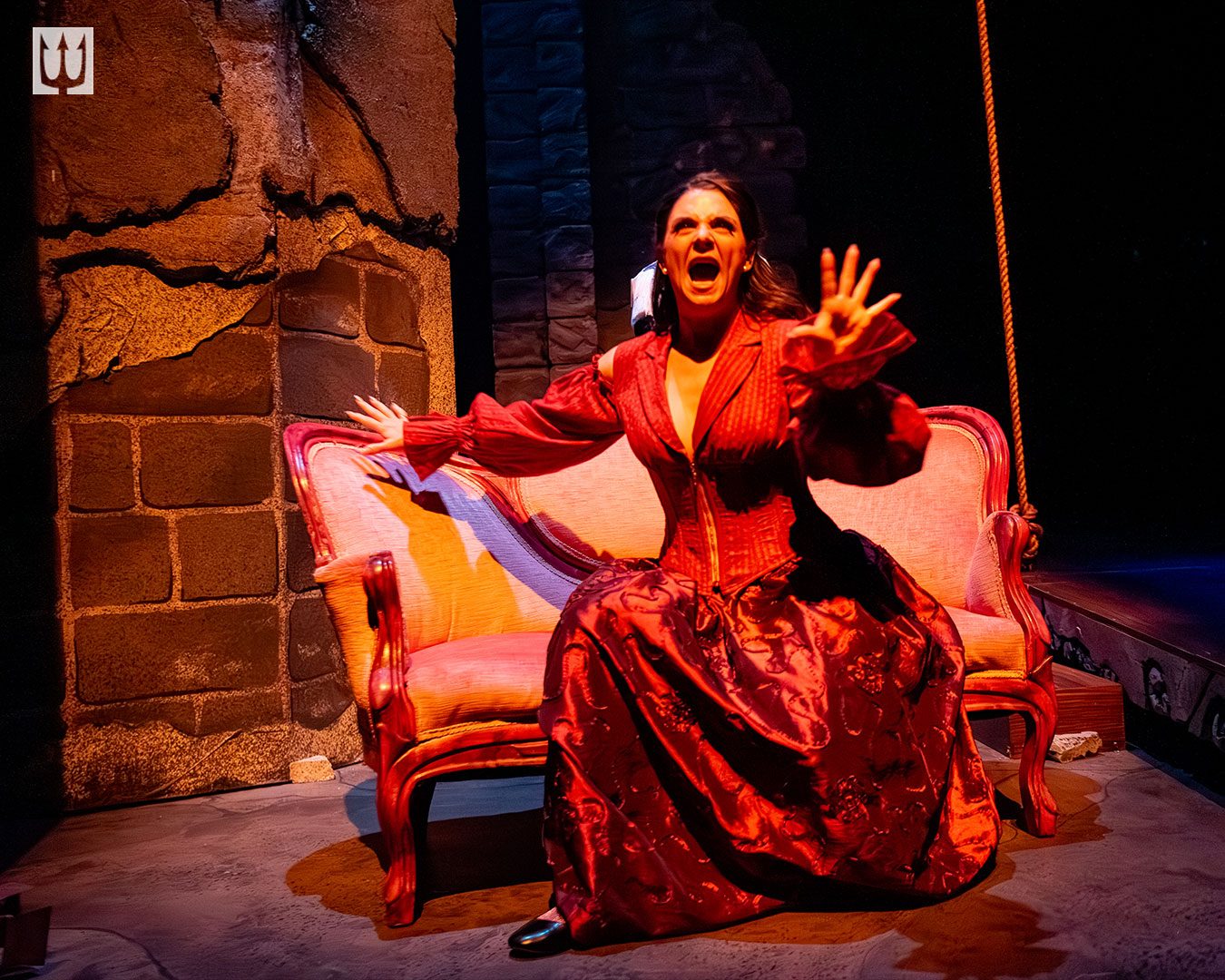
Katelyn McCulloch as Margaret and Nancy Kenny as Queen Henrietta Photo by Stoo Metz
There is a scene in Rose Napoli’s play Mad Madge where Margaret Lucas, played by Katelyn McCulloch, writes a trailblazing novel in weeks and shares it with her beau William Cavendish, played by Santiago Guzmán, who tells her that it is a bit difficult to understand. Margaret responds to him, “well, the story is very simple.” During a recent conversation I had with Katelyn McCulloch and Nancy Kenny about the play via Zoom McCulloch shared that she tried to read the book The Blazing World (1666), but agreed with William’s assessment. It was not easy to read.
“What makes it so cool is that she did invent the genre of science fiction,” says McCulloch, noting that this is a fact that has been largely lost to history. Napoli’s play is not attempting to dramatize Margaret’s story with historical accuracy: quite the opposite. Napoli is re-imagining these 17th Century characters through a hilarious and bodacious 21st Century lens and this meant that McCulloch and Kenny did not have to ground their performances in the realities of their characters’ lives, but had to find a different way to connect with their parts.
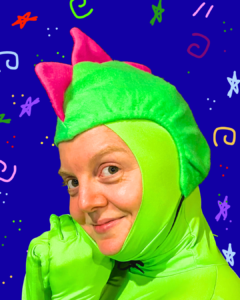
“I’m not a cerebral person, I’m a very instinctual, emotional artist,” says McCulloch, “things are always alive for me… they’re always changing in the moment… I’m always trying to respond as honestly and authentically in the moment.” She immediately saw herself in Margaret when she first read the play. She connected to the way that Margaret continues to reinvent herself by declaring, filled with confidence, that she is this new thing (a writer, a philosopher, a scientist) without waiting for anyone else to agree with her. Similarly, McCulloch has had a career trajectory that would give most people whiplash. She has been a dancer, a circus performer, a stand up comedian, a Dora Award winning actor who performed for two seasons at the Stratford Festival, and a filmmaker who writes, directs, produces, and stars in shows like Everybody’s Meg. “I think there are a lot of women that have the same tenacity and passion and rigour [as Margaret] but [who] haven’t been given the support to do that, and I think that’s why Rose, speaking about the play, is like, ‘It’s for a woman in the 17th Century, but it’s really for a woman today.’ It’s for anybody… who’s had big dreams and wanted to achieve lofty goals.”
“When I [am] playing her, I just always think, ‘how can I have the most fun and be the most open?’… This play does not work if you are not brave enough to swing big… and to do that I’ve had to have a very rigorous process with the script.” McCulloch mentions how breakneck the speed of the play is saying, “[once] the show starts going you’re really on a train that’s not gonna stop moving…so in terms of every day [I’m] taking care of myself [and] showing up to the text so that when I do the show for the audience, they’re paying to have the time of their life, I know that we can deliver that, and this, for me, is the time of my life… you just gotta let ‘er rip and trust.” She conjures up the imagery of a cartoon character being shot out of a cannon saying, “that’s me. Once it starts… you don’t have time to overthink.”
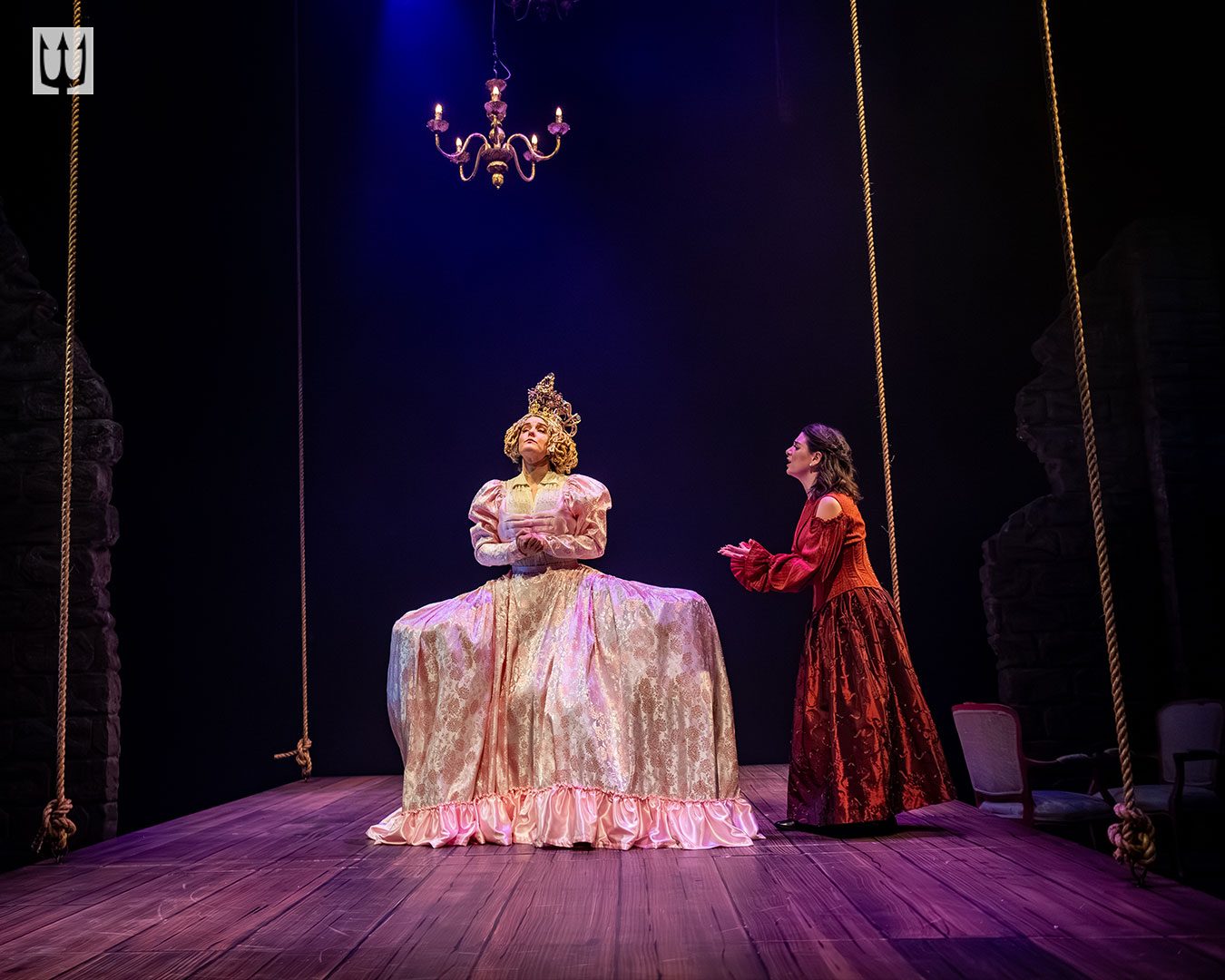
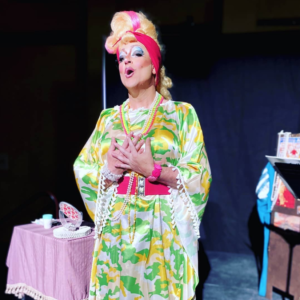
For Nancy Kenny, who plays Queen Henrietta, Margaret’s little sister Pye, and Samuel Pepys, she also did some cursory research but was more interested in finding out how she related to Napoli’s version of these characters. Pye, for example, comes completely from Napoli’s imagination- in reality Margaret was the youngest in her family. Kenny says that when auditions for the play came up she was so busy she didn’t know whether she would have time to read the entire play before she had to choose a character to audition for. Since the play is called Mad Madge, at first she assumed she should audition to play her. “I started reading the play and I was like, ‘I don’t know how to get into this character… I don’t feel it for me.’ Then I got to the Queen and I was like, ‘oh, her I get’ because for me it wasn’t about a historical figure… it wasn’t about being a queen… for me it’s a woman who is in such deep grief and deep denial of what’s going on around her and [she’s] seriously protecting herself… that’s why she threatens to cut people’s heads off… because she is protecting herself… and later when the relationship builds with Margaret…[I realized] it takes her a long time to trust people and to allow them into her life. That’s what her whole arc is, and so that’s how I approached it… I understand these feelings. I have these feelings. I am this person, you know?”
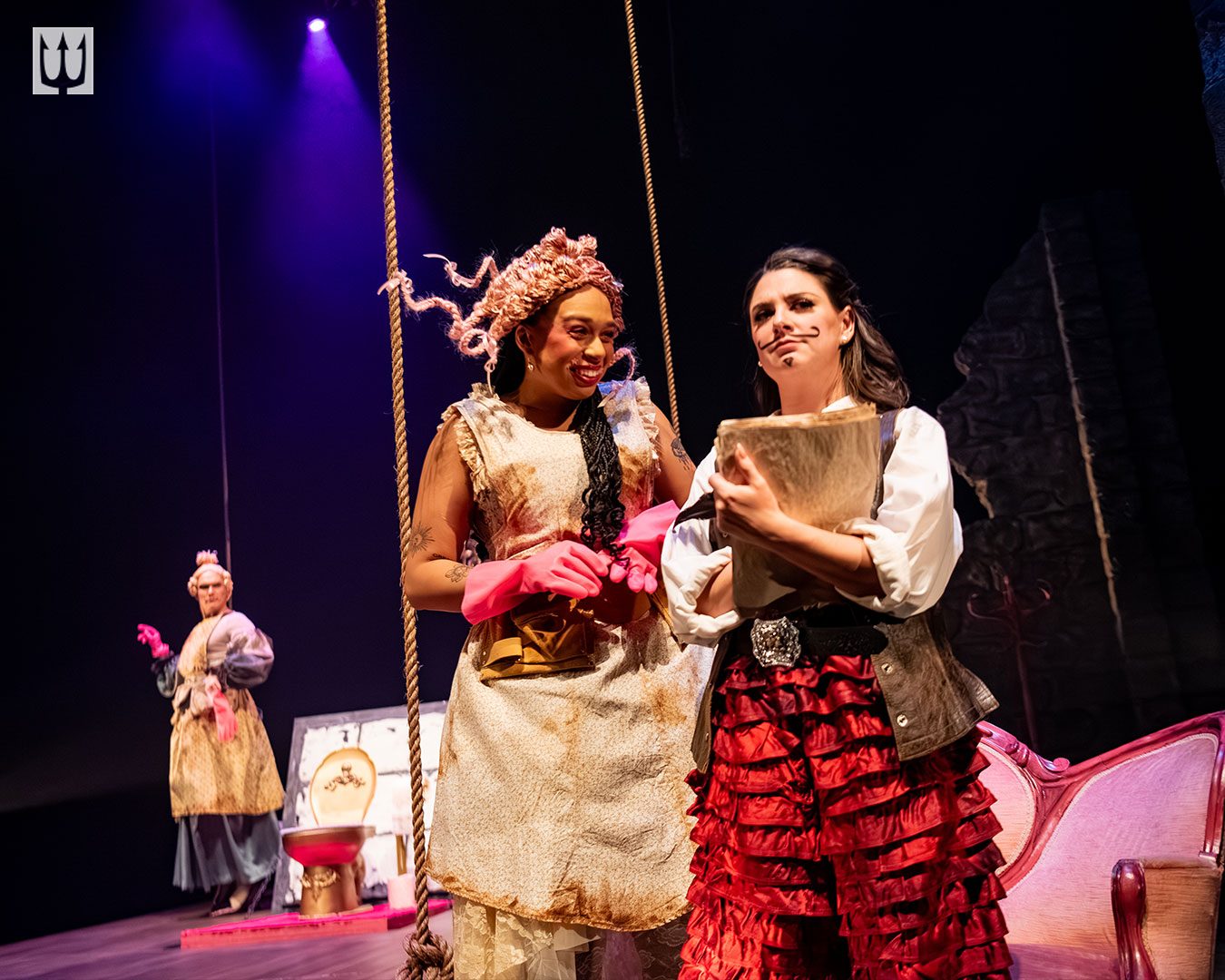
She created Pye to have “wide-eyed innocence” and says that Pepys was the hardest character to get into, but that she found her way once she got her costume. “Suddenly all of my clown and Commedia dell’arte training just ramped up and that’s when I found Pepys. I’m not trying to play a realistic portrayal [of a historical figure] because the text is not [written that way].”
As Queen Henrietta Kenny has a range of very distinctive voices. The one she teaches to Margaret, her “regal” voice, came to Kenny first, but through rehearsals director Jeremy Webb worked with her on diversifying the Queen’s range. He encouraged her to watch the British sitcom Blackadder (1983) where Miranda Richardson plays Queen Elizabeth I, and that helped Kenny find the Queen’s higher register, “The Queen has her [regal] voice when she is proclaiming [and] taking charge of a situation, but in private when she’s with other people… she trusts, then the voice becomes a lot higher pitched…. the accent just came out. I don’t know… that just happened because, actually, Queen Henrietta is French.” She says there are elements of a RP (Received Pronunciation) accent, but also that it is free to come and go and change like Moira Rose’s accent on Schitt’s Creek as played by the luminous Catherine O’Hara.
“[Margaret] is such a vulnerable and revealing role, both in how big and comedic it needs to be, and then where I wanted [her] to be at the end of the play in terms of the vulnerability of her, and… showing her flaws, not hiding away from them,” adds McCulloch. “It’s hard… we love our characters and you’re fighting for them always, but she does make some big mistakes… but can we love a woman through her big mistakes? I think this play shows that we can and we should and we must. I think men have gotten away with so much in literature, whether it’s plays or books or… film and television… and we have all these flawed men that hurt women and people and communities, and then we still let them have redemption. I love that this play has that arc for a woman… it’s not that she’s [behaving this way] to be just flamboyant or a jerk… she’s resisting a society and a world that doesn’t want her to take up space.” McCulloch points to the line that Margaret says to William, “I don’t expect you to ever understand this, but this is what I have to do,” and says that it resonates so deeply within her as a woman running a female-driven comedy production company, as an actor in her 30s who is auditioning for projects where there are no leading roles for women or none that are “multidimensional or complex.” “I think the gift that I can give myself and the work is to actually just be completely me in it,” says McCulloch.
As someone who has always had a big personality, like Margaret, McCulloch says that as she has grown up in this business, attending theatre school, performing at some of Canada’s most prestigious theatres, and making her way into the film industry she had noticed the times when she sought to make herself smaller and more palatable for the comfort of others. She said that when the neighbours who had known her as the ten year old performing in Peter Pan at St. Margaret’s Bay’s Unicorn Theatre came see Mad Madge and told her afterwards that she “hadn’t changed” in all her time away she felt quite emotional. “The closer I get to that kid the more myself I become, the more powerful I become, the more embodied, and I really do think, like, in Margaret’s voice I just want it to be mine. When we think about the great roles like Hamlet… you want to see all the amazing male actors, and now female and non binary actors, play Hamlet because you want to see that person’s POV, and what I love about Mad Madge is [that] I can’t wait… to see the next woman play Madge. I want to see their POV… and that is the gift of an amazing play, because it shouldn’t be like, ‘so and so is better-’ it’s like, no, show me how Katie sees this world- show me how Rose does. And I just can’t wait for whoever does it next that I get to go sit in the audience.”
She emphasizes that roles like Margaret Cavendish are still rare for women, especially ones that aren’t children or ingenues. She cites playing Abigail Williams in Arthur Miller’s The Crucible at Stratford and how there is a narrow window for actors hoping to play this role. “We’re just getting better and better with age. I love getting older in this art form, but there aren’t necessarily roles to meet the moment for you to get to do that.”
Both McCulloch and Kenny mention that it shouldn’t be considered “brave” for Jeremy Webb to program a play like this one, but that that is still the landscape in many theatres across the country. Kenny says that producers being too hesitant to program plays like Mad Madge because they are afraid it’s not what their audience wants to see is only limiting the scope of what those audiences understand Canadian theatre to be. “It’s not that risqué,” she says, “There’s nothing in [Mad Madge] that I haven’t seen on Bridgerton (2020) or in a Naked Gun movie…” In reference to the bodily functions that form the crux of Margaret’s relationship with Queen Henrietta that some might dismiss as crass McCulloch says, “It’s a metaphor for her grief and loss. It’s actually so smart and the female friendship that gets developed… it’s actually so meaningful, but then we get the comedy- because I always believe that comedy is an entry point into our deepest truths… getting the audience’s trust through laughter is why… we can take [these characters] as far as we do in Act II.”
“We walk around this world pretending like women don’t poop, you know? The fact that I get to sit on a toilet for two whole scenes and just poop… we don’t do that… [yet] guys get to do gross humour all the time. And, honestly, it’s not even that gross; you don’t see anything,” says Kenny.
“How can women ever expect to stay in this art form as actors and artists if we don’t have work to look up to?” asks McCulloch. She mentions that there was one performance of Madge where she noticed a young girl in the front row, and says that she was so glad that she had come to see the show. “You don’t go to the theatre to stay comfortable or to stay the same. That’s not… what great art is supposed to do. It should change you on some vibration, even if it’s just getting those big laughs, or… having laughter open you up to experience something else… I think if we aren’t brave and don’t continue to tackle plays like this, write plays like this, embody characters like this… what does the younger generation really have to look forward to?.. I know there have been big shifts in the last five years, but from where I sit as someone who writes, directs, and acts, they’re not big enough, and they’re not happening fast enough. There’s still an urgency for women to have that kind of representation and to have things to look forward to.”
McCulloch mentions going through years of feeling uninspired by the theatre, which is part of the reason that she ended up turning toward television and film. “I want to be fully engaged and pushing the boundaries of my own craft. [It’s] felt so good to have a role like [Margaret] come along.” She says it’s going to be a tough act to follow for her, but she hopes that there will be something just as satisfying in the future to keep her excited about performing on the stage.
Kenny can relate citing how difficult and expensive it has become to be a theatre artist creating their own work. She said working on a budget to mount a solo show having everybody involved paid fairly was well beyond what she was able to afford on her own, and that she isn’t getting the funding needed to realize these projects. “It had really soured my taste for theatre. It’s too much work to do on my own. So, this opportunity with Neptune came along… and I so full on believe that the right projects come at the right time, and this has been an absolute dream of a project, dream of a role, dream of a cast, of a costar, of a team… those moments are rare- but I don’t want them to be rare. That’s the thing. So, I’m holding on to the feelings that I have to still be in the present [with this show], but I’m also aware that these opportunities are few and far between, and, like Katie said, there aren’t that many of them for women. For [my character] so much of the story… is about female friendship, it’s about grief. The beauty of what Rose has done is there’s a woman talking about unsatisfactory sex… and doing things for men in order to gain access to power… women becoming friends and the difficulties and the roadblocks that can come with that… one of my favourite lines in the show is between Madge and Judy and Trudy when they talk about there [not being] enough stuff for all of us. There IS enough stuff. It’s just being sucked up… and the heartbreak of female friendships breaking up, there are so many themes that Rose has tackled in this show that we don’t see talked about because we don’t allow women to take up more space and tell their stories on stage.”
“I think this play is healing a huge part of me,” says McCulloch, “because on stage, in real time, I get to make mistakes, be flawed, have arguments, and then be loved in the end. … I just think about how many women who have spoken up [have] been shut down, silenced, not believed, hated for being too much this [or] too much that… I can speak as a Millennial… I was brought up with that, I was brought up [being told] that standing out puts you in danger of something happening to you-… being publicly humiliated or being shut down or being made fun of- whatever that is. … I have tried to be small, I’ve tried to hide, I can’t. This personality, this gravitas I have, I spent years of my life trying to hide it and I can’t. I actually do feel so emboldened by this show [that] I shouldn’t have to feel like I need to hide the ambition, the love, the passion, the rigour… like Nancy said… there’s enough for all of us, but we have to step in to who we really are and our own power… to be able to claim it. It’s a big, scary thing to do, but I do think… getting older you just give less fucks as well. I think this play has been healing in this reminder of ‘what message do I want to send to the women coming after me?’ And also to thank the women before me who are the reasons that this play exists.”
Kenny says that she also has felt pressure to make herself small and to not take up a lot of space. “It’s been so inspiring watching Katie work,” she says, “… it’s so fucking inspiring when you’ve spent a lot of time making yourself small to have another woman give you permission in a way to say ‘hey, I’m shining bright here so that we can all shine bright together,’ but again, it comes back down to the whole patriarchy of it where we’re told we can’t all be shining… and so that’s why, for me, it’s been healing in that sense to learn that I can be big and loud and bright and take up space and still be loved in the end, and that’s why Katie’s the perfect Madge.”
Mad Madge by Rose Napoli directed by Jeremy Webb plays at Neptune Theatre’s Fountain Hall (1593 Argyle Street, Halifax) until February 8th, 2026. Tickets range in price from $33.00 to $68.00 (depending on seating) and are available online here, by calling the Box Office at 902.429.7070 or in person at the Box Office at 1593 Argyle Street.
Please note: this show contains adult content, strong language, flashing lights, strobe effects Fog and haze.
KEY PERFORMANCES
Talkback
Thursday, February 5 – 7:30pm
Masked Performance
Sunday, February 1 – 2:00pm
Audio Described Performance
Sunday, February 7 – 2:00pm
Neptune Theatre is fully accessible for wheelchair users. Neptune offers hearing-assistance devices, along with their masked performance and audio described performance. For more Accessibility Information Click Here.