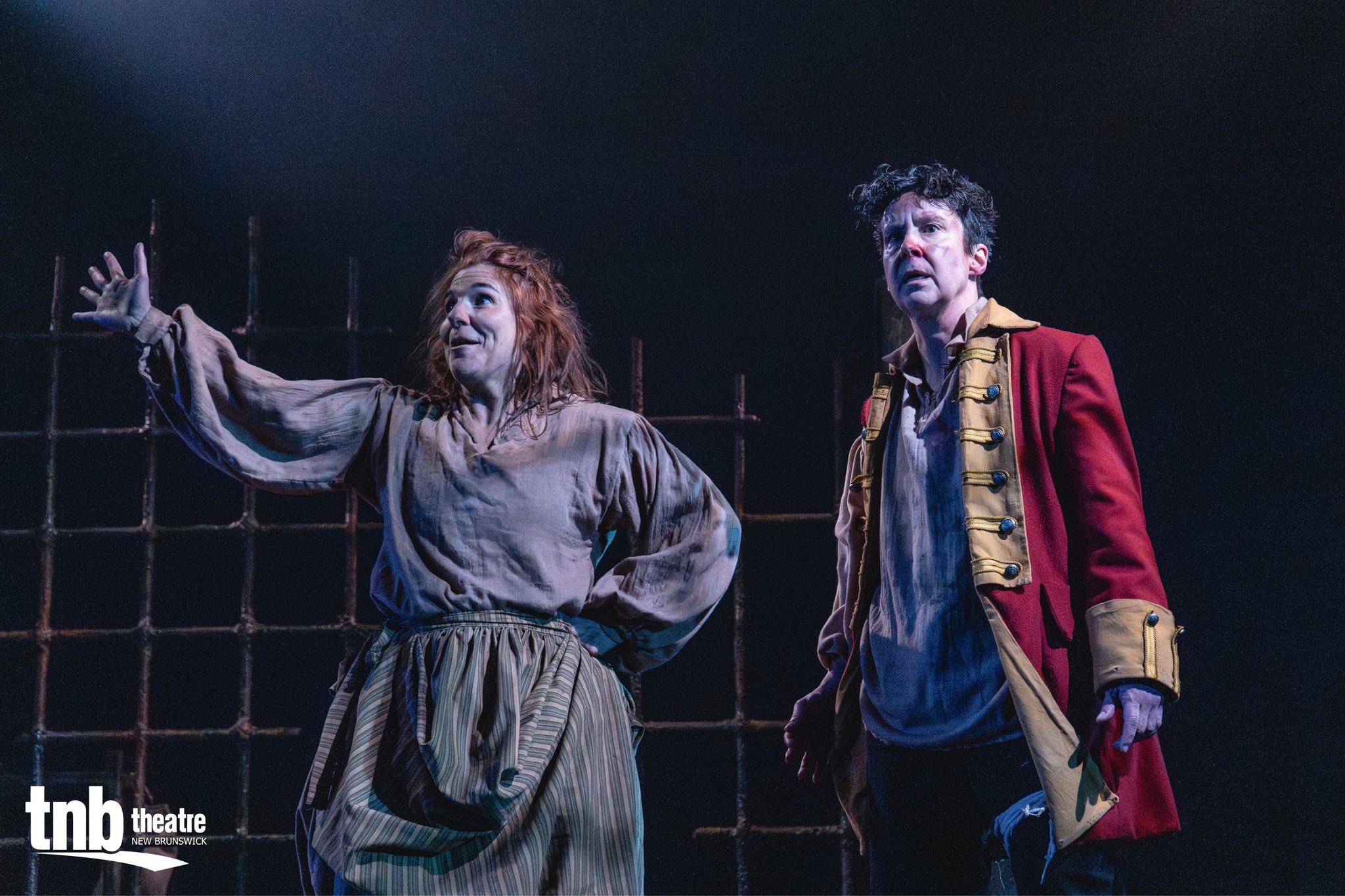
Mélanie LeBlanc and Karen Bassett in Heroine Photo by Andressa Photo
In March of 2020 as the theatres and indeed the world were shutting down Natasha MacLellan was in the Dress Rehearsal for Theatre New Brunswick’s production of Heroine by Karen Bassett, which premiered at the Bus Stop Theatre here in Halifax in 2010. Finally, six years later this production opened in Fredericton on March 6 and has since played in Florenceville, Saint John, St. Stephen, and Moncton before coming back to the theatre where it all started here in Halifax where it plays until March 22nd.
We begin with Anne Bonny (Mélanie LeBlanc) and Mary Reade (Karen Bassett) being literally thrown into their cell in a Jamaican jailhouse in 1722 under the charges of murder, piracy, and, in Reade’s case, crossdressing. Despite the fact that I went through a huge pirate phase from the time I saw YPCo’s 1998 production of Peter Pan when I was thirteen until a little after Pirates of the Caribbean: At World’s End came out I didn’t come into the play with an exhaustive knowledge of the real Anne Bonny and Mary Reade, however I was caught off guard from the start when it became clear that in this version of the story Bonny and Reade do not like each other, and in fact, Reade doesn’t even consider herself to be a pirate.
The true facts surrounding these women’s lives are so scant that Bassett had all the freedom in the world to construct her own story creating a sort of patchwork of fact, legend, and her own playful imaginings. In Heroine Reade has very recently been discovered to be a woman, a fact that she has hidden from almost everybody for her entire life. Even more surprising than that, certainly for the audience, but for Bonny too, is when she reveals that she wishes to die as a loyal and not disgraced subject of England. This creates immediate tension with Bonny, an exuberant Irish rebel who is arguably in love with being pirate more deeply than she has ever loved another human person. While Bonny is adamant that she can get them out of even this predicament Reade just as stubbornly wants to give up her life of crime and begin to make more honourable choices. Thus throughout the play we see them rehash their own histories to pass the time, but each one is also trying to coerce, convince and manipulate the other to do as she wants. Will they escape by treachery or will they die with honour?
Mélanie LeBlanc and Karen Bassett bring two completely opposing energies to their characters. LeBlanc’s Bonny has a frenetic, dramatic and deliberately bold, combative and often abrasive spirit. She is very much like the proverbial caged animal, jumping and pacing around frantic to be set free. Bassett’s Reade is very quiet and contemplative- more angry at herself than she is at the world around her. There is something very youthful and almost innocent about LeBlanc’s Bonny. She is often reminiscent of a child as she bounces from singing to dancing to sword sparring- her emotions bursting out up and down without much forethought, and in all of this she does have a puckish charm that I think ingratiates herself to the audience while tormenting her cellmate. Although perhaps less overtly immoral than Bonny for much of the play Reade comes across more like a wet blanket- undercutting the ways that we and Bonny tend to glamourize pirates. In this way I think Heroine is able to showcase two things at once- there is a lot in it that captures the fun swashbuckling antics that can sway audiences toward rooting for the murders and the thieves because they represent a fantasy of pursuing a life of freedom beyond any one country- on the sea- and resisting oppressive and colonial systems of power. Yet, the reality of piracy, or in our case here in Halifax, privateering, is much more complex and intertwined with those systems of oppression and colonialism, and, as we see in Heroine, the brutal reality of what it would have been like for people like Anne Bonny and Mary Reade, not just in a Jamaican prison, but also as female pirates, as women who might find piracy to be her best option at this time in history, is also quite poignant and sad. I don’t want to give any spoilers away, but Bassett’s performance at the end of this play is absolutely stunning.
Director Natasha MacLellan finds lots of creative ways for LeBlanc to be in nearly constant motion, which really adds to the sense that Bonny has this aggressively nervous hyperactive energy about her that is barely being contained in this jail cell. There were a few times when I felt like she could have been constrained by the cell a bit more, but I really liked how every move Reade did for most of the play seemed deliberate and considered, while Bonny was flailing all over at glorious random. The fight scenes were choreographed by Jean-Michel Cliche, and again, they’re all done in a way that keeps in mind the close quarters these two are in, and also, presumably, that they aren’t trying to draw attention to themselves from the guards. I did have a question about how they were able to keep their swords with them while in prison in the first place? There’s one fight in particular that is especially brutal, and the ferocity of it in contrast to the others is aptly intense. This also shows a different side to Bonny that captures the play’s interest in the real versus the imagined.
Set designer Andrea Evans and lighting designer Emily Soussana work well together to create the cold and damp feeling of an early 18th Century Jamaican jail in a way that is also easy to transport for a tour. I really liked the way Sherry Kinnear costumed LeBlanc and Bassett, especially the style of LeBlanc’s erratic hair and Bassett’s makeup, which makes her look like she has been especially roughed up in the fight that preceded their arrest. The soundscape by Andrew Scriver and the use of sea shanties is also very effective in rooting us in this world.
In her Director’s Note Natasha MacLellan writes about how so often still we see female characters only as they relate to men. Even in the Wikipedia articles for Anne Bonny and Mary Reade you get a sense of cultural frustration because there is no true accurate source that elaborates on either of their real relationships with John Rackham, their Pirate Captain. Perhaps there was no other relationship with him at all- perhaps all they ever were to each other were shipmates. Would that be so disappointing? In Heroine both Bonny and Reade have relationships with and to men, as most women raised in a society do, but they are all tertiary to the story of what Bonny and Reade’s relationships are with themselves, and how that impacts what kind of a relationship they can ever find with one another.
Heroine plays at The Bus Stop Theatre (2203 Gottingen Street, Halifax) until March 22nd, 2026. Performances are at 7:30pm Tuesday to Friday with a 2:00pm matinee on Saturday. Tickets are available to purchase at this website or at the door. Doors open a half hour before the show.
Content warning: Ages 16+, Heroine contains adult themes and salty language, violence and sexual content. Because pirates. They are pirates. Show Runtime: 75mins (no intermission).
The Bus Stop Theatre is one of the most fully accessible theatres in Nova Scotia. For more detailed information please visit this website.
Incoming search terms:
- https://www twisitheatreblog com/?p=6322