
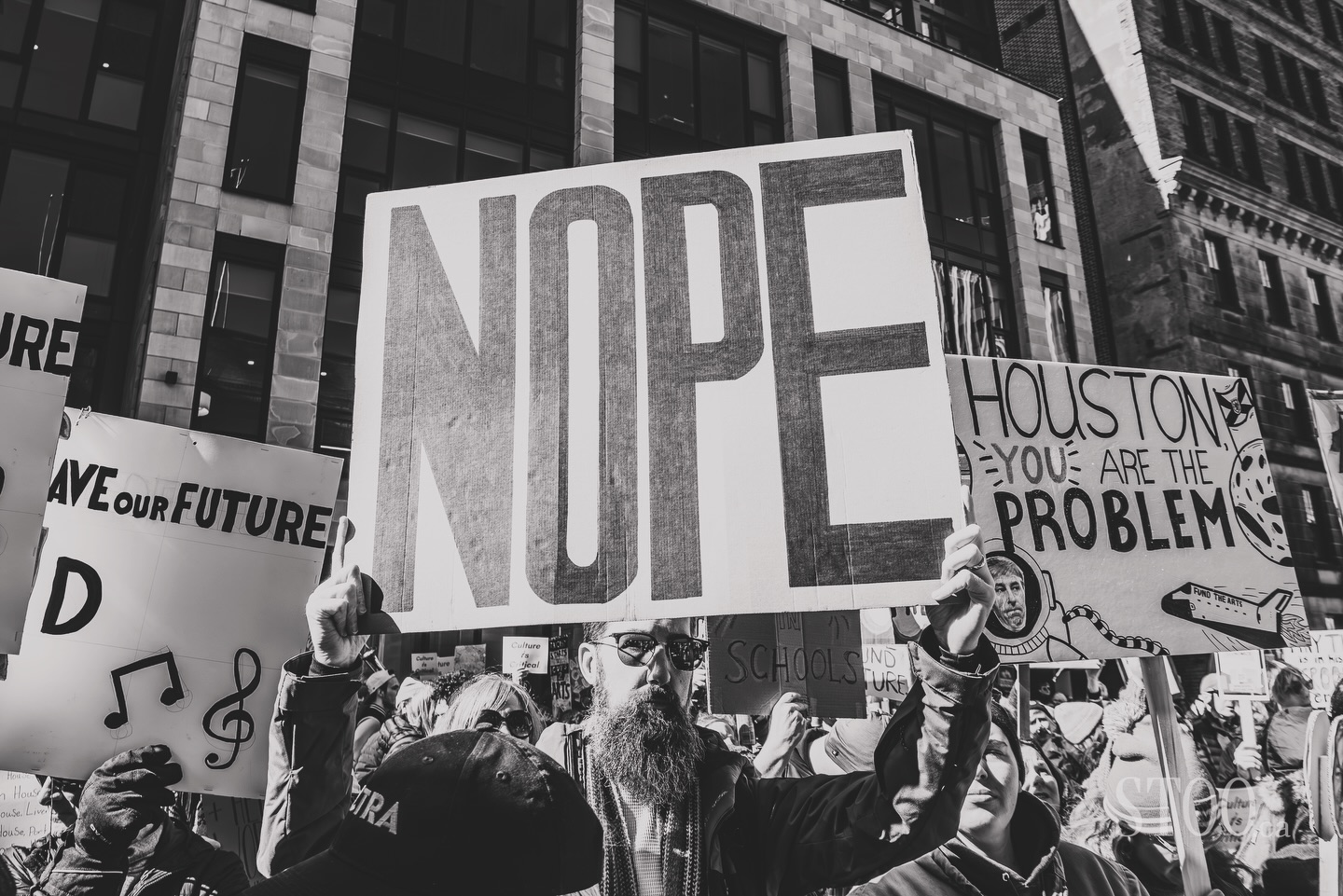
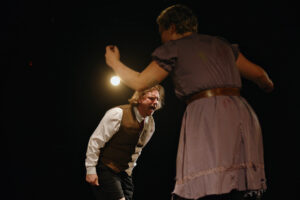
Photo by Stoo Metz
If there is one thing that I have learned from reading locally published books it’s that from the very first moment that the British landed on these lands they have been trying to keep those who might be sympathetic to one another apart because they were afraid of what would happen if the Mi’kmaq, the Acadians, the Gaelic speaking Scottish and Irish settlers, and the African Nova Scotians were able to band together to resist the British hegemony that had permeated the entire peninsula by 1800. The British did not only forcibly remove over 11, 000 Acadians (thousands of whom died) between 1755 and 1764 because they were afraid they would provide support for the French who had their own colonial plans, but also because they were afraid that if the Acadians kept working together with the Mi’kmaq they, the British, might be driven from Mi’kma’ki entirely.
We see throughout history the British working overtime to keep all the more marginalized groups in what became Nova Scotia both geographically distant and at sometimes odds with one another- encouraging them to focus on their differences instead of what they had in common and building a hierarchy of race, language, religion, and culture that allowed certain demographics to more easily assimilate into whiteness and what became the dominant Nova Scotian culture and to be able to access more economic and social privileges. This led to much loss of culture and language that communities more recently are trying desperately to revive and restore. This should be a narrative that Premier Tim Houston is aware of given that his own maternal line seems to descend mostly from Catholic Irish and Scottish settlers and looks to include an Acadian connection as well.
Yet, Tim Houston is taking a page from Edward Cornwallis instead as he tries to perform this same old hackneyed hat trick of dividing and conquering- trying to convince Nova Scotians that those who work in arts, culture, and heritage sectors are somehow not the same as the folks who works in other industries- and therefore the arts, culture, and heritage jobs that contribute 2.6 billion dollars to Nova Scotia’s GDP are “discretionary.” He is deliberately trying to sow disagreement between folks and to pit one type of art form against another. He is taking a page from the tired out Trump playbook too by hoping that by throwing so many cuts at us all at once- to transit, accessibility, education, museums (nearly half in the province have closed), to visual art, film, theatre, music, dance, to publishing, to programs that specifically help make Nova Scotia a fairer place to live for Mi’kmaq and African Nova Scotian folks, to sports, and tourism- it is designed to make us feel exhausted, overwhelmed and burnt out- especially since it comes within the greater political context that Canada and the World face right now, which is in itself exhausting and horrifying.
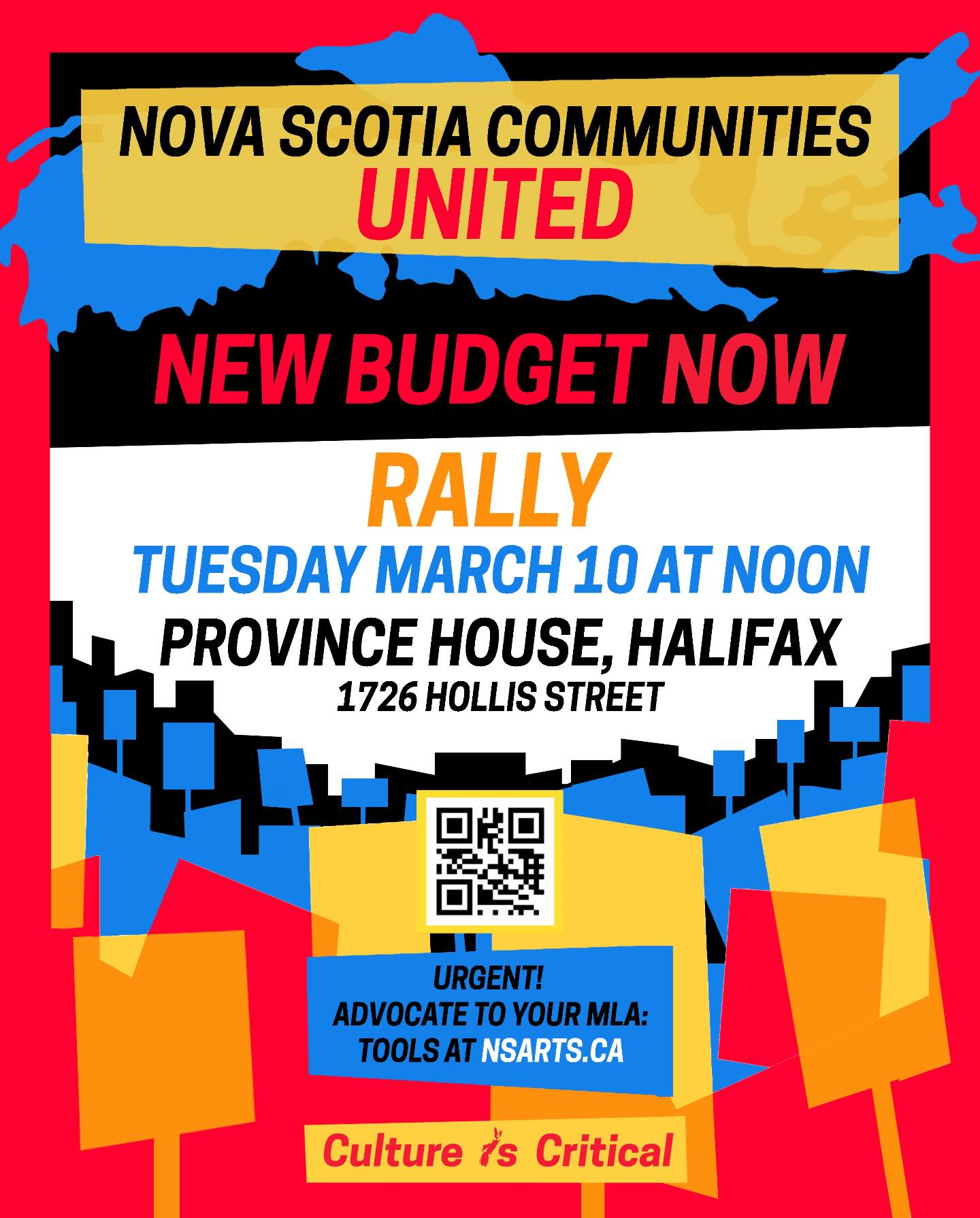
This time though, Nova Scotians will not be divided. Last Wednesday thousands of regular Nova Scotians rallied at Province House for Arts and Culture to be respected in the budget. The day before hundreds more came out in solidarity with the Mi’kmaq who are having their Aboriginal Sport funding cut, as well as cuts to Mi’kmaw Native Friendship Centre, and to Treaty Day Awards and Education, all of which are essential foundational aspects of this province. Tomorrow, March 10th there is a rally for everyone affected by the budget to come and stand together again: shoulder to shoulder to shoulder to find kinship and solidarity, strength and resilience and hope together. This is what all these politicians like Houston want to keep us from feeling: hope and optimism and a belief that we don’t have to sacrifice ourselves as so many of our ancestors did for a tiny slice of the pie, we really can make an entirely better world all together for all of us.
This is exactly why Tim Houston is attacking the arts. It has absolutely nothing to do with economics and everything to do with fear. The arts are powerful. Attending the theatre can make audience members more empathic and even has the ability to change people’s minds on socio-political issues. I think all the art forms that Houston has targeted have this power. These cuts won’t just affect the programming of the arts it will make them less accessible to the young, to those in rural communities, and to the working class- exactly the demographics that Houston wants to be able to control and disenfranchise. To the people who have left uninformed casually disparaging comments under Facebook posts about the protests: just know you aren’t being subversive, you’re being manipulated. Tim Houston knows he can’t stop the wealthiest Nova Scotians from patronizing whichever theatre they want, but he’s trying his damndest to keep you from seeing something he views as dangerous because it encourages folks to think for themselves.
At the rally on Wednesday Chris O’Neill, Executive Director of Ross Creek Centre for the Arts and member of the Nova Scotia Arts Coalition, gave a passionate speech that was also rooted in truths and facts. She said in part: “There is no longer any doubt about the vital importance of Arts, Culture and Heritage on education, health outcomes, and our economy. The evidence is clear. In every area that this government says it wants to succeed, Arts, Culture, and Heritage are key to that success. Tim Houston says he wants to improve Nova Scotian health care. Then invest in the arts. Involvement in the arts reduces use of the health care system and improves the mental and physical health of communities. It allows us to recruit health care workers to our province when there is a vibrant cultural community. Tim Houston says he wants to modernise Nova Scotia. Then invest in the arts. Modernising doesn’t mean abandoning the communities that have shaped this place with vibrant cultures that make us unique in Canada. It does mean investing in creativity. We are the change makers, the visionaries, and the creative and nimble thinkers. And Tim Houston obviously needs us. Tim Houston says he is ‘only doing what Nova Scotians told him to do.’ Did we tell him to devastate the cultural landscape of Nova Scotia? Did we ask him to change Nova Scotia from a place of a thousand welcomes to a place with shuttered tourism offices, abandoned museums and fewer musicians, theatres, writers, artists and others who enrich our lives and tell the stories of Nova Scotia both to ourselves and to the world? Tim Houston’s government has told citizens who are impacted by these disproportionate cuts- and we will all be impacted by these cuts- that cultural workers need to… ‘Do their share.’ I’m here with you today, to give a message to Tim Houston’s government: We are doing our share! There are 14,000 cultural workers across this province, more than in agriculture, fishing and forestry combined. Workers who make art, who help our children learn to tell their stories, who keep seniors connected to their communities and families through music and movement, workers who tell our stories and the stories of our ancestors, and the stories of worlds we haven’t even imagined yet (and even tell the stories of gay Hockey Players). For every dollar the government invests in the very programs they propose to cut, we generate an additional $4.59 into our communities and create 8,000 more jobs. We contribute $331 Million in tax revenues to the province. We generate $2.6 Billion in GDP. I am not an economist but I know that is a good return on investment.”
Representatives from other political parties spoke at the rally, although, despite what Tim Houston wants you to believe they did not organize the rally. Claudia Chender, the Leader of the NSNDP, with her characteristic friendliness, charm, and exuberance that stands in complete contrast to the PC Leader, reiterated the NSNDP’s unwavering support for artists and all the disparate communities affected by this budget. Susan LeBlanc, who theatre makers and goers know as a founding member of Zuppa, told us that when she asked the Minister of Culture why these cuts were made he called them “discretionary funding.” She responded to this with, in part, “Art is tourism, art is mental healthcare, art is regular healthcare, art is social services, art is less people in the justice system, art is Reconciliation, art is Black Lives Matter.” She also chronicled something that I know we’ve all been feeling- that we have been here before- citing when former Premier John Hamm “shuttered the Nova Scotia Arts Council in 2002” and when Stephen McNeil ended the Nova Scotia Film Tax Credit in 2015. From my perspective it’s also giving Stephen Harper in 2008 when he made $45 million dollars in cuts to the Arts and Culture sector federally, and who said at the time that “average Canadians” have “no sympathy” for rich artists who gather at galas and whine about grants. He then went on to play the piano at a National Arts Centre gala a year later. Stephen Harper, I think Tim Houston knows, is not the most popular politician in Nova Scotia, and probably not someone who he benefits from channelling.
As I said, this is all deliberately constructed for the people who care, the activists, the artists, the community minded folks to burn out.
Yet, we also have reinforcements. DeeDee Austin, a young Indigenous musician who is nominated for 3 ECMAs this year performed “Create a Life,” a beautiful call to action for each of us to create a beautiful, fulfilling life for ourselves. Her giant voice soared over the crowd as she encouraged each one of us, “Don’t be afraid.” Austin was a standout on Canada’s Got Talent 2025 where Howie Mandel told her, “What you’re doing is not only great, it’s important.” It’s not “discretionary.” It’s important.
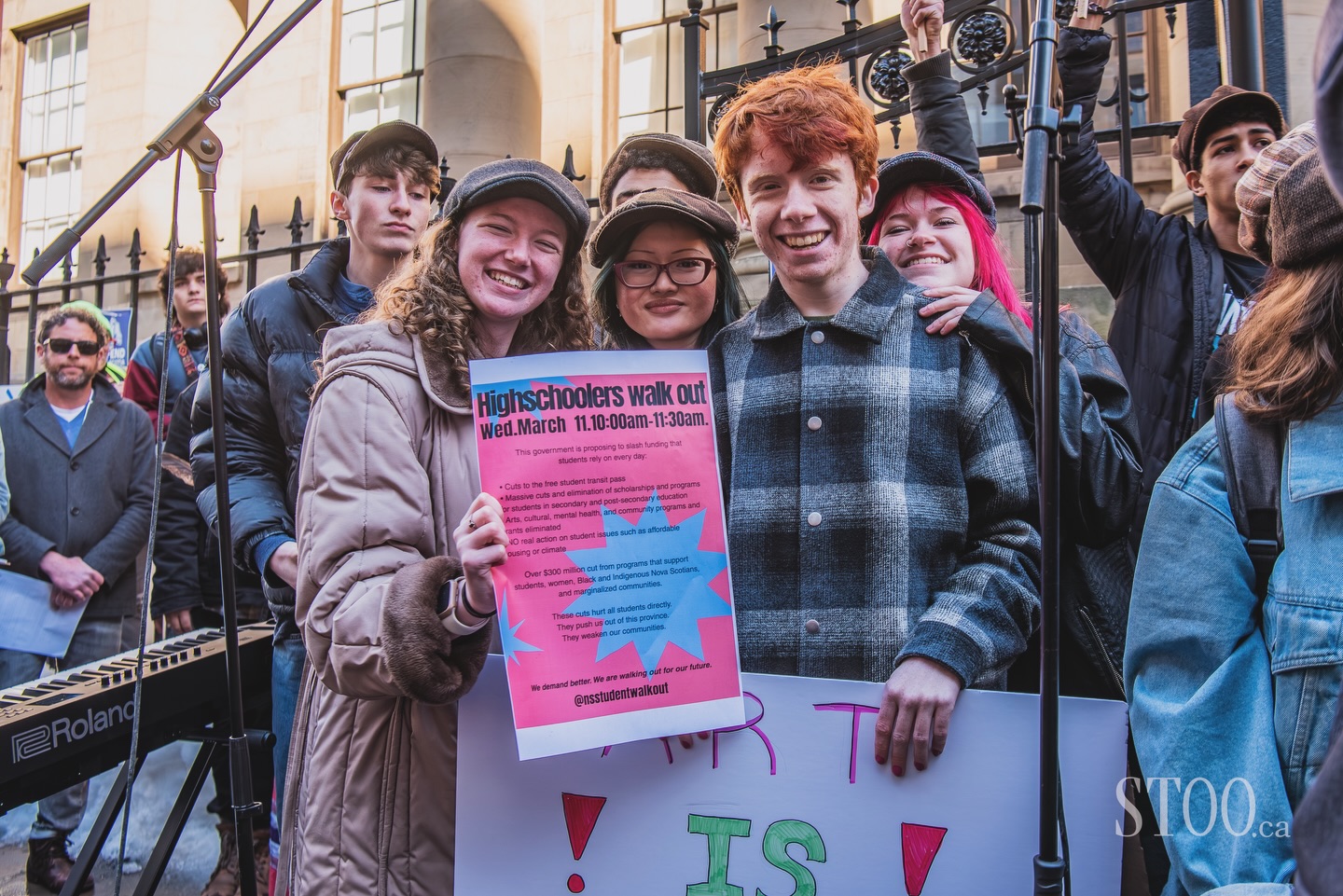
Neptune Theatre School’s Youth Performance Company also attended the rally and they sang the very apt “Seize the Day” from their production of Disney’s Newsies (2012), which closed Sunday. Newsies is loosely based on the 1899 youth-led newsboys’ strike which forced Joseph Pulitzer and William Randolph Hearst to change the way they compensated the boys for their labour. “Seize the Day” has become the musical’s most famous anthem. The song is about all the boys, from every neighbourhood in New York, standing strong and united together and not allowing the capitalistic crooks to pit them against each other or break them apart and that “proud and defiant [they]’ll slay the giant…” It could not have been more perfectly tailored for this moment. These young people know first hand the transformational and restorative power of having access to art. Their enthusiasm, eloquence, and feisty energetic spirit was buoying for folks like me who may feel dispirited that they have been standing on these front lines for decades and to no avail. I found watching the YPCo advocating for themselves in such a joyful way extremely poignant.
A lot of these students will not grow up to work in the arts- but every single career that they pursue will benefit from the leadership, team building, confidence building, creative experience that they had at Neptune’s Theatre School. They will benefit from having found a supportive community of friends and mentors, from being exposed to a wide range of different types of arts, from being able to speak (and sing and dance) in front of a large audience, and learning critical thinking skills, text analysis and healthy emotional expression that will serve them as they navigate a world filled with political doublespeak, AI masquerading as truth, and a constant deluge of propaganda. There is potentially a future Broadway star in the cast of Newsies, but there may be a future Premier of Nova Scotia among them too- all the skills learned in YPCo would be advantageous for someone who genuinely wanted to be of public service. I speak from experience as someone who was also once a member of YPCo.
The rally included a wide array of voices- and that was the point. Sean MacGillivray from The Green Party of Nova Scotia spoke, as did Melissa Marsman, the President of the Nova Scotia Federation of Labour, as did a speaker from Formac Publishing, and Devin Casario from the Association of Nova Scotia Museums. I am especially horrified by what this government is doing to our local museums. Who asked for this? Someone spoke from NSCAD, where workers are on strike, and Trevor Murphy spoke on behalf of Fédération Culturelle Acadienne de la Nouvelle Écosse. I am expecting to see an even more diverse array of voices at the rally tomorrow, since this one was specifically focused on arts, culture, and heritage, and many others came out to show their support and solidarity- but also to emphasize that they know that we are all connected. Where would Acadian education be, asked Murphy, without locally published books for students? What would an Acadian celebration like Quinzou be without any Acadian music? As it is theatre en français in this province is already woefully under-represented. We as artists want to create art that is more accessible and more representative. There is room for Gáidhlig and Mi’kmaq and Arabic and Akan, Mandarin and Hindi in our theatre community. Festivals like Prismatic Arts Festival are, again, essential, to making sure our arts and culture sector truly reflects the reality of who were are as province today.
Kay MacDonald gave an especially fervent and thoughtful speech about how these cuts disproportionally affect African Nova Scotian and Mi’kmaq communities and how this political moment we are all facing together is connected to all the many other political moments engulfing our world. They spoke about the need for artists to have the Turret Arts Space so that the arts can have the opportunity to really thrive downtown again (because right now very little is thriving on Barrington Street (or Granville or Hollis for that matter).
Ian Sherwood led the crowd in “It’s Okay to Change Your Mind,” a song that protesters recently sang at ICE agents when Minneapolis was under siege. Charlie A’Court sang “An Ounce of Trust” which has lyrics that go, “No amount of bullshit/ ever bought an ounce of trust.” Terra Spencer and Sarah Frank led the crowd singing Dave Gunning’s gorgeous song “These Hands.” Choirs for Change rewrote the lyrics to “Farewell to Nova Scotia” to imagine the dystopian reality of our beloved province without the very people who have, from time immemorial, given this land its heartbeat.
Iain Rankin, the Leader of the Nova Scotia Liberal Party and Derek Mombourquette, the MLA for Sydney-Membertou, spoke sincerely and with great respect about their connections to Cape Breton and how absurd it is for anyone from Cape Breton to support this budget. What is Cape Breton without its music, its dances, its distinct culture, its heritage? How is the PC MLA for Inverness going to explain to his constituents that not only is everything that their county stands for “discretionary”- but so is funding for the Gàidhlig? You cannot divorce Inverness country from its languages, its music, its deep, proud history, and its traditions that have withstood colonialism in Nova Scotia for hundreds of years, and defied colonialism in Scotland for hundreds before that. Indeed, I wonder for the future of all the PC MLAs as they will no doubt be explaining to their constituents why they completely sold Cape Breton out from now until election day.
It is a testament to the fact that Cape Breton is one of Nova Scotia’s cultural touchstones that the rally ended with Terra Spencer, Sarah Frank, and Stewart Legere leading the whole crowd in a rousing rendition of Leon Dubinsky’s song “Rise Again,” which was popularized in the 1990s by Raylene Rankin of Mabou’s The Rankin Family. Mabou is in Inverness County. “According to Dubinsky, the song is about, ‘the cycles of immigration, the economic insecurity of living in Cape Breton, the power of the ocean, the meaning of children, and the strength of home given to us by our families, our friends and our music.” Indeed, the song was written about a time when Cape Breton was going through a real economic crisis, not one manufactured by Tim Houston. Dubinsky centres the necessity for music in the lyrics, “We rise again/in the voices of our song.” Our song, our voices, our children, the ocean, they are all irrevocable parts of who we are as Nova Scotians, and “sure as the sunrise/ sure as the sea/ sure as the wind in the trees” we keep rising in protest and in righteous defence of everything that makes Nova Scotia, to borrow from Rita MacNeil, another legendary Cape Breton artist, “a treasure no other has seen.”




1 thought on “The Arts & Culturalist Papers 2: On Rallying Together”
Comments are closed.