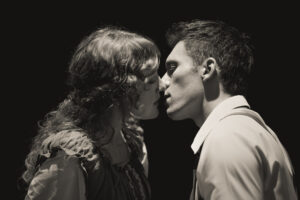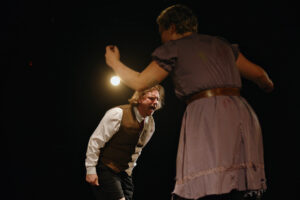
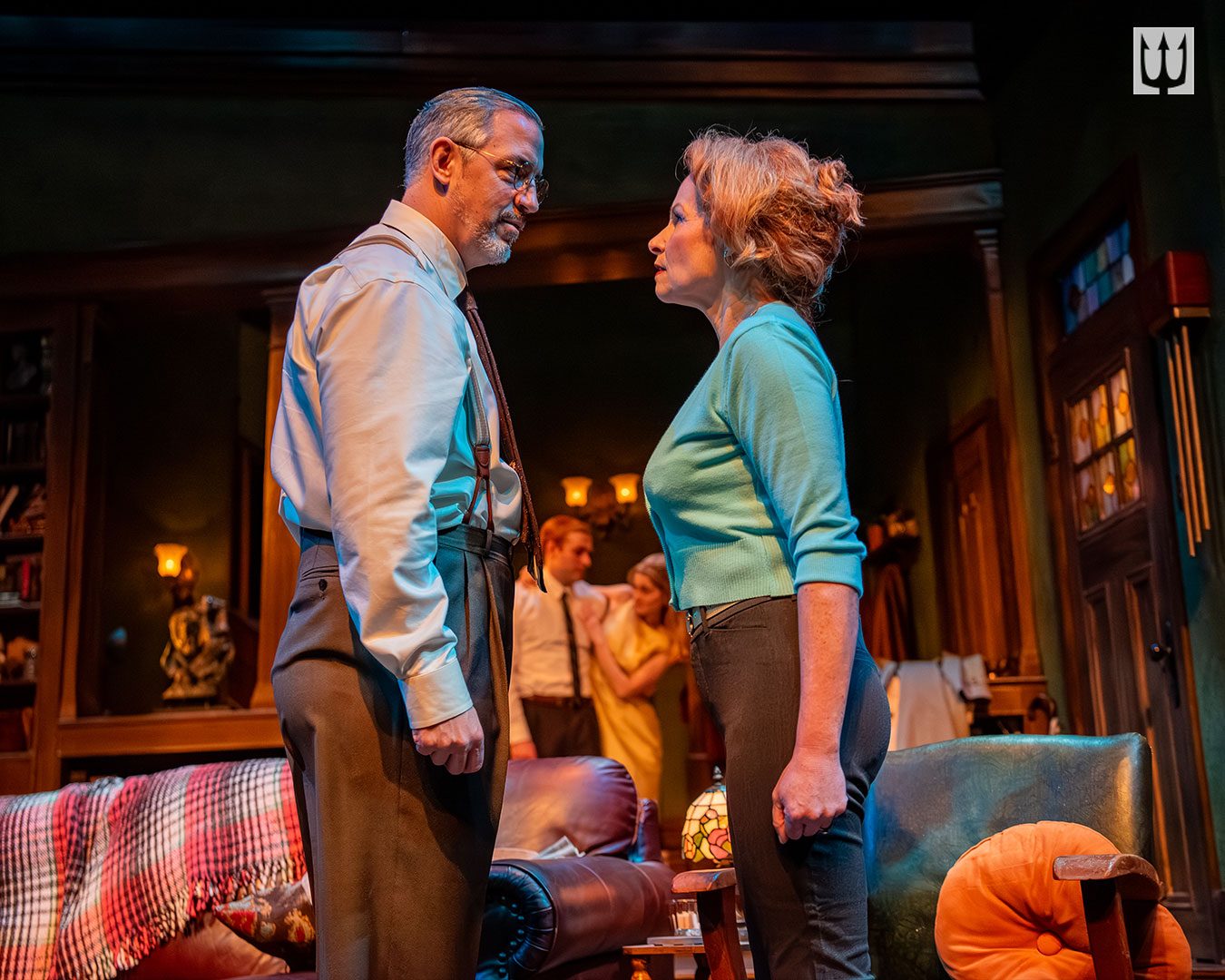
Anthony Black as George and Raquel Duffy as Martha in Edward Albee’s Who’s Afraid of Virginia Woolf directed by Ann-Marie Kerr at Neptune Theatre Photo by Stoo Metz
When I first reviewed Edward Albee’s play Who’s Afraid of Virginia Woolf after seeing a production at Soulpepper Theatre in Toronto in October of 2009 I, at 24 years old, wrote that I thought it was “one of the greatest plays ever written.” Now having seen and read considerably more plays my opinion remains unchanged. This is one of the greatest plays ever written, and the production playing at Neptune Theatre just until March 15th directed by Ann-Marie Kerr is an absolutely delicious example of all the elements coming together just right to create a truly formidable evening at the theatre.
The play is set in a home at a small New England college in 1962 and we see Martha, the daughter of the college president, coming home at two o’clock in the morning with her longtime husband, George, from a faculty party hosted by her father. George works at the college, in the history department. Martha could have worked at the college if it weren’t 1962, but as it is she is expected to use her intellect, ambition, and wit to exert a discreet influence within the domestic sphere. We see from their first entrance that Martha is buzzing with both adrenaline and booze, while George is clearly drained- both from the physical exhaustion and the mental exhaustion of having to sit through one of these weekly schmoozy parties where he always fails to perform in a manner befitting the president’s son in law, and Martha grows more and more resentful having to overcompensate for him. It’s out of this context that she springs the news on him that she has invited guests over- Nick, a handsome young new asset to the Biology Department and his “little wife” Honey will be arriving momentarily.
What follows is a contest of sorts between Martha and George where they each use their hapless guests to push each other to the brink of destruction in a dizzying tug of war of wits, cruelty and sadism. Martha seeks to emasculate George as punishment for not living up to expectations, but we also get the sense that she is trying, in albeit a convoluted and deranged way, to rekindle a spark of life in him that will keep him from giving up and settling for mediocrity. George lashes back with ferocity of his own, in ways that often seem solely in self defence, but we come to find that he is, actually, perhaps even more calculating than she is- and that he is after Martha’s own coping mechanisms and all that keeps her at a safe distance from what is really broken inside her.
It is also, as Ann-Marie Kerr writes in her Programme Notes, “fucking funny.”
It is funny because these two gargantuan characters are so literate: in literature, in history, in film and theatre, and in the English language that the audience marvels over the way they spin their sophisticated erudite webs around Nick, Honey, and each other as Martha oscillates between the more esoteric, “I swear to God, George, if you even existed I would divorce you,” and then swings to the much more colloquial with, “You make me puke.” Nick, a biologist, is no match for George in this kind of literary repartee, but as a young and handsome athlete Martha is sure to show off her appreciation for his more physical advantages.
I know this is the very definition of what actors do, but it takes incredible acting prowess to be able to say the lines that Albee has written for Martha and George and to have them sound like they are flying out from the top of the characters’ booze sodden heads. This is exactly what Raquel Duffy and Anthony Black are able to do so masterfully in this production. Not only does everything they say sound like it is being spoken for the first time, but everything they hear is landing fresh too. You can see the wheels in their heads spinning as they are constantly calculating what their next move should be, not just what they should say but how they should say it to most throw their opponent for a loop. Not just with each other, but with Nick and Honey too, both Martha and George are trying to say the least expected thing, in the most jarring way possible to knock the other off their game. Raquel Duffy’s Martha can be sparkling and charming, she can be exuberant and childlike in giddy moments of gleeful joy; she can also be deliberately vicious and cunningly manipulative and cold. We also see moments of what is genuinely vulnerable in her: the heart that all the artifice protects. Duffy can change Martha’s entire emotional trajectory on a dime- revealing the layers upon layers of complex humanity we are seeing so brilliantly brought to life on stage. Her performance is nothing short of a theatrical marvel.
Anthony Black’s George is in a way the inverse of Martha, as he appears to wear his weaknesses more on his sleeve. On the surface they seem unfairly matched in this game, and whether he can needle Nick into losing his temper seems moot. Yet, while Black’s George comes into the house ready for bed, he becomes more and more energized as the morning wears on, and with his energy comes a sense of confidence and his own menacing playfulness. Black is known to audiences in Halifax for his own profoundly literate and intellectual plays, so it is delightful to see him bringing that to George. It is also such a treat to get to see him be so funny and how he mines every moment to bring out George’s affinity for the absurd and ridiculous. He relishes in being able to show Nick that he and he alone is quite the worthy opponent for Martha because he understands the way her mind works and he can anticipate her constantly changing ground rules. In the same way, of course, Black is in every way a worthy partner for Duffy on this truly wild and ostentatious ride where they have to be in such intimate sync with one another to create the illusion of this deeply dysfunctional martial dynamic.
In complete contrast to this chaos is Patrick Jeffrey’s portrayal of Nick, a very buttoned-up biologist looking on the surface to make a professional first impression on the elite of this college, but as the party unravels it becomes clear that his ambition is as morally ambiguous as Martha’s. While the names George and Martha are clear references to the Washingtons, I wonder if Albee took Nick from The Great Gatsby. There is something of the mixture of the midwestern and the Nouveau Riche about Nick’s ability to capture an essence of the “All American” boy for Martha. Jeffrey does an excellent job of using different types of restraint- whether that be Nick’s very WASPY regard for decorum and proper etiquette, or whether it’s the way he performs his masculinity as an unmistakable superiority that requires no effort of proof. His wife, Honey (is that her given name or just what her husband calls her? Albee leaves this up to us), played by Kya Mosey, begins the play wanting to help Nick make a good impression, but as she continues to drink more and more brandy (which, unlike the others her body can’t tolerate) she begins to assert her own opinions and desires, forcefully rejecting the control Nick believes is his right and obligation to have over her. Mosey creates a lot of the physical comedy in the play in juxtaposing Honey the sloppy drunk against the others.
What becomes so striking as the play goes on is that while both of these marriages seem to perhaps be destined for destruction, it is Martha and George who have a love for each other that Nick and Honey have never known. Nick and Honey may be destined for divorce as the 1960s make way into the 1970s, even at a small college in New England, but they will never be able to hurt each other nearly as deeply as George and Martha do because their attachment is much more tenuous. “George and Martha: Sad, sad, sad,” Martha says to Nick at the end of what seems on one level to just be a melodramatic swan song she plays for sympathy and affection, but it actually exposes a deeper truth.
The rollicking pace of this play is very much a testament to director Ann-Marie Kerr, but the other thing I found so striking, so real in a way that theatre isn’t always real, is the way that the characters move around the set. Martha and George are in their own living room, a place where they have lived together for 23 years, and that gives them the utmost in familiarity in this space. Nick and Honey have come into this house for the very first time. All four of them are drunk- with Honey the most unable to handle her liquor, and George is the most sober, and all four of them move in ways that denote a dichotomy of how comfortable they feel in this space and how comfortable they feel in their own bodies. Especially significant is the way that Raquel Duffy’s Martha moves on the furniture when she doesn’t overtly need to. She moves from sitting on the chair to the arm of the chair, she climbs over onto the couch- forcing everyone else to move to accommodate her- at one point she stands up on George’s writing desk and nothing ever feels like “keeping a talky scene moving” or “finding ways to make the scene more interesting-” Kerr has found every way to make these scenes feel human.
Tamara Marie Kucheran’s set is also instrumental in bringing this play to vivid life. You can see with gorgeous detail that this is a beautiful old house, but this mixed living room and office space we see has a real lived in quality to it, and, as we see with the way Martha and George move around, they have no reverence for these things, everything about living at Martha’s father’s college is part of the trap they’ve created for themselves. Sean Mulcahy’s costume design helps to tell us so much about the characters too. George is probably the same age as Anthony Black is in real life but his clothes give him a frumpy and homespun quality that makes him look much older and stands in contrast to Nick and Honey who exude timeless class, and Martha, who changes from an elegant party dress into much more casual but also specifically youthful attire. While Nick and Honey seek to capture the esteem given to grownups, Martha wants to prove she can be as hip and cool as any twenty year old.
The play is divided into three acts and at the end of each we get a different mosaic or pattern of light from Jess Lewis, and then a wall of sound from Aaron Collier as a song contemporary to the period floods the space and provides a bridge between the end of the action and the intermission. The result is both a visceral push back out of Martha and George’s space and into the real world, and also a reflection of the fracturing we are seeing onstage.
The title of the play comes from the song “Who’s Afraid of the Big Bad Wolf” from Disney’s 1933 short The Three Little Pigs, where each pig builds their house with materials they’ve found in attempt to keep themselves safe from danger. We can see that George and Martha’s house is built sturdily, but that the danger is already inside. The reference to esteemed British writer Virginia Woolf here, a woman who suffered from mental illness, who had an early life marked by tragedy, and who died by suicide in 1941 is initially viewed by Martha, Nick, and Honey as a harmless clever college witticism. But the fear of Virginia Woolf is the fear of the unraveling that can come by not numbing, not repressing, not turning your traumas and fears into parlour games, and actually allowing yourself to access your real emotions. What if you aren’t as strong as you pretend to be and you can’t handle the truth after all? Initially it is George who says, “I cannot stand it,” referring to his being mercilessly humiliated by his wife, and she counters with “You can stand it,” but in the end it is George who seems to offer a sincere faith in Martha that she can walk into the dark and survive.
Who’s Afraid of Virginia Woolf by Edward Albee directed by Ann-Marie Kerr opened March 6th and only runs until March 15th, so you are going to want to buy your tickets right now. You can do that online here, by calling the Box Office at 902.429.7070, or visiting in person at 1593 Argyle Street. Tickets range in price from $33.00 to $68.00 depending on seating. Performances are Wednesday to Saturday at 7:30pm with 2:00pm matinees on Saturdays and Sundays.
Please be advised: This production includes coarse language, excessive drinking, smoking of herbal cigarettes and instances of violence that may not be appropriate for all audiences.
Masked Performance
Sunday, March 8 – 2:00pm
Neptune Theatre is fully accessible for wheelchair users. Neptune offers hearing-assistance devices, along with their masked performance and audio described performance. For more Accessibility Information Click Here.
Incoming search terms:
- https://example com/p8670