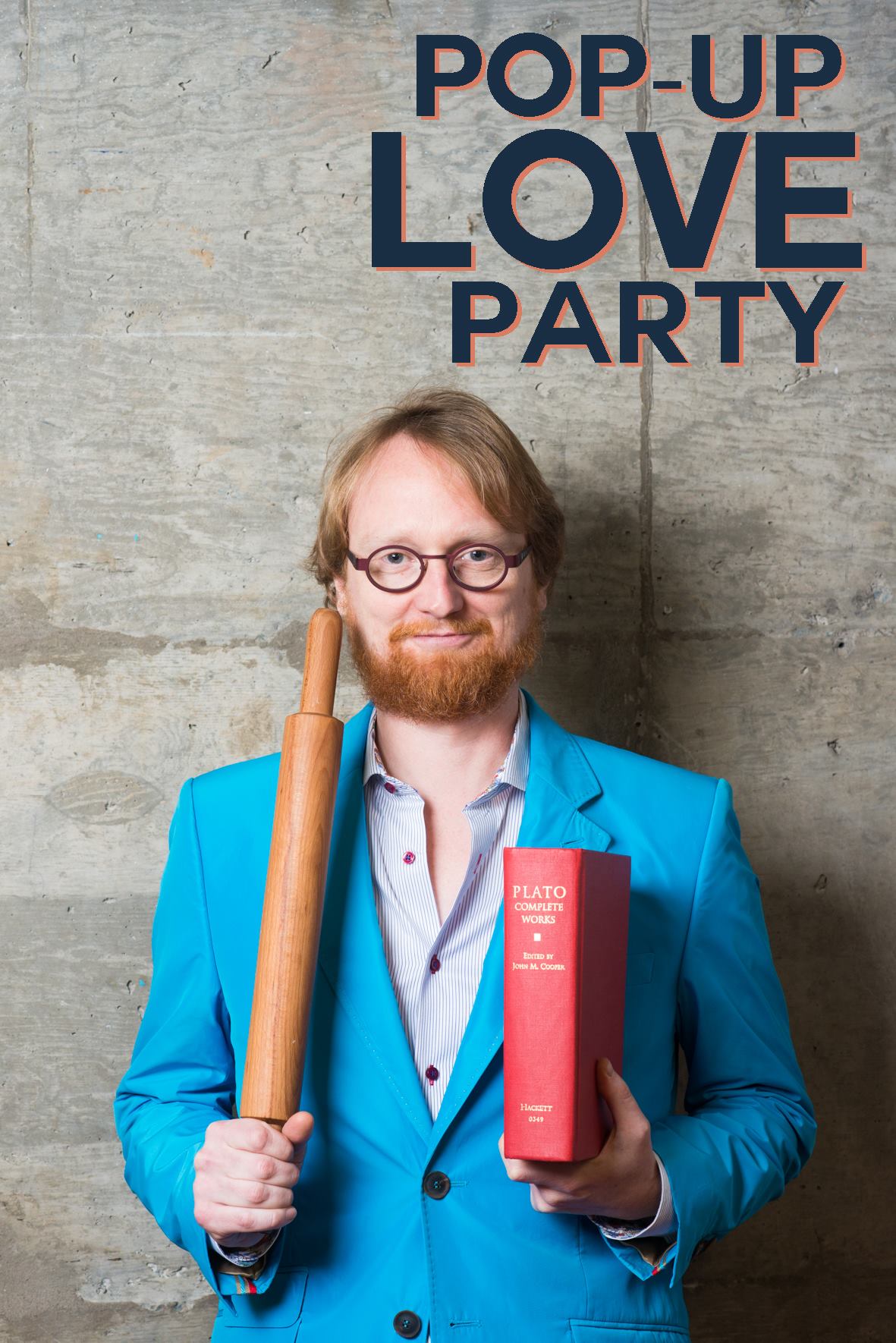
Alex McLean
There is evidence to suggest that in his youth, a little less than 400 years BCE, Ancient Greek philosopher Plato was a poet and tragedian, but he abandoned these passions and “burnt his poems” when he met Socrates who inspired him to turn his attention toward Philosophy. From here he became quite critical of Greek theatre and the arts in general, but as part of his philosophical writings he wrote Symposium between 385-370 BCE, which is a dramatization of a “friendly contest” of speeches given by famed Athenian men, including Socrates and playwright Aristophanes, set at a banquet in 416 BCE at tragedian Agathon’s house.
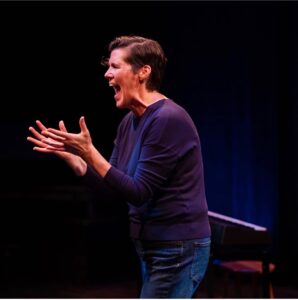
In 2015 Zuppa’s Alex McLean (Director) and Susan Leblanc, Stewart Legere, and Ben Stone created Pop Up Love Party in part through The Collaborations at Canada’s National Arts Centre and while in residence at Eastern Front Theatre to reimagine Plato’s Symposium as both a piece of theatre and a banquet- in short a “philosophical feast.” I sat down with Alex McLean via Zoom to chat about Pop Up Love Party coming to Alderney Landing Theatre just for two performances- March 19th and 20th, 2026, and how the creation of this show came to be.
“Plato was an aspiring playwright in Ancient Athens,” McLean says, “and, the story goes, that he met Socrates the philosopher and basically was encouraged by Socrates to abandon theatre for the truer pursuit of philosophy. He kind of changed gears and started writing these philosophical works, all of which are stories about Socrates and the teachings of Socrates… They’re all written in dialogue form, so there’s this way that they’re still kind of theatrical. … The Symposium is, I think, often thought of as the most theatrical. It almost reads as a play. It’s set on the night after the big competition for best playwright for Greek tragedies, and the poet and playwright Agathon has just won the competition, and everybody’s gathering for… sort of post-show drinks. The word ‘symposium’, even though we now think of it as a dry thing that happens at conferences, the word ‘symposium’ means ‘drinking party.’ So, everybody gathers for this drinking party to celebrate Agathon’s great triumph at the theatre competition, and somebody then proposes as like, ‘here’s a fun thing we should do this evening- we should all give speeches in honour of love.’”
In Greek eros means love (in the more erotic sense of the word) and also desire. “It’s character driven,” says McLean of the original dialogue, “there’s a person who’s sort of like a socialite character who gives the first speech and it very much says as much about the person who’s talking as it does about what they’re talking about. Then a lawyer gets up and gives a speech, and the lawyer’s version is very legalistic. Then a doctor gets up and gives a speech, and it’s very medical and about health… and it goes through over the course of the night until the sort of penultimate thing is that Socrates gives the speech from the philosophical perspective, and, because it’s written by Plato, it’s very much about how great philosophy is- we’re intended to think that the philosopher’s speech is the one that’s true and correct.”
McLean also brings up that Plato’s work inherently has some comedy in it too. “People fall asleep at the table, and somebody gets the hiccups, there’s all these funny little details in this kind of ostensible work of philosophy.”
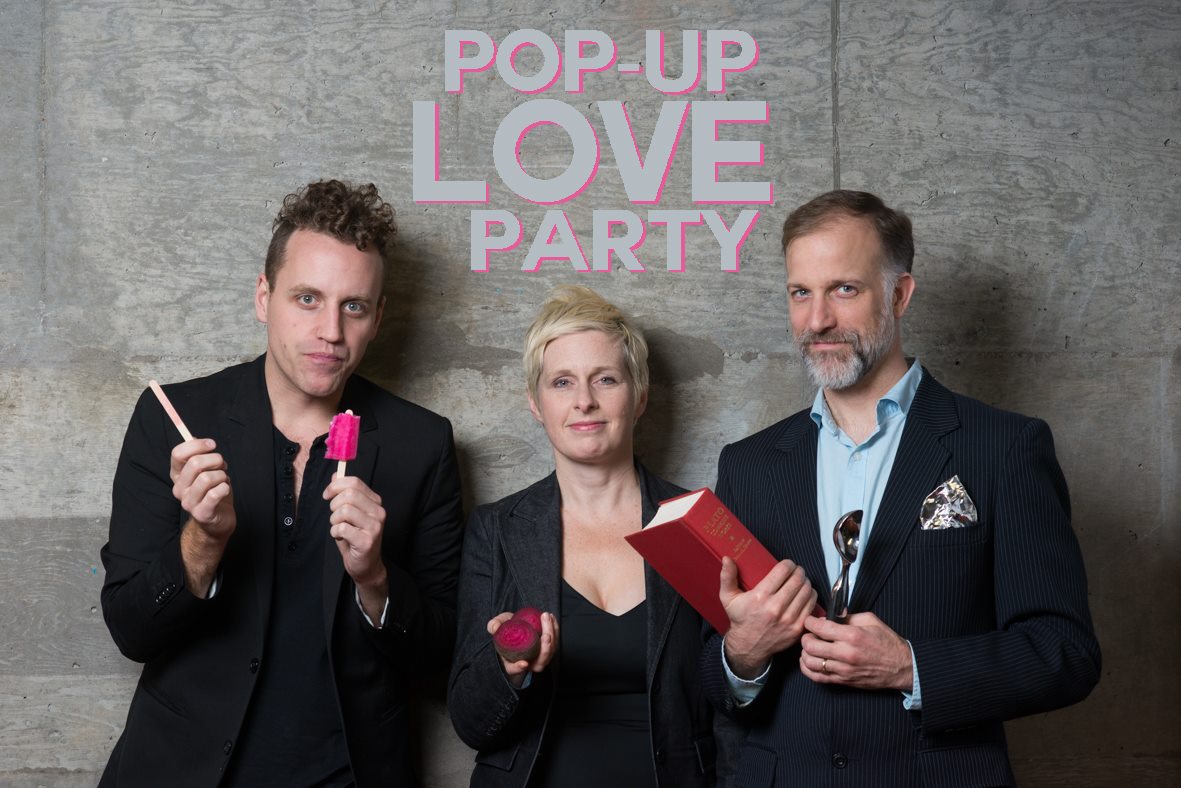
He says that when the Zuppa members initially read this work they found it interesting how in some ways it captures a world completely different from our own, and yet, in other ways it is still very resonant. Their goal in creating Pop Up Love Party wasn’t to stage The Symposium verbatim but for Ben Stone, Susan LeBlanc and Stewart Legere to each take two of the speeches and to “try to do them justice while also speaking from their own perspective as Ben, Sue, and Stew.” He mentions for example that Susan Leblanc took the doctor’s speech and he says, “Sue had just completed yoga teacher training, and, of course what medicine was in Ancient Greece is very different from what we think of as medicine now. [In The Symposium] it’s very much about like the balanced elements [and] the humours in the body, so our way in to that, and Sue’s way into that, was using her yoga training and mindset to interpret that speech.” McLean says that the “underlying point of the show in a way is us kind of defending the idea of theatre by taking this thing that is meant to kind of say ‘theatre’s not enough’, but then using it to say, ‘no, don’t you see that there is actually a value in us doing this thing?’ Theatre, and art in general, is always under attack, as it is in Nova Scotia right now. It’s always trying to prove itself. It’s always trying to say, ‘oh we’re good for the economy‘, ‘oh, we’re good for public health‘, and there’s always this thing where we all know that’s true, but there’s also another thing underneath it that’s also important and that’s the harder thing to explain.
For Plato and for Socrates the argument was, ‘well, it’s just fake, you’re playing with people’s emotions. You’re getting people revved up, but you’re not telling them what’s true. You’re manipulating them and when you manipulate people, when their emotions are manipulated, they make bad decisions.’ Our whole show, in a way, is about saying, ‘No theatre can do something more than that. But we’re going to try to do it by using [Plato’s own] words, and see if we can, at the end of the night, convince people that theatre is actually something that’s worthwhile on its own terms.’ It can still be a little bit deceptive and slippery too, and to try and embrace that in it… and the expertise of that, and the doing of that can generate empathy and understanding and bring people together. That’s what I think is at the heart of this show.”
Pop Up Love Party also captures The Symposium’s banquet setting in offering the audience a multitude of vegetarian snacks created by Halifax’s own Chef Jamie MacAulay. “If we’re going to be praising Eros, not only what are the ideas that Plato’s writing about, but what do they sound like? And what do they feel like? And what do they smell like? And what do they taste like?” says McLean, “So, the food is meant to be the chef’s interpretation of these different ideas that are being talked about.” This menu is brand new for this production of the show. Earlier productions, both in Halifax and on tour, featured a different menu by Daniel Burns. McLean is excited to have audiences experience these specific snacks for the first time at Alderney.
He goes on to say that wherever they have travelled with this show in the past (with their suitcases filled with strange food ingredients and packed dried mushrooms) audience reactions have always been similarly warm and positive.
“We try to make it a very festive show. The initial impetus for it was [that] we wanted to make something that was joyous- not just the idea of joy, but actually pleasurable… we do it in pubs and restaurants [too], so it’s also an environment where people feel like they can have permission for that, and people can get up and get a drink during the show- we really do try to make the invitation to have fun and be festive… It’s more like a kitchen party than a sit down and buckle into your chair kind of vibe.”
With all that is going on politically, here in our own province and across the world, I can think of nothing more timely to pop up than a love party.
Zuppa’s Pop Up Love Party has one show tonight (Thursday March 19th) in association with Eastern Front Theatre and produced by Sophie Schade at Alderney Landing Theatre (2 Ochterloney Street, Dartmouth) at 7:30pm. Doors open at 7:00pm. Tickets are available here. They are $22.00 for just the show with no food and an additional $14.00 ticket purchased separately on the same site to add the food to your experience. Tomorrow’s show- March 20th is SOLD OUT.