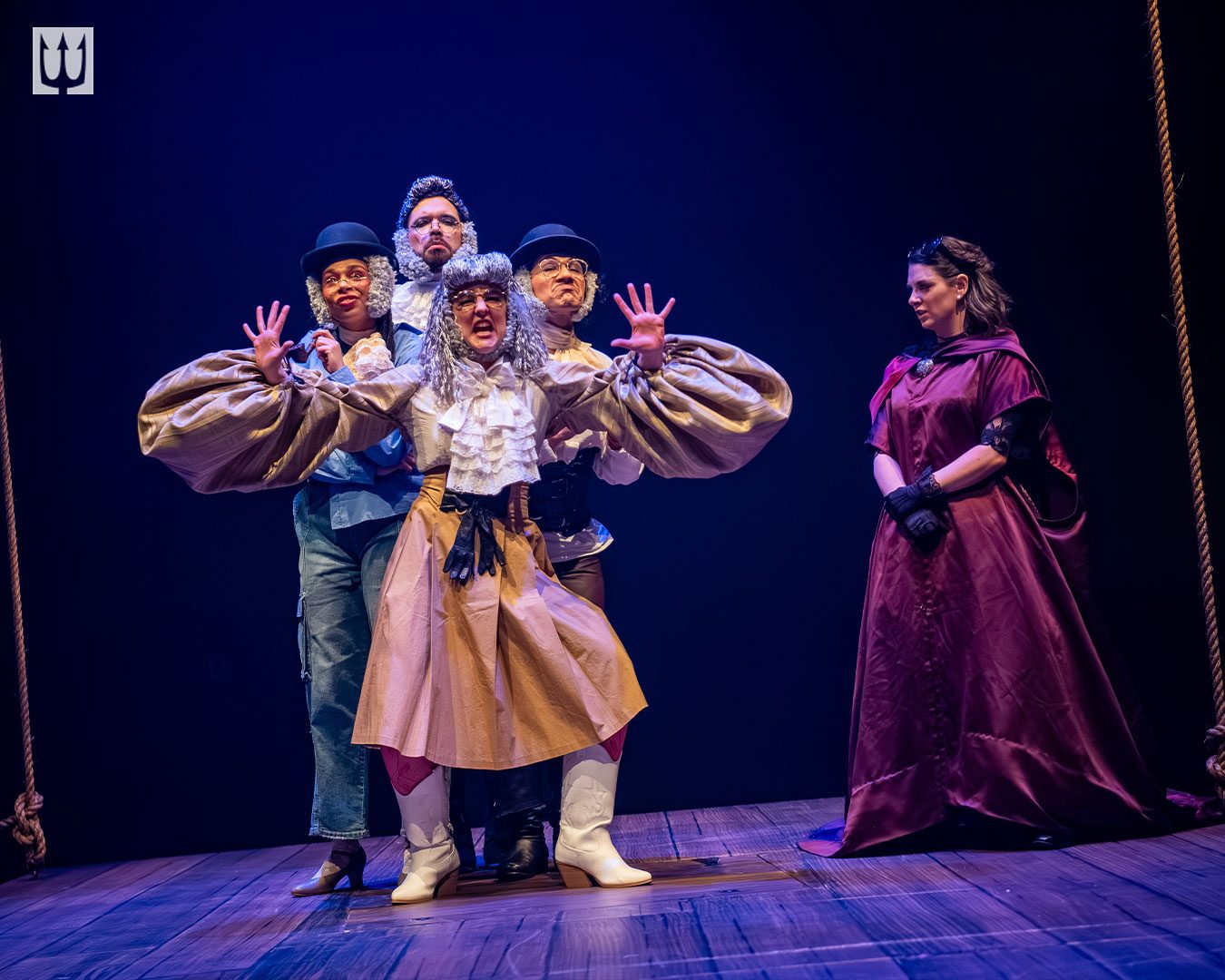
Kih Becke, Henricus Gielis, James MacLean, Nancy Kenny, and Katelyn McCulloch. Photo by Stoo Metz
Just before Christmas Sharisse LeBrun directed the Youth Performance Company (YPCo) in a riveting production of Frankenstein. The adaptation by Rona Munro put Mary Shelley into the action of the play interacting with her famous characters. Most of us are quite familiar with certain interesting tidbits about Shelley and her life, and we know her to be a pioneer in the genre of science fiction. A name that might be quite a bit less familiar, especially for us Canadians, is Margaret Cavendish whose science fiction book The Blazing World was published in 1666. And in 1666 Cavendish actually had the temerity to put herself into the action of her work, similar to how Munro plunks Mary into Frankenstein.
Who was this woman of such audacity, who was not only writing books, but publishing them and seeing herself as the protagonist at a time when all the women on the stage in England were being played by men, and really the only English women whose stories have been passed down to us in any detail are Queen Elizabeth I and Henry VIII’s wives?
In her play Mad Madge, which plays at Neptune Theatre’s Fountain Hall until February 8th, Rose Napoli doesn’t just seek to introduce Cavendish to contemporary audiences by showing us what she was like in her own time, she presents us with an entirely imaginative through-the-looking-glass absurdist, satirical romp that has Cavendish, and all the other characters in the play, moving seamlessly from her world into our own. This kind of repackaging of history to make it more immediately accessible, especially to younger audiences, is familiar to us- we’ve seen it in the way Lin Manuel Miranda constructed Hamilton, for example. Yet, unlike in Hamilton where Miranda mostly treats the backdrop of the Revolutionary War and its heroes with the expected reverence of an American writer, Napoli relishes in every opportunity to poke fun at the misogynistic culture that pervades everything at this time from new interests and breakthroughs in science, to the constant colonial wars, and ruthless violence and ambition showcased by members of the Royal Family clamouring over one another for power and wealth.
Napoli’s Madge is desperate for attention in a way that suggests not just the way she was marginalized in life, but also in the way she has been largely forgotten in death. She comes out swinging asking us to imagine that we are intelligent and capable, filled with ambition, dreams, and madcap energy, precociousness, insight, and creativity, but we have the misfortune of being born as a girl in the 17th Century where it is impossible for all that potential to be realized. We meet her family- the Lucases- her recently widowed mother who is depicted as a sort of down on her luck Kris Jenner, her adoring Queer “bastard” brother, Thomas, her sulking envious heteronormative brother John, and her cute but strange little sister Pye. Margaret is repulsed by the idea of marriage, as she knows that this will thwart all her ambitious plans, and she runs away to become a Lady in Waiting to the Queen of England: Henrietta Maria.
In Napoli’s imagined sequence of events Margaret does not initially make a good impression on the Queen and is relegated to the crappiest job in the palace. Yet, once the King is executed and the Queen and the rest of royal household are exiled to France Margaret ingratiates herself in the most unexpected way, appealing to Henrietta Maria’s most basic and biological needs. At the same time Margaret meets William Cavendish, a musketeer with a poet’s heart, and she finds herself suddenly trying to repel love in order to prioritize her ambitions in writing, philosophy, and becoming an intellectual woman about town that the other men might eventually be forced to see as an equal.
In her Playwright’s Note in the programme for the original production at Nightwood Theatre in Toronto in 2024 Rose Napoli wrote that she was inspired to write “a comedy about female rage-” exploring the idea of how women getting mad (angry) have so often been transformed by men into women becoming mad (crazy). I don’t think it’s a spoiler to say that in life, and in this play, Margaret is not able to overcome her gender and to live as a woman but with all the rights, freedoms, and privileges of a man. Of course she couldn’t- over 300 years later and women still can’t. What struck me so much about this play was how hilarious it was: silly, bawdy, irreverent, sprinkled with pop culture references, satirical, absurd, weirdly whimsical, and yet there were moments where I still felt in my gut, in my bones, infuriated. Napoli takes the piss out of every man in the play, except William Cavendish. Samuel Pepys, a diarist whose work has shaped much of what we know first-hand about this time period, who was also a civil servant and a Fellow of the Royal Society, along with Robert Hooke, a scientist are both portrayed raucously as absolute doofuses and yet their complete dismissal of women’s ability to be intelligent or to be relevant at all, still hangs in the air as a resonant, enduring assumption that is as stupid as it is persistent. It is not often that you see a work that is punching up with such delicious comedic retribution, but that still rouses the ire in your body.
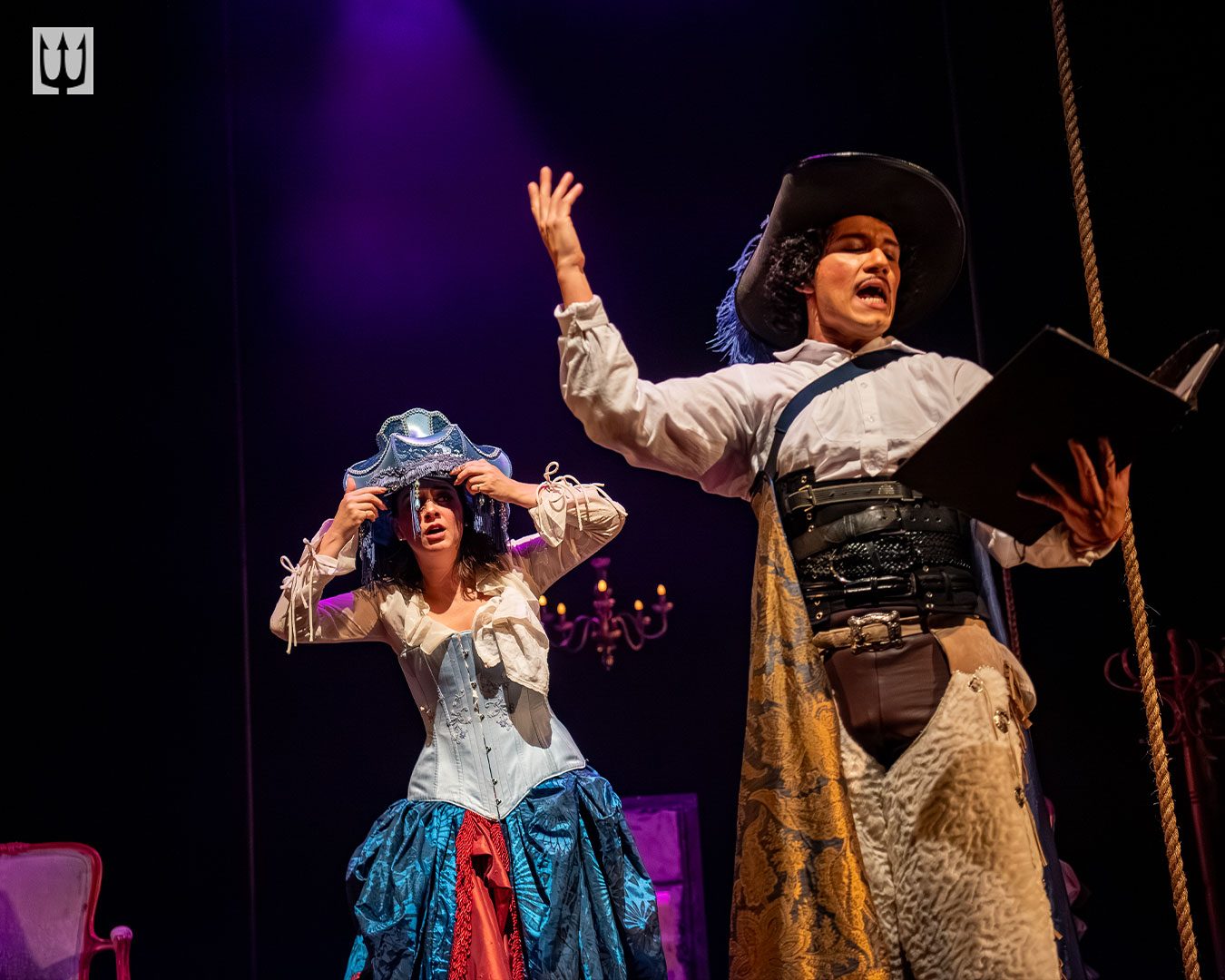
Jeremy Webb directs Mad Madge with a cast of powerhouse Nova Scotian actors. He succeeds in capturing the sort of Lewis Carrollesque lens through which we are looking at the past. The comedy here is densely packed in a way that is often a signature of Webb’s work, but here it is more biting and provocative; even at its most silly we are encouraged to think critically about what Napoli is saying about British history, culture, and its lasting impact on us.
There’s a bit of room to tighten up the pacing a bit. I wish that there was a way to make the transitions between the scenes instantaneous, but obviously there are constraints in moving set pieces. The actors have also only had two audiences, so they’re still figuring out the timing of all the comedic moments around the audience’s response, so I imagine they will be more into their groove after the weekend.
The play is set on a massive drawbridge that looks more like it was blasted out of the stone wall behind it like the Kool-Aid Man than it was drawn down deliberately. This suggests a sort of smashed down fourth wall, with the action occurring, in defiance, on top of it. In this way Scenic Designer Lucas Arab mirrors another of Napoli’s themes- denying these historical figures any sense of privacy and imagining what kinds of crass realities and saucy sexcapades could have been happening behind the closed Royal doors. The magical candelabras that swing around amid Leigh Ann Vardy’s gorgeous lighting design also add to the sense that everything is a bit off-kilter.
JB Nelles’ costume design is visually stunning, and filled with so much detail- oscillating from accuracy to fantasy to playing with how to mix the historic and the contemporary in the same way Napoli is doing in the text. There is one particular dress that Nancy Kenny wears as the Queen that is absolutely breathtaking, and I especially loved Margaret’s style in her breeches, which really presents a sort of fantasy of what femininity could have/should have been back then.
Most of the actors play a variety of roles, and they work very well together as an ensemble to create the world for this specific ‘Mad Madge’ to emerge from. James MacLean is so tender as Margaret’s disillusioned but realistic brother who believes in her ability to break through the conventionality he abhors but abides by nevertheless. He also plays Trudy, a servant to the Queen, who views Margaret as a threat to what little social capital she has, and who will mindlessly do the patriarchy’s bidding to hold onto that. Judy, played by Kih Becke, while seemingly the play’s most stereotypical superficial airhead, is inspired by Margaret’s frenetic plans and unwavering confidence in herself. Henricus Gielis plays Dycker, the seemingly stoic and gruff butler and body guard for the Queen, and also Margaret’s petulant older brother John, whose masculinity is constantly being threatened by the self assuredness and productivity of his sister. MacLean, Becke, and Gielis are all deft at playing these characters who are at times ridiculously over the top but also finding nuanced ways to root them in their humanity, so we can see them both as satirical but also as individuals.
Santiago Guzmán plays the dashing, humble, and poetic William Cavendish, a man who seems, especially for his own time, too good to be true. His ability to see Margaret and to love her, for all she wants the world to be, and despite her own flaws, makes him very difficult to resist. Guzmán plays this character with a wide open heart and a sincerity deliberately at odds with nearly everything else in the show.
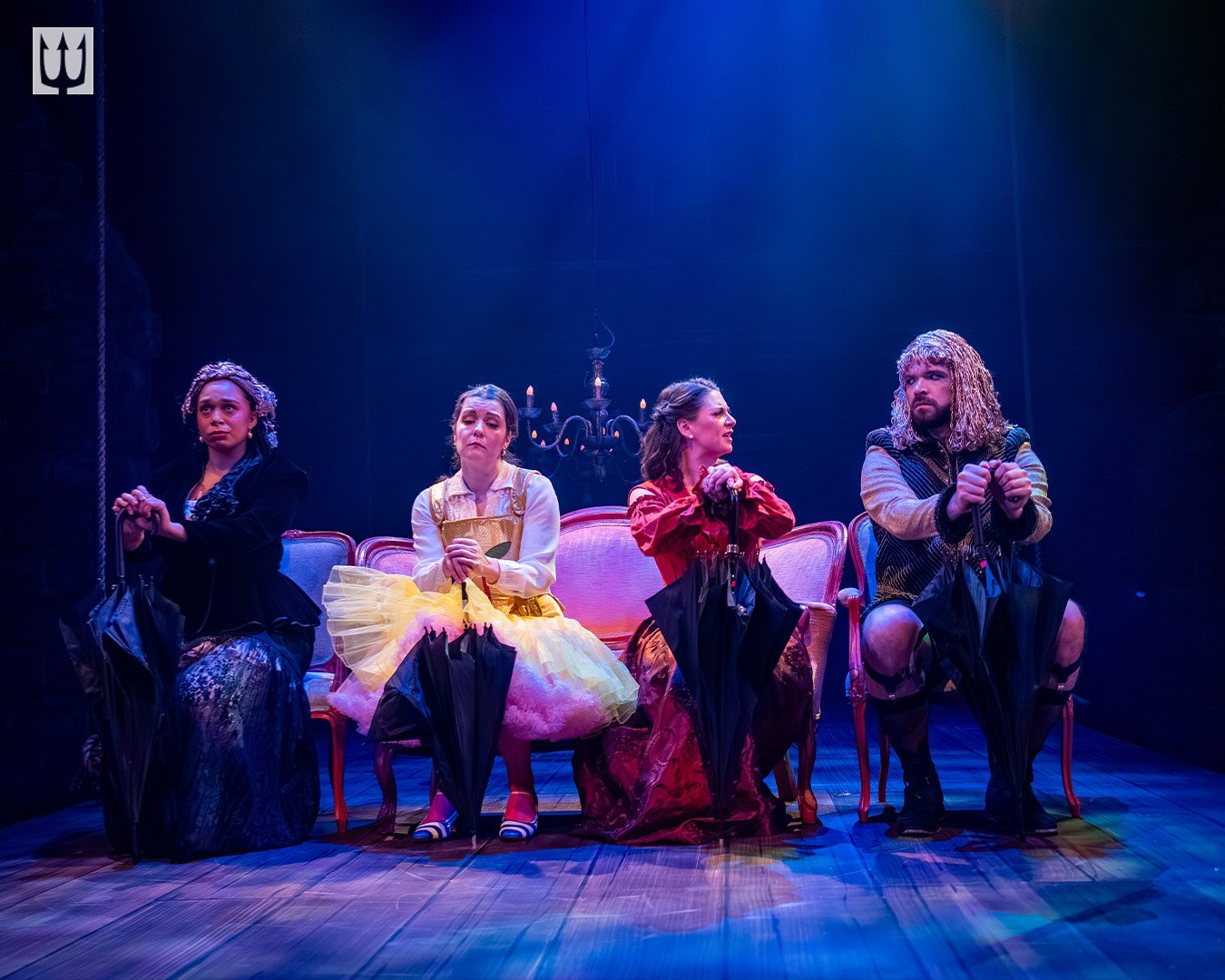
Nancy Kenny plays Queen Henrietta, Pye, and Samuel Pepys and she gives a formidable performance. As the Queen especially Kenny has to walk a strange line between being in a humbling (if not humiliating) situation while still holding all the status and the power that her crown affords her (even in exile). Napoli has certainly written the Queen to be absurd in the things that she says and the way she behaves, but at the heart of her relationship with Margaret we see the depressing truth around Queen Henrietta Maria: the only reason she has any power at all is because of her proximity to three men: her father, a King, her husband, a King, and her son, a King. Margaret dreams of becoming famous for her own actions, her own works, not because of who she marries or gives birth to. In the same ways as the others in the ensemble Kenny deftly swings from being a symbol of monarchy, to being a woman just trying to navigate through it.
Making her Neptune debut as Margaret Cavendish is Halifax’s own Katelyn McCulloch. After working in Toronto, at the Stratford Festival, and in film and television for the last decade and half, what a homecoming this is. Rose Napoli is deliberately flippant about so many of the realties of Cavendish’s world, but one thing that she holds onto with gravitas is that Margaret sought to use her intellect to both write something that would become her legacy and also to engage with the headiest philosophical and scientific discussions of her time. There is an inherent paradox in the way this character is written as she both wants to be taken seriously, but also is not afraid to be outrageous, she courts the spotlight, but also faints if it shines down too hard. We can see all these layers in McCulloch’s performance- someone who is trying to fake it until she makes it, but who knows her own deficiencies, who is both defiant and defensive when it comes to her imperfections, and who rails against the status quo and also has to admit it is stronger than her alone. While Margaret is the intensely vigorous narrator of this piece McCulloch also grounds her in the honesty of her emotions, and this connects her so ardently to the audience’s hearts.
Last year as Hamilton was celebrating its 10th Anniversary my friend asked me what I thought its successor has been in musical theatre. I conceded that I didn’t know, but I said that of all the shows that have been on Broadway recently the one with the most Hamilton-esque buzz seems to be Cole Escola’s satirical comedic romp Oh, Mary!, which I have not seen, but have heard very much about. Escola jokes in interviews that they wrote this play about Mary Todd Lincoln having done no research, and in her programme notes from Nightwood Theatre Napoli writes that Mad Madge is “not wholly inaccurate. But close.” My sense is that anyone who has seen anything about Oh, Mary! and thought that it looked like something they would be interested in should definitely come and see Mad Madge. It’s giving a similar vibe.
Unlike Mary Todd Lincoln Margaret Cavendish was not waiting for someone like Rose Napoli or Cole Escola to come along and make her a hero, to give her a voice, but a play like Mad Madge can be a launchpad for folks to research more about her life, to read The Blazing World, or to go looking for other bodacious women whose stories have yet to be excavated. We still have a ways to go to walk in the world the way Margaret Cavendish dreamed we could. Her rage last night became my rage, but I didn’t leave the theatre angry. I left marvelling over how funny, how smart, how powerful all the many women telling this story are.
I can’t wait for the YPCo students to see it.
Mad Madge by Rose Napoli directed by Jeremy Webb plays at Neptune Theatre’s Fountain Hall (1593 Argyle Street, Halifax) until February 8th, 2026. Tickets range in price from $33.00 to $68.00 (depending on seating) and are available online here, by calling the Box Office at 902.429.7070 or in person at the Box Office at 1593 Argyle Street.
Please note: this show contains adult content, strong language, flashing lights, strobe effects Fog and haze.
KEY PERFORMANCES
Industry Night
Tuesday, January 27 – 7:30pm
Talkback
Thursday, February 5 – 7:30pm
Masked Performance
Sunday, February 1 – 2:00pm
Audio Described Performance
Sunday, February 7 – 2:00pm
Neptune Theatre is fully accessible for wheelchair users. Neptune offers hearing-assistance devices, along with their masked performance and audio described performance. For more Accessibility Information Click Here.
Incoming search terms:
- https://www twisitheatreblog com/?p=6240
- https://www twisitheatreblog com/?p=6240#:~:text=In her Playwrights Note in women becoming mad (crazy)