
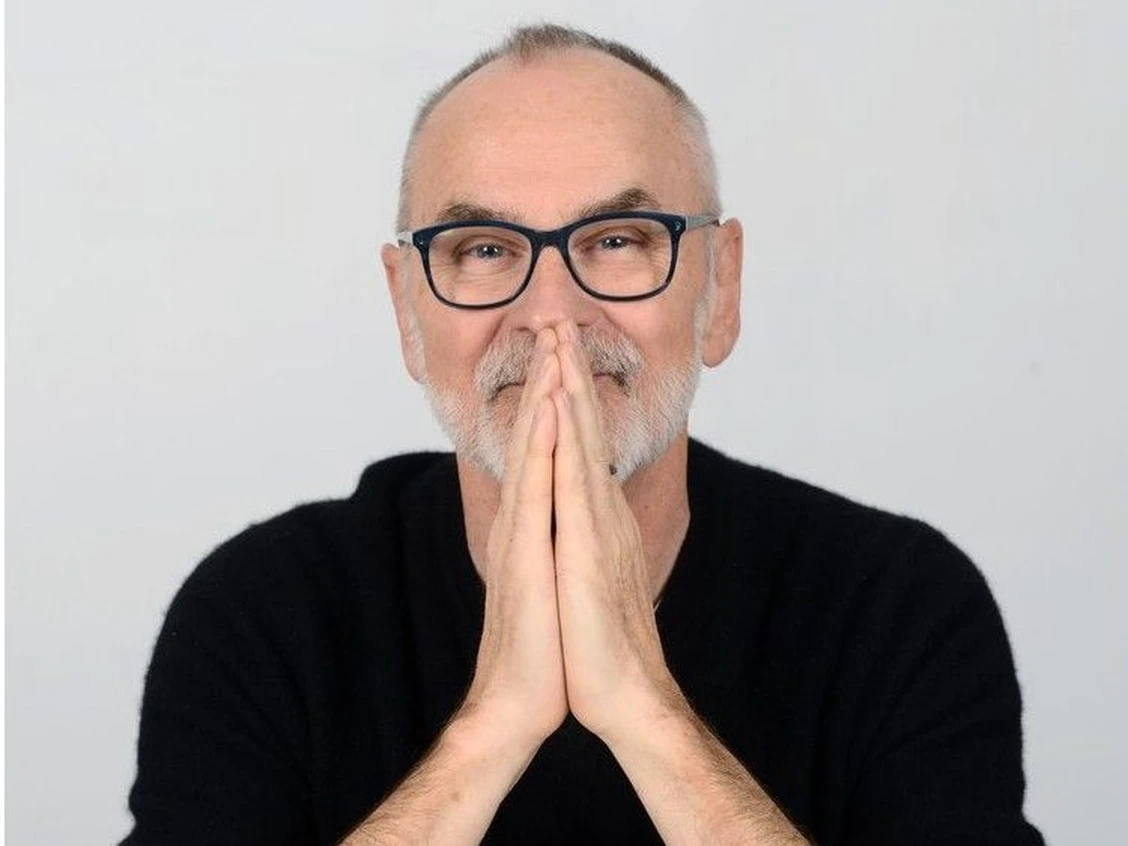
Daniel MacIvor
When my mother died three years ago I went to live with one of my aunts for the first two months of my grief. While everything that happened during that time was meant with the best of intentions it was extremely isolating for me to feel so suddenly plucked out of my home and the life that was so familiar to me while my relatives and I attempted to make some semblance of sense out of this unexpected catastrophe that had come along at random and shattered our family to smithereens. I have never felt more alone.
At some point during those eight weeks, after my aunt had gone to bed, I stayed awake in the living room and I started to watch Seinfeld from the beginning. I think I was drawn to it because it was something comforting I had watched since childhood, but there were no memories of my mom attached to it. If anything, I don’t think she liked it. I also was fairly confident that Morty and Helen Seinfeld and Frank and Estelle Costanza were not portraits of parents that were going to make me break down into puddles of tears. By the time I finally went back to my own house and some semblance of my own life I had rewatched the entire series.
The story that Daniel MacIvor tells in Your Show Here, his own mediation on grief after the loss of his best friend and frequent collaborator Daniel Brooks, which plays at the Bus Stop Theatre in Halifax until May 8th, could be an episode of Seinfeld. It is about one little irritant in a rather mundane series of events, namely, getting off an airplane after your flight and maneuvering your way out of the airport’s parking lot. A dramatic situation arises that showcases how fallible we humans are when faced with an inconvenience that requires patience and grace. On Seinfeld George Costanza would behave badly in this scenario because he is prone to behaving badly, and in pushing his bad behaviour to the extreme we, the audience, laugh at the absurdity of living in a society where people can’t just wait their turn and everyone is rushing everywhere all of the time. If you watch Seinfeld now you also laugh at how absurd it seems for the characters to complain about anything in 1995.
Unlike in Seinfeld, in Your Show Here we are privy to the complex emotional state of the man in the Subaru, and so that everyday moment that is so relatable, trying to leave the parking lot of the airport after a long day of travelling, isn’t about a universal experience of inconvenience, it is about how when you are already heavy in grief one seemingly small inconvenience can be all that is necessary to push you from rational and functioning to completely unreasonable, maybe even momentarily unhinged. For me, my George Costanza moment came when I wasn’t able to just switch our home insurance policy over to my name, I had to do all the paperwork on the home I’d lived in since 1986 from scratch as though I had just moved in, and the insurance company who had insured the home for decades pretended they’d never seen the house before. In Your Show Here our protagonist has survived big events: the death of his best friend, the death of his mother, navigating through his friend’s “dance” (Brooks’ words) with cancer, but it is an otherwise inconsequential confrontation within a minor nuisance that cannot be carried because the body is already overflowing from managing the impossible.
The story could be an episode of Seinfeld, but “the thing” (#8 on the list that our narrator in the show gives for ‘how to make a show’) is what makes it a MacIvor, and that is the depth of the theme, and the creative way it is woven into all the parts of the play that aren’t overtly the story. Daniel MacIvor and Daniel Brooks created seven plays together before Brooks died on May 22, 2023, ten days after my mom, and here MacIvor deconstructs the play, in a way, as we are watching it, shining a light on the process that he and Brooks used to create their work together. The process, we come to understand, the time together talking in the room, much more, it’s seems, than the finished work, is where their friendship truly came alive. The collaboration, that shared magical experience of creation, was woven into their personal experiences together, and that process provides not just the foundation, but an entire structure and framework to house the characters, the story, and the thing in Your Show Here. The play is directed by Brooks (“in absentia”), and I take this to mean that of course Brooks has built this structure because he is inherent in the process of creating the work.
From the man who gave us a theatre piece called This is a Play back in 1992 Your Show Here lets audiences back in behind the fourth wall, but instead of centring the art form itself, the centre of this piece is the human connection required to make the magic work. MacIvor, as the narrator, continually alludes to the ways in which he is creatively fluent, where Brooks would bring in some rigidity to shape the always churning open door of ideas, and we get the sense of both MacIvor’s deference to Brooks’ talent, but also a bit of mischievous glee in now being able to choose the thing he knows Brooks would balk at were he here in person. This dichotomy really beautifully captures the way that our brains can cope with a loss of this magnitude through humour, irony, and, in my experience, exerting newfound power to make a frightening new reality feel more like our own.
Onstage there is just a man in ordinary clothes with a water bottle, a few chairs, and a music stand with some posters to display, and the magic, as always, is in watching Daniel MacIvor, with some clever lighting from Kathryn Smith, oscillate between seemingly being himself, both engrossing and charming, and a number of different characters, all with more pronounced Cape Breton accents that are immediately evocative of a different city, a different airport, and a different context. At one point, as often happens during MacIvor and Brooks shows, I marvelled over how his face seemed to actually change as he played the beleaguered concierge character, and suddenly he didn’t look like Daniel MacIvor at all. It’s not like he dramatically changes his facial expressions, like Robin Williams doing an impression, but more like my eyes, in on the magic, start to play tricks on me.
During the talk back after the show 2b Artistic Director Christian Barry said of the list MacIvor gives the audience for how to create a show that he learned that same process, largely through osmosis, from studying MacIvor and Brooks. He mentioned how foundational their work has been for generations of theatre artists in every province of this country who have come up since 1991. This made me think that this process is very much specifically how to create a Canadian play. In the published version of this play, at the end, is the foreword to Cul-de-Sac (MacIvor/Brooks #4, 2002), which was written by Daniel Brooks. He tells the truly harrowing story of how that play came to be. I don’t think it’s possible to read that story and not believe that these two artistic geniuses don’t also have access to a little bit of magic. What is clear from the story too is that Cul-de-Sac required both MacIvor and Brooks to be salvaged in such a dramatic and triumphant fashion. What happens now that MacIvor has seemingly been left on his own? Your Show Here is one answer to that question.
I think I first gravitated toward Seinfeld in my grief because its shallow cynicism and absolute remoteness from my own life experience allowed me a safe distance to allow my brain that had been in overdrive a chance to zone out and rest. The characters in Seinfeld run from the truth, and what’s so interesting about Your Show Here is that that impulse is there too- to hide behind the story and not have Brooks be so overtly in “the thing.”
So many of Daniel MacIvor and Daniel Brooks’ plays have been, at least in part, about how they were written, and many explore the question of what’s next. If this is indeed their last collaboration, it is a beautiful bookend that honours all that has come before in a way that admits the truth of what grief really looks and feels like. It is a way for MacIvor to process the profound loss of his best friend, for his dramturge and goddaughter, Kate Brooks, to process the profound loss of her dad, but it is also a way to keep Brooks here in a very almost nearly tangible way. There is a lot of talk of the magical quality that is intrinsic to the theatre in this show, but we get a very real sense that instead of haunting all the theatres in Toronto in a traditional sense, Daniel Brooks lives on in that magic the audience sees onstage, and in the magic nurtured in the room where the talking eventually becomes the show.
reWork Productions and 2b Theatre’s production of Daniel MacIvor’s Your Show Here, directed by Daniel Brooks (in absentia), plays at the Bus Stop Theatre (2203 Gottingen Street, Halifax) May 7th and 8th at 7:30pm, and both these shows have sold out. You can join the Wait List here.
The Bus Stop Theatre is one of the most fully accessible theatres in Nova Scotia. For more detailed information please visit this website.
Canadian Theatre Criticism is an essential part of a healthy and thriving theatre community. It helps theatre companies find new audiences for their shows, deepens audiences’ engagement with local artists and the work being created in their communities, and it is one of the best ways to preserve a snapshot of an ephemeral art form for future generations of theatre lovers. TWISI relies on support from its Subscribers, folks like you who care about the survival of local and independent arts coverage. Please consider becoming a Subscriber today, or click here for more information. Thank you so much for supporting TWISI.




1 thought on “MacIvor & Brooks’ Your Show Here is Spellbinding & Poignant”
Comments are closed.