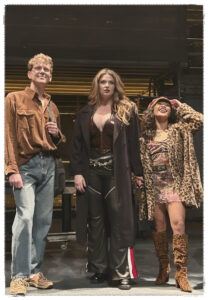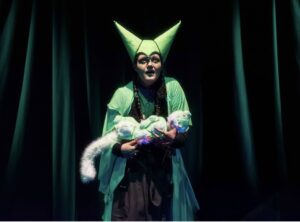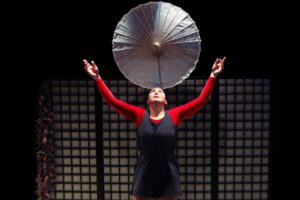

Sandrella Mohanna as Jinan and Ellis Pickersgill as Alia in Emil Sher’s The Book of Ashes. Photo by John Davie
Halifax Theatre for Young People opened their production of Emil Sher’s The Book of Ashes directed by Annie Valentina on April 16th at Alderney Landing Theatre in Dartmouth/Punamu’kwati’jk.
I had the opportunity to sit down with two of the actors at the theatre; Ellis Pickersgill plays Alia and Claude Daniel plays Abu, and both are making their professional theatre debuts in this production.
Ellis Pickersgill has a lot of community theatre experience, and also works as an educator and youth worker saying that, “it’s very exciting to be doing a show that’s friendly for youth and about youth,” while this will be Claude Daniel’s first time on stage. He notes it is his first time reading lines and memorizing lines, and that he is “learning all kinds of new terms and asking a lot of questions,” but he also says that he’s “surrounded by lovely people that are so patient and helpful throughout the whole process.”
When his friend suggested that he go out for a role in this show he initially thought it was a joke and laughed. But his friend was serious, and encouraged him to give it a try. He works in property development, conversions and construction, but also has experience in front of crowds as a Volleyball Canada National Referee. “A little different,” he says, “One you expect to be yelled at and hear mumblings under people’s breath… this will be, hopefully, smiles and applause,” he laughs.
The play takes place in Basra, the second largest city in Iraq, in 2003, during the invasion of that country led by the United States. It is based on a true story and centres on a young boy, Amir, and a librarian, Alia, who are trying to protect tens of thousands of priceless books, some of which are centuries old and handwritten, and other artifacts in the library from being destroyed. “[Amir] has all these adults in his life who are worried about the impending violence as things continue to kind of ramp up in intensity,” says Pickersgill. “We are drawn into his world of wonder and imagination and innocence. The story is kind of told from his perspective. The arc centres around the librarian who is trying to protect the precious books and artifacts in the library that she manages because of the kind of history of destruction that she is aware of… that all the older characters are aware of, because it’s not the first war in their lifetimes. There’s a lot of themes of community, and grief, and fear, and war, but also hope and innocence and resilience, and there’s some metaphors around stories, and how people’s lives are impacted very individually when there’s these large-scale traumatic events.”
Daniel plays Abu, Amir’s mentor, who is a roller pigeon restaurant owner and friend, as well as Gabir, Alia’s husband, who Daniel characterizes as showing “some resistance at first” to her desire to save these books, and then some “understanding and compassion. That’s a beautiful relationship that they have,” he says. He also plays the General who he says is focused just on one “agenda, one mission, one single focus, and that’s just the war and strategy.”
He continues, “I think one of the beautiful parts of the story for me is when we’re trying to save all the books, and some of the books we feel might not be of value. And the librarian, Alia, stops us and says, ‘you know every book is important, [and] needs to be saved. Sweeping certain parts of history under the rug is not what we need to be doing. We need to be sharing all the stories.’”

Obviously the themes about the destruction of culture, of property, of land, of books, and history, along with lives, are unfortunately very relevant in the current political landscape. Pickersgill notes, “I think what is really powerful about the story is that it’s really easy to think of everybody involved [in wars] as kind of just masses of people; this story really humanizes everybody. It really shows that these are real people, individuals, who are distinctly different from each other, who are impacted in every part of their life, even just by the threat of war, let alone the actual violence of it. That message, I think, is really important right now when we are kind of inundated with these big, sensational stories of violence happening. It’s really easy to forget that these are people, the same as you and me and your neighbour and your friend and your family. To me that’s the biggest takeaway.”
“Personally, libraries are one of the first places I love to go and check out,” says Daniel, “it’s an open door for everybody to come in and just enjoy.” He went for a tour of Halifax’s Central Library when it opened and notes that the staff members told him that “you can eat wherever you want, you sit at any table that you want, this is your home away from home, enjoy every floor, enjoy every book, there’s no restrictions. That’s where you want community to meet.” Pickersgill agrees, pointing out that libraries are such a central community location for folks for all sorts of reasons, even beyond the knowledge that is available to them there in the books. They also connect the loss of physical books to the loss of any information database saying, “that’s what’s so interesting about the show, there’s so many layers: it’s about knowledge, and it’s about shared stories, and it’s about history, and it’s about people, and it’s about humanity, and it’s about community, and it’s about the connecting of all of those things, and how you can’t erase the bad parts of history, and you can’t erase the people involved either, even when we have so much trauma that happens.”
Daniel points out that in this library in Iraq the books were not digitized, “[When] they’re gone, they’re gone, and saving them, the importance of keeping those stories going, [Alia’s] the only one who can [save them].” Pickersgill adds that Alia doesn’t do it alone, saying, “there’s a group of people who decide that this is worth it. It’s worth the risk to save this shared cultural history, and to me, that’s a really beautiful message. Both literally and metaphorically this community comes together to save each other, and save their past, and their history… Talking about relevance in the world, that’s the lesson, right? There’s so much happening in so many different ways… The way forward has to be through working together. There’s no other option.”
Halifax Theatre for Young People’s The Book of Ashes has two more public performances, on on Tuesday April 22nd at 12:30pm, which is *Cash only, Pay-What-You-Can at the door* and one on Wednesday April 23rd at 7:00pm at Alderney Landing Theatre (2 Ochterloney Street, Dartmouth). Tickets are available here on a sliding PWYC scale from $10.00 plus fees to $30.00 plus fees. It is recommended for children between Grade 3 and Grade 8 especially.
Alderney Landing is accessible for wheelchair users; the theatre is on the second level, and there is an elevator. For more Accessibility questions please email HTYP at info@halifaxtheatreforyoungpeople.com.