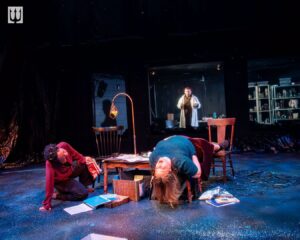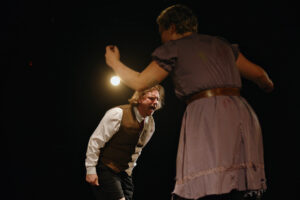

Garry Williams as Thomas and Stephanie MacDonald as Pauline
Casey & Diana opens on Friday April 25th, 2025 at Neptune Theatre’s Scotiabank Studio Theatre. The play, written by Canadian playwright Nick Green, was originally commissioned by the Stratford Festival of Canada in 2017. It opened there on May 23, 2023, directed by Andrew Kushnir, and went on to win the Toronto Theatre Critics Choice Award for Best New Canadian Play.
I chatted with Richie Wilcox, who directs the production here in Halifax, and local actors Garry Williams, who plays Thomas, and Stephanie MacDonald, who plays Pauline, about bringing this story to life here in Halifax.
The play is set in 1991 at the Toronto AIDS hospice Casey House, and it centres around the real-life visit of Diana, Princess of Wales to this hospice where she met with patients dying of AIDS.
“Nick Green did a ton of research for this show,” says Wilcox, “[he] read a great book called Sanctuary [by Patrick Conlon] that gave first-person accounts from multiple perspectives of the early days in the Casey House, [and he] interviewed a lot of people that worked [there] or had family members in the Casey House, so while [the play] is fictional, there’s a lot of reality in it. I think that Nick has been able to capture a number of perspectives from that time so people can come here and see a character and find their connection, and find their way in, because whether it be a gay man of the 1990s, or their sibling, or a nurse… there’s multiple people in here that I feel like give different faces to the ’90s and the AIDS crisis.”
Of his character, Thomas, Garry Williams says, “Thomas is living with AIDS and there is no cure in sight. There’s no hope, initially, for Thomas, and he felt abandoned, certainly by his parents, in a life perspective, and then in the shorter term by his sister Pauline, and he ends up needing to go to this hospice, the Casey House, and finds a sense of queer family [and] community, there.”
Stephanie MacDonald says that her character, Pauline, originally “tried to rally with all the friends around them that were getting diagnosed and dying, but when her brother got [diagnosed] it was just a bridge too far for her, and she really didn’t know how to metabolize that.”
“[Thomas] begins the play waiting to die,” says Williams, “and in this one week, he initially wants to meet Princess Diana, because he’s so starstruck. It’s sort of like the drag fantasy, the sister-mother… that he wants there. And then his sister, Pauline, reaches back out to him, and that opens up this floodgate of feelings of the time before, the life when he didn’t have this diagnosis and didn’t know he was going to die. All of the people he watched living with illness and dying, and then the very personal pain of losing, really his bestie… Thomas says about Pauline [that] she was ‘my everything.’ And so then he’s on this incredible rollercoaster, dealing with deep bone pain, and kind of phases of dementia, and then personal waves of anger and resentment, and grief, and love, and loss, and is sort of battling that- so that it doesn’t weigh him down, but in fact, allows him enough levity to make it through, to meet this iconic idol.”
“This relationship between Pauline and Thomas in the show, I think, it’s pretty common for the time,” says Wilcox, “that family members were having strife because of the situation, and that people were challenged- the relationships were challenged- because of homophobia.”
MacDonald says that in talking with people in the theatre industry who lived through the 1980s and early 1990s as adults she heard about how scary and also confusing it was, even a decade or more into this crisis, to feel that there was no funding, no one was trying to figure out how to cure or treat this epidemic, and that it was dismissed in homophobic terms as “the gay cancer,” and people were left to fend for themselves. “The anger that [Pauline] has when she finds out that [her brother] has AIDS is the tip of the emotional iceberg,” says MacDonald, “there’s deep sadness and a bunch of stuff happening and [it’s] very confusing.”
Wilcox notes that like in the United States at the same time it took a long time and mounting pressure from activist groups for Prime Minister Brian Mulroney to finally take some or any action on the growing AIDS Crisis. Indeed, it wasn’t until 1990, just a year before this play is set, that Mulroney created Canada’s first HIV/AIDS strategy, which carved out a role for the federal government to play to halt the spread, and care for, treat, and support those who had already been diagnosed with the disease, among other initiatives that were backed by epidemiological data and research. Mulroney had been Prime Minister since September of 1984.
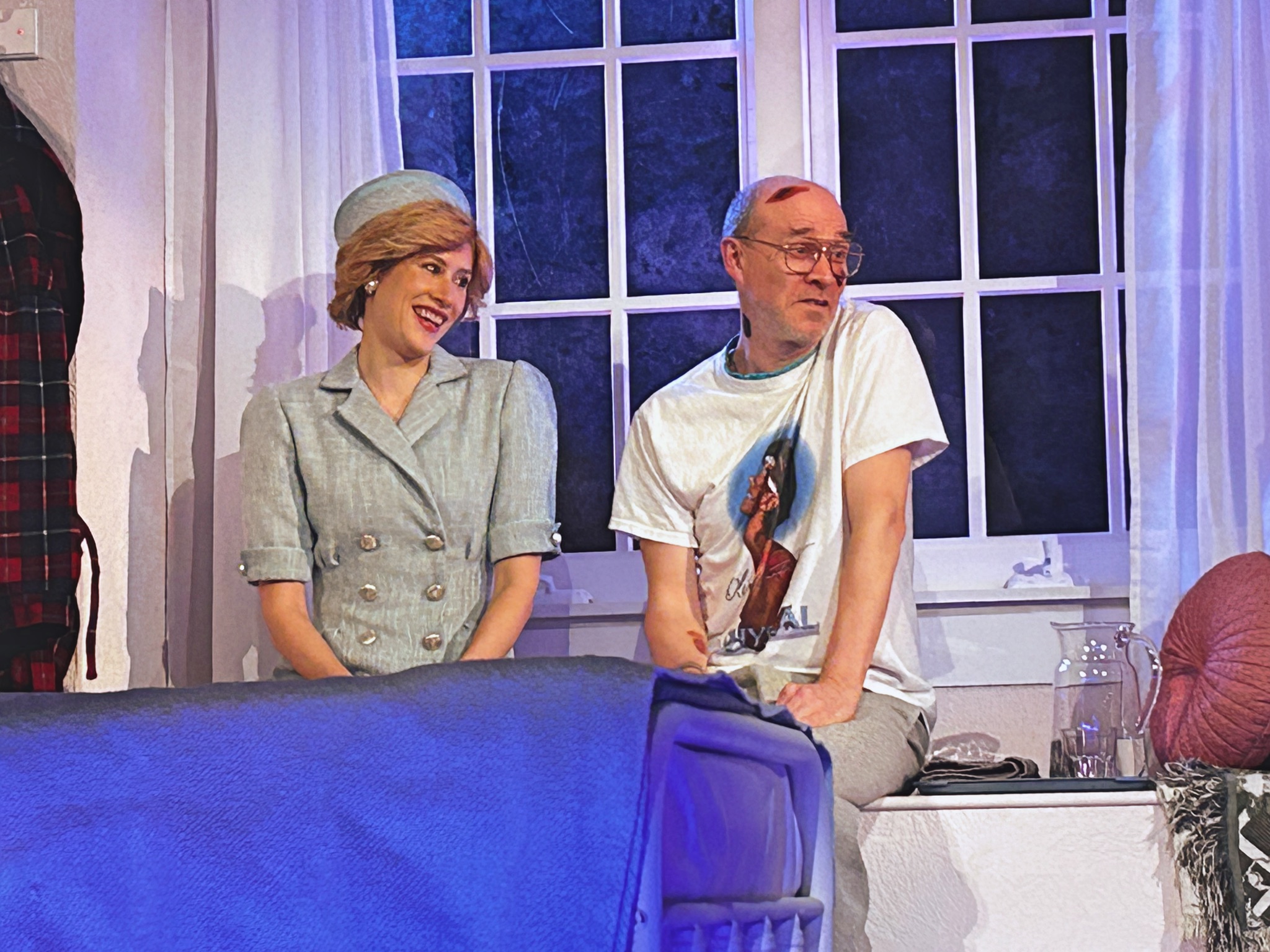
Wilcox says that Princess Diana coming to Casey House and spending time holding the hands of those dying from AIDS was a turning point for the Canadian public, and indeed the world. “People were still very scared, even after almost a decade of people living with AIDS, people were misinformed and scared, and there was lots of prejudice and homophobia, and so Princess Diana was taking a huge stance.”
“That hand holding is exactly what the state wasn’t doing for people living with AIDS. Nobody was standing by them, giving them access to medication, access to counselling, and so a lot of people felt entirely abandoned. So this hand holding, yes it’s personal, there’s stigma, there’s fear, and there’s this much bigger sense of isolation and aloneness,” says Williams.
“Casey House was founded upon the principles of dying with compassion and dignity. And so, while it’s also Princess Diana, it is what the Casey House was known for and doing already,” adds Wilcox. “I know something that really struck me last summer… I was talking with a woman who had been a volunteer at the time of Casey House in ’91, not at the Casey House itself, but in the city and helping organize drag shows, and she observed that the people who ended up in the Casey House were the people who had nowhere else to go. There were some people living with AIDS who had families, who had means, but there were other people who couldn’t hold a job, couldn’t take care of themselves, had no one,” adds Williams, “That also speaks to this question of what systems were in place. Whatever systems were in place failed certain individuals.”
“I think what Nick Green seeds in this play so well is the anger, the rage, yes it’s grief- you’re losing people, and you’re watching the church, you’re watching the state, you’re watching strangers judging you, blaming you, after a community won freedoms in the late 1960s or the ’70s, and were finally feeling that they could be out and open, and weren’t criminalized, then people start getting sick, and that’s put on their doorstep, as if they had brought about a virus. And that fury is also there with that deep, deep grief, and a kind of premature need to face your own mortality. It’s a bit of a horrendous cocktail of emotions,” says Williams.
“I will say, to balance that out, though, that Thomas has a campy, dark sense of humour that is necessary because when you’re faced with all of what Garry just talked about, you do need to laugh. You do need to figure out how to survive, and how to survive, Thomas even says, is to laugh,” says Wilcox.
Casey & Diana plays at Neptune Theatre’s Scotiabank Studio Theatre (1589 Argyle Street, Halifax) until May 18th, 2025. Performances run at 7:30pm Tuesday to Saturday, with 2:00pm matinee shows on Saturdays and Sundays. Tickets range in price from $33.00-70.00 based on seating. Tickets can be purchased online here, by calling 902.429.7070 or in person at Neptune Theatre, either at 1589 or 1593 Argyle.
Run time is approximately 2.5 hours, including a 15 minute intermission.
Please note, this show contains: Strong language, realistic depiction of epileptic attack, medical needle use, brief depiction of blood, & discussions around death and dying.
This show is recommended for ages 12+
Key Performances:
Industry Night
Tuesday, April 29 – 7:30 PM
Talkback
Thursday, May 1 – 7:30 PM
Masked Performance
Sunday, May 4 – 2:00 PM
Neptune Theatre is fully accessible for wheelchair users. Neptune offers hearing-assistance devices, along with their masked performance and audio described performance. For more Accessibility Information Click Here.
Incoming search terms:
- https://www twisitheatreblog com/?p=5529