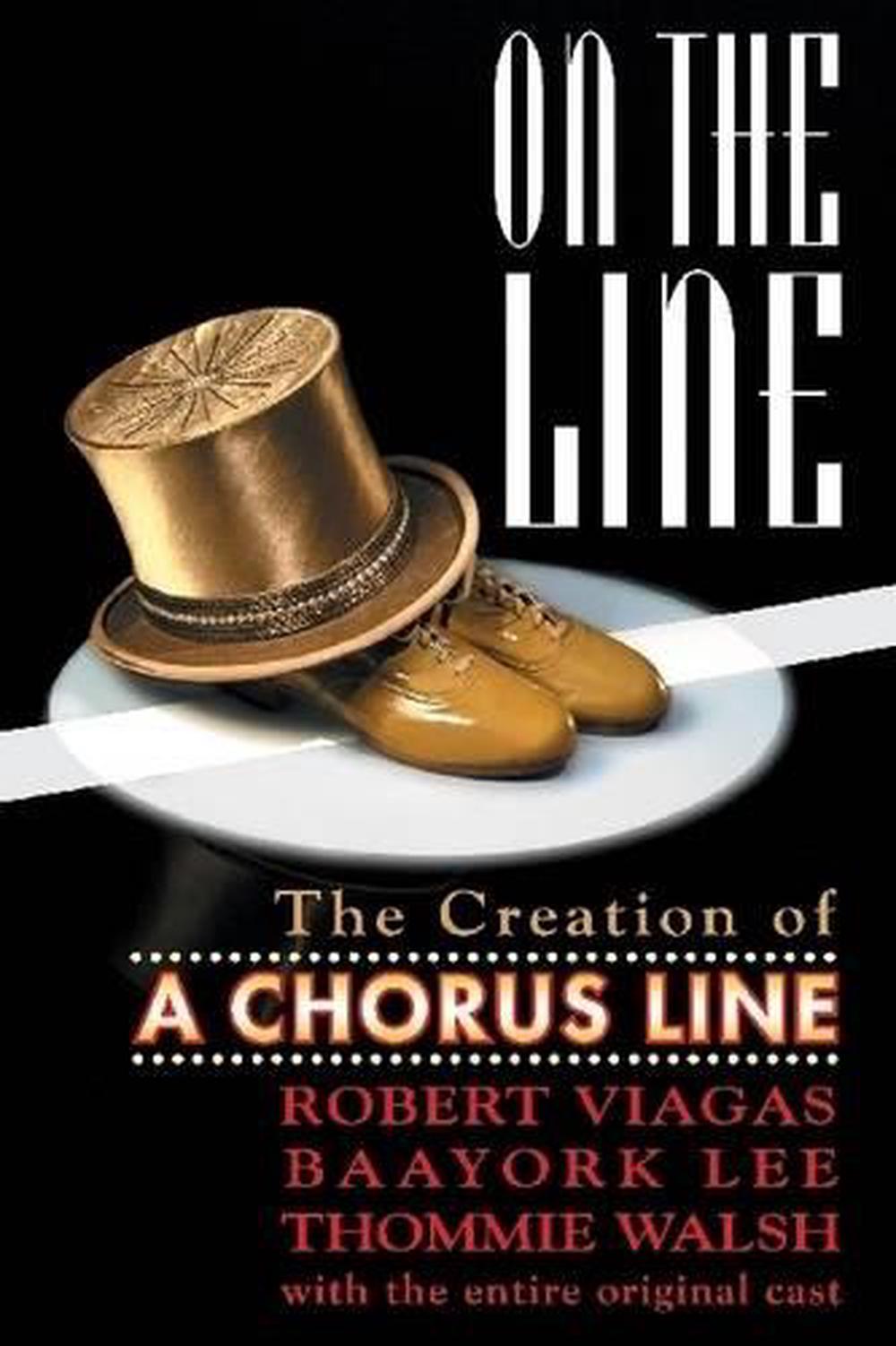
I just finished reading On the Line: The Creation of A Chorus Line, which was written by two Original Cast members Baayork Lee and Thommie Walsh with author and Playbill editor Robert Viagas taken from extended interviews with all nineteen of the Original Cast, as well as others who took part in the initial workshops and early development of the show. The result is a very comprehensive history of this 1976 Tony and Pulitzer Prize winning musical, which was the longest running production in Broadway history between September 29th, 1983 and June 19th, 1997, and it provides a panoramic view of equally weighted perspectives on how A Chorus Line came to be.
I first encountered A Chorus Line in 2001 when I was in the Neptune Theatre Youth Performance Company (YPCo) where I remember my cast mates bursting out with Val (Pam Blair)’s cheeky (literally) ode to plastic surgery “Dance Ten, Looks Three” and “Nothing:” Diana (Priscilla Lopez)’s experience with an abusive ‘Method Acting’ teacher doing improv at the High School of Performing Arts, which resonated with us as theatre kids who could imagine her scenario perfectly, and may have even experienced moments that were similar in our own lives. This led me to the film version of the musical, which is quite different from the stage version, directed by Sir Richard Attenborough and released at the end of 1985. In the book the Original Cast members note that the filmed version really missed the point of the original production, which was always about working dancers auditioning for their next gig, not, as Attenborough apparently said in an interview when asked why he didn’t use any of the original dancers in the film, about young people breaking into the industry for the very first time (329). I have only seen the stage production of A Chorus Line once, an American Touring production in Toronto back in 2008, which I don’t think gave me an accurate portrait of how powerful this story can be. Nevertheless, when I saw this book for sale at TheatreBooks (RIP) around the same time, I bought it. For whatever reason it had sat on my shelf since then, but I was suddenly moved recently to pick it up and read it.
I was surprised to learn from the very beginning of the book that A Chorus Line had been a collective creation- a fact I cited in my review back in 2008, but I don’t think back then I connected that with the early work of Paul Thompson at Theatre Passe Muraille where he and the ensemble there created iconic works like The Farm Show (1972), 1837: The Farmers Revolt (1973), and I Love You Baby Blue (1975). I don’t think I fully appreciated how groundbreaking and novel it was for A Chorus Line, an American Broadway musical, to have been created this way too.
A Chorus Line is often thought of as synonymous with its director-choreographer Michael Bennett, but in fact the original idea to take the dancers out of the chorus and put the spotlight on them as individual performers instead of a uniform line of kicking legs, and showcasing how versatile their talents actually were came from two Broadway dancers Michon Peacock and Tony Stevens. Peacock had been in Georgy (1970), Beggar on Horseback (1970), That’s Entertainment (1972), and Seesaw (1973), while Stevens had been in The Fig Leaves Are Falling (1969), Billy (1969), Jimmy (1969), Georgy (1970), The Boy Friend (1970), On the Town (1971), Irene (1973) and Seesaw (1973). Together Peacock and Stevens thought maybe they could create a resident company of dancers who could also act, and that they could find a way together to create some more job security for themselves and their friends. They ended up scheduling a ‘marathon’ all night tape session for dancers they knew, many of whom were in Seesaw, to come and dance together, but also to talk, sleepover style, about what it meant for each of them to be dancers, and the experiences that had led them into the industry and within the industry thus far in their careers. They decided to invite Michael Bennett, who had directed them in Seesaw, to attend, as more of an observer. Bennett, famously, would eventually take over the entire concept and reimagine it in his own vision, which, over the next two years, eventually became A Chorus Line. By most accounts, at least initially, the dancers who participated in the first tape session idolized Bennett and were excited at the prospect of working on a project with him at the helm. This led to everyone, even from the very beginning, making concessions to him that eventually led to him having a kind of absolute power over the project that eventually allowed him to cast Tony Stevens as Larry for the first workshop, but not cast Michon Peacock at all. Both Stevens and Peacock ended up working in the Original Broadway Cast of Chicago (also 1975), so I think it’s arguable that they may have gotten the last laugh.
The first thing that interested me so much in this book was hearing about how A Chorus Line was developed largely from these different series of tape sessions, and how each new dancer who was brought aboard was also interviewed about their life in dance. Essentially, everyone involved in the development of the musical had their lives mined for material by Bennett, and eventual book writers Nicholas Dante and James Kirkwood Jr. (who came in much later in the process), and lyricist Edward Kleban (who wrote the songs with composer Marvin Hamlisch). What is so wild to me is that the real life stories that were shared in these tape sessions showed up verbatim as monologues and lyrics in the show, but there was absolutely no attempt made to cement the dancer to the character portraying their own personal story. In fact, Bennett seemed to sadistically enjoy doing the complete opposite- giving the dancers each others’ lives to play, and keeping large sections of the stories shared by performers eventually cut or replaced in the show. The book also goes into detail about how some of the dancers were not compensated at all, while most were compensated very little for their contributions as storytellers in the development of the musical. In fact, the dancers were continually signing contracts every step of the way that ended up disenfranchising them from the show’s eventual economic success- even signing away their rights to their own images in the shows’ logo- which was later used for various merchandise for which they never received any compensation.
It is darkly ironic how a show whose genesis was centred on empowering Broadway dancers and seeing them as capable of playing individualized roles, principal and supporting parts with their own through-line narratives, still ended up with the people in charge trying their damnednest to reduce them all, financially especially, back to being replaceable bodies desperate to hold onto this precarious job at any cost and seeing each other all as competition. The book does a beautiful job of layering the experience and the perspectives of the performers so that we see their initial excitement, their idealism, how much they loved creating the show from scratch, how proud they were to be developing these characters who were so personal to them, and how much they loved and idolized Bennett, while also showing us how deeply folks were hurt, screwed over, manipulated, betrayed, pitted against one another, and had promises broken time and time again in order to get this show on its feet. Since the interviews take place in 1990 the performers also have the benefit of hindsight, and also distance to attempt to be more objective, more diplomatic, but also sometimes bitingly honest about how they felt every step of the way over these formative years in their careers.
It is also ironic to hear that in a show with a song like “Nothing” Michael Bennett was making Diana’s toxic acting teacher Mr. Karp look like a pussycat. You hear a bit of the misogynistic tropes about the Broadway divas who can’t get along with one another, especially surrounding Kelly Bishop and Priscilla Lopez, who sounded like they had a completely healthy close friendship with one another, but folks were expecting them to literally catfight and for the friendship to dissolve once they were both up for the same Tony Award. Unsurprisingly, their friendship survived. Yet, the biggest drama queen by far in A Chorus Line was, also unsurprisingly, Michael Bennett, who seems to have been trying to hide his own queerness by overtly elevating Donna McKechnie, who played Cassie, over the rest of the company, either because he genuinely had a crush on her (they were briefly married after the show opened), or in an attempt to create the allusion or fantasy of a real-life Zach/Cassie relationship to obscure his attraction to men. He did this to the determinant of everyone else in the cast, McKechnie’s relationships with her cast mates, and the original spirit of ensemble inherent in the initial concept. MacKechnie even ended up earning significantly more money than the rest of the cast, both when the show premiered off-Broadway, and after it transferred uptown. You can still hear the defensiveness in her voice about this from her interviews in 1990. Yet, she also continually brings up the valid point that she was working overtime in the emotional labour department that was required to manage Bennett’s volatile emotions. She was not alone in this task, however, it also took Baayork Lee and co-choreographer Bob Avian to create even a quasi-tolerable ambiance in rehearsals.
It sounds like Bennet also masked his queerness by leaning into being a controlling bully, especially to the openly queer performers in the show. He also turned on Robert LuPone (older brother of Patti LuPone), who was playing Zach, the director, essentially what Bennett wanted to be an idealized version of himself, either because seeing Zach played by someone who was actually straight made him crazy with jealously, because LuPone was subconsciously bringing in Bennett’s own effeminate qualities, and seeing them reflected back at him filled him with rage, or just because he wished he was playing the role and hated that LuPone wouldn’t do it exactly the way he was line reading. Either way, Bennett couldn’t handle LuPone creating this character and it brought out the absolute worst in him. LuPone ended up being Nominated for a Tony Award for Best Featured Actor in a Musical. Hilariously, even though he tried to quit several times, LuPone is one of the performers who stayed with the show the longest.
Ron Dennis, who played Richie, speaks a bit about being the only Black character in A Chorus Line, saying on the one hand that, “I thought it was important that I be in a show: a new face, a small face, a [B]lack and a male in a show that’s basically about white… dancers” (157). He also suggests, though, that it’s telling that Richie is the only Black character, and that he and Baayork Lee, who is Asian and played Connie, saw their parts get drastically cut through the process, while the ‘Big Six,’ who ended up with the leading roles were all white.
There are aspects of the book, even in the 2006 edition, that are dated when it comes to the language that people are using, the ways that they skirt around what was then considered Bennett’s hidden bisexuality, although it’s impossible to know how he would identify today, and his addictions, but the theme that remains so overwhelmingly relevant is this exploration of directors in the theatre who are considered geniuses, those who have created what we consider masterpieces, and reckoning with their absolutely deplorable and harmful behaviour through the process. Sammy Williams, who won a Tony Award for playing Paul, had his entire career, and furthermore his entire life, derailed by his experience in A Chorus Line, and he left the industry for ten years shortly afterwards. Part of this had to do with the way he had been treated by Bennett, and also the lack of support that he had after his Tony win to have the confidence to transition into another role after Paul. The gay performers who play gay characters often mention that aspects of what their characters were saying and doing onstage at that time in their lives, in 1976, was embarrassing. Some weren’t even out to their parents yet. Being further berated and humiliated by Bennett in rehearsal was absolutely immoral.
I don’t want it to sound like after Bennett’s tragic and untimely death from AIDS the cast completely turned on him when creating this book; there is a lot of nuance presented from every single cast member as they detail their very individual experiences and feelings toward him as a director, a friend, a mentor, and an artist. There is a lot of love and compassion for him in the book as well, which sounds like it was warranted; it is sad that he felt that he couldn’t live openly and happily as himself. McKechnie and Lee defend him loyally and passionately at nearly every turn. But, Bennett’s legacy, I think, remains in the Broadway world as being this genius visionary and renowned creative force, but I don’t think we are able to divorce these truths anymore from the question: at what cost? If we continue to give a free pass to directors who work in this way because of their talent we perpetuate the idea that talent and abuse go hand in hand, and that if we create a rehearsal hall that is healthy and respectful the quality of the work will somehow suffer. This is absurd, but this idea still prevails to this day.
I loved the way that Viagas, Lee, and Walsh created this book- how they really took the time and the effort to allow everyone involved with this creation process (ironically except Bennett who had already passed away in 1987) to speak about it in extensive detail, and then they wove each of the stories together in a really vivid tapestry of experiences. It would have been interesting to hear from Bennett, of course, but it seems also like poetic justice as well, in a way, for everyone else to finally fully be able to step out from beneath his shadow and to take a piece of the credit for this iconic musical for themselves. Lee and Walsh also speak about how they were very careful to ensure that everyone was fairly compensated for their collective work on the book, which I think speaks volumes for the respect and care that these nineteen dancers have had for each other for their entire lives.
I find this way of writing contemporary theatre history, centring the creators, instead of just academics writing essays, so much more insightful, readable, and connected to the work itself. I would love to read a book like this about the creation of The Farm Show, for example.
Maybe I should email Paul Thompson.
If you are in Halifax you can order On The Line: The Creation of A Chorus Line by Robert Viagas, Baayork Lee, and Thommie Walsh into the store from either Bookmark or King’s Co-Op Bookstore, if you are elsewhere please consider ordering it from your own local bookstore, or from Chapters/Indigo in Canada.
Incoming search terms:
- https://www twisitheatreblog com/?p=5583
- Best broadway musicals