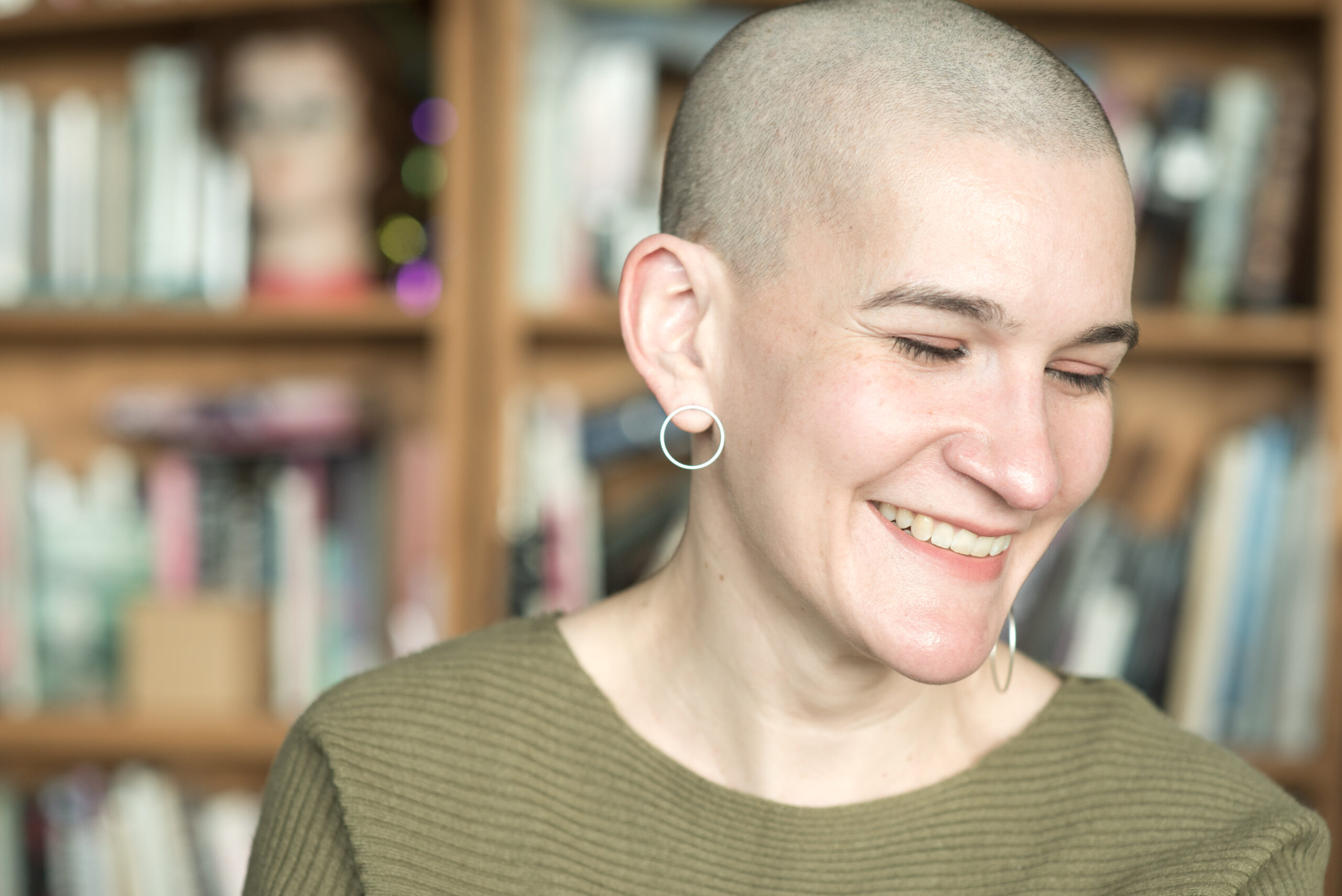
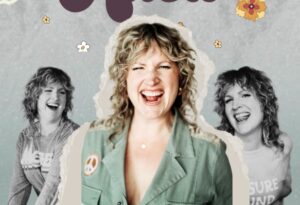
Her friend Paul Vienneau took this candid headshot of April last fall. She sits in front of a bookcase in a warmly lit room, wearing a ribbed, khaki green sweater. One silver hoop earring hugs her ear, the other dangles from a chain at her collarbone, mirroring her asymmetrical pose and spirited personality. Her shaved head is striking, her chin tilted away from the camera to accentuate her sharp, angular features. Caught mid-laugh, her eyes are closed in a gentle, joyful expression. The photo beautifully captures the connection and trust between April and her photographer. (Portrait by Paul Vienneau www.paulvienneau.com)
April Hubbard was recently in Ottawa accepting the Ramon John Hnatyshyn Award for Voluntarism in the Performing Arts at the Governor General’s Performing Arts Awards for her over two decades long dedication to the Halifax Fringe and her dynamic work as a pioneering Mad Disability advocate in our theatre community. She received a beautiful commemorative medallion from the Mint in recognition and gratitude for the profound impact she has left on the Canadian Theatre.
She was honoured along with 2025 laureates Bob Ezrin (music and entertainment producer who has worked with artists from Pink Floyd and Kiss to Taylor Swift, Alice Cooper and Lou Reed), Denis Gougeon (a prolific composer), Graham Greene (one of Canada’s most recognizable and prolific actors), Patrick Huard, (another of Canada and Quebec specifically’s most recognizable actors), and Sandra Laronde (a multidisciplinary artist and founding Artistic Director of Red Sky Performance, Canada’s leading contemporary Indigenous performance company). Jeremy Dutcher, Wolastoqiyik composer, performer, language carrier, musicologist and activist from Tobique First Nation in what is colonially known as New Brunswick received The National Arts Centre Award, and Atom Egoyan, one of Canada’s most influential filmmakers is a Mentor in the Awards Mentorship Program for Joshua Odjick, a rising filmmaking star of Algonquin-Anishinabe/Cree heritage from Kitigan Zibi Anishinabeg First Nation. Hubbard mentions to me how surreal it was to have folks like Ezrin, Greene, and Egoyan coming up to her and saying that they respect her work. “How is this possible?” she says.
But, for me, it’s not surprising that Hubbard’s work has had rippling effects beyond our province, and that folks elsewhere in the country (and beyond), even those with such illustrious careers, have taken notice of how dedicated Hubbard has been to not just making the theatres in Halifax more accessible, but changing the ways the people in the community understand accessibility and strive to create spaces that are truly inclusive.
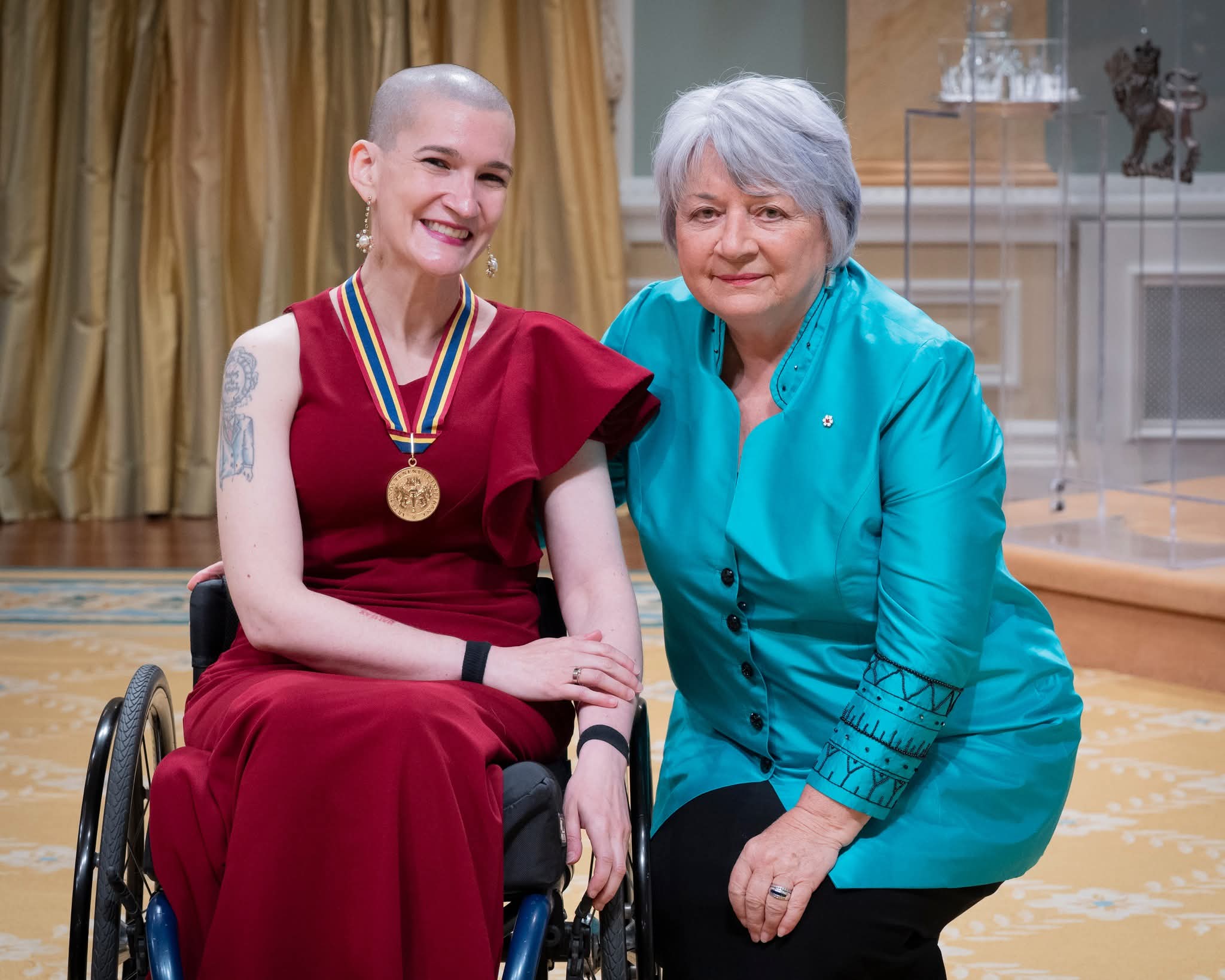
I had the chance to sit down with Hubbard and chat with her about her time in Ottawa and her life in the theatre last week. She told me about two beautifully memorable moments from the Awards ceremony. The first was when she was brought down to the red carpet, she was the first laureate to enter the space, and when the doors opened “it was like the parting of the seas walking down the red carpet and feeling all that love of everybody, really welcoming me and thanking me for my work was really awesome and really surprised me how emotional it actually was.” There was also a tribute part of the gala where a community had come together of disabled artists from across Canada, some that Hubbard had never met before, and they came together and performed a dance piece, and a spoken word piece, to honour her and her work. “To see them all come together and want to do that for me was what it was all about for me. Bringing the outsiders together and bringing community together [has been what my work has been about all along], and just to see how well it was received in the room as well.” She says that seeing the “crip artists” standing on equal footing with those paying tribute to Ezrin’s Pink Floyd album was “really awesome.”
Hubbard fell in love with the theatre when she was fourteen in Yarmouth, Nova Scotia when her mother volunteered her to be a script prompter at the community theatre there. She then began acting and assistant stage managing throughout High School and says, “I just never went back from there once I knew what theatre was, and knew that we could create a whole new reality and come together as a group of strangers and make this thing happen. I was in love from there.”
She came to Halifax in 2003 and started taking theatre classes at Dalhousie University but had to step back in that first year because of her health issues. Hubbard has tethered cord syndrome, a syndrome where the spinal cord is attached to surrounding tissue which prevents it from moving freely in the spinal canal. This causes her severe chronic pain. She is an ambulatory wheelchair user. When she returned to the theatre department at Dalhousie for what she calls her “second first year” she says that at the end of that year the “professors made it very clear that I would be a distraction on stage and that they didn’t really want to support me continuing.”
That stopped her acting career in its tracks.
“I kept getting drawn back in,” she says, “I knew that I still wanted to be involved in some way,” so she needed to find her own way in to the community, and that ended up being what was then known as the Atlantic Fringe Festival. She began volunteering with the Festival, and then in 2011 when the Festival’s Founder and Artistic Director Ken Pinto announced that the Fringe was going on a two year hiatus so he could focus on Titanic 100, the Halifax Theatre Community rallied to reclaim the festival as its own, to reimagine its future, and to put it into the hands of folks for whom it would be their first priority. Hubbard was approached to write a grant to secure funding and save that next Fringe, since she had both the time and grant writing experience. She was then asked to join the new Board of Directors. Once there, due to her unbridled passion for the festival, her joyfully welcoming spirit, and her diligent hardworking commitment to ensuring the festival reached its potential, she “kept getting more and more responsibility” within the organization. She became Halifax Fringe’s first female and first disabled Chair in 2017.
“Fringe is a group that brings outsiders together and that’s what I’m all about, and what I’ve connected with all along. It’s bringing the outsiders and the people who don’t have a space, that aren’t naturally welcomed in, giving them a space, and Fringe does that for eleven days each year. That was kind of my way of saying, ‘okay, you don’t necessarily want me in the mainstream performance arts, but this is my space, I’m going to claim this, and I’m going to bring everybody else together that you don’t want to let in, and we’re going to do our own thing, and you’re going to want to be a part of it.’”
At first Hubbard says that she didn’t think that she would see a seismic shift in the levels of accessibility in the theatre community in her lifetime. “As a disable woman I was used to speaking up for the things I saw that I didn’t like. I was used to being an advocate, at least for others; it’s always more difficult [to speak up] for ourselves. So, when I saw things happening, I’d naturally speak up. Fringe gave me a little platform that at least people will hear my voice and listen to my voice in this setting.” She says the more that her voice was being listened to and respected within the smaller Fringe community, the more folks in the broader community began to pay attention as well. Her perspectives were not always well received, and she says that to this day “a lot of times I think a lot of people see me as just the annoying person that’s always poking about accessibility and [they are like], ‘why won’t you just be quiet and let us do our thing?’ But the people who are willing and ready to listen are listening, and I found over the years I’ve built a community. It’s not just me doing [this advocacy work] anymore. I can point to all these other people who are doing the work alongside me now, and that’s been really exciting to see the community grow over time.”
Hubbard notes that the increased inclusivity she has seen in the theatre community over the last twenty-five years has not just been centred around disabled artists- the more Indigenous, BIPOC, trans and 2SLGBTQ+ artists who are welcomed in, the more diverse the bodies of folks who are cast in shows, it all helps open the doors for disabled artists to be involved as performers and in other creative capacities as well. “I don’t think Nova Scotia is that ready in the theatre world as a whole yet to accept people with disabilities on stage. I still think there’s a lot of resistance to that,” she says. But, she says that once some of the communities who have been historically marginalized are made to feel welcomed in, they help to bring others who have been historically marginalized in with them, and that benefits the disabled community.
While we have made tangible strides toward accessibility here, there is still work to be done. “We’re at the point in the performance arts that we’re willing to listen to the opinions of disabled people and hear them as the one-time experts on a panel, but then [the insinuation is] ‘you go away and you be quiet now…’ that also comes with the micro-aggressions of then being reminded that you still don’t have a space here, and we still don’t want you here. And that takes a toll on all of us advocates that have been fighting this fight for so many years… to be kind of brought out for the photo op and then pushed back into the closet. I think there’s still a lot of work the theatre community needs to do to really be welcoming…we’re not props to be used, we’re real people and we deserved the same respect as everybody else.”
It is not just in Halifax, obviously, where things are changing, albeit at a glacial pace. In Jon M. Chu’s 2024 film adaptation of Wicked, which has been playing on Broadway since Hubbard started at Dalhousie in 2003, Marissa Bode made history as the first wheelchair user to play the role of Nessarose, Elphaba’s younger sister, who is herself a wheelchair user. Cesily Collette Taylor plays Young Nessarose in flashback, and she is also a wheelchair user. On March 4th of this year the Broadway production followed suit, casting Jenna Bainbridge as Nessa, the first wheelchair user to perform the role on the New York stage. Again, the show opened October 30, 2003. Bainbridge has not only used her platform to interrogate the way Nessarose was written by non-disabled writers whose ableist perspectives have permeated into the story, but she also does disability advocacy on her Instagram page. Hubbard mentions to me that she has been offered just two roles on stage in the theatre community in the last seventeen years, both when the script called for a wheelchair user. Yet, as both Bainbridge and Hubbard have been advocating for, why can’t any character in the theatrical canon become a wheelchair user? Representation, after all, is often more authentic in media that isn’t overtly about the thing that’s being represented, whether that’s race, culture, queerness, or disability.
Hubbard says that in watching Maeghan Taverner, a dancer and choreographer who is also a wheelchair user, and who is just one generation younger than her, highlights that the community here is progressing on this issue as well. “Seeing the opportunities they’ve been given that I would have killed for [back] then, or seeing another wheelchair user in the theatre scene is amazing to me,” she says, “At the Merritt [Awards] this past year they had to build the wheelchair ramp because there was going to be three of us on stage that were wheelchair users, and looking around and kind of doing the secret handshake of all the other invisibly disabled people who had won, and it’s like ‘okay there’s more of us now.’ It’s not this dirty little secret that we keep hidden away. We’re the majority now whether you know that they’re disabled or not, there’s so many of us in the arts field.”
Hubbard also notes that even though every space in the theatre community here still isn’t an inclusive space, disabled artists know what spaces are safe for them here, and they know who in the community is safe to work with. This alone makes the experience of being a disabled artist feel a bit less like a minefield.
“For so many years I felt like I was being held up as the cautionary tale,” Hubbard says, “like, look what happened to April’s acting career when she became visibly disabled, so [folks felt that they couldn’t] come out as disabled because that [might happen to them too]. Now I’m seeing the other side of that, there are other people that we can point to and say ‘oh, well they’re still having a career.’ Not to say it’s an easy career, but it’s still possible now.”
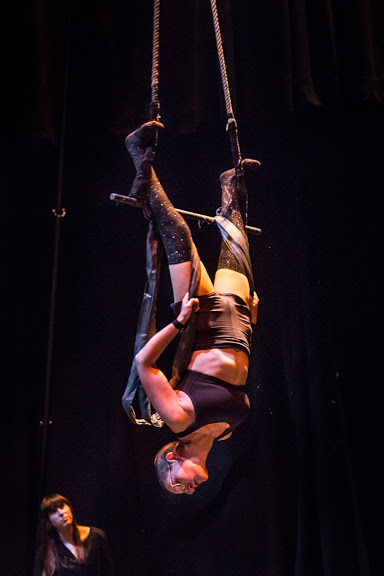
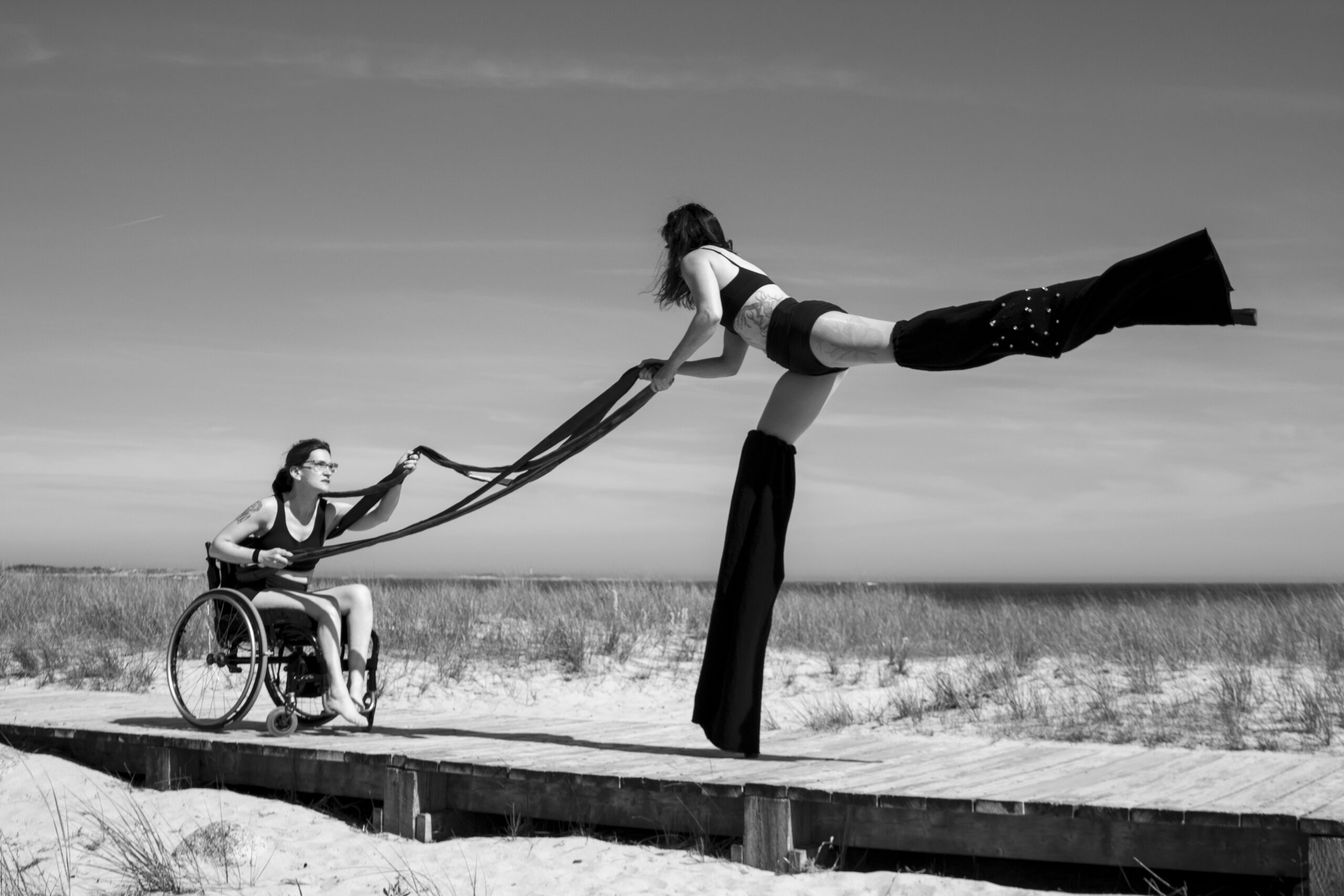
Hubbard was finally welcomed onto the stage when she found LEGacy Circus in 2018. Vanessa Furlong and Erin Ball are the founders of LEGacy Circus in Halifax, and Ball met Hubbard when they were doing a workshop for circus instructors centred on working with “atypical bodies.” So Hubbard went as someone with an atypical body and started playing around on the apparatuses and the instructors in the workshopped learned how best to give her feedback on what she was doing. “As soon as I touched the trapeze I was in love,” says Hubbard, “I knew that was my thing from there on out, and luckily Vanessa recognized something in me and asked if I would do Spinning with the Stars with her that year. I started training right away for my first professional show. From there there was no looking back. I found a real kindred spirit with Vanessa in that we had the same desires to create and the same passions for showing crip joy on stage and showing different ways of performing. Right away I felt like we belong together, and we had so many stories to tell. I’m really lucky that I got to have such an awesome career with her.”
In fact, in some ways being a wheelchair user is an asset for a trapeze artist. “I could do a lot of the tricks that a lot of the beginners couldn’t do because I had so much more upper body strength already. And not only the upper body strength, but just so much awareness of how to move my body through space. Because I’ve had to move my body in atypical ways and adapt as a disabled woman for so many years, I already kind of had a little bit of that knowledge of how to fall safely, how to find ways of travelling through space that worked for me, even if they weren’t the norm. So, yeah, it really lent itself naturally to circus. I didn’t necessarily do it on purpose, but I chose another form of art that was for the outsiders.” Hubbard notes the circus’ historic association with “freak shows,” and says that it’s a community where those who don’t belong still come together as a family. “I was welcomed into the circus community right a way in a way that I never really felt in the theatre community, even after being there for 25 years.”
“The circus community really looked at me as an expert in [how my body functions].” She says that even as a beginner more experienced performers were watching the ways in which she was moving and learning from her and respecting her “rather than feeling like I had to battle my way in again and again, and still always being kind of pushed away as the annoying gnat that I was experiencing in the theatre community. So it very much felt like this is the home I’ve been looking for for so long.”
Hubbard thinks that being cast as a performer in the circus world has had an impact on how not just she was seen in the theatre community, but how disabled artists are viewed more broadly. “Sometimes a community just needs to see that it’s possible. When I showed up on stage in the circus community it was like ‘oh, it’s possible now. It’s not April theoretically saying this could happen, it’s she’s onstage and she’s doing it. So, we can’t argue now that it’s too difficult or too expensive or too…all of the excuses. It’s happening.’”
She also notes that the way she sees her wheelchair in her own life, as a tool that has made her feel graceful for the first time in her life, differs from the way abled-bodied folks often see wheelchairs- as cumbersome inconveniences. “I’ve always had invisible disabilities and I was always very clumsy as a result and always really struggled to take each step and had to think about it. And then all of a sudden I’m in this chair and instead of fighting against my own body I’m moving fluidly through space and understanding where the inclines are, and can kind of ride that like a wave. I related it a lot to sailing, honestly, instead of fighting against the wave, you move with it and the power of it. It’s the first time I ever felt graceful and felt like I was dancing. It brought so much more to my life and my experience rather than being this cumbersome thing that… chained me down.”
As far as the city more broadly is concerned, Hubbard mentions that the government has promised that Nova Scotia is going to be “fully accessible by 2030,” but she says, “nothing’s been done to make that happen. It’s not going to be in reality, but at least I can see little steps along the way, the little breadcrumbs that are being laid along the path… it comes back to community and other people finding their voices. I’m not feeling like I’m advocating alone anymore or just screaming into the void like I felt I was for so many years. Now there’s a network of [people] and we’re doing this work together now. When I feel too tired and need to take a break, I don’t have to feel guilty that the work is not being done. I can rest because someone else has this for a bit.”
Hubbard’s chronic pain has worsened considerably since 2022, which has made it considerably more difficult for her to perform. She is currently working on a couple new projects, the Touch Project, she says will likely be one of her last performance pieces, and she hopes to do “CripTease Serves One More Piece,” which will be a drag performance. Hubbard applied for medical assistance in dying (MAID) in 2023 and was approved for it. She had her Living Funeral at the Spatz Theatre last September. Initially, she didn’t think she would be able to accept her Governor General Performing Arts Award in person, but a few weeks before the ceremony, with the support of the folks putting together the ceremony, she was able to go and relish in this moment herself.
April Hubbard has left a beautiful, lasting impact on the arts communities in Nova Scotia; her legacy is the continuing commitment each theatre venue and company is showing as they keep asking themselves both ‘who has been historically excluded from our audience and from our stages’, and ‘how can we work to dismantle these often centuries-old barriers that limit who in our society has open and welcoming access to theatre and these theatre spaces.’ The work is incremental and ongoing, but Hubbard’s decades of advocacy is woven into the heart of all of it. Here in Nova Scotia we can sometimes feel as though we are isolated from the more central parts of the country, and that the way that our theatre community is evolving and changing, because of people like April, is existing in a vacuum or a bubble. Yet, seeing her being honoured for her work in this way in Ottawa is a reminder that we are all connected, and those like April who are pioneers, and leaders are inspiring folks not just here at home, but across the country and beyond.
Congratulations April and thank you for everything.

40 thoughts on “April Hubbard Receives Governor General’s Performing Arts Award for her Advocacy & Volunteerism in Theatre”
Comments are closed.