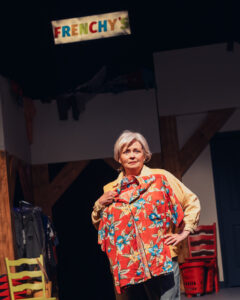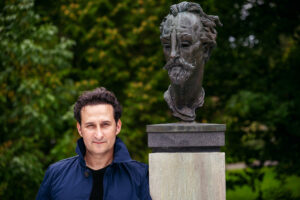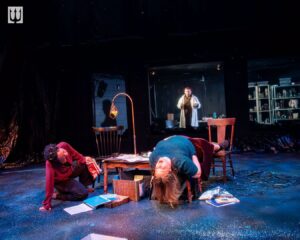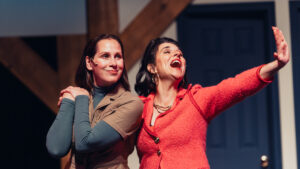
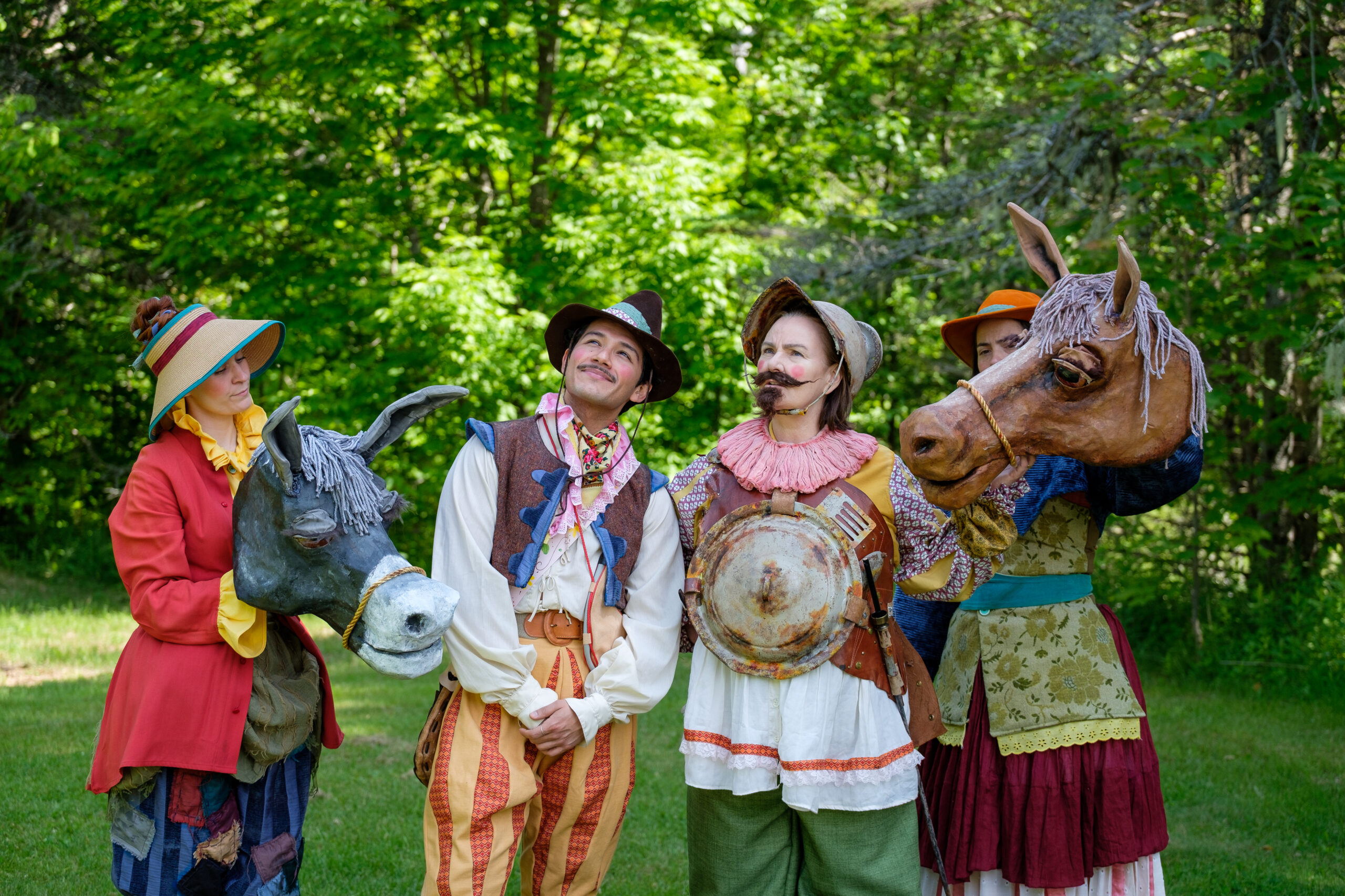
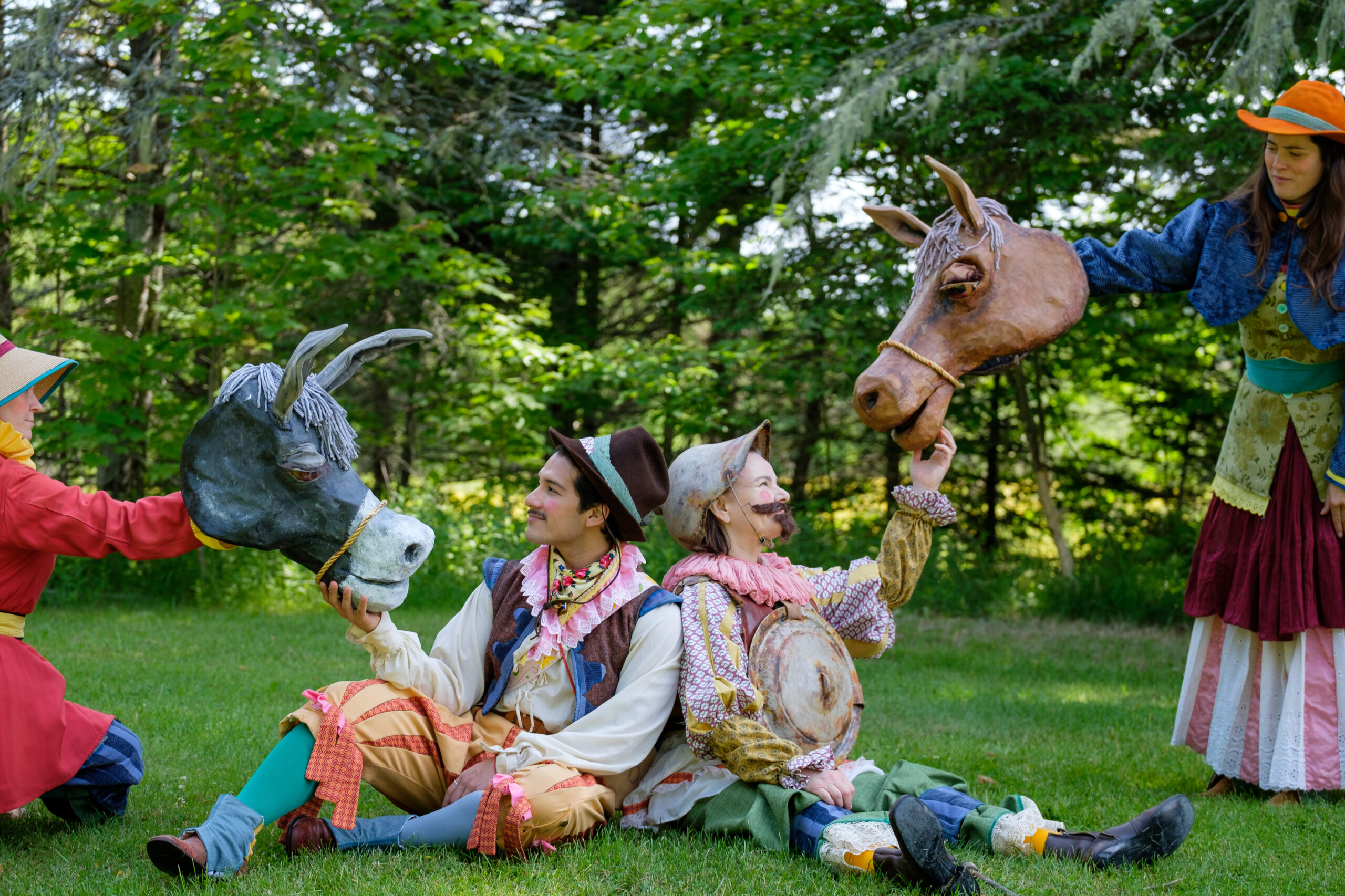
Becca Guilderson (Donkey) Santiago Guzman (Sancho Panza) Don Quixote (Burgandy Code) Rocinante (Hilary Adams) Costumes and Puppets designed by Diego Cavedon Dias Photos by Memo Calderon
Two Planks and a Passion Theatre open their season June 28th, 2025 with two world premieres: Quixote! by Ken Schwartz is an adaptation of Miguel de Cervantes’ 1605 novel Don Quixote, and The Haunting of Sleepy Hollow By Fire is a new musical experience around the fire created by Schwartz with Allen Cole based on Washington Irving’s 1820 short story The Legend of Sleepy Hollow.
I caught up with Ken Schwartz, Artistic Director of Two Planks and director of Quixote! via Zoom to chat about the exciting summer ahead at Ross Creek Centre for the Arts.
Schwartz says that they chose to adapt these two, quite disparate, stories because they both are “responding to the moment that we’re living in right now, politically.” In fact, Schwartz was thinking of adapting Don Quixote back in 2016 after Donald Trump was elected President of the United States the first time. “It’s incredible to read the book and realize how out of time Cervantes was in a way, you read it and just go, ‘did someone write this yesterday?’ It’s hard to believe it’s 400 years old, especially the humour and the absurdity, and the way that it kind of is conscious of its own form. It’s one of the first novels [ever written], and yet it’s making fun of the idea of a novel at the same time. It just seems incredible. For me there’s something really profound about a story about two people who, when they stand shoulder to shoulder and look at the same thing, see two very different things. And yet, they can love each other, and they can be loyal to each other, and they can live side by side, even though one person sees a windmill and the other person sees a giant.”
Schwartz says that even though in the novel this discrepancy between Quixote and the other characters is played for comedy and absurdity there is a “profound lesson” here as well. He says that he’s taken this lesson and then in this adaptation has taken the characters on a somewhat different journey in terms of what they are learning from each other.
“Honestly when you read the beginning of Don Quixote, it’s about someone being radicalized… He’s reading and reading all these books and he starts to believe that what he’s reading is real… he wants to go back to a time that never existed and live in that time because it makes him feel whole. It makes him feel of consequence, even though it’s all fantasy and was never real at any time. He becomes this way because he’s by himself in his house. It’s like being in the basement on the Internet. The parallels are so crazy. It almost feels too on the nose in a way.”
Don Quixote recruits Sancho Panza to be his squire. In the novel he is an illiterate farm labourer who is incredibly loyal to Quixote. Schwartz says that Sancho needs to learn how to see the world through Quixote’s eyes. “It’s not so much that he learns to agree with that, to become radicalized himself, it’s that he learns to understand how to cope with it. How can he live with this person? How can he take care of this person, but yet still respect this person’s autonomy and how they see the world and respect them as a human being and love them? For me, that’s everything right now. We’re not all going to be the same, we’re not all going to have the same opinions, we’re never going to agree on everything, but how do we live together? And more importantly, how can we love each other? It’s not just tolerance. It’s love.”
Schwartz’s adaptation is presented as a play within a play. He says he was inspired by Station Eleven a 2014 science fiction novel by Emily St. John Mandel about a “post-apocalyptic group of travelling players who are performing Shakespeare. That really kind of inspired me- this idea of a group of players and what do they perform, and how do they perform it, and why [as they are] travelling through the forest to village to village.”
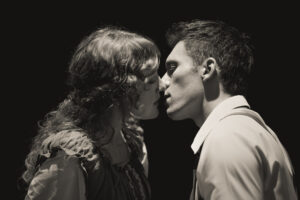
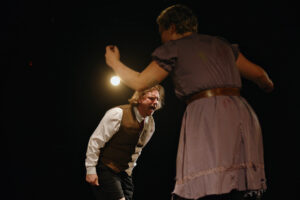
Schwartz says that the way they are telling the story of Sleepy Hollow is very different from Irving’s original. “The veneer of it is the same, but there are huge twists in the story… by the time you get to end of 70 minutes, you realize that it’s not your Grandpa’s Sleepy Hollow… It’s also deeply connected to the moment we’re in, in terms of… the whole aspect of how people in society are lining up to obey to totalitarianism. I can’t say anymore,” he says, “because it will spoil it.”
He says that he hopes that folks will come away from both places thinking about their responsibility as citizens: “what are we going to do today? What are we going to do tomorrow… with the people around us? How do we repair what feels like a rift that’s unrepairable?”
As climate change has brought more extreme weather to Nova Scotia Two Planks and a Passion Theatre has encountered a number of challenges continuing to create theatre outside on the North Mountain in Canning. The conceit of Two Planks, as Schwartz says, is “the marriage of nature and the imagination… we’re collaborating with nature.. the existential question is: what happens when it’s the marriage of nature when nature is scary?”
Schwartz says that it’s apparent to everyone who is doing this kind of work- theatre performed outside in nature- across Turtle Island that we are “in crisis.” On a basic pragmatic level theatres like Two Planks have to protect the folks they are working with and they have to protect their audiences from the elements. He says that he is now looking to build some infastructure at Ross Creek so that “we can still be outdoors, still have those outdoor vistas, and yet protect our audience from the direct sunlight… give ourselves options so that we can preserve the essence of what we’re doing.” He notes that when he and co-founder Chris O’Neill started doing plays outdoors here in 2007 “the fog rolled in every day and bathed everything in cool air. The problem was we didn’t have enough blankets… not that everything was going to catch fire.”
He says that when they started their Fireside Shows, where plays are performed around a campfire, in 2013, just twelve years ago, it was unfathomable that you wouldn’t be able to start a fire before 7:00pm during the summer. “That’s the new world we’re in,” he says, “So we are adapting just like everybody.” In 2023 Two Planks initiated the Acts of Resilience Conference, which brought together producers of outdoor theatre to develop new strategies and share knowledge on how to continue to create work in this way in a rapidly changing physical landscape. “All that work is ongoing and operating on very pragmatic levels.” He notes that some of these revolve around the protocols of when to make the call that it’s too hot for the actors to be outside, and how designers are creating costumes that allow the actors to stay cooler. Also they are developing strategies around communicating with audience members about when the location of the performance may change, and noting that they’re asking audience members to become more adaptable as well and asking ‘what does that look like in practice?’
Schwartz isn’t just brainstorming about what is needed today, he is also thinking about what Two Planks might need ten years from now. He also encourages folks who are coming from elsewhere in the province to make sure they are checking the weather forecast for Canning as weather systems can vary drastically, even within areas that are geographically close to one another.
Another thing that is unique about seeing a show at Two Planks is that when you arrive at the Ross Creek Centre for the Arts you don’t know exactly where on the property, a 178 acre former cattle farm made up of a mixture of fields and forests, the performance will be taking place. Schwartz says that he enjoys changing up the location because as a director it keeps him from always doing the same things in the space. “We can let the landscape inspire us to do different things. If we build infrastructure we need to find a way that we could still perform all over the place… and then have a facility where if it gets really hot we can still keep the essence of that and still be outdoors.” He says that it will require making concessions, but hopefully not as big as moving the show into Ross Creek’s 40 by 40 foot studio theatre, which is the current reality.
The land is an essential part of the Two Planks experience and Schwartz says that sometimes it even influences which show they will choose to program. He said looking at the pond where they staged Wind in the Willows (2023) had made him think of how amazing telling that story there would be. The Odyssey (2007) was also inspired by the pond and the little island in the middle of the pond. He was inspired by the forest to stage Our Town (2008) by having the characters “coming out of the trees, [thinking] ‘what if when the two kids are, instead of being on ladders, if they were up in tree houses?’” He says that the fireside shows often inspire the company to tackle scarier stories, citing Sleepy Hollow this year and Turn of the Screw (2015). “It’s such a specific and weird aesthetic that very few, if anybody, almost nobody does it, especially in the way that we do it, but it’s a unique communal experience,” he says of the actors performing in and around an audience seated around a campfire. But he notes that there is something so “elemental” about telling stories around a fire, dating back to our earliest ancestors. “The landscape also influences us in the sense that so much of what we do is about seeing things through a rural lens. Through the lens of rural existence and… isolation.”
He mentions that even when thinking about larger themes, like the rise of Fascism or Xenophobia, practically, it’s always through this rural lens. He references The Stranger (2022) saying it “was really about small town xenophobia and the incapacity to deal with difference… even though it was an adaptation of Dr. Jekyll and Mr. Hyde. What the landscape does is it kind of gives us an interesting restriction, which is that it’s a constant reminder: You are Here. This is your reality. This is your experience. Tell a story from that perspective… it doesn’t allow me to, in a way that I appreciate, to deviate from that core mission, that core vision of ‘we’re going to tell stories that we think matter and we’re going to tell [them] from a perspective that we know, or at least that we have some experience in.’ The connection between the landscape, it’s challenging, but it’s also, I find it liberating, because it answers a whole series of artistic questions before I’ve even begun. Then I can start asking other questions that are really interesting.”
Some of these exciting questions stem from how to take a classic story, like Dr. Jekyll and Mr. Hyde, for example, and adapt it in a way that feels “extremely local,” For Schwartz that’s about asking himself what a story like this would look like if it was set 200 years ago in Canning. “What I find really cool about it is that it tends to reduce stories to microcosms… like there’s three roads, and one doctor…” and this can change the way the stories work. In The Stranger the story went from relying on the anonymity of the city to being a story about a stranger who stood out like a sore thumb because he couldn’t fit in in a place where everyone knew everybody else.
This season Schwartz says that the design work for both shows is “extraordinary,” which includes both the costumes for the shows, and puppetry. “It’s a really great sign when you’re looking at things in the rehearsal hall and you want to take a picture, but [you also don’t want to post the photo online] and spoil [the surprise].” As always, the shows are a mixture of intimate connection with the performers amid an “epic landscape.” Schwartz says, “It’s being able to have nuance and subtlety and beauty in performance while experiencing all of outdoors.”
It’s a special and often magical mixture that Schwartz and O’Neill are working diligently to preserve, both for audiences this season and for the audiences of the future.
Quixote! and The Haunting of Sleepy Hollow open June 28th, 2025 and run until August 16th. Quixote! plays Tuesdays and Wednesdays at 6PM, Saturdays at 4PM, and Sundays at 2PM. The Haunting of Sleepy Hollow, plays Tuesdays, Thursdays, Fridays, and Saturdays at 9PM. Tickets range in price from $15.00 for children, $25.00 for students/artists/unwaged, $35.00 for adults. You can get yours here or by calling 902.582.3073. There’s also seat upgrades available and picnic options. Babes in arms can see the show for free.
For one night only (August 24th at 6:00pm) Icarus, the Falling of Birds by Gale Force Theatre will be presented as a Pay What You Can event with limited seating.
Ross Creek Centre for the Arts is wheelchair accessible, and there is a golf cart available for those who may need help moving around the outdoor space. Please let the staff know when booking your tickets if you need wheelchair accessible seating or will require the golf cart. Sunscreen and bug spray and dressing in layers is advised for all theatre patrons. For more information about what to expect when you arrive at Ross Creek please visit this website.
Incoming search terms:
- https://www twisitheatreblog com/?p=5705