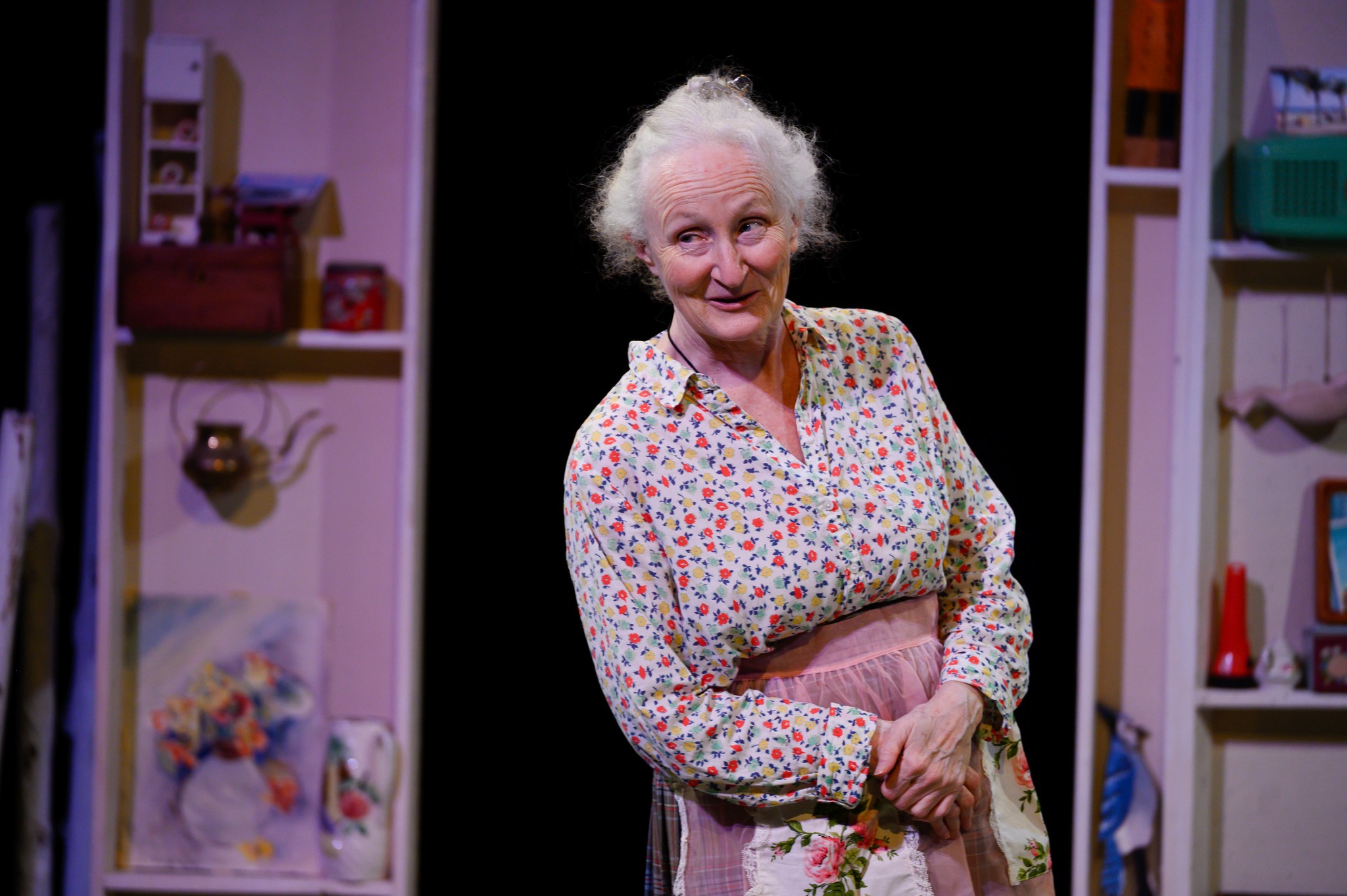
Mary-Colin Chisholm as Gramma Photo by Hannah Ziss
When Mary-Colin Chisholm met Paula Dankert when Dankert was moving to Nova Scotia, before she worked as a producer for CBC Radio Drama, the two found out that they were related. “She told me that her mother was Mary MacNeil from Glace Bay, and Mary MacNeil was my Aunt Pat’s first cousin.” This discovery led to a discussion of the funny family nicknames that you often find in Nova Scotian families, especially those with connections to Cape Breton. Once Dankert was working at the CBC she suggested that Chisholm create a radio sketch on the subject. Chisholm stresses that, of course, she couldn’t use the nicknames of real people she knew for this exercise, so she had to make them up. In this iteration of the sketch that became her play He’d Be Your Mother’s Father’s Cousin Chisholm played the “Mom” character and Marguerite MacNeil and Ed MacDonald played all the other characters in the scene that she interacted with. “It started out as one little five minute episode, just to showcase nicknames and silliness,” she says, “But then the characters that they used became ongoing, like a little family sitcom.” MacDonald wrote some of the subsequent sketches, and after a year or two playwright Carol Sinclair came aboard and wrote a couple, even their sound technician, an Irishman named Dermot Kenny was inspired to write one. “For benefits and fundraisers I had all these little short form pieces I could pull out and do the voices,” says Chisholm.
She first organized the sketches into a singular one person show in her hometown for the Late Night Series at Festival Antigonish for Addy Doucette; it was then expanded into a play with four actors at Mulgrave Road Theatre in Guysborough.
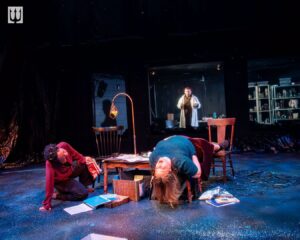
Then, in 2019 Theatre Baddeck staged the newest incarnation of the show, which has been expanded into a play with five actors playing all the different characters. The newest version of this play, with a new cast, directed by Heidi Malazdrewich, opened July 11th, 2025 at Theatre Baddeck’s new Greenwood Arts Centre and plays there until August 29th. I had the chance to sit down and have a lovely conversation with Mary-Colin Chisholm about the development of the show via Zoom.
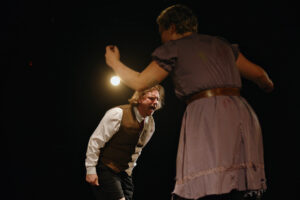
The play centres on a family, Mom, played by Christy MacRae-Ziss, and Dad, played by Michael Peng, and Gramma, played by Chisholm, who are adjusting to becoming empty nesters as their child Mary Rose has left their cozy home in Cape Breton and moved to the Big Smoke. Chisholm says that she grew up being “the kid who’s the fly on the wall, just soaking everything in,” and that when she was writing these characters for both the sketches and the play, all that she remembered from her own family members came out in these hilarious situations.
The Gramma character throws a few Scottish Gàidhlig phrases into her vocabulary, but Chisholm says that it’s a deracinated version of the language, where no one in the home is fluent anymore. Chisholm grew up in Antigonish and three of her four grandparents spoke Gàidhlig, and then, as was the case in so many families in Nova Scotia, “all my grandparents’ generation decided not to compromise their kids’ opportunities by teaching them a language that could make them sound funny or ignorant. So it was amazing, this cultural death in one generation because [the Gàidhlig] had survived from [when the first Scottish settlers arrived in Nova Scotia] after the Clearences started right after Cullodean, so the language survived [here] for almost two hundred years, and then almost completely disappeared in one generation.”
Gàidhlig was introduced into the curriculum of some schools in Cape Breton, in Inverness County in particular, in the 1970s, which has led to a small resurgence of the language. Taigh Sgoile na Drochaide in Mabou is a new Gàidhlig immersion school for early elementary schoolers. For this reason, hearing Gramma’s deracinated Gàidhlig brings a “chuckle” to local audiences, rather than a feeling of sadness. “We’re also finding out that the tourists and travellers who come here, they get a huge kick out of it because, of course, they’re here hoping to catch something that is a little more specific about the place, a little more authentic, so it’s a treat for them, and they don’t have to understand it to get the gist of what’s going on.”
Chisholm also mentions the mouth music, an extension of the fiddle so iconic to Cape Breton. “My father used to play the fiddle. He’d worked construction and his hands got too stiff. So when he couldn’t play it well, he gave it up. But he’d walk around the house playing mouth music- playing the tunes over and over to himself and his fingers would twitch because he’d remember how he held the fiddle. When we were rehearsing, because it’s a comedy, [we were trying to find] lively Scottish songs, but [we realized] 95% of Scottish songs are full of longing and heartbreak and nostalgia. That’s where the Scots who are not expressive tend to put their emotions.”
Chisholm’s rich connection to Cape Breton Island goes back to early in her career. She had been working at Mulgrave Road Theatre on a show where Leon Dubinsky, who wrote the anthemic “Rise Again,” did the music. These shows often toured up to what was then the University College of Cape Breton (Now Cape Breton University) in Sydney. In Sydney they had the One Act Play Festival, which Chisholm characterizes as being “foundational” for Cape Breton theatre. “We went to the One Act Play Festival with a comedy, and I started to become friends with people up there, and even though I can’t sing for beans, I got in The Rise and Follies [of Cape Breton] with Raylene [Rankin]. We were roomies. We were in a rooming house on George Street and, oh my god, we snuck Gerard Morrison in for supper one time and the landlord caught us. Oh my God. You’d think we were running orgies. So, that was not just a work opportunity, it was an incredible learning opportunity for me because those guys [Maynard Morrison, Kenzie MacNeil, Max MacDonald, Doris Mason etc.] had an ear for comedy, and they were developing, organically, their own style of creation of comedy: the sketch revue style. It’s mass entertainment at a high art level. They do it so well. People don’t realize what a level of skill is happening when those guys take to the stage and make everybody laugh and clap along.”
Chisholm notes Leon Dubinsky’s passing in 2023 and Mary Vingoe and Michael Melski’s passing just on July 18th of this year, and says, “I realize I’m part of the wave that’s passing, that is leaving; I guess I’m sort of scaffolding, you know? Leaving behind a unique way of working, and many unique views of the world- and a voice to this part of the region… Mary did it with some incredibly deep political and sociopolitical analyses; she did pieces that could budge society, and The Summertime Revue did it by bringing authentic voices out and having people finally see themselves celebrated. It is creating a canon that speaks of this region, the way the Irish have a canon. … I wasn’t in the very first Rise and Follies, but even in Antigonish you could make people laugh by saying, “and who’s your father?” because, even though people have been saying that for generations: “who’s your father now?” somebody said it on stage and [audiences] heard it and they realized, ‘oh my god, that’s a wild and unique thing that we do say here, and that is kind of absurd and wonderful.’ We’re living in this, on the surface, hyperconnected world, but it’s a world that’s been put in a blender and people have been flung everywhere, and we’ve been cut off at the ankles, you know, people who were thrown out of multiple European countries by war and colonialism came over here and it’s like: what does it mean for me to believe in the faeries when I’m not from the land where the faeries are from? We’re looking for that connection [with each other] because it’s been disturbed around the world, and it’s still in the process of being disturbed… I think it’s why people seek connection, and why something as simple, simple seeming, as a local comedy is actually functioning on a pretty deep level for people.”
She notes that the conceit of the play is very simple. “It’s just a family going, ‘Oh my God, we’re empty nesters. Now what do we do? We’ve got nothing to say to each other, we’re getting on each other’s nerves, driving each other nuts, but trying to figure out who we are now that we have to adapt to this phase in our lives.’ So, it’s about connection and disconnection in a way too.”
Like Mary Rose, as a young person Chisholm left Antigonish for Toronto and got some push back from her parents. “I had to go and look up all these people [in Toronto] that [my mother] probably hadn’t seen in twenty years, but that were from Antigonish, because it was like a village thing, as long as somebody from the village knew I was there… I had to make that connection for her peace of mind.” Chisholm’s father was a radio operator in the Navy and he was stationed in New York during the Second World War. “That was the one time he travelled from the farm,” she says, “and he said, ’I’ve been to New York. They don’t got nothin’ there that we don’t have here’” Chisholm laughs at the absurdity of this. “Once some people get uprooted they just stay in motion, but once the Scots were uprooted, they just landed with a thunk wherever they were and clung.” She cites a line from her play, “I can’t imagine what people in Ontario do with themselves all summer. Just go up and down and up and down the CN Tower for two weeks?” She says that was her mother’s take on it as well, and that she would feel sorry for their Ontarian cousins who were “stuck” at their cottage on the lake each summer “because she could only imagine that you go swimming in the ocean.” Her mother spent the war in Sydney running the procurement office for the shipyard, with an office on George Street, and then later her parents lived in Margaree, where she was born, before returning to Antigonish, so she feels like she has ‘dual citizenship’ with Cape Breton.
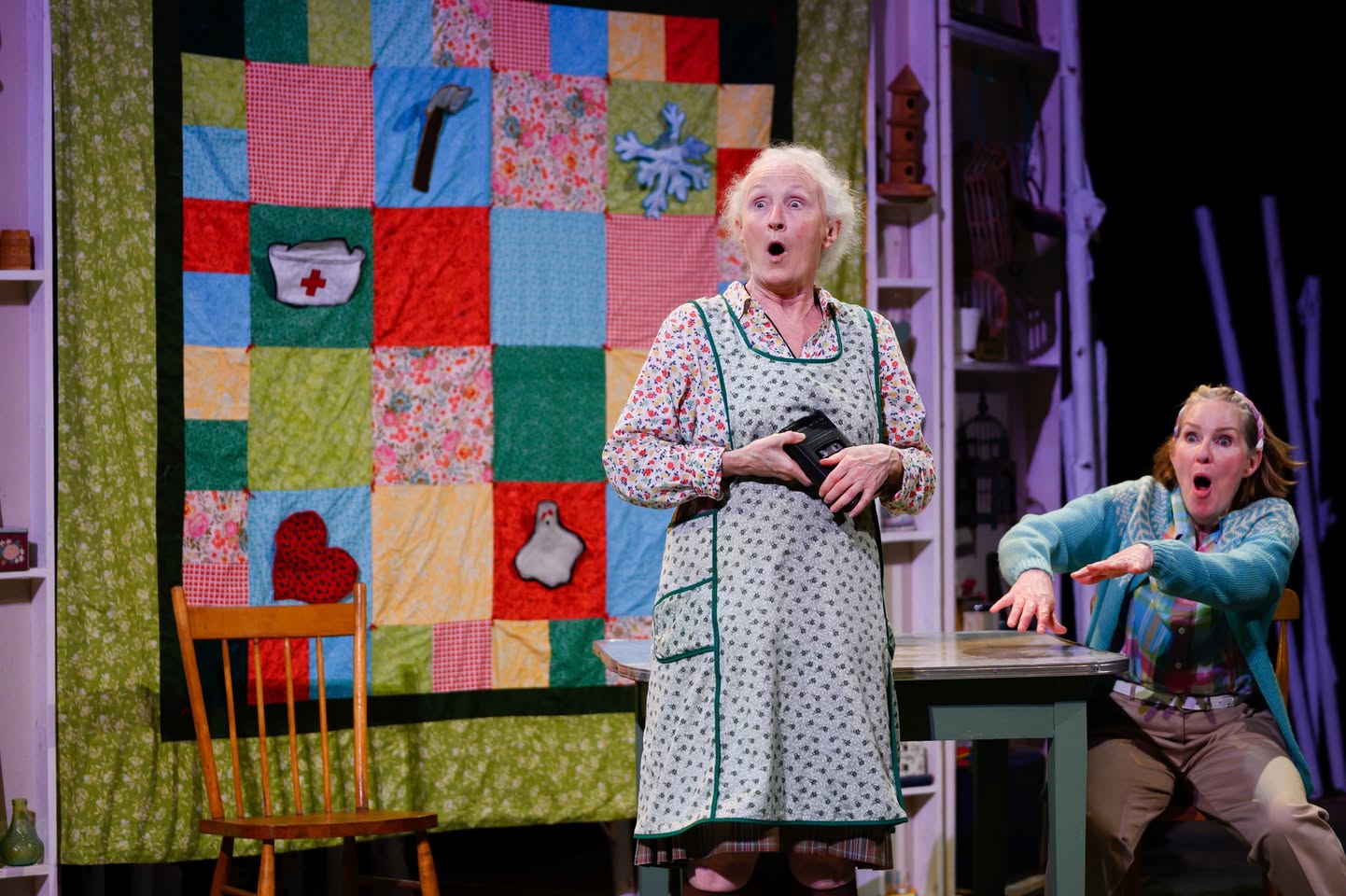
Chisholm says that when she first wrote the sketches that became this play she was in her 30s, and now she’s 68, so, initially, she related more to MacRae-Ziss’ Mom character, and now here she is playing Gramma. “Sometimes I’m there and I’m going, ‘I’m playing an old lady.’ And then I go, ‘oh, wait a minute. I don’t actually have to play it, I can now be it,’ which is kind of fun. I’m basically channelling my mother and a few old aunts that I knew who were kind of funny.” She references the way that older folks in Antigonish and up in Cape Breton would bring little bits of Gàidhlig grammar or vocabulary into their English, even if they weren’t a fluent speaker (or in the case of my own grandmother, didn’t have the Gàidhlig at all but the idiosyncrasies were passed down regardless). “That’s why the title is ‘He’d Be…’, because my mother, we’d be talking about somebody, my mother would say, ‘oh well now, I’ll tell you who he’d be’… well, it’s ‘who he is.’ The grammar is conditional because it’s coming from the Gaelic. And then she’d go on the kind of biblical lineage.”
One of the funniest elements in the play is the family’s cat, puppeteered by one of the ensemble actors. “We always had cats, little cats and dogs, even a couple of ducks, and at one point some geese growing up, even though we were townies, but it’s like a child growing up, animals, there’s no distinction, they’re just part of the family. But our cats were always into all kinds of trouble. And it’s kind of a cartoon [in the play], because they were written as sketches, it’s almost Looney Tunes-level of things that we do to that poor cat, but at least the cat has its own kind of resilient spiteful nature… and boy do people relate to that cat.” Chisholm mentions that the main cat in her life was named Mother Cat, referencing her umpteen litters of kittens, some of whom found good homes in the community, and some of whom stayed with Chisholms, “she was a very tiny little cat, and very stroppy, and could take on every dog in the neighbourhood.” Chisholm also says that the cat is essential to the empty nesting storyline, because the cat becomes Gramma’s focus in the absence of her beloved Mary Rose.
As for what has changed since the last time Theatre Baddeck staged this show in 2019, Chisholm says there’s a few rewrites, a few additions, and she notes that it’s great having two very accomplished musicians, Zach Parsons and Steve Maloney, joining the cast this year. Chisholm says that if folks are travelling to Baddeck to see the show from elsewhere that they should make sure to go for a swim at Indian Brook and Little River Beach, or take a tour in either Middle River or Big Baddeck, and she also recommends the Alexander Graham Bell Museum, which is right in Baddeck itself, very close to the theatre. “[From Baddeck] you’re in Margaree in 40 minutes, you can go swimming in Chéticamp, or swimming at Chimney Corner. Cape Breton is the best for hikes and walks and swimming, really. And every time I come to Cape Breton there are more fantastic restaurants and craft shops. You kind of can’t go wrong. You’re free to roam, you know?”
This is Theatre Baddeck’s tenth season, and their first in their new home: the new Greenwood Arts Centre, in partnership with the Greenwood United Church. The church will continue to have their services in the building, and Theatre Baddeck will be able to use the building as a rental venue, both for arts and culture events, as well as community events, during the off-season. “Christy and Hannah [Ziss] are kind of amazing,” says Chisholm, “like my mother used to say, ‘if you want to get a job done, you give it to a busy woman’… Hannah is acting in [Ed’s Garage] and Christy’s acting in Your Mother’s Father’s… and it’s beautiful what they’ve done, they’ve created a nice beautiful new lobby with a bar, and they’ve created enough of an infrastructure within the actual sanctuary that it’s quite [a] beautiful [theatre]. There’s a timbered ceiling so there’s that warmth of a wood building for the sound. It’ll keep getting more impressive [as the renovations continue].” She notes that the theatre in Cape Breton has historically been the “kid sister” to the dazzling older sibling: the island’s illustrious music industry, but she says that theatre on the island is now really “carving out it’s own place… I think we are beginning to offer a buffet to the tourists that they can see a play as well as a cèilidh… we can produce our own stories, we can give you Mamma Mia!; we can do it all.”
He’d Be Your Mother’s Father’s Cousin plays at Theatre Baddeck (98 Twining Street, Baddeck) until August 29th, 2025, in repertory with Ed’s Garage. Check out this review from the 2019 production. Please check the schedule for individual performances here. Performances are at 7:30pm Tuesdays to Saturdays with 2:30pm matinees on Wednesdays, Saturdays, and Sundays. Tickets range in price from $21.50 to $31.50 based on the patron’s age. They are available online here, or by calling the Box Office at 902.412.7122. If you are purchasing tickets for a group of more than five people, use the Discount Code GROUP to receive a group rate.
Accessibility Note From Theatre Baddeck: We are committed to welcoming patrons with disabilities. Should a support person be required to accompany the patron, we will waive payment of the ticket amount for admission to the theatre.
The theatre can be entered via ramp and is fully barrier-free. Any seat in the front two rows can be removed to accommodate a wheelchair. Since seating is general admission, we will happily reserve seats for you if you need seats removed, cannot climb stairs, or need to be close to the stage. Contact us at 902-412-7122 or boxoffice@theatrebaddeck.com to make these arrangements – we are here to help!
Incoming search terms:
- https://www twisitheatreblog com/?p=5804