Photo by April Maloney
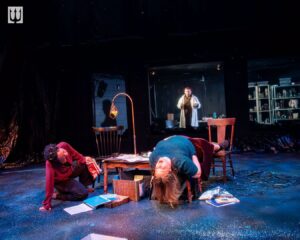
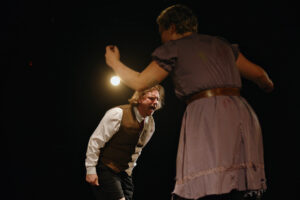
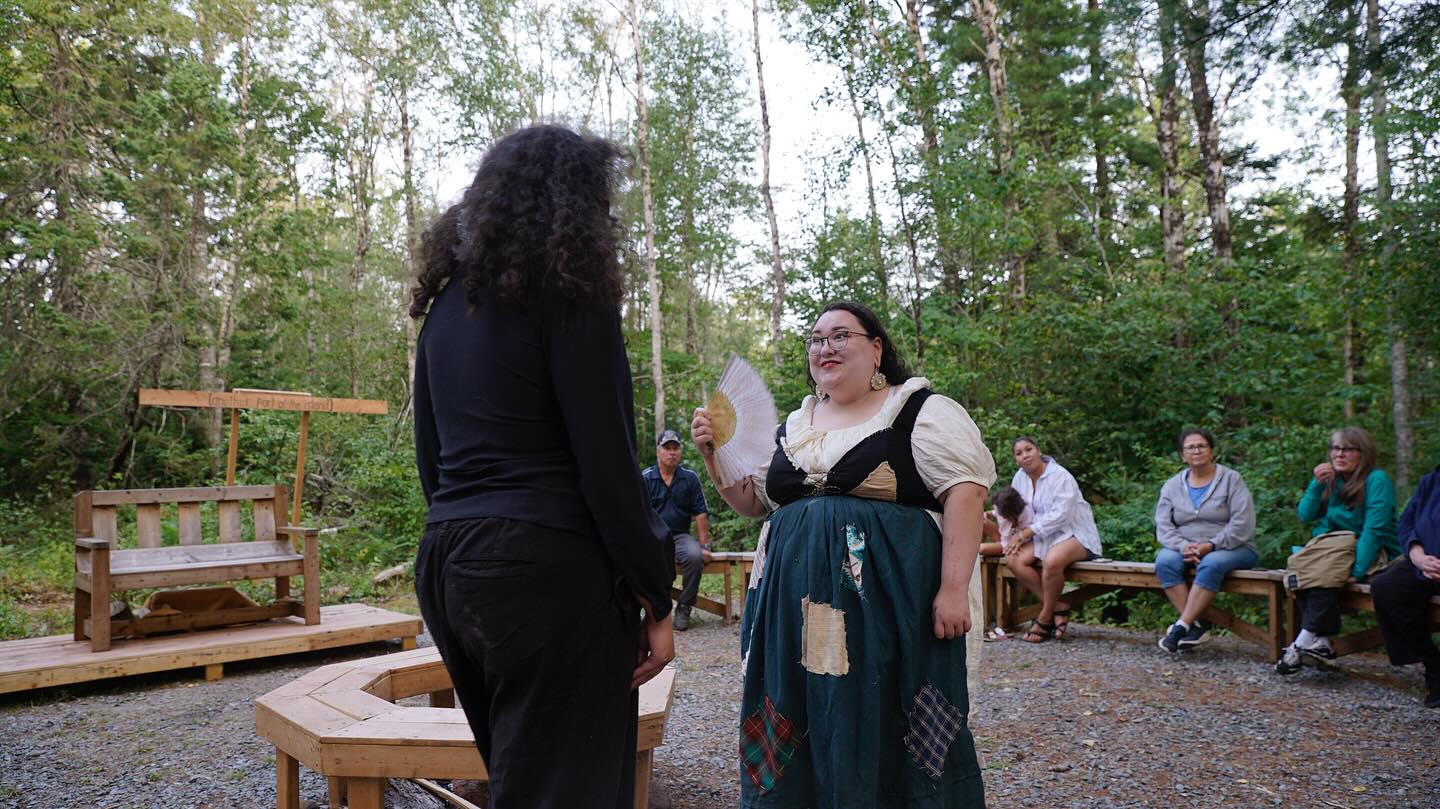
The Sipu Tricksters in association with Zuppa are bringing their play Metu’na’q (Caliban’s Version), an outdoor community-driven production that weaves Mi’kmaw culture into scenes of William Shakespeare’s play The Tempest, to Point Pleasant Park this week (hosted by Shakespeare By the Sea, and under the same permit that allows them to do theatre in the park during the current provincial woods ban). The show opens Wednesday August 13th and runs until Sunday August 17th, 2025. I had the chance to chat with Bella Rose Masty, a young Indigenous actor who plays Caliban, via Zoom, about the show.
Masty tells me that in this version of the story Caliban and Ariel are both Indigenous characters who have their land stolen by Prospero, who is characterized as a wizard. Masty says, “[Caliban] was enslaved in a way to this wizard, and he’s trapped in service, and is forced to service this wizard, and he’s not happy about this.” In Shakespeare’s play Prospero is the former Duke of Milan who does have powers of sorcery, and, having been exiled from Milan by his brother, he and his daughter, Miranda, wash ashore of a small island, which is where they meet local inhabitants Caliban and Ariel. Masty says, “in our version these characters are interpreted as just regular Indigenous people, but in the play [Caliban] is described as a fish or non-human, but that’s just the racist views of Prospero… he also views Ariel as a spirit, also not being human.” Masty says that from the opening of the play we see that Caliban has had enough of being indentured to Prospero for over a decade, and finally he finds two new Europeans, Stephano and Trinculo, who have newly washed ashore, “and they’re drunks. But Caliban doesn’t understand that because he’s never known what alcohol is. He just thinks, ‘oh, these guys are going to be my way out. I’m going to get these guys to kill Prospero.’” Complications in this plan arise though because, as Masty says, “Caliban realizes that, ‘dang, these [European] guys are just complete idiots.’”
Most of the dialogue is taken from Shakespeare’s original, but director Ben Stone has cut the play up, reducing the story to just fifty minutes focused on Caliban’s narrative and perspective, and has moved the scenes around, and the collective of multigenerational Indigenous performers have helped to root the play in Mi’kmaw cultural practices and history.
Masty saw a casting call that was put out by Sipekne’katik First Nation community member Richard Taylor, who is a Zuppa Theatre collaborator, asking if anyone on the reserve was interested in taking part in a theatre project. “I was already doing a lot of theatre outside of the community, I was running a drama club and I was going to Neptune Theatre [School], so then I was like, ‘hey, this is perfect for me,” says Masty. The collective is made up of nine members of the community who, like Masty, are interested in acting. Masty says that she had no idea The Tempest even existed before this opportunity presented itself. “All I knew was that I liked Shakespeare. I always wanted to perform a Shakespeare play, but Shakespeare scared me, but now it’s actually growing on me a lot, and I really want to do more.” She says that it’s interesting to her that The Tempest is one of Shakespeare’s lesser-known plays, especially since it was the last one he ever wrote. “I find it kind of ironic too,” she says, noting that it isn’t produced as often as his more popular works, “because it could be interpreted as an Indigenous story, yet it’s forgotten? It’s kind of ironic to me,” she says.

It’s also interesting the ways in which Shakespeare has the two Indigenous characters interacting, and more notably, not interacting with one another. “Caliban doesn’t like Prospero, he doesn’t like listening to Prospero, he only does so because he’s scared of him. Ariel is also scared of him, but he listens to him a lot more and actually does his wishes. He’s kind of like the teacher’s pet; he wants to be on Prospero’s good side so he can be free, ’cause Prospero constantly says, ‘oh, I’ll free you for this,’ and so that’s why Ariel listens to Prospero because they want to be free. Prospero constantly tells Ariel to go and torment Caliban, so throughout the play he talks about how the spirit ministers they haunt him, scare him, and hurt him, and drive him mad. It’s deeply upsetting because Prospero turned the two Indigenous characters in the play against each other. So, they’re not fond of each other.”
When tackling Shakespeare’s language Masty credits Ben Stone and Sophie Schade as being “Shakespeare experts.” “It can be really hard to understand a lot of the stuff that’s going on, but I feel like a lot of the time when you do understand, you realize that he’s actually funnier than a lot of people give him credit for. I feel like everyone thinks that Shakespeare is so serious; he’s written some of the funniest things ever. He was a comedic legend back then,” she says, referencing the Jacobean time period when The Tempest was written.
Beyond taking classes at Neptune Theatre School Masty also had experience doing theatre at her school. When she was in Grade Nine two older students asked if she wanted to take part in establishing a drama club, and she definitely did. In fact, one of the reasons why she changed schools was because Hants East Regional High School had a drama club, and she was disappointed when she arrived there and realized that actually they didn’t have one. After the older girls graduated Masty and one of her classmates took over their roles in the club, and she was involved in productions of The Wizard of Oz and Alice in Wonderland. She also did a Christmas play called The Story of Christmas, presented by community members in Enfield. Since tickets are so expensive Masty is only able to see professional theatre sporadically, and she says that, despite the fact that Hants East Regional High School has an actual auditorium, she never had any touring theatre come to her school.
With this production, everything has been collaborative. Masty created the drawings for the show’s poster, Kayli Raye Marr created the costumes, “Ariel and Prospero, they’ve created their own hats that have a bunch of foliage and flowers and leaves on them for their invisibility hats, my brother Andrew, he’s Stephano and enters the play singing, so he sings, and… it’s a big collaboration of a bunch of different artistic talents. I really enjoy that about the play.” Masty also says that she loves performing in the park because “it elevates the experience of the show… [in] Caliban’s monologue he talks about the island and I get to look around at the place that I grew up and say how beautiful it is. That’s my favourite part of the play, where Caliban talks about how the island is amazing.” She says that not everyone gets to appreciate how beautiful it is to be outside in nature, but that, for her, this is “the best theatre experience that [she’s] ever had.”
The Sipu Tricksters production of Metu’na’q (Caliban’s Version), in association with Zuppa, opens August 13th, 2025 and plays until August 17th at 7:30pm at the far end of Point Pleasant Park, where Cambridge Drive and Arm Road meet. This is a 20 minute walk from the lower parking lot (not where Shakespeare By the Sea performs their shows). Tickets are free for Indigenous community members (on or off reserve) and PWYC for everyone else. Tickets are available here through Side Door.
Additional Notes from Zuppa: Trigger Warnings: colonial violence, consumption of alcohol, racism and racial slurs.
Accessibility: this production takes place outdoors, in the evening, which means bugs. Please dress appropriately.
On select performances, a golf cart will be available from the lower parking lot to drive to the site. If you want to attend the show but have mobility accessibility needs, please book tickets for one of the accessible performances listed below.
Audience seating is general admission on wooden benches. The show is 1 hour with no intermission.
ACCESSIBLE PERFORMANCES:
August 10th, 14th,& 16th.
For assistance, please reach out to info@zuppa.works or call or text 902 489 9872.
Incoming search terms:
- https://www twisitheatreblog com/?p=5851