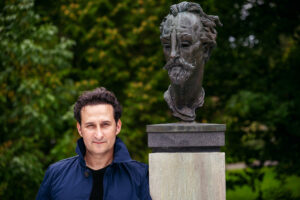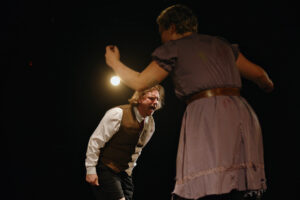
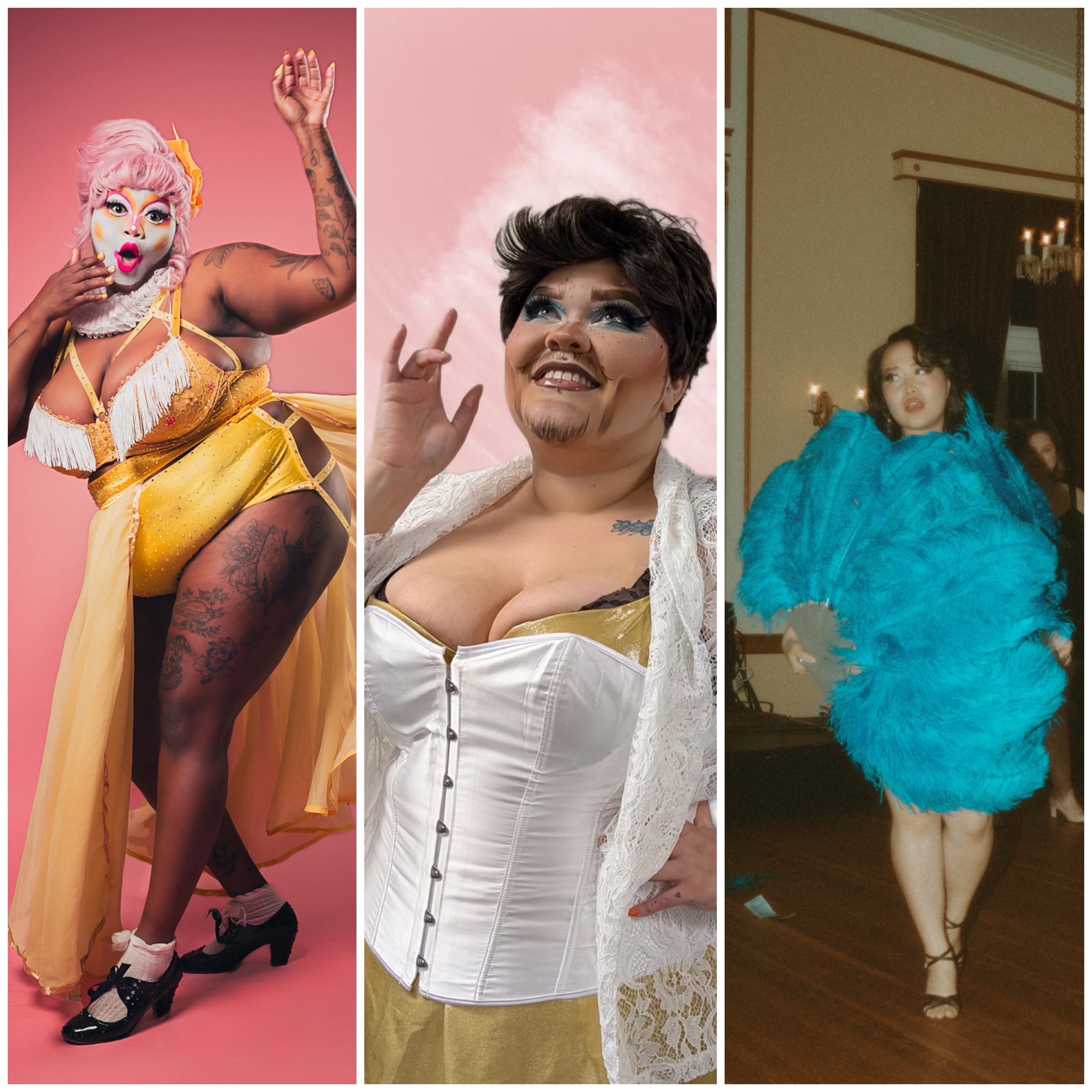
Beef Pattie Photo by James Arthur MacLean, Mike Hunt, and Elle Lixir, Photo by Devyn Mckillop
The Halifax Fringe is in full swing in venues in both the downtown and in the North End of the city. While most shows in the festival have multiple performances A BIPOC Agenda: A Drag & Burlesque Showcase is a one-night only special event on Sunday August 31st at the Neptune Theatre Scotiabank Theatre. It was organized by Mike Hunt, Beef Pattie, and Elle Lixir, following Hot Pot: An All-Asian Variety Showcase, which Lixir has produced for the past three years, and an All-Black drag and burlesque show that Pattie and Hunt produced this past year. I had the chance to chat with Mike Hunt and Beef Pattie via Zoom about the showcase.
“A lot of the reason why [Mike and I] lean toward doing programming like this is because there is not as many BIPOC performers in the city, and even BIPOC performers that exist in the city, they don’t often get as many bookings as the average person…. I think it’s important for spaces like a BIPOC show to exist for up and coming performers- it doesn’t matter what the medium is- so that they know that they have a right and ability, a space, to create their art and whatever type of art form that is- our art deserves to be celebrated,” says Pattie.
Mike Hunt (Michael Hunter for the youth) has been working steadfastly for the past ten years performing in drag and burlesque, and they got their start at a Queer camp called Camp Seahorse, which is for young folks 13 to 18 years old, and it is put on by the Youth Project. Hunt had the opportunity to be a camp counsellor there for Camp Coyote this summer. Beef Pattie has been performing burlesque for five or six years, and in the last two they have been incorporating more clown drag energy into their work, as they started out in comedy, but say “comedy was not the vibe, [it’s] not the most inclusive community… My favourite part about burlesque is being able to feel in touch with your body and connecting with your body in a different way, which is always nice, and I think it’s also needed and important for a lot of people- it helps me process a lot of my emotions, if I’m being real honest.”
There can be some misconceptions about what burlesque actually is. The original American heyday of burlesque was between the 1920s and the 1940s when all the various elements of the dying Vaudeville circuit: music hall, minstrel shows, striptease, comedy, and cabaret, amalgamated together. For some stars, like the famed Gypsy Rose Lee (the subject of the musical Gyspy) wit and intellect were woven into their act, taking the emphasis away from the strip and rooting it in the tease. In Neo-Burlesque, the revival that has been building since the mid 1990s, performers often play homage to this heyday, and may incorporate lavish or otherwise impressive costume pieces, humour, satire, dance, lip synching, circus or aerial silk skills, and they may explore more political themes such as gender, sexuality, objectification, racial identity, and all that is inherently political about the human body and how our culture is obsessed with controlling and homogenizing it. Hunt says that one thing that is unique to Halifax is how intertwined the drag and burlesque communities are here, “which allows us to push our own boundaries and learn about different types of performance art.”
Like their forebears Hunt and Pattie explain to me that in Halifax burlesque performers still have to be very careful not to run afoul of some of the strict licensing laws that exist in Halifax, rules that they note are looser in other cities, like Montréal, which has contributed to that city having such a thriving Burlesque and Draglesque community. Theatre venues, they note, are safer for them because the performances there are all viewed through an “art lens,” whereas the guidelines in other spaces are less clear, and certain rules exist to protect the performers, but others seem to be leftovers from a more regressive time, although Pattie points out there is still slut-shaming rhetoric in Halifax connected to Burlesque which they think comes both from fear and misconception. This is why the Halifax Fringe Festival and having access to spaces like Neptune’s Scotiabank Studio Theatre are so important. “There’s not that many stages of this size that people get the opportunity to perform on, which is very exciting and is a confidence boost that we deserve, and folks from our community deserve to see,” says Hunt. They note that they’ve done a show at the Bus Stop Theatre before, which was “fantastic,” but “working at Neptune is huge.”
Hunt also notes that fellow drag performer Richard Rockhard produces Drag in Colour, which is also a BIPOC Drag and Burlesque Showcase and there’s the melaNATION Showcase for Halifax Pride, but they say that within the broader Queer community “new performers may not be as comfortable to step out on stages because the spaces don’t curate safety for them. This art can be really vulnerable for us. There’s a lot of intersectionalities that we’re hitting as being a person of colour and so on and so forth in these spaces, so we have a lot of weight on our backs, and, unfortunately, we’re still under-represented. A lot of casts are very diverse [but it’s] 2025 and we’re still seeing all white casts, and so it’s really important for us to showcase the beautiful talented performers that we have. Our ancestors were the spearheads of this community, and it’s not respected or looked at with the same admiration as the mainstream media of what performance art is. [Elle, Beef and I] wanted to bang our three heads together to really curate the space to show people that we can make full casts of all these [BIPOC] artists and performers.”
There are ten performers in the showcase: Aiya Xiaoxin, Richard Rockhard, Kage, Elle Noir, Babia Majora, Anita Landback, and Vanessa Buttercup, along with Elle Lixir, Hunt, and Pattie. “Everyone has different art mediums,” says Pattie, “There’s definitely different types of emotions that are going to be invoked on the stage on Sunday. You’ll get some high energy, you’ll get some acts for the culture, you’ll get some folks [doing] odes to old school burlesque, and Aiya Xiaoxin’s act is very much a twist on old style burlesque, but the singer of the specific number that she does is someone of Chinese descent. It’s beautiful. I’ve seen the act before; it’s breathtaking. I get chills. The first time I saw it at Hot Pot I got chills… and hands down she’s one of the most talented costume makers in the city right now.”
Hunt agrees, “Each of these performers bring something so unique and so different, between the costuming, the performance concept, the energy… a lot of thought and effort goes into each phase that’s just for us. It makes it that much more deep and meaningful, and it allows us to really be in our element and showcase that to the audience, because we take care of each other, even on the stage as an audience watching our people, or backstage holding each other, it just makes it that much more special.” He mentions Chris Cochrane, Elle Noir, specifically as someone who has blazed trails ahead of him saying, “To this day [Chris] is still someone I look up to as someone who makes sure that our voices are heard and we don’t get stepped down on or stifled. We have a lot of powerhouses in this cast, and it’s going to be an absolute banger of a show…. We shouldn’t have to be fighting to make these spaces. We shouldn’t have to be arguing with other performers in the city for opportunities. We deserve it just as much as anyone else, and, if anything, sometimes we have to work even harder to take up the space.” Hunt mentions that he feels grateful to have the platform he has now, having performed here for ten years, but that he wants to use that platform to help other folks have an easier time. “Drag has really healed me; it’s allowed me to come into myself, discover my identity as a trans man, and it’s more than just putting on sparkles and glitter and doing a two-step on the dance floor, it’s a lot deeply rooted in it… I feel like for some people it may just be fun, but for a lot of us it’s really healing, and same with burlesque… being plus size, I don’t see a lot of performers like me.” He says that sometimes he can feel insecure, but burlesque helps him realize that his body is also beautiful. “I can feel sexy and powerful and who I am. I think it’s a great thing for us to be showcased and represented and safe in these spaces, and to have these conversations with other performers or producers- that we can all work together and not feel like we’re being left out.”
Pattie agrees saying “If it wasn’t for me seeing other plus-size bodies perform on stage, or even other Black or trans bodies perform on stage, and feeling connected to themselves, I feel like I wouldn’t feel as comfortable and as confident in my own body. With all the dysphoria that I may navigate on a day-to-day basis, that five minutes that I’m on stage, I do feel beautiful, and I know that there’s people who come to other shows and they feel the same.” They continue, “Having a show that showcases exclusively BIPOC performers is not a threat, but rather an opportunity, especially when it comes to diversifying the audience. “I think it’s beautiful when people see themselves on stage, it makes you feel so valid and welcomed into a community. I didn’t see or have access to seeing Black artists, Black trans artists, on stages in Halifax.” They mention that the representation that they DID see was via the Internet. Without that they say, “it would have hindered my ability of feeling comfortable participating in this art form, feeling valid in my queerness… or feeling true and right. In a day and age like what we’re living in now, which feels like we’re dystopian to say over and over again: representation saves lives… it’s like [Mike] said, it’s more than just putting on glitter, you are saving a person’s life when they see themselves on stage. You make them feel like [they’re] not alone. I really hope that people within our communities, both in Halifax, and even abroad, recognize that that is the truth. Having all BIPOC stages, even all trans stages, it’s not a threat to the existence of anyone else that doesn’t attach to those identities. It’s a gift and a reminder that we all bring something beautiful to this art form and are capable of bringing and sharing our narratives through this art form.”
A BIPOC Agenda: A Drag & Burlesque Showcase is a one-night only special event at 10:30pm on Sunday August 31st at the Neptune Theatre Scotiabank Theatre (1589 Argyle Street, Halifax). Tickets are $23.00 and are available here. CONTENT/SENSORY: burlesque, explicit language, suggestive content, loud music. Neptune’s Scotiabank Studio Theatre is wheelchair accessible and has all gender washrooms.
Incoming search terms:
- https://www twisitheatreblog com/?p=5978