Forrest Goodluck and Blake Alec Miranda
The 40th Atlantic International Film Festival opened last night at Cineplex Cinemas Park Lane with their Opening Gala Screening of bretten hannam’s film Sk+te’kmujue’katik (At the Place of Ghosts). hannam, a Two Spirit L’nu filmmaker from Kespukwitk, Mi’kma’ki, spoke before the film about their long association with the film festival, dating back to 2005 when they were a film student at NSCAD. They said that back then the message that they routinely got about their interest in telling Mi’kmaq stories through film was that no one would be interested in them, or that they would have to drastically change their vision in order for the film to become marketable. Looking out over the packed audience in one of two full theatres at Park Lane hannam noted how much has changed and progressed since then here in Kjipuktuk. For me, even before the film started my eyes were filled with tears listening to the Elders’ welcoming prayer and song, the dedication to Kenny Prosper, an Elder, language keeper, and Mi’kmaw community and cultural touchstone, who passed away on August 28th, and hearing folks speaking the Mi’kmaw language. It was a beautiful introduction to the film, which is grounded beautifully in this land, here, in Mi’kma’ki and, as hannam said, it is their vision and uncompromisingly so.
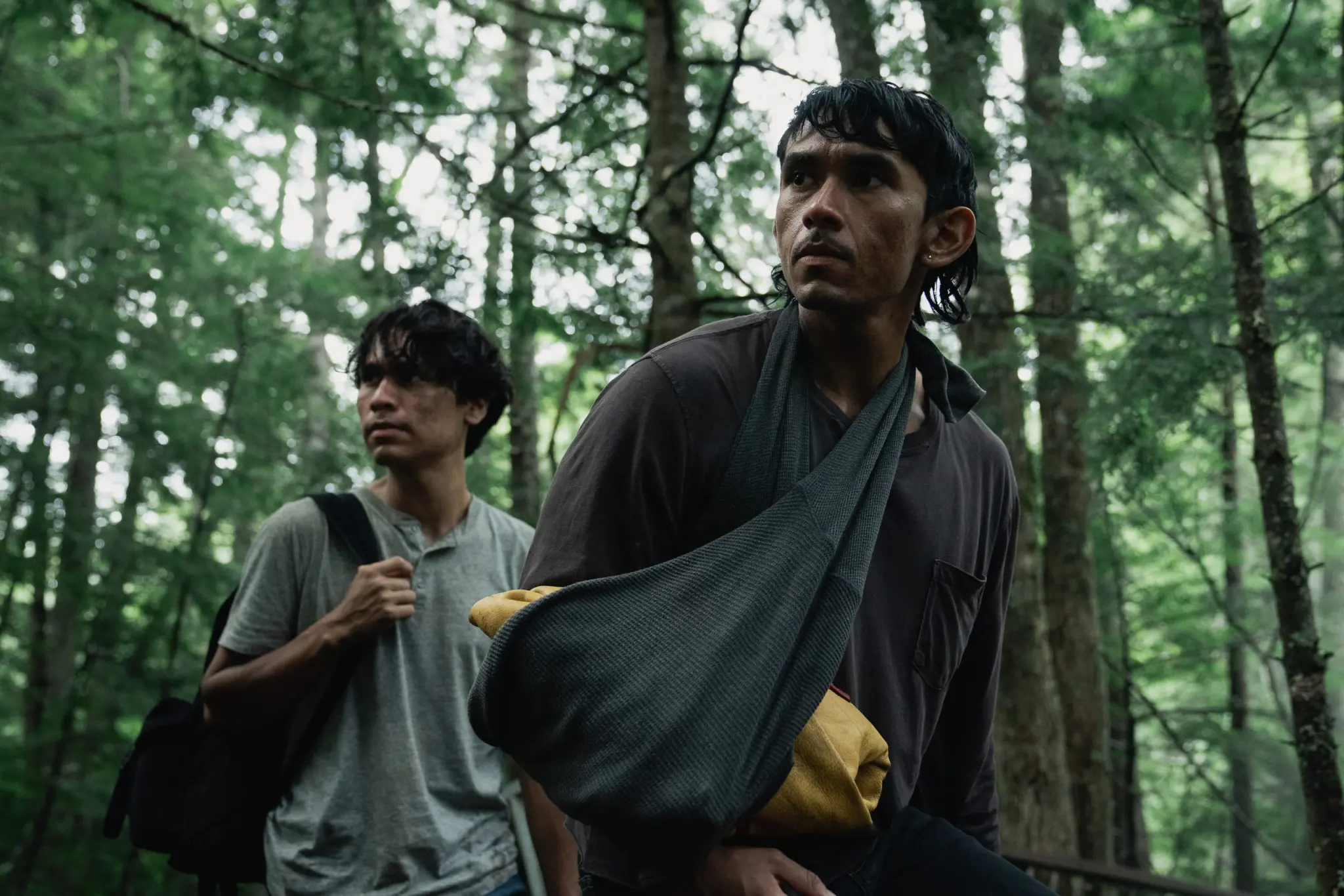
Sk+te’kmujue’katik (At the Place of Ghosts) is a horror/fantasy hybrid that tells the story of two brothers, Mise’l, played by Blake Alec Miranda, and Antle, played by Forrest Goodluck, who have been separated from one another for their entire adult lives. Antle has remained at home in their rural Mi’kmaw community, while Mise’l has moved to an urban centre where they have built a life with their partner Barry (Alexander Nuñez). When the past comes back to haunt Mise’l they realize that they have to go home and, together with Antle, they have to contend with their childhood trauma before it literally eats them both from the inside out.
The film reminded me a bit of the Netflix horror series The Haunting of Hill House (2018) by Mike Flanagan, where there are jump scares and menacing creatures, but you are more interested in untangling what you are learning about the characters’ pasts and the familial dynamic, so it becomes sort of a psychological drama working within the horror genre. I really love this, and the way that hannam weaves both together using the forest that Mise’l and Antle must navigate to literally travel to their own personal past, while the collective past of their people is irrevocably connected to them and to the woods, to the land itself, all around them, is so evocatively conceived.
The violence in Mise’l and Antle’s past is inherently saturated with ghosts from the past, as this specific violence, we know, is a symptom of inter-generational trauma stemming from the colonial violence inflicted on the Mi’kmaq since 1749 by the British settlers, and further exacerbated by the Shubenacadie Residential School, which was in operation between 1930 and 1960. This school violently severed two generations of Mi’kmaq and Wolastoqiyik children from their families, their language, their culture, their communities, and their land, to devastating consequences that continue to reverberate throughout Mi’kma’ki to this day. Sk+te’kmujue’katik is also a Queer story, and as Mise’l and Antle encounter their Ancestors as spirits along their journey, they also meet Pipukwes and René, 2 Spirit/Queer lovers who are Mi’kmaw and Acadian respectively, played by t’áncháy redvers and Nancy Kenny, who lived during the time of Father Le Loutre’s War, which ended in 1755. Here we see a brief, but significant, reminder, for us and for Mise’l and Antle, that Two Spirit and Queer folks have existed, of course, since the beginning of humanity, despite what the history books would have us believe.
The acting in this film, especially from the young folks involved, is exquisite. Ainsley Cope plays Young Grace, Antle’s daughter, the bright light who we see as the innocent future Antle and Mise’l are desperate to protect. They want to be the cycle breakers at any cost. Atuen MacIsaac and Skyler Cope play Young Antle and Young Mise’l, and they capture so beautifully the essence of their older counterparts, and also the friendship between them. It’s also heartbreaking to see the fear and the despair in them as they enact the day that changed their lives forever deep in the forest. Similarly, Blake Alec Miranda and Forrest Goodluck are equally heart-wrenching and mesmerizing to watch as they are forced to relive this horrific day as adults, and to face their childhood fears, their childhood suffering, and to release what has been buried, both literally and figuratively.
I don’t want to give away too much more of the plot, but Glen Gould also gives a harrowing performance.
I was struck in the cinematography from Guy Godfree how vividly green the forest is that surrounds Mise’l and Antle, and how often we see them through the trees, from lower angles than I was expecting, and in wide shots so that the landscape really feels like a character in the film. It is also striking how the film can depict events from the modern day, and also harken back more than 270 years, and this specific land remains relatively unchanged as the backdrop for both. It is a reminder of how lucky we are to have places like this here, and how it is incumbent upon all of us to protect them.
The film is told in a mixture of English and Mi’kmaq (with a tiny bit of Acadian French from Kenny as René), and I loved seeing both the historical characters and the contemporary characters speaking Mi’kmaq with one another. As we have seen a huge resurgence of French being spoken at home and at school by Acadian children over the past three decades, hopefully this will be a blueprint for more and more Mi’kmaq children to have opportunities to be similarly immersed in their own language now and in the future. The film’s score works effectively at building the tension and suspense, and creating a sense of foreboding, while also showcasing some gorgeous original pieces by Jeremy Dutcher, which further embeds the story in the culture of its people.
Sk+te’kmujue’katik is a perfect example of the very specific being simultaneously universal. The film speaks with deep love and care to Mi’kma’ki, but you don’t have to be from here or know this place to be able to have it resonate. You don’t have to be Indigenous to understand the feeling of having an event in your past that haunts you into adulthood, or to feel the reverberations of the hardships faced by your ancestors shaping your path.
My favourite thing is seeing the stories from this place creatively and vividly told, either on stage, on screen, or in a book, and this one filled my heart right up.
Sk+te’kmujue’katik was written and directed by bretten hannam. It was produced by Jason Levangie, Marc Tetreault, Martin Katz, and Diana Elbaum. In Canada it will available in the future on CBC and Crave.
The Atlantic International Film Festival continues in Halifax until September 17th, bringing over one hundred films from Halifax, Canada, and around the world, to local audiences. There are also free panels and other special events happening in venues around the city. For more information please visit this website.