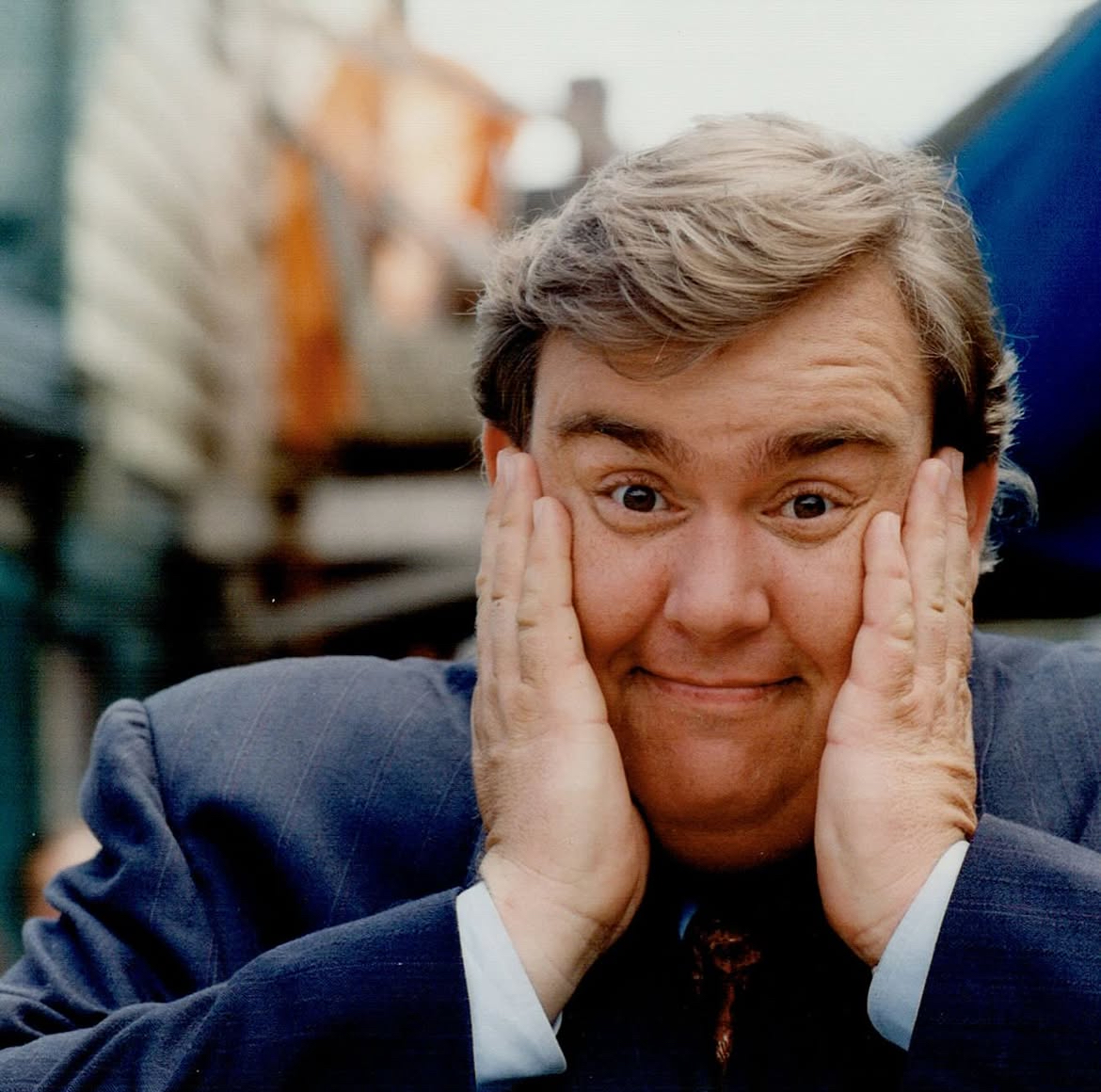
John Candy
On September 16th I was excited to attend the Atlantic Canadian premiere of Colin Hanks’ new documentary John Candy: I Like Me, produced by (among others) Ryan Reynolds, at the Atlantic Film Festival.
As an Elder Millennial I was the sort of kid for whom renting movies or going to the theatre to see something newly released was a novel experience. I largely preferred to watch the small collection of VHS tapes that I owned over and over ad nauseam. If I had to guess I would say that the movie that I have seen the most in my life is the John Hughes and Chris Columbus classic Home Alone (1990), which I watched all year round. Home Alone and The Rescuers Down Under (1990), which I also loved, were my only connotation with John Candy (along with seeing Uncle Buck (1989) once at a sleepover) before he died tragically on March 4, 1994 while filming Wagons East in Durango, Mexico at the age of forty-three. I was nine, and yet, even having just seen those three performances of his- as Gus Polinski, Wilbur, and Uncle Buck- I remember mourning his death along with everyone else in Canada.
Home Alone, The Rescuers Down Under, Honey I Shrunk The Kids (1989), The Flintstones (1994), and Parenthood (1989) were my gateways as a child to a path that would eventually lead me to The Second City in Toronto, and understanding an iconic and unique Canadian cultural zeitgeist of which John Candy (Johnny Toronto) was the beating heart. Hanks’ documentary does a beautiful job of mixing clips from Candy’s films, his personal life, and his media interviews, with contemporary interviews with his colleagues, friends, and family members to tell the story of how a shy boy from the East End of Toronto found his way onto the Second City MainStage, and eventually became a bonafide Hollywood superstar. Although I was familiar with the basic trajectory of his career, this film is filled with all sorts of interesting information about his family and his upbringing, and details about his early years in the Toronto theatre scene that I had never heard before.
The documentary is rooted very much in Candy’s untimely death; it begins with footage from a special memorial mass held for him at St. Basil’s Church in Toronto, which was televised, and the film very much delves into Candy’s family history of heart disease, and his relationship with death, which dates back to his father, Sidney James Candy, who died from a heart attack four days before John’s fifth birthday. Sidney was just 35 years old. In this way, the film begins in 1994 and we see the dates rolling back to 1950, when John was born, and we are aware as each year passes the clock is ticking and he is perpetually running out of time. John Candy, and his older brother Jim, obviously, grew up very much affected by the death of their father, and in a household where they were not given proper space to grieve for him. Their mother, Evangeline “Van,” dealt with the loss by never speaking of it, and attempting instead to focus on the future. John’s wife, Rosemary Margaret Hobor, and their son Chris speak a lot about how they perceive this atmosphere of the repression of difficult emotions may have led John to turn to food, alcohol, and cigarettes as a means of comfort and escape from an inherent sadness rooted in losing his dad so young.
Candy was a star football player at the Catholic Neil McNeil High School, with dreams of playing the sport professionally, but these plans were scuttled when he blew out his knee. After High School he tried to join the US Marines because he wanted to be able to fight in the Vietnam War, a fact that seems a bit at odds with the giant-hearted, sensitive, gregarious, loveable person we know him to be, especially with the benefit of hindsight. He was rejected because of his knee injury, and he ended up working at the flagship Eaton’s department store and taking acting courses at McMaster University in Hamilton. At the same time, in 1970, he met agent Catherine McCartney, who worked above Fran’s restaurant on College Street, and often had lunch near the Eaton’s Centre. They met completely by accident and Candy ended up booking a Colgate commercial. The documentary touches a tiny bit on Candy’s time in the Toronto theatre community before he made his debut at The Second City. On October 6th, 1971 Creeps, written by David Freeman and directed by Bill Glassco, was the very first play produced at the brand new Tarragon Theatre, and John Candy was in the ensemble. By this time he was hanging around with Dan Aykroyd and Valri Bromfield, and one night in 1972, at Clinton’s Tavern, Bromfield offered Candy a job working with her at Caravan Theatre, a children’s theatre that operated out of the Poor Alex Theatre. He also worked for a children’s theatre troupe called the Jolly Jesters. On December 19th, 1972 he returned to Tarragon Theatre in The Stag King, written by Sheldon Rosen and directed by Stephen Katz. After the play closed in 1973 Dan Aykroyd tells the story of how he and Bromfield tricked Candy into auditioning for the new Second City Toronto cast. Catherine O’Hara says that he was cast because of his excellent listening skills in improvisation- while others were dominating the scenes trying to impress with their comedic skills, Candy was more focused on being engaged in the moment and teamwork. He joined this legendary cast which included Aykroyd, Joe Flaherty, Catherine O’Hara, and Gilda Radner.
The following year Andrea Martin would join the cast, and she says of the experience that the cast members never competed with one another, they were never trying to outshine each other or one up one another, instead they were all invested in creating something unique, funny, and interesting together through collaboration for the audience through their improvisation. I think this spirit still largely remains among the improv companies in Canada to this day. From there, of course, came SCTV (1976) where Candy teamed up with Flaherty, Martin, and O’Hara, along with Eugene Levy, Dave Thomas, and Robin Duke. Eugene Levy points out that he, Andrea Martin, Gilda Radner, and Martin Short all knew each other from being in the iconic production of Stephen Schwartz’s Godspell together, which opened June 1, 1972 at the Royal Alexandra Theatre, and Levy jokes that Candy was sick and tired of them always talking about it. Between SCTV and that production of Godspell Canadian comedy, and these specific Canadian comedians (along with adopted Canadian Gilda Radner) cemented something fundamental in the national consciousness that continues to reverberate today. Especially now when Canadians are looking for our own cultural touchstones and our own cultural identity more than ever, I think more and more people are pointing to the intersection in time between Godspell and SCTV as a defining time in the history of the country.
Catherine O’Hara says that in characteristic John Candy fashion when he was the first of the Second City Toronto troupe to be cast in a Hollywood film he wanted to try to take all his cast mates along with him. Eugene Levy says that even when they were all making their meagre Canadian television paycheques Candy would always offer to buy his cast mates a round of drinks. In fact, this theme of being loyal to his friends, and generous nearly to a fault, is a recurring one, as Hanks also explores the ways that Candy often spread himself very thin as he got more and more successful, never wanting to say no to a friend, and trying to be everything to everybody. According to his children, Jennifer and Chris, he was a world-class dad, trying to be everything for them that he had wanted as a child growing up without his own father. In an interview clip from some talk show he is accused of not being discriminating enough in choosing his projects, but for Candy it was more important for him to support his friends and their projects. Chris Columbus, who directed Home Alone, says that because of Candy’s busy schedule they were only able to have him for one day to shoot all Gus Polinski’s scenes (which were mostly improvised), but that Candy worked for 23 hours that day, not wanting to let anyone down. He was also the sort of person who was extremely generous to the crew, to any working person that he encountered, often going the extra mile to show his gratitude and appreciation for their work. When he became an owner of the Toronto Argonauts football team he would stay late after games signing autographs for anyone who wanted one. Colin Hanks dramatically captures this breakneck pace of Candy’s life leading up to 1994 in a way that is quite harrowing and devastating to watch.
One thing that I did not know was that John Candy and John Hughes became best friends over their collaborations, including, of course, Planes, Trains, and Automobiles (1987), Uncle Buck (1989, which was written for him), Home Alone (1990), and National Lampoon’s Vacation (1983). Columbus characterizes them as “kindred spirits,” and it was this friendship that prompted Candy to do his cameo in Home Alone. Macaulay Culkin, who worked with Candy as a child on Uncle Buck and starred in Home Alone, although they didn’t have any scenes together, says that Candy was one of the few adults in his life at that time who noticed his father’s terrible behaviour on set and attempted to check in on him in a paternal way. “I remember John caring,” says Culkin, “and not a lot of people did.” Heart-wrenching.
I’m not sure how John Candy would feel about this, but I cried through most of this documentary, although through many parts of it I was also laughing through my tears. All of Candy’s friends who spoke, folks like Martin Short who is almost always doing a bit when he’s being interviewed, speak with absolute sincerity about how much they love John, and the wonderful person he was. Steve Martin too, speaking about one of the funniest buddy comedies ever made, speaks about how difficult it was to do that scene where his character, Neal Page, berates Candy’s character, Del Griffith, in a motel room, because of how beautifully Candy captured Del’s hurt feelings. Similarly, we see clips of Candy as himself being interviewed on a series of talk shows and being asked about his weight, and, although he shrugs it off as best he can in the moment, he has the same look of deep dismay in his eyes as Del does in Planes, Trains, and Automobiles.
I would have happily listened to all the full interviews about Candy’s life and his legacy, and I salut Colin Hanks for being able to cut the film down to just 113 minutes. John Candy: I Like Me is, at its heart, a love letter to John Candy, while also seeking to better understand a man who was living a sort of a paradox- he knew he had his father’s heart and needed to stay healthy, he had everything and more to live for, and yet, he struggled to prioritize his health over his coping mechanisms. It is a very relatable and very human paradox, and even more so as we see him being a product of this specific place and time. I have loved John Candy since I was six years old, and I have loved him more and more as I’ve gotten older, and have been introduced to more and more of his work, and, more importantly, the more and more I have learned about who he was as a person- how he exemplified the very best of what it means to be a Torontonian and a Canadian. Colin Hanks’ film gives audiences even more reasons to fall in love with him, to feel deep gratitude that he was here, and intense sorrow that he was taken from us far, far, far too soon.
John Candy: I Like Me directed by Colin Hanks will be available on Prime Video starting October 10th.