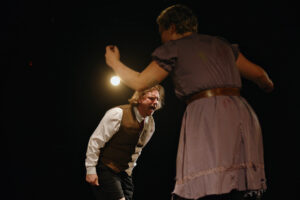
Jordan Gracie as Laurie in Little Women. Photo by Kate Hayter Photography
On Friday evening I attended DalOpera’s production of Mark Adamo’s 1998 opera Little Women, based, of course, on the novel of the same name by Louisa May Alcott, which was published in two volumes in 1868 and 1869. I have seen several different stage adaptations of this classic story of the March sisters, both a straight play and the musical by Allan Knee, Mindi Dickstein, and Jason Howland. I was very curious to see how different Adamo’s opera would be from the other adaptations of the story I had seen, and to explore this story through a medium that I am much less familiar with than plays and musicals. Little Women closes today, November 30th, 2025, at the Sir James Dunn Theatre.
Adamo’s opera is framed as a reflection that middled aged Jo March has on her relationship with her three sisters and their friend and neighbour Laurie, inspired by a meeting with Laurie as two grownup married near strangers, and Laurie’s carefree assessment that their friendship as children was “perfect” and that they should seek to emulate it now at this new stage of their lives. The rest of the opera exists as a flashback and begins at a moment of seismic shift in Jo’s life, when she realizes that her older sister and best friend Meg is no longer centring the childhood games the girls played together and is more interested in fostering a much more adult relationship with Laurie’s tutor, John Brook. This utterly disgusts Jo who resents having to grow up, having to change their dynamic, and the introduction of romantic love into their boisterous world of imaginary adventures. Yet, unfortunately for Jo, Meg’s interest in John Brook is a watershed moment that ushers in an entire litany of changes that end up completely transforming the family.
The singers in Roberta Barker’s production of this opera are all very skilled at bringing these different character dynamics to life. The show is double cast, so this review will focus on the November 28th performance. Corinne James plays Jo and she really captures the stubborn ferocity she feels, especially toward Meg and Laurie, blaming them for ruining the sweet childhood dynamic that she clings to so fervently. James also does well to show us the slow subtle softening of this resolve over time, as Jo herself leaves home and realizes that she must accept her new reality or live entirely in her memories. Jordan Gracie is utterly charming as Jo’s playful kindred spirit, Laurie, who is happy to play as one of the girls if it means getting to spend time with the one he idolizes so much. Laurie is profoundly hurt when Jo rejects his romantic overtures and the two need to live at a distance from one another to mend their broken hearts. Ella Howard plays Meg as a kind hearted oldest sister both falling in love for the first time, and also learning how to establish boundaries with her headstrong sister. Katie Alexander plays sweet sickly Beth, too good for this world, who attempts to ease all the pains her three sisters have, and to never cause any trouble to anyone. Caralina Knights plays Amy, the precocious youngest sister, who takes Laurie side in his quarrel with Jo, and thus runs afoul of her sister. Adamo leaves out a lot of the animosity between Amy and Jo- notably the moment where Amy spitefully burns the only copy of the novel that Jo has been writing, which in the book serves as a chasm of betrayal and grief that Jo struggles for years to come to terms with, and highlights Amy’s deep seeded jealousy and resentment of how bright a light her older sister is. In this production the only friction between the girls is the love triangle with Laurie, and this is much more easily mended, and the two never really come to any real kind of blows over it. I did appreciate the way that Knights really held Amy’s characteristic haughtiness and interest in the material things in her body even if her lines didn’t really highlight these aspects of her personality- she very much looked like Amy, and her cute short hair, even in its anachronistic way, highlights that she is the youngest, most fashionable, and in certain respects, the most modern of the sisters. I especially liked Amy’s hair in contrast to Beth’s, which was so long and was worn loose, and showed that she not only was much more of her time than Jo and Amy, but also that she existed entirely within the home. It also really suited the moments when she appeared, like an angel, from the beyond.
Maddy Mensour plays Marmee, gentle and with constant concern for Beth, Hannah Kroesbergen plays the girls’ wealthy and materialistic aunt with stiff propriety, mirroring Amy nicely. Stephen Deturbide’s characterization of John Brook (and the way the role is written) was interesting as well, as it almost seemed as though we were seeing him more from Jo’s perspective as dull, but also absurd in his passion for Meg. I found that I didn’t necessarily see Jo and Laurie’s concerns that Brook would “break” or “tame” Meg in marriage, but I certainly sympathized with their dismay at Meg leaving all the fun and frivolity, warmth and coziness of the March house for such a prosaic existence. Interestingly, in the novel and in many adaptions of this story what becomes sort of problematic for audiences is the fact that Jo spurns Laurie, who in many respects should be her ideal partner, and ends up settling for Friedrich Bhaer, which often feels anti-climactic or even frustrating for those of us who identify as Jos. In this production, however, we see very little of Friedrich Bhaer, played by the extremely suave Karina Matys, and the fact that he is sort of shrouded in mystery (as well as the gender dynamics, of course, of having him be played by a woman) gives Jo a much more satisfying resolution.
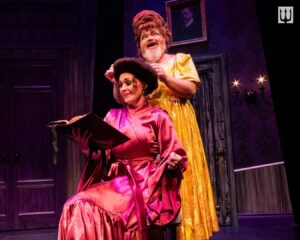
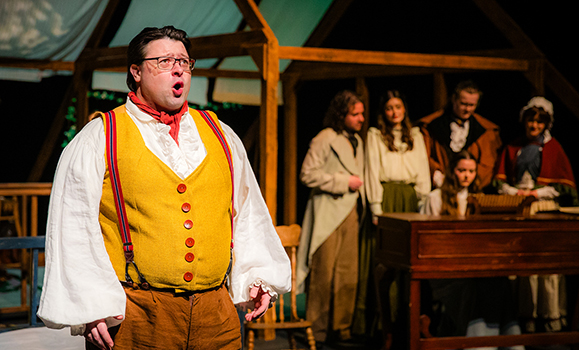
Diego Cavedon Dias’ costume design is excellent. You can tell so much about these characters just by looking at what they’re wearing. The glaring difference between Marmee and her sister in law is staggering, and I particularly liked the way that Jo’s skirt changed between looking like a dress and looking like pants depending on how Corinne James was moving. I liked the staircase in Katrin Whitehead’s set because it really rooted the scenes in the March’s home in the attic or the loft, which seems both like a magical place for the girls and Laurie to play, and also a cozy place for Beth to have her bedroom.
Full disclosure, I find operas in English, especially the ones like this one which have scenes of dialogue and are in some ways so similar to a play or a musical, challenging because they really lay bare how different the musical conventions between an opera and a musical are, and I have to let go of all the dramaturgical criticisms that I would have if a musical had been constructed this way, and there is an inherent discrepancy between how much realism there is in the costumes, the performances themselves, and to some degree the set, and then how astronomically heightened the dialogue becomes in song. I still haven’t gotten used to how weird this seems, but all the singers, of course, have beautiful voices and were meticulously directed by Cindy Townsend and accompanied by Indra Egan on the piano. I was the most impressed, though, with how rooted their acting prowess was, which I think you need to have when portraying such complex and beloved characters as these ones.
There was some kind of technical difficulty which caused a short delay in the first Act of the opera, just about ten minutes before the scheduled intermission, in the performance on Friday night, and Jonathon Kean, who played Gideon March, the girls’ father, and Mr. Dashwood, the New York publisher, was ill and performed in a mask in the First Act, but then was replaced (I believe at the last minute) by Karina Matys, so it was a bit of a dramatic performance, but the singers seemed entirely unfazed by it, which is an incredible testament to their professionalism. I’m sure launching back into Act 1 80% of the way through after a 10 minute unplanned pause isn’t easy. Roberta Barker, who directed the piece, played Kean’s roles last evening, and will again for the final performance this afternoon. Hopefully Jonathon Kean will feel better soon!
Even though I find this opera adaption more challenging than others I really enjoyed the DalOpera production. The emotion of Jo, especially, in her futile attempt to thwart the changes that come with growing older, and the humour and the nostalgia, and the lonesome heartache this evokes makes this a compelling and poignant story that I think is easy for many to relate to. While there is nothing overtly Christmasy about the opera (despite the novel beginning at Christmas), it feels very apt for this time of year when many of us wish that we too could project ourselves back to our childhood home with all our childhood comforts and delights.
DalOpera’s production of Little Women directed by Roberta Barker at the Fountain School of the Performing Arts has one last performance today, November 30th, at 2:00pm, at the Sir James Dunn Theatre (in the Dalhousie Arts Centre, 6101 University Avenue, Halifax). Tickets are $18.25 for students and seniors and $26.50 for General Admission. They are available online here, by calling (902) 494-3820, or going in person to the Box Office at the Arts Centre (Rebecca Cohn) on University Avenue.