Photo by Stoo Metz
Walking down Barrington Street on Tuesday evening where all the Christmas lights were twinkling in the early dark and the Christmas Tree towered over Parade Square on my way to see YPCo’s production of Frankenstein in the Oland Rehearsal Hall felt a little bit incongruent. And yet, at the same time, it was also raining and quite windy, in effect, it was a dark and stormy night, and as soon as I reached the bottom Barrington entrance of Neptune Theatre Lord Byron and Percy Bysshe Shelley were there to welcome me to a cozy and delightfully chaotic pre-show party with just a little bit of creepiness thrown in for good measure. A class full of teenaged students fromShakespeare By the Sea were invited to this same performance, and participated enthusiastically in the immersive party atmosphere before the show: dancing with Lord Byron’s guests, reading bits of poetry aloud, visiting with a psychic, and even providing some of the music themselves. I had never seen teenagers from the two different theatre schools thrown together in this way before and it was marvellous.
While Lord Byron and Percy Bysshe Shelley are out in the rain greeting guests the party is largely left in the capable hands of the very charming Claire Clairmont, Mary Shelley’s stepsister, who is pregnant with Lord Byron’s child- which puts the party around the Christmas season of 1816- about a year before Frankenstein was published. As Percy Shelley and Lord Byron return from outside we are also introduced to Shelley’s wife, Mary, who comes to the forefront when Lord Byron proposes a challenge for his party guests to write a gripping tale in the horror genre and Mary has one ready to go.
In this adaptation of Frankenstein by Rona Munro we see Mary Shelley, played in this production by Scarlett Reynolds, as she constructs this seminal work of science fiction. She weaves in and out of the action, interacting with her characters and expressing a mixture of confidence, and pride in her creations, but also at times hesitance, disgust, and fear at the images emerging from her imagination. Munro divides the familiar narrative (an originally goodhearted scientist from a prominent family is shattered by the death of his mother and seeks the knowledge to bring the dead back to life. He is driven mad by his work and when he finally succeeds in creating an un-dead creature he is immediately repulsed and rejects and abandons him) into two narratives- one from the perspective of Dr. Frankenstein, and one from the perspective of the Creature, who has been left to fend for himself in a cruel world.
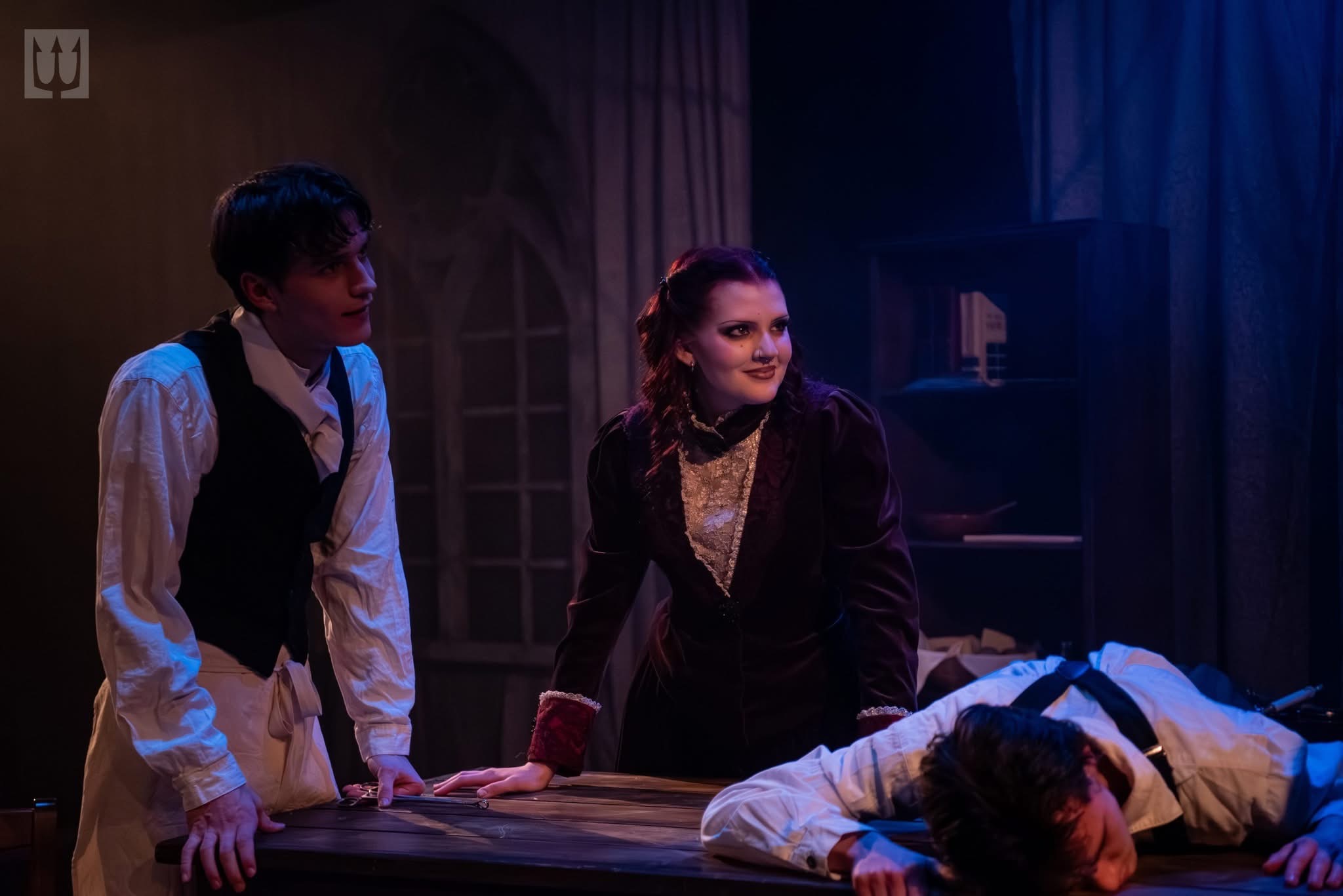
Sharisse LeBrun’s direction of this play is absolutely stunning. For a story that shifts from a boat in the arctic ice floes to Geneva to Bavaria to Orkney and includes culturally iconic laboratory scenes LeBrun masterfully uses the physicality of the ensemble cast to transform a few ordinary set pieces, largely a table and a bookcase, into everything they need for the audience to make these leaps of imagination. The opening scene on the boat when Tennessee Toombs, as Dr. Frankenstein, exhausted and bereft drags himself into the sailors’ midst is especially spectacular. Another highlight is the way the ensemble act as Frankenstein’s cadavers, again using the utmost of highly specific physicality to create a frantically creepy moment where we see Frankenstein’s obsession turn to insanity.
This is very much an ensemble show and every single one of the YPCo cast members work together fluidly to create these visually stunning images and bring this world to vivid life. There are elements in this production which I think are completely unique, which is a breath of fresh air given how integrated this story and these characters are in our cultural zeitgeist and that is how much Tennessee Toombs as Frankenstein, Felix Silver as the Creature and Scarlett Reynolds as Mary Shelley mirror and complement one another. Tennessee Toombs is an exceptional young actor. His ability to channel his characters’ emotions and personality traits physically in his body with such detail and precision is breathtaking, and he is also a very grounded actor who, even when playing someone as intense as Dr. Frankenstein, refrains from over-playing his scenes. I was so heartened when Felix Silver’s Creature burst onto the stage to see that his skill with physicality mirrored Toombs,’ and Silver brings an excellent other-worldly voice to the Creature which contrasts nicely with the way Toombs characterizes Frankenstein. I also loved the way the Creature was imagined. He is much more akin to a human than most of his counterparts in popular culture- he does not hulk over the other characters, although he possesses great speed and great strength, and he has long, thick, wet curly hair that often covers his face, which makes him look more unkempt than monstrous. This begs the question: what is it about him that makes humans both flee in terror and turn on him with violence? Is it just that he looks impoverished, in need of help, and marginalized, and thus this society would rather reject him with suspicion than offer him empathy? Then, Scarlett Reynolds, as Mary Shelley, in some ways mirrors Frankenstein in her own determined passion to tell this story, to press on through her fear and reservations to the point where she is taunting her characters as she kills them off one by one, showing a sort of perverse pleasure in torturing Frankenstein, with much more glee than the Creature shows. She seems to be both critiquing a heartless world while still, to some extent, being a byproduct of it herself.
I wish that Munro’s adaptation had shown us more of the relationship between Frankenstein and his mother, played by Alexis Wolfe, his brother, William, played by Samson Gallant, his friend, Justine, played by Abby Jenkins, and his beloved Elizabeth, played by Vera Dunlop Vaillancourt, so that we really got a sense of the depth of his love, and the depth of the goodness of these characters so the stakes of the loss for Frankenstein were even more apparent. We see this loss in Toombs’ performance, but we aren’t given a lot of time to grow to love these characters ourselves.
The transformation of the Oland rehearsal space into this early 19th Century banquet hall by scenic designer Lucas Arab and lighting designer Bea Crowther was impressive- I have never seen this room so transformed (and rigged with lights, including excellent candelabra chandeliers). It really helped to set the right ambiance for the production.
I think when most of us picture “Frankenstein” our brains immediately conjure up images of a green monster, perhaps even a cartoon, even if we know logically that Frankenstein is actually the name of the doctor. There is nothing cartoonish at all about YPCo’s production of this story, directed by Sharisse LeBrun. It is very nuanced and captivating and offers the audience the opportunity to see these characters and the circumstances they have emerged from in a very grounded and resolutely human way.
YPCo’s Production of Mary Shelley’s Frankenstein adapted by Rona Munro and directed by Sharisse LeBrun plays until December 14th at Neptune Theatre’s Oland Rehearsal Hall (1593 Argyle Street- although the entrance is on the Barrington Street side). Performances run Fridays and Saturdays at 7:00pm and Saturday and Sundays at 1:30pm with the pre-show running one hour to fifteen minutes before the performance. The entire run appears to be sold out. For more information please call the Box Office at 902.429.7070 or visit Neptune’s website.
Content Warning: Fog and Haze, Flashing lights, scary monster, moments of theatrical gore, violence, murder and death. Recommended for ages 12+.
Immersive Production Warning: The venue is a small, intimate theatrical space. This production is designed to feel immersive with the audience feet away from the actors and action. People sitting in the front rows may feel like they are in the room with the characters.
Neptune Theatre is fully accessible for wheelchair users. Neptune offers hearing-assistance devices, along with their masked performance and audio described performance. For more Accessibility Information Click Here.
Incoming search terms:
- https://www twisitheatreblog com/?tag=tennessee-toombs
- https://www twisitheatreblog com/?p=6216