Aida Cupcake
Today I started out at one of the Bring Your Own Venues, Grafton Street Dinner Theatre, where I saw The Defenestration of Prague and Apples: As Told By an Expert.
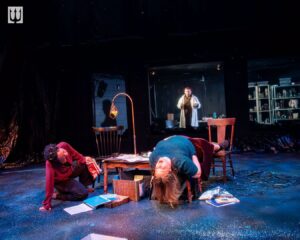
The Defenestration of Prague is written and directed by Jake Wilke, and it centres on a true event from 1618 when there was a breach in the established norms in Bohemia where suddenly the new Catholic King sought to impose Catholicism on all his Protestant subjects, when previously Catholic Kings had ruled in part by leaving the Protestant religion alone. Incensed at having their right to religious freedom attacked a group of Protestant nobles confronted a group of Catholic lords acting in place of the King as regents, and ended up throwing two of them and their secretary out of a third floor window.
This is a great narrative for a play, and I really liked the way that Wilke has drawn comparisons between this very specific circumstance that is quite different from ours, to the recent barring of singing activists from Province House (their bans have since been lifted). The Progressive Conservatives in the Legislature still seem to be easily intimidated through song. So too are the Catholic lords in this play intimidated by a very powerful scene where the Protestants begin to sing all together what sounds like maybe a real folk song from the area.
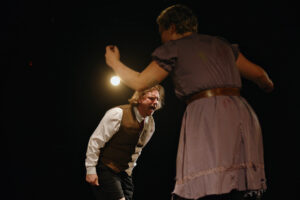
There are a couple of challenges in this play. I commend Wilke for wanting to stay as true to all the complex nuances from history as he can, but the exposition especially can be dense and a bit difficult to follow. I think trusting that for most audiences just understanding that a new ruler has imposed unfair rules about religious freedom, and now the Protestants are ready for a fight is sufficient to get folks on board for the story. There is a lot in the writing that is literary and clever, but there’s a tendency for the humour in the writing to get lost in the deliberate over the top acting choices. I think a lot of the humour, especially in the depiction of the Marie Antoinette adjacent Catholic lords, would come out more clearly if the actors were being absurd, but playing it more seriously.
I really like that Lorenzo Castro-Tytelman’s Protestant revolutionary character breaks away and has a personal experience, like when Marius arrives at the barricade in Les Misérables distracted because he’s just fallen in love with Cosette. The fact that his quite random tryst with Alina Kogas’ Okenko offers him a different perspective is very interesting, and I’d love to see this arc between the two of them expanded- perhaps we are introduced to Okenko earlier, and we see their relationship progress over a longer period of time. There’s a line in the play where one of the characters says, “None of this matters,” and I think the play runs a bit of a risk of making so much light of everything that it’s hard for the audience to find what or who it is they care about. I appreciate so much that Wilke doesn’t want either side to be entirely virtuous or villainous, but I know that he also is trying to tell a story about social change, so I think there’s some room to clarify why, in this instance, it was worth the Protestants advocating for themselves, even though it didn’t entirely go the way they had planned it.
Artmageddon Theatre’s The Defenestration of Prague plays at Grafton Street Dinner Theatre (1741 Grafton Street, Halifax) on September 10th at 2:00pm, 5:00pm, and 8:00pm.
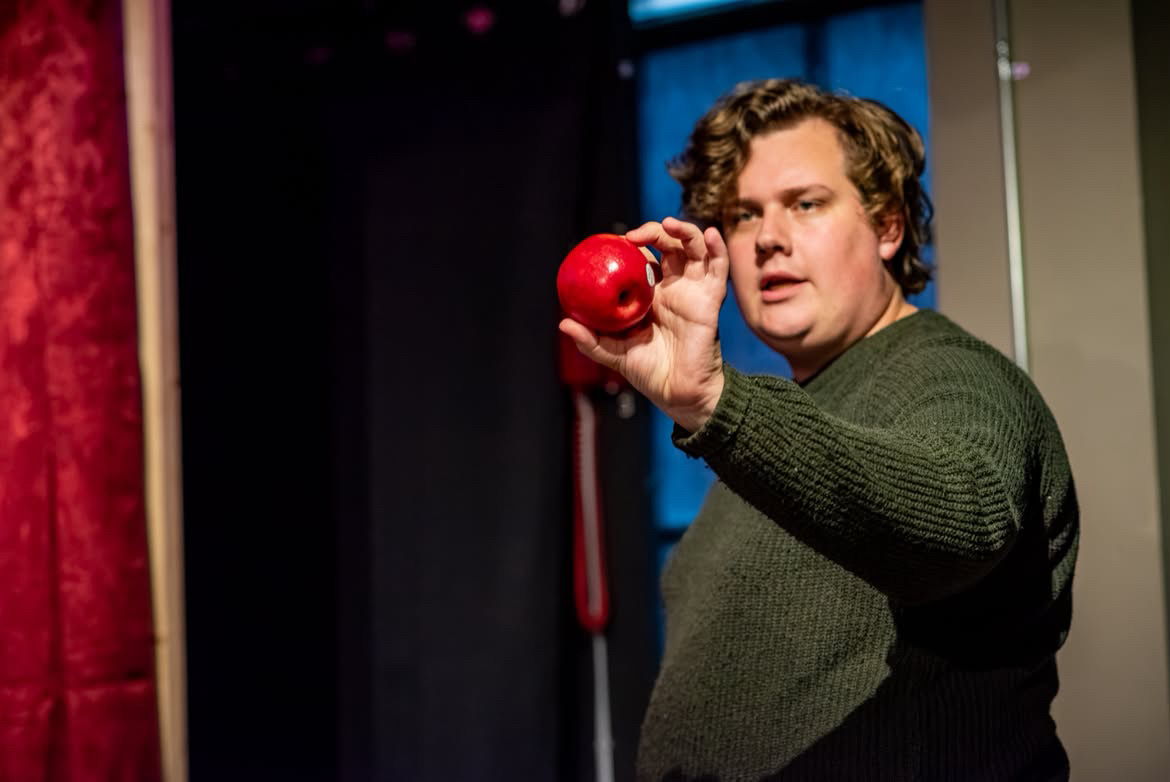
Next I saw August Van Meekeren’s show Apples: As Told By An Expert. August Van Meekeren is really exploring a concept in this show instead of purely constructing a narrative or doing a stand up routine. They are playing with the concept of truth and fiction as it relates both to autobiographical storytelling and also standup. How much do performers take liberties with the truth from their lives and shape it, exaggerate it, change it all together, and at any point do they owe the audience a disclaimer? Van Meekeren is also touching on an underlying theme of at what point do you decide that your real life isn’t interesting enough, isn’t funny enough, that you need to dramatically change it in order to make it more palatable for an audience? And what effect does that have on someone’s own self esteem?
The challenge in Apples is that much of it is designed on purpose to be awkward, as we see Van Meekeren judging their own material as not being funny or sharp or insightful enough, especially for stand up, and pivoting instead to telling these three very engaging stories that also aren’t necessarily meant to be hilarious, but that have compelling narrative arcs, and are harrowing and disturbing at times, and none of which have anything to do with apples- which they are shamed for by a secondary character. If the audience is hooked into the conceit, there’s a great bait and switch moment near the end of the show that works well, and Van Meekeren has really accomplished, I think, what they set out to do- I just wonder if you don’t get the conceit of the piece it might be a little bit confusing.
Van Meekeren has an antagonist up on stage with them, but they also have quite a few moments where they engage defensively with the audience, but the audience today was very supportive and wasn’t giving them the kind of energy that would warrant that kind of response. I wonder if also having some plants in the audience who push against August might be helpful to really help feed into their anxiety and desire to cater to the crowd. I also wondered if having the lies that August tells be more substantial might clarify the theme of the piece for the audience a bit more.
Fringe is the place for theatre artists to try out new things, and Apples: As Told By An Expert is almost like a theatrical experiment, and I’m sure that with every new audience, each different performance of it Van Meekeren is learning more about these forms, and that invisible contract that exists, at least to some extent, between a performer and their audience members.
TWISI Fringe Rating: ⭐️⭐️⭐️⭐️
Apples As Told By An Expert plays at Grafton Street Dinner Theatre (1741 Grafton Street) on September 10th at 3:30pm, 6:30pm, and 9:30pm.

I then went over to the Neptune Theatre’s Imperial Studio to catch the last performance of Ada Cheng’s The Trouble With My Hair, an engaging storytelling show that is very much exactly like the write up in the Fringe programme.
Cheng, who was born and raised in Taiwan and moved to the United States as an adult, begins by telling us about the trouble she has getting exactly the right haircut from her Italian hair stylist, even though she is much more consistently pleased with the colour. Under the lights in front of us her hair looks more pink, matching her bright lipstick, and we see a photo of her with very bright but deep and rich red hair, and I agree that both colours are magnificent. Cheng finds it challenging to have difficult conversations with people, especially when this includes having to be honest, advocate for herself, and draw some boundaries.
She tells us about what it was like growing up in Taiwan as a young tomboyish kid, a closeted Queer kid, a little girl who didn’t fit the narrow standards for conventional and celebrated femininity in her culture. She had a grandmother who prized her brother over her because he was a boy, and a mother who grew more and more concerned that she wasn’t meeting the cultural expectations for a young lady. Cheng’s way of dealing with this pressure and disappointment was to leave. Her hair, which both her school and her mother had controlled in the past, became something that she could take ownership over, and a way for her to express herself and her individuality.
Hair also became important to her in her romantic life, as she realized that all the women she’s been attracted to have had a variation on the same haircut. In this way, hair has been a way that she’s explored not just her own gender identity, and how she both presents, wants to present, and is read by others, but also the way her concept of queerness and queer relationships have grown and evolved over time too.
Cheng is a very engaging performer with lots of energy and the piece is well directed by Jessica Lynn Johnson, who helps Cheng oscillate between speaking directly to the audience and acting out key moments from the narrative. My favourite part of this piece was the way that Cheng spoke about a particularly memorable love affair that she had with a woman who lived in the Philippines. It was this relationship that taught Cheng the benefits of allowing a relationship to evolve into something new rather than cutting it off when it becomes imperfect. She became genuinely choked up in telling us about this time in her life, and the way that she vividly described their intimacy together was absolutely gorgeous.
This show is really touching and sweet, and it celebrates the triumph of someone who has learned how to come into their own authentically, and to ask for what they want and what they need in clear and confident language because they deserve it.
TWISI Fringe Rating: ⭐️⭐️⭐️⭐️1/2
The Trouble With My Hair has closed at Halifax Fringe.
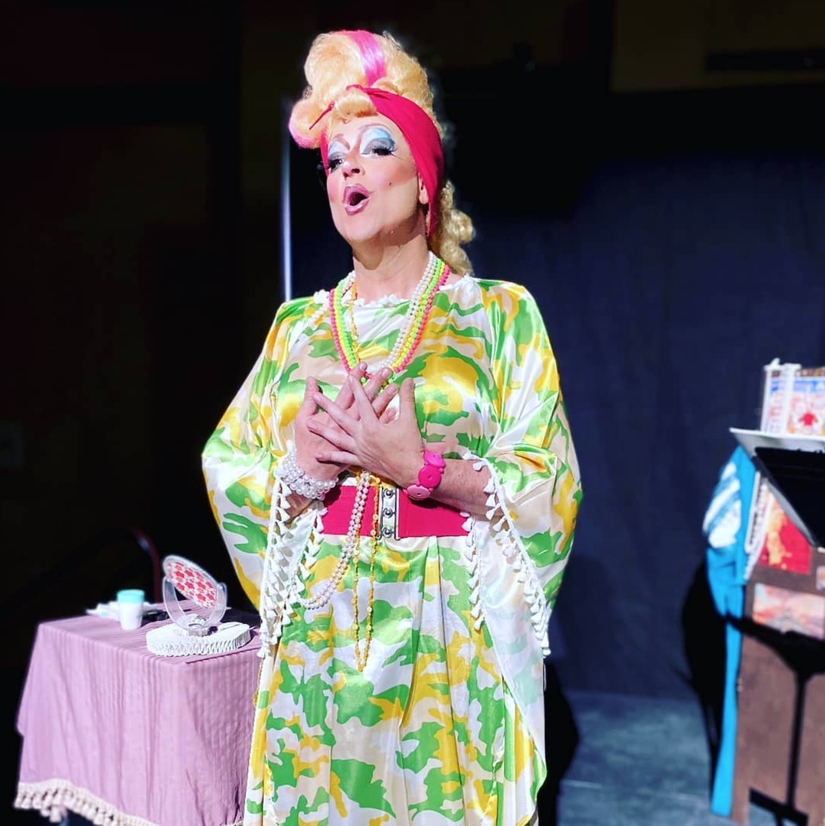
I then went down to the Stardust Bar + Kitchen to see Steven Morton’s show Drag Me To the Opera. This show is so clever, beautiful and multilayered. We are introduced to Aida Cupcake, a drag queen who performs soprano opera roles, but she is telling the true autobiographical story of Steven Morton, the writer and performer of the piece, who dropped out of business school in University quite abruptly to switch into studying voice with the dream of someday becoming an opera singer. Inter-spliced between the parts of this story that take Steven from Calgary to British Columbia to Weimar, Germany, and back to Calgary Aida Cupcake sings a selection of arias from Romeo and Juliet to Dido and Aeneas, which is interesting because Steven himself is performing tenor roles during this time in his life. But, there’s something wrong. The feedback that he gets from a panel in Germany has the power to careen his singing career all together. The discrepancy between what his voice can do in these soprano roles and what he’s being told is lacking in his performance as a tenor is beautifully illustrated through Aida Cupcake.
Then there is an unexpected shift, and we actually get the opportunity to meet Steven, and to see what happens when the elements begin to fit together in a way that will be more advantageous for Morton within the realm of opera. So much of drag is about the drag persona being in some ways the more authentic version of someone, but in this show we actually see that while both represent different sides of Morton’s abilities as a performer, it’s actually as Steven that he is coming into his own and finding his true voice, which is really lovely.
The costumes and wigs in this show are incredible. Morton has a wig station that Moira Rose from Schitt’s Creek would approve of. Some of the characters have elaborate headdresses; it’s just stunning. Morton also knows how to have effective and efficient costume changes, and when he is transitioning from Aida Cupcake into himself it’s very poignant.
Morton’s performance is a real tour de force. His storytelling is heartfelt and engaging, and he commits to really bringing these moments from each opera to life in a way that makes Aida Cupcake a committed serious opera performer. A lot of the humour comes from Morton playing the secondary characters in the world around him. There is an intense level of vulnerability later in the show that, again, is very unique for a drag show and is using the medium in a powerful way.
TWISI Fringe Rating: ⭐️⭐️⭐️⭐️⭐️
Drag Me To the Opera plays at Stardust Bar + Kitchen (1688 Barrington Street, Halifax) at the following times: September 10th at 8:00pm, September 11th at 9:30pm, September 12th at 8:00pm, and September 13th at 3:30pm.
Halifax Fringe runs from September 3rd to September 13th, 2026 in venues throughout the downtown and North End of Halifax. For more information and to make your Fringe schedule please visit this website. All official Fringe venues are wheelchair accessible. Many shows have at least one mask mandatory performance. Grab a Fringe Guide at any of the venues for a handy way to follow along with all the events at the festival. See ya there!
A Note On TWISI Fringe Ratings:
I have never liked rating Fringe shows, or any shows, using the 5 Star system as I have done in the past, but they can be helpful for productions that are touring, or seeking funding for further opportunities for development, so with that in mind I will be giving out four, four and a half, and five star ratings this Fringe.
Canadian Theatre Criticism is an essential part of a healthy and thriving theatre community. It helps theatre companies find new audiences for their shows, deepens audiences’ engagement with local artists and the work being created in their communities, and it is one of the best ways to preserve a snapshot of an ephemeral art form for future generations of theatre lovers. TWISI relies on support from its Subscribers, folks like you who care about the survival of local and independent arts coverage. Please consider becoming a Subscriber today. Thank you so much for supporting TWISI.